

Decolonizing Justice: Reclaiming Bharat’s Legal Identity
 K. Sindhu · 04/11/2025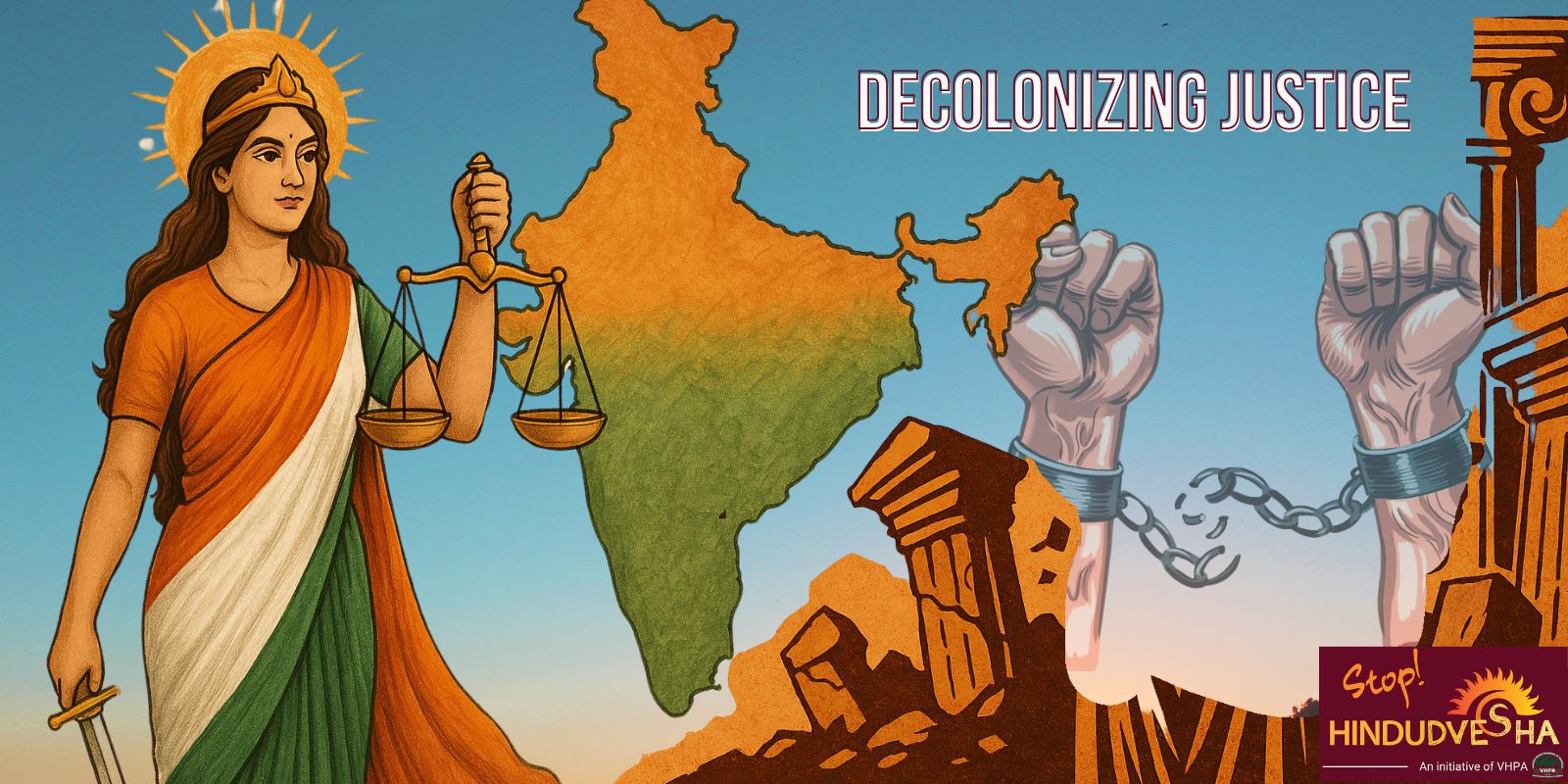
- Bharat’s legal system still uses Latin-based degree titles (LL.B., LL.M.), a remnant of British rule, disconnected from Indian culture and language.
- Renaming legal degrees is vital to decolonize the system and align it with Bharat’s indigenous legal heritage and civilizational ethos.
- Ancient Indian texts and philosophies offer a deep, sophisticated legal tradition that can guide new terminologies.
- Suggested indigenous titles (e.g., Vidhi Snatak, Nyaya Shastra Visheshagya) and renaming institutions like the Bar Council of India can promote clarity, accessibility, and national pride.
The current legal system in Bharat is a colonial imposition—an imported framework that was never designed to reflect the values, culture, or needs of Indian society. Imposed by British rulers to serve the interests of an occupying empire, this legal machinery displaced a rich and sophisticated indigenous tradition of law, justice, and governance that had flourished for millennia. Its continued use, more than 75 years after independence, is not just outdated, it is an offense to Bharat’s civilizational heritage. It is time to cast off this colonial yoke and undertake a sincere effort to decolonize the Indian legal system. Indianization is not merely a symbolic gesture; it is essential for making justice more accessible, relatable, and culturally rooted. By aligning legal education and practice with indigenous languages, values, and knowledge systems, we restore dignity to our traditions and bring the law closer to the people it is meant to serve.
Reclaiming Bharat’s Legal Identity
The conversation around Indianizing Bharat’s legal system has gained renewed momentum in recent years. At the heart of this growing movement lies a deep desire to reclaim indigenous identity, remove colonial vestiges, and make legal education and practice more accessible, intuitive, and culturally rooted.
Former Chief Justice of India N.V. Ramana emphasized this broader concern at a public event, where he stated that “Indianization of the legal system is the need of the hour[1].” His call underscored the importance of reforming the justice delivery system to make it more inclusive, transparent, and aligned with Indian sociocultural realities. Similarly, during the parliamentary debate over the new criminal laws introduced in 2023, Union Home Minister Amit Shah reiterated this view while presenting the new criminal laws in 2023 in the Parliament and asserted that “the proposed laws will free people from the colonial mindset and its symbols[2].”
While the government has taken several commendable steps to Indianize the legal system—such as the introduction of Bharatiya Nyaya Sanhita[3], Bharatiya Nagarik Suraksha Sanhita[4], and Bharatiya Sakshya Sanhita[5], along with the translation of Supreme Court judgments into Hindi and 16 regional languages[6]—there remains a curious silence around the fundamental pillars of Bharat’s legal education system. One particularly overlooked—but symbolically powerful—aspect of this transformation is the continued use of Latin-derived degree titles: LL.B. (Legum Baccalaureus[7]) and LL.M. (Legum Magister[8]). Even after 77 years of independence, aspiring lawyers in Bharat are still awarded degrees in Latin—a language with no cultural, historical, or linguistic relevance to this land.
The Case for Indigenous Law Degrees
The abbreviations LL.B. and LL.M. originate from Latin—Legum Baccalaureus (Bachelor of Laws) and Legum Magister (Master of Laws). In Latin, legum is the plural of lex, meaning “law,” and doubling the ‘L’ is a typographic convention denoting the plural form. Baccalaureus translates to “bachelor” and magister to “master.”
These designations, commonly used in other common law countries, were adopted wholesale into Indian legal education during the British colonial era, when English common law was imposed as the governing legal framework in Bharat. Law schools were established on the British model, training a new class of Indian legal professionals in the English language and legal philosophy. The LL.B. became the foundational degree for practicing law, and the LL.M. was introduced for advanced specialization.
While functional and systematic, this system was never designed to reflect Bharat’s legal culture, philosophy, or history. Instead, it replaced centuries of indigenous jurisprudential thought with an alien structure rooted in European tradition. The continued use of Latin terminology, therefore, is not merely a linguistic issue—it symbolizes the persistence of colonial influence in the very identity of legal education.
The Problem with Latin Abbreviations
To many in Bharat—even within the legal community—the abbreviations LL.B. and LL.M. are unclear and confusing. Unlike degree titles such as B.A. (Bachelor of Arts) or M.Sc. (Master of Science), which are straightforward abbreviations of English words, LL.B. and LL.M. rely on Latin—a language most Indians are unfamiliar with.
The continued use of Latin abbreviations like LL.B. and LL.M. in legal education deviates from the standard academic norm in Bharat, where most degrees follow a clear and consistent abbreviation style. This inconsistency often leads to confusion, even among educated individuals. The meaning of LL.B. is frequently misinterpreted as “Bachelor of Legislative Law,” highlighting how disconnected these terms are from the linguistic reality of the average Indian. Such foreign terminology reinforces the perception of legal education as elitist and inaccessible. More critically, it sustains a colonial legacy that subtly suggests that Indian languages and knowledge systems are unfit for legal discourse. This not only alienates the masses but also perpetuates a sense of cultural inferiority that stands in direct opposition to the ideals of a sovereign, self-respecting nation.
Bharat’s Rich Legal Heritage
Ironically, a civilization as ancient and philosophically rich as Bharat continues to define its legal education using foreign terminology. Bharat was once a renowned seat of learning, revered worldwide as a “Vishwa Guru.” The foundations of law, ethics, and governance in this land are not shallow—they are deep-rooted in thousands of years of philosophical and textual tradition.
Bharat’s legal heritage is deeply rooted in its ancient texts and philosophical traditions. The Vedas and Smritis explore fundamental concepts like Dharma, justice, crime, punishment, and governance. Manusmriti and Arthashastra present detailed legal codes and administrative frameworks. Beyond their narratives, the epics Mahabharata and Ramayana offer profound insights into ethics, justice, and statecraft. Additionally, the Nyaya and Mimansa schools of thought developed sophisticated systems of logic and legal interpretation that remain comparable to modern jurisprudential theories.
In this context, the claim that Bharat lacks the intellectual depth to craft its own legal vocabulary is not just flawed—it’s laughable. The idea that we must continue borrowing foreign terms because we supposedly lack our own is rooted more in intellectual inertia than historical fact. Bharat has always had the tools—it’s time we began using them.
Rethinking Legal Degree Titles
A complete Indianization of the legal system must involve renaming LL.B. and LL.M. degrees using terminology that is accessible, intuitive, and rooted in Indian linguistic and philosophical traditions. Just as the National Education Policy 2020 encourages the use of regional languages in education[9], legal degrees, too, should reflect Bharat’s identity. A few suggested alternatives are:
LL.B. (Bachelor of Laws): Vidhi Snatak (Graduate in Law), Nyaya Shastra Snatak (Graduate in the Science of Justice(since there is no word in English for “nyayshastra” and “science in justice, as you suggested means “nyayvigyan” in Hindi which is very different from nyayshastra, so, I suggest you to either use “Graduate in Nyayshastra” or “Graduate in Jurisprudence” instead of “Graduate in the Science of Justice”), Vidhi Ratna (Gem of Law – to signify prestige)
LL.M. (Master of Laws): Vidhi Visheshagya (Legal Specialist), Vishisth Vidhi Visheshagya (Distinguished Legal Expert), Nyaya Shastra Visheshagya (Justice Science Specialist (can use Jurisprudence Specialist or Nyayshastra Specialist)
These terms are not only easier for the common citizen to understand, but they also resonate with Indian academic traditions such as Acharya[10] and Shastri[11], which are still in use in Sanskrit studies. Using such indigenous titles can also help law graduates feel a deeper cultural connection to their field, as opposed to merely echoing colonial designations.
Reassessing the “Bar”
In addition to degree titles, there is a compelling case for renaming the “Bar Council of India.” The word “Bar” has multiple unrelated meanings—ranging from a counter in a pub to a barrier or restriction—and carries no specific cultural or linguistic association with the legal profession in Bharat.
Possible alternatives that are more precise and culturally appropriate include: National Council of Advocates, Indian Advocates’ Council, Vidhi Parishad (Council of Law), Nyaya Parishad (Council of Justice).
Such alternatives offer clarity and exclusivity while reinforcing the profession’s cultural relevance.
A Step Toward Legal Decolonization
In recent years, the Indian government has undertaken multiple efforts to simplify, modernize, and Indianize the legal system. Replacing British-era laws like the Indian Penal Code, Indian Evidence Act, and Code of Criminal Procedure with their Bharatiya counterparts is an important step forward. However, the effort remains incomplete without a corresponding change in the academic framework and professional terminologies.
Legal professionals and academics must begin to view degree titles not as static labels but as evolving symbols of national identity. Updating these terms would not only reduce confusion but also create a more inclusive and culturally grounded legal education system.
Moreover, such changes would align with the broader vision of Bharatiyakaran—the Indianization of institutions, frameworks, and language—to ensure that they reflect the soul of the country.
Conclusion
It is high time Bharat reclaims the cultural and intellectual autonomy of its legal system. The continued use of Latin degree titles like LL.B. and LL.M. and ambiguous terms like “Bar” stand as lingering reminders of colonial influence. These terms neither reflect the country’s legal heritage nor serve the goal of making legal education more inclusive and intelligible to the masses.
By adopting indigenous alternatives such as Vidhi Snatak or Nyaya Shastra Visheshagya and renaming institutions like the Bar Council of India to something more precise, Bharat can take a meaningful step toward decolonizing and democratizing its legal framework.
Such reforms are not merely symbolic. They represent a deeper realignment of the legal system with Bharat’s civilizational ethos—one that can inspire a new generation of legal minds to serve not just as practitioners of imported laws but as custodians of indigenous justice.
Citations
[1]Need to “Indianise” our legal system to suit our society:CJI ; https://www.thehindu.com/news/national/supreme-courts-views-on-indianisation-of-the-legal-system-have-varied/article38057819.ece
[2] Three new criminal bills will free people from colonial mindset, focus will be on justice delivery: Amit Shah in Lok Sabha; https://timesofindia.indiatimes.com/india/three-new-criminal-bills-will-free-people-from-colonial-mindset-focus-will-be-on-justice-delivery-amit-shah-in-lok-sabha/articleshow/106153907.cms
[3] Government of India Act No. 45 of 2023
[4] Government of India Act No. 46 of 2023
[5] Government of India Act No. 47 of 2023
[6] Using regional languages in courts; https://pib.gov.in/PressReleaseIframePage.aspx?PRID=2042983
[7] LLB abbreviation; https://www.merriam-webster.com/dictionary/LLB
[8] LLM abbreviation; https://www.merriam-webster.com/dictionary/LLM
[9] National Education Policy,2020: Ministry of Education, Government of India; https://www.education.gov.in/nep/nep-languages-2020 (last visited on 05.04.2025)
[10] Acharya (Eq. M.A. in Sanskrit); https://nsktu.ac.in/index.php/acharya-eq-m-a-in-sanskrit/ (last visited on 06.04.2025)
[11]Sastri (Eq. to B.A.); https://nsktu.ac.in/index.php/sastri-eq-to-b-a/ (last visited on 06.04.2025)

Donate to HINDUDVESHA
Our Mission is to explore and expose Hindudvesha through research analysis, education and response.
SUPPORT US