

Selfless Indian Danam vs Toxic Western Charity
 Rakesh Krishnan Simha · 03/01/2025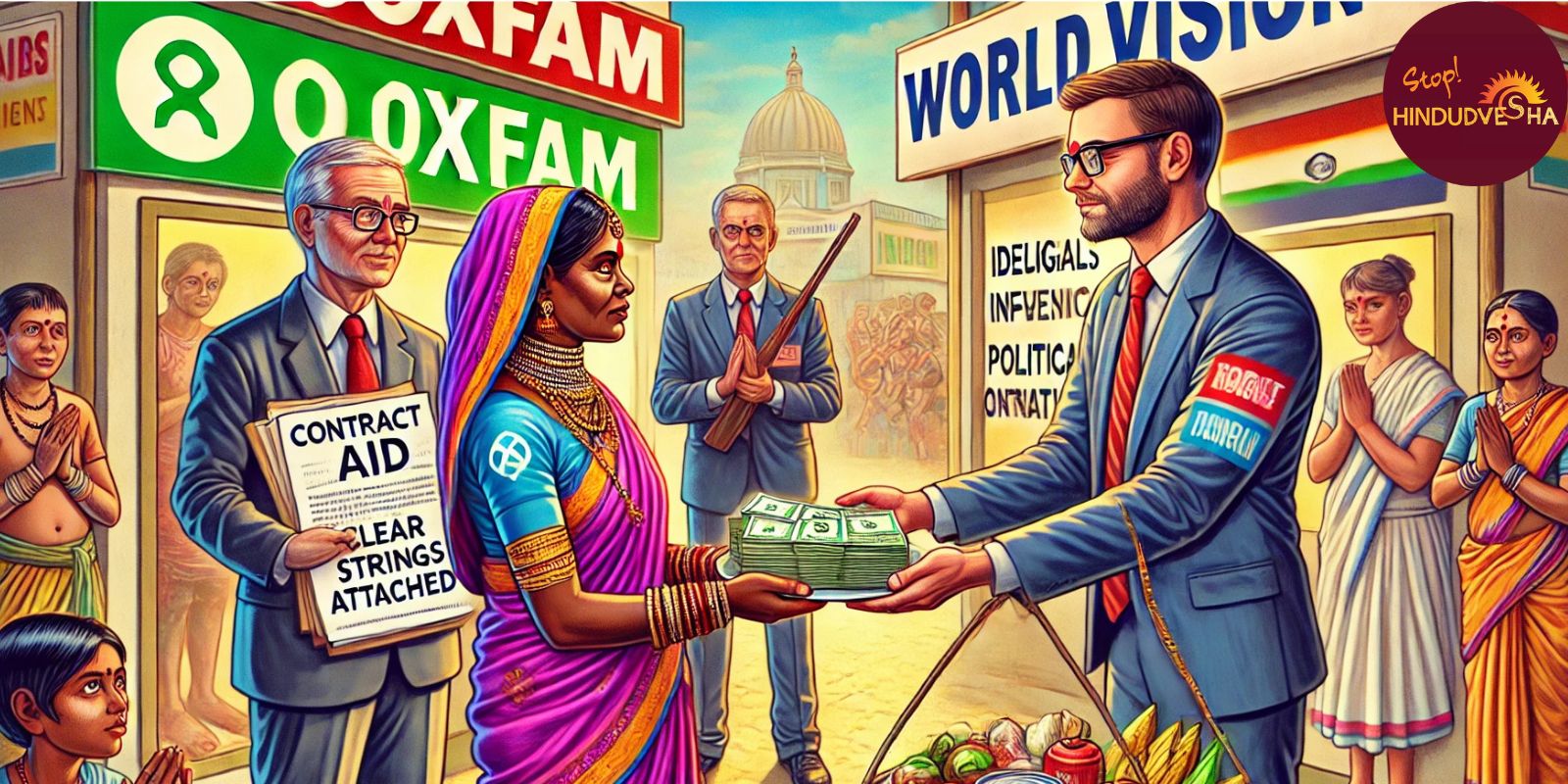
- Foreign aid is often a tool for political interference, economic exploitation, and religious conversion, as seen with USAID’s election funding and groups like World Vision and Missionaries of Charity.
- India has a deep-rooted tradition of philanthropy, with 84% of adults donating annually and most nonprofit funding coming from private Indian contributions rather than foreign aid.
- Hindu scriptures emphasize selfless giving (Danam) without expectation, warning against charity given to unworthy recipients, unlike Western charity, which often demands conversion or allegiance.
- Indian entrepreneurs, religious institutions, and corporate donors are driving a resurgence in structured, large-scale indigenous philanthropy, reviving traditional models of giving.
- Countries like Russia and China have expelled foreign NGOs for meddling in internal affairs, and India should follow suit by banning foreign charities that undermine national interests.
Western charity is little more than a well-disguised racket. Simply put, it operates as a trade—offering food and shelter to the poor in exchange for their loyalty or ideological submission. USAID’s decision to allocate $21 million to increase voter turnout in India’s 2024 elections exemplifies neo-imperialism, using foreign aid as a tool to interfere in the country’s political landscape with the intent of unseating Prime Minister Narendra Modi.[1]
Name any Western charity—World Vision, Oxfam, or Teresa’s Missionaries of Charity—and you’ll find that they all prey on the vulnerable. Teresa herself was a fraud whose so-called charity work was primarily a front for converting Hindus to Christianity. While presenting herself as a servant of the poor, she was, in reality, a wolf in sheep’s clothing, exploiting the destitute, stripping them of their faith, and subjecting them to degrading and outdated medical practices.[2]
Does India Need Foreign Charity?
For the answer, let’s turn to former President Pranab Mukherjee. In 2012, while serving as Finance Minister, Mukherjee attempted to discontinue British aid amounting to £280 million. Dismissing the significance of the UK’s contribution, he remarked in the Indian Parliament, “We do not require the aid. It is a peanut in our total developmental expenditure.”[3]
Further, according to a leaked memo, a senior Indian diplomat proposed “not to avail of any further British assistance” because of the “negative publicity of Indian poverty promoted by Britain’s Department for International Development.” However, London begged Delhi to keep taking the money because canceling the program would cause “grave political embarrassment” to Britain.[4]
Britain’s ulterior motive was exposed when Development Secretary Andrew Mitchell said aid to India was partly “about seeking to sell Typhoon” jet fighters.
Charity Begins At Home
The plain truth is that India is a net donor and doesn’t require foreign aid of any kind. More importantly, grassroots donorship by private citizens is huge in India. The ‘India Giving Report’ by Charities Aid Foundation says 84 percent of 836 million Indian adults give at least once a year.[5]
A four-year study by the Central Statistics Office titled ‘Non-Profit Institutions in India,’ to measure the broader non-profit sector, provides the most credible source for measuring the size of giving to non-profit sector organizations. The report reveals that the non-profit industry derives almost 70 percent of its income from private Indian donations, offerings, and grants. The industry has over 15 million volunteers, who account for over 85 percent of the sector workforce, far outnumbering the 2.7 million paid staff in associations.[6]
This indicates that at the grassroots, informal, and individual levels, charity in India is nearly six times greater than the organized sector, including Western aid organizations such as Oxfam, World Vision, and USAID.
Dilemma vs Dharma
It doesn’t take a rocket scientist to recognize that Western and Christian charities are precisely the kinds of institutions unworthy of your hard-earned money. Yet, countless ill-informed Hindus continue to donate to causes that ultimately work against their nation and Dharma. These Hindus typically fall into two categories.
In the first category are those who donate out of a perverted sense of secularism, whereby they believe donating to World Vision or Oxfam will make them look progressive. They will casually leave envelopes addressed to them by these organizations around the house so guests will notice that they are sponsoring the education of a 12-year-old tribal girl in Madhya Pradesh to Rs 1,500 a month. Ego-boosted and conscience-mollified, they can now head to the newest Mexican bar and blow Rs 15,000 on food and drinks.
The second category comprises God-fearing but ignorant Hindus. They believe – despite stark evidence staring them in the face – that all religions are the same, and therefore, it doesn’t matter what denomination they support. If you suggest they offer their money to Hindu charities like Ekal Vidyalayas instead of World Vision, they will say: “All charities do similar work. Besides, I’m already committed to donating to World Vision for five years. At the end of five years, I’ll check the progress and then make a decision.” Five years down the line, World Vision will mail them a photo of a 17-year-old allegedly studying at some computer science institute in Bina or Satna, and these pious bumpkins wouldn’t have the slightest clue whether that claim is true or fake.
If you tell them that Christian charities do the handiwork of Western intelligence agencies and want to break India, they will snap at you, “So what? So many Hindus also want to destroy India.” Such people are like a brick wall – no point banging your head against them.
If you belong to either of the above categories, you should know what our ancient texts say about such mindless charity.
Consequences of Wrong Charity
Bhagwad Gita says that charity, which is given at the wrong place and wrong time to unworthy persons, without showing respect or with contempt, is held to be of the nature of nescience (BG 17.22). [7]
An adverse consequence (dushphalam) follows when Danam is given to a morally degenerate and unworthy recipient, such as an atheist, a thief, or one who creates mischief.[8] In other words, donating to World Vision—which is driven by the goal of undermining Hinduism and, by extension, the Indian nation—only leads to the accumulation of bad karma.
Also, praising oneself for making a Danam, expressing regret after making a Danam, and repeatedly and unnecessarily mentioning the Danam will ultimately destroy all the good karma of the Danam.
Hindu Way
In traditional Indian texts, Danam is defined as the action of relinquishing ownership of what one considers or identifies as one’s own and investing it in a recipient without expecting any return.
Unlike Christianity, which says the rich can enter heaven as easily as a camel can pass through the eye of a needle, within Hinduism, wealth is regarded as a beneficial and positive value, just like love and morality — if pursued within limits. The highest praise in Hindu history is not reserved for the generous but for those who regard wealth with indifference and can renounce all their belongings when the proper stage of life arrives.[9]
Charity is so deeply institutionalized in India that we have major literary works that deal exclusively with Danam. Mitakṣara by Vijnanesvara is an 11th-century canonical discussion and commentary on Danam, composed under the patronage of the Chalukya Dynasty.
In ‘Theories of the Gift in Medieval South Asia: Hindu, Buddhist, and Jain,’ Maria Heim lists some of the major Sanskrit treatises that discuss ethics, methods, and rationale for charity in India. These include the 12th-century Danam Kanda (Book of Giving) by Laksmidhara of Kannauj; the 12th-century Danam Sagara (Sea of Giving) by Ballalasena of Bengal; and the 14th-century Danakhanda which is part of the voluminous Chatur Varga Chintamani (The Gem of the Four Aims of Human Life) by Hemadiri of Devagiri.[10]
Ancient texts such as the Mahabharata and Dharma Shastras indicate that the notion of reciprocity (ingrained in Christianity) is not mentioned in the description of Danam. However, emotional and attitudinal reactions on the part of the recipient of Danam (closer to feelings of gratitude and respect for the donor) are mentioned as qualities of a worthy recipient.[11]
Danam can be performed in a myriad of ways. According to the ancient Dharmasutra of Gautama, before a man eats, “He should give food first to guests, children, the sick, pregnant women, females in his household, and the old, as well as the menials.”[12]
Lilavati Krishnan and V.R. Manoj write in the paper ‘The Indian Psychology of Values: The Concept of Danam’[13] that Danam should be done as a routine activity because:
- It involves the giving away of wealth that belongs to everyone.
- Everyone has an equal right to acquire wealth.
- It is the duty of everyone to ensure that others are getting the proper share that is their due.
- Whatever we consume in this world is only for the sustenance of the mortal body. This fact is common to everyone, so one must ensure that such sustenance is possible for everyone.
- Nothing truly belongs to us; we act as mere custodians of someone else’s wealth. When the real owner (in the form of a recipient) comes along, we return what belongs to him with due respect.
Hindu philanthropy is alive and kicking
For 1,700 of the past 2,000 years, India was the wealthiest country on the planet.[14] The Islamic invasions did considerable damage to India’s social fabric, temples, education system, and economy, but British rule caused the maximum economic destruction and the complete erasing of native education. Now, after three centuries of poverty, India is on the cusp of creating great wealth.
With the explosion of private enterprise in India, major changes are happening in the country’s philanthropy sector. India is again close to the pre-British tradition of trade and industry guilds supporting education and charitable works.[15] Caroline Hartnell writes in ‘Philanthropy in India’ that because of this explosive growth, Indian businesses are thinking about a long-term vision and a structured way of contributing to charity via a “portfolio of investments and interventions.”[16]
“Many of these givers are first-time entrepreneurs, often tech entrepreneurs, who are not from traditional wealthy families. Many of these are bringing their intellectual and social capital and financial capital. They have generated a lot of wealth and are now looking to give back to the society that allowed them to prosper, seeing themselves as stewards of wealth rather than owners.”
A UBS report titled ‘Revealing Indian Philanthropy’ points out that many of these entrepreneurs, having grown up without wealth, are less concerned about preserving wealth for the next generation. Their relationship to the wealth they create leads to more freedom in distributing it. For instance, Kalpana Morparia, chief executive officer of JP Morgan India, has chosen to outsource her philanthropic initiatives to the Bharti Foundation, giving Rs 1.5 crore to set up and operate a school in Haryana.[17]
Tapping into this sentiment, billionaire philanthropist Mohandas Pai of the Manipal Education Group and former Infosys CFO says every billionaire should contribute 2 percent of their wealth to charity.[18] Many of Pai’s friends and former colleagues have contributed to his Akshaya Patra Foundation, which has a balance sheet of over Rs 200 crore and over 5,000 employees. The Foundation aims to feed 3 million children every day by 2025.[19]
Alongside the new givers, members of the old order continue to do good work. For instance, Tirumala Tirupati Devasthanams (TTD), which manages one of the wealthiest temple trusts in the world, established schools in its vicinity as far back as 1876. Today, the TTD manages a number of explicitly social endowment schemes and runs at least 22 educational institutions in and around Tirupati, in addition to an Ayurveda college, a vocational training center, and a university hospital. Such religious institutions continue to receive huge but mostly unreported donations every year.[20]
Time to banish the conversion crowd
In the backdrop of such an extensive network of charitable organizations across the country and a history of selfless charity since ancient times, it is clear that India doesn’t need the presence of foreign charities, which are basically probing arms of neo-colonialism and agents of religious conversions, just as in an earlier era the Sufis and Jesuits were the scouts of Islamic invaders and European imperialists respectively.[21]
Hindus lacked the “Shatrubodh” – a sense of the enemy – to understand the motives of these early Muslims and Christians and allowed them in, and consequently lost their freedom for hundreds of years. The least we can do is learn from our own past mistakes and ban today’s foreign interlopers.
Vladimir Putin has set a fine example by ordering USAID[22] and the British Council[23] out of Russia. This was because they interfered in Russia’s internal affairs (translation: spying). These two organizations are likely doing the same in India. The Chinese do not allow such organizations to even step into their country.
So why should India alone allow foreign charities to create and promote mischief? To its credit, the Narendra Modi government has choked the funding of thousands of NGOs and charities carrying out anti-national activities. However, this isn’t enough, as crooks always find a way around the law. A complete ban on all foreign charities and NGOs should be imposed immediately.
Many Indian liberals have a favorite catchphrase – “What will the world think?” For more than 70 years, the hero of these liberals, Jawaharlal Nehru, spoke the same words: “What will the world think if India takes back its own territory in Kashmir?” His dithering allowed a much weaker Pakistan to grab a third of Kashmir, leading to decades of terrorism in that state. What Indians should worry about is that the survival of India as a nation is at stake here.
Just Say No
Finally, if you had promised to support foreign charities and would like to stop but are confused, the ancient seer Gautama offers a solution to this conundrum in his Dharmasutra: “When a request is made for an unlawful (adharma) purpose, he should not give, even if he has already promised to do so.”[24]
Citations
[1] ‘Deeply troubling’: Govt as USAID row heats up (Hindustan Times); https://www.hindustantimes.com/india-news/deeply-troubling-govt-as-usaid-row-heats-up-101740162516423.html
[2] Mother Teresa: Here are some accounts of forced conversions, primitive medical practices and suffering (OpIndi); https://www.opindia.com/2020/09/mother-teresa-forced-conversions-primitive-medical-practices-suffering/
[3] India rejects aid from Britain, says it is peanuts (Economic Times); https://economictimes.indiatimes.com/news/politics-and-nation/india-rejects-aid-from-britain-says-it-is-peanuts/articleshow/11769932.cms?from=mdr
[4] Britain embarrassed as India spurns ‘peanuts’ (The unday Morning Herald); https://www.smh.com.au/world/britain-embarrassed-as-india-spurns-peanuts-20120205-1qzsx.html
[5] Philanthropy in India, an age-old tradition (Mint); https://www.livemint.com/Specials/91k22CWjd0CU36or3ezHoN/Philanthropy-in-India-an-ageold-tradition.html
[6] Revealing Indian Philanthropy (Alliancepublishing.org); https://eprints.lse.ac.uk/50924/1/Kattumuri_Revealing_India_philanthropy_2013.pdf
[7] Bhagwat Gita commentary by Swami Mukundananda; https://www.holy-bhagavad-gita.org/chapter/17/verse/22#:~:text=BG%2017.22%3A%20And%20that%20charity,of%20the%20nature%20of%20nescience.
[8] The Indian Psychology of Values : The Concept of Daanam (Mandala of Indic Tradition); https://indicmandala.com/the-indian-psychology-of-values-the-concept-of-daanam/
[9] https://interfaithhousinginitiative.wordpress.com/2017/09/07/homeless-wealth-from-one-hindu-perspective/#:~:text=Possessing%20and%20earning%20wealth%20is,just%20like%20love%20and%20 morality.
[10] Theories of the gift in South East Asia; (Maria Heim – A Rutlegde Series); https://dn790005.ca.archive.org/0/items/danatheoriesofthegiftinsouthasiahindubuddhistandjainreflectionsondanamariaheimroutledge_202003_27_T/Dana%2C%20Theories-of-the-Gift-in-South-Asia-Hindu-Buddhist-and-Jain-Reflections-on-D%C4%81na%20Maria%20Heim%20Routledge.pdf
[11] The Indian Psychology of Values : The Concept of Danam (Mandala of Indic Tradition); https://indicmandala.com/the-indian-psychology-of-values-the-concept-of-danam/
[12] Dharmasūtras – The Law Codes Of Āpastamba, Gautama, Baudhāyana And Vasiṣṭha (Internet Archives); https://archive.org/details/DharmasutrasTheLawCodesOfApastambaGautamaBaudhayanaAndVasistha
[13] The Indian Psychology of Values : The Concept of Danam (Work sponsored by Infinity Foundation); https://www.infinityfoundation.com/mandala/h_es/h_es_the_indian_psychology_of_values.htm
[14] 2,000 Years of Economic History in One Chart (Visual Capitalist); https://www.visualcapitalist.com/2000-years-economic-history-one-chart/
[15] Guilds in Ancient India: The Roles, Organization, and Working of Srenis; https://management.cessedu.org/sites/management.cessedu.org/files/32.%20Guilds%20in%20Ancient%20India%20The%20Roles%2C%20Organization%2C%20and%20Working%20of%20Srenis.pdf
[16] Philanthropy in India; https://www.psjp.org/wp-content/uploads/2017/10/Philanthropy-in-India-October-2017-1.pdf
[17] Revealing Indian Philanthropy (Alliancepublishing.org); https://eprints.lse.ac.uk/50924/1/Kattumuri_Revealing_India_philanthropy_2013.pdf
[18] Billionaires must give 2% of their wealth every year for greater good: Mohandas Pai (India Forbes); https://www.forbesindia.com/blog/the-good-company/billionaires-must-give-2-of-their-wealth-every-year-for-greater-good-mohandas-pai-290745.html
[19] Akshaya Patra website; https://www.akshayapatra.org/
[20] Revealing Indian Philanthropy (Alliancepublishing.org); https://eprints.lse.ac.uk/50924/1/Kattumuri_Revealing_India_philanthropy_2013.pdf
[21] Architects of empire (AEON); https://aeon.co/essays/how-the-jesuits-cultivated-the-idea-of-european-empire
[22] Russia Expels USAID, meddling cited (The Herald); https://www.herald.co.zw/russia-expels-usaid-meddling-cited/
[23] Russia: Moscow Orders Closure Of British Council Branches; https://www.rferl.org/a/1079259.html
[24] Full text of “Dharmasūtras – The Law Codes Of Āpastamba, Gautama, Baudhāyana And Vasiṣṭha” (Internet Archives) ; https://archive.org/stream/DharmasutrasTheLawCodesOfApastambaGautamaBaudhayanaAndVasistha/Dharmas%C5%ABtras%20-%20The%20Law%20Codes%20of%20%C4%80pastamba%2C%20Gautama%2C%20Baudh%C4%81yana%20and%20Vasi%E1%B9%A3%E1%B9%ADha_djvu.txt

Donate to HINDUDVESHA
Our Mission is to explore and expose Hindudvesha through research analysis, education and response.
SUPPORT US