

Zohran Mamdani UNMASKED: Progressive Muslims Expose His Radical Agenda
 Dr. Jai G. Bansal · 08/01/2025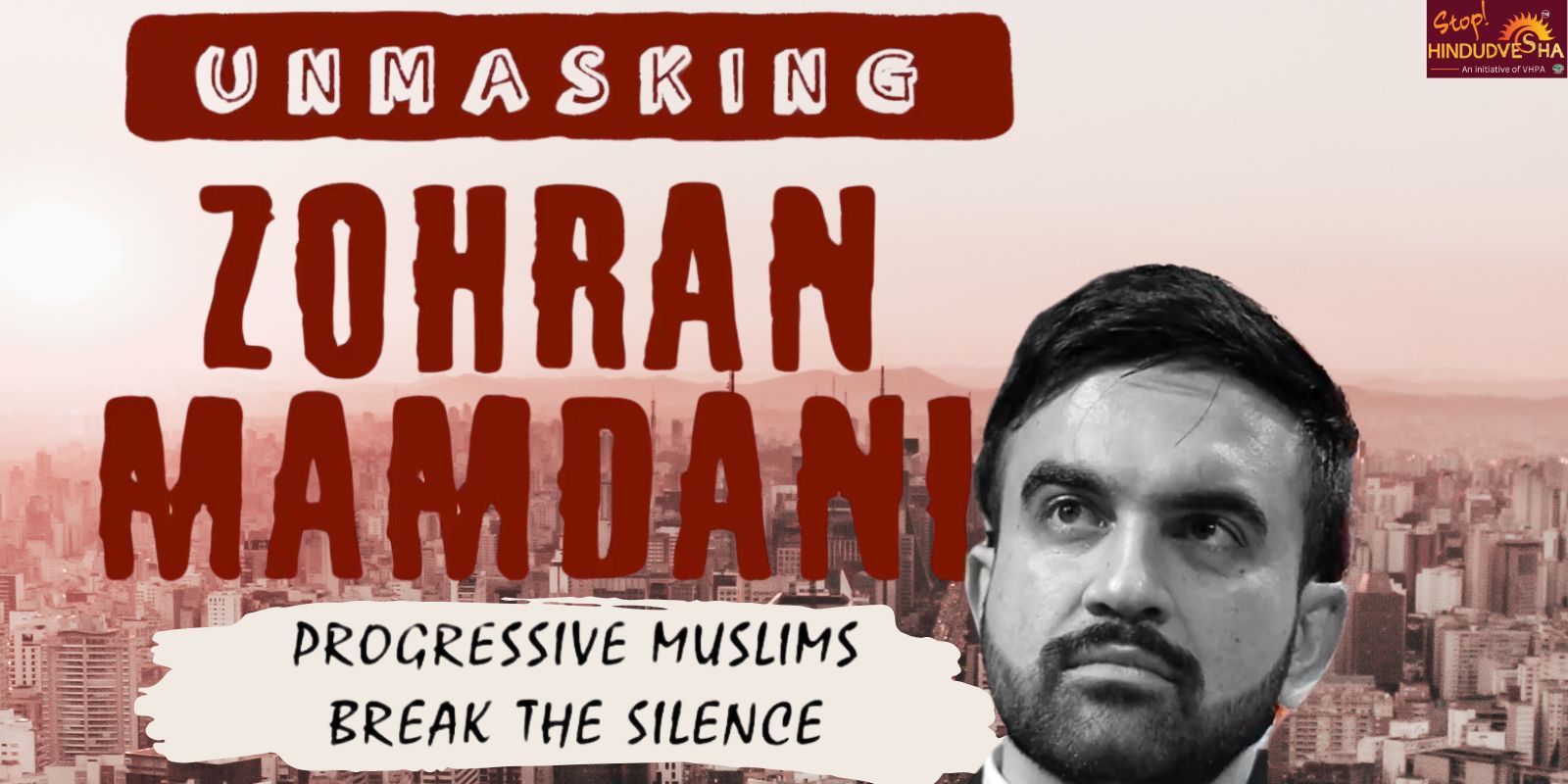
Brief Summary
- Mamdani’s Divisive Rhetoric: Panelists raised concerns over Zohran Mamdani’s repeated targeting of Hindus and Jews while shielding Islamist extremism under the guise of progressivism.
- False Gujarat Narrative Exposed: Mamdani’s claim that Muslims were “wiped out” from Gujarat was debunked using census data and first-hand accounts, showing Muslim populations are thriving.
- Erasure of Gujarati Muslims: By denying the existence of millions of Muslims in Gujarat, Mamdani insults both the Hindu community and Gujarati Muslims themselves for political gain.
- Dangerous Importation of Foreign Conflicts: Mamdani injects global issues like Kashmir and Palestine into NYC politics, risking communal tension in a diverse civic space.
- Misuse of Fascism and Nazi Labels: The panel denounced the casual use of terms like “fascist” and “Nazi” against Hindus, calling it ideologically dishonest and historically ironic.
- Islamophobia as a Silencing Tactic: Panelists explained how the term “Islamophobia” is often weaponized to shut down legitimate criticism of extremism and shield ideological agendas.
- Red-Green Alliance Identified: The discussion exposed the ideological nexus between Islamists and Marxist-leftists working together to undermine Hindu and Jewish communities globally.
- Progressive Muslim Counter-Narrative: All three panelists—Arshia Malik, Arif Aajakia, and Omer Ghazi—emphasized internal reform, truth-telling, and solidarity with Hindus as essential for genuine progress.
- Rejecting Victimhood and Embracing Indian Identity: The panel called on Indian Muslims to abandon false victimhood narratives and reconnect with their civilizational roots.
- Call to the Hindu Diaspora: Hindus were urged to stand strong, stop appeasing ideological bullies, and build thoughtful alliances with reform-minded Muslim voices resisting extremism.
In a city celebrated for its pluralism and multicultural vibrancy, few issues strike a more sensitive chord than those involving religious and ethnic harmony. Recently, however, rising concerns have emerged surrounding the rhetoric and political posture of Mr. Zohran Mamdani, a New York City mayoral candidate whose statements and activism have triggered alarm among Hindu and Jewish communities alike.
This article draws from a recent panel discussion hosted by StopHindudvesha.org, an initiative of the Vishwa Hindu Parishad America (VHPA). The latter is a 501(c)(3) nonprofit organization committed to promoting Hindu heritage and community welfare. As a nonpartisan entity, VHPA does not endorse or oppose any political ideology or candidate. However, it remains deeply invested in ensuring the safety, dignity, and cultural security of the Hindu community, especially within the unique sociopolitical landscape of New York City.
This panel, comprising three progressive Muslims – two from India and the third from Pakistan, now living in the U.K. – sought to unpack the increasingly polarizing public record of Mr. Mamdani. Though he identifies as a progressive voice, his rhetoric has raised critical questions about ideological extremism, selective outrage, and the importation of foreign conflicts into American municipal politics.
Among the most troubling aspects of Mr. Mamdani’s public statements is his tendency to frame issues through a lens of divisive identity politics and class struggle, often underpinned by an ideological fusion of Marxism and Islamic political narratives. At a 2020 protest, for instance, he pointedly refused to denounce anti-Hindu slurs and instead launched attacks on the Ram Mandir project in India—an issue with no direct bearing on New York governance. He has also accused Hindus of ethnic violence in Gujarat, echoing accusations frequently promoted by Pakistani propaganda outlets.
Equally concerning are his statements that have unsettled the Jewish community. His public support for slogans like “Globalize the Intifada” is seen as incendiary and threatening, particularly in a city where interfaith trust is vital to civic peace. By continually injecting fraught international issues—like Kashmir and Palestine—into the context of American urban politics, Mr. Mamdani risks inflaming tensions among communities who have long coexisted in mutual respect.
As this article will explore through the lens of our expert panel, the political trajectory of Mr. Mamdani is not merely a local electoral story—it is a case study in how ideological radicalism, when left unexamined, can compromise the delicate fabric of communal harmony in America’s most diverse city.
About the Panelists
Here is a brief introduction to our distinguished panelists, each bringing a unique perspective shaped by personal experience, scholarly insight, and a commitment to truth and reform within and beyond the Muslim world.
Arshia Malik is a Delhi-based writer and commentator originally from Kashmir. Renowned for her work on Muslim women’s rights and conflict zones, such as Kashmir, her writings appear in publications including Swarajya, News18, and Firstpost. She is also known for curating progressive and heretical literature from within the Muslim world, offering critical insights on Sharia, Islam, and the Indian subcontinent.
Arif Aajakia is a former mayor of Jamshed Town, a suburb of Karachi, Pakistan. Born into a traditional Muslim family with ancestral roots in Gujarat, India, he now resides in the United Kingdom. A vocal human rights activist and social commentator, he embraced Sanatana Dharma in 2022 through ghar wapsi and actively shares his views through a widely followed YouTube channel.
Omer Ghazi is a writer and public intellectual with a focus on history, culture, and geopolitics. He serves as a research associate at a public policy think tank and represented India at the Best Diplomats Conference in Dubai in 2023. His book, The Cosmic Dance, explores the deep connections between modern science and ancient Indian philosophy.
The following write-up presents a paraphrased and structured summary of the hour-long discussion between the host and the three panelists.
1. Debunking Mamdani’s Gujarat Muslim Lie
(Video time stamp: 5:22)
Host
Zohran Mamdani has claimed that not many Muslims are left in Gujarat, implying ethnic cleansing. Arif ji, since you recently visited Bharat, particularly your ancestral region of Gujarat, and had the opportunity to interact with local communities, I’d like to hear your response to this irresponsible claim.
Arif Aajakia
First of all, Mamdani’s claim that Modi killed all Muslims in Gujarat is completely false. Let’s look at the facts. In 2001, Muslims made up 9.1% of Gujarat’s population. By 2011, that number had increased to 9.7%. In just one decade, the Muslim population in Gujarat increased by over a million people.
And yet this man claims Muslims were wiped out? It’s a blatant lie. And I wonder why no one is demanding an apology from him—he’s a candidate for mayor of one of the world’s most powerful cities, making such inflammatory and baseless accusations.
Let me share my personal experience. I visited my ancestral village in Gujarat. My parents had told me that during the 1947 riots, all Muslims had left the village. But when I went back, I found many Muslims still living there. I asked them, “Why didn’t you go to Pakistan back then?” They told me there was fear at the time, driven by propaganda, and many people fled. But they chose to stay—and have been living very well ever since. They said they’ve faced no problems and are living prosperous lives.
I also visited Ahmedabad, Porbandar, Rajkot—many places across Gujarat. I found Muslims living peacefully and thriving everywhere I went. Many even told me they enjoy more than equal rights, because in India, minorities have special protections. And frankly, in a secular country, this distinction between majority and minority rights shouldn’t exist.
The point is: Muslims in Gujarat are living happily. Mamdani is spreading lies—nothing more. And this kind of rhetoric isn’t new in his family. His father, Mahmood Mamdani, wrote a book titled Good Muslim, Bad Muslim in the early 2000s, in which he claimed Islamic extremism is a result of Western policies. This same ideological mindset runs through the family.
As someone who lives in London, I’ve seen what happens when such leaders take office. Our mayor, Sadiq Khan, has won three terms, but I’ve personally witnessed the decline of London. The transport system is failing. Just recently, there were no trains for two days. Council tax has tripled—from £99 to £299. The quality of life has gone down dramatically. This is what happens when incompetent, ideologically driven people are elected.
Host
Omer ji, I know you’ve also written on this subject. Could you share your perspective?
Omer Ghazi
Absolutely. When I heard Mamdani’s statement, I was outraged—because it’s not just misleading, it’s an outright lie.
Let’s look at hard numbers. The Muslim population in Gujarat is approximately 6 to 7 million. In contrast, the entire Muslim population of the United States is around 3 to 4 million. Gujarat alone has nearly double the Muslim population of the U.S.
So when someone like Mamdani claims that Muslims have been “wiped out” in Gujarat, what he’s doing is not just political spin—it’s a complete erasure of an entire community. He’s denying the existence of millions of Muslims in Gujarat for his own political gain.
It’s an insult on many levels. It’s an attack on Prime Minister Modi. It’s an attack on the Hindu community of Gujarat. But perhaps even more shamefully, it’s an insult to the Gujarati Muslims themselves, who are living prosperous lives, who have equal rights, who are thriving.
I know many Gujarati Muslims personally. They’re doing well, building businesses, raising families, and contributing to society. Their numbers are increasing, not decreasing. That can only happen in a place where there is peace, stability, and respect for rights.
And then Mamdani comes along and tries to paint them as victims of genocide, just to build his own brand of victimhood politics. It’s morally corrupt and politically treacherous. It shows exactly what kind of politician he is: one who will erase his own community’s existence to score ideological points.
He even said in his own words, “When I tell people I’m a Gujarati Muslim, they are surprised. They think all Gujarati Muslims were wiped out.” That’s not just exaggeration, that’s deceit. It’s gaslighting. And it reveals the deep dishonesty at the heart of his political project.
Mamdani belongs to that ideological camp that believes only two communities are responsible for all the world’s problems—Hindus and Jews. For people like him, there’s no other lens through which to view the world. That’s what makes his rhetoric so dangerous.
So yes, I’m infuriated—not just for the Hindus of Gujarat, but also for the millions of Muslims he chooses to ignore, disrespect, and erase for his own gain.
Host
As you are aware, some of this rhetoric dates back to the events of 2002. I’m sure you’re all familiar with the history, the subsequent investigations, and the Supreme Court’s findings. Arshia ji, would you like to shed light on that broader context—what’s happened over the past 20–25 years?
Arshia Malik
As someone who’s been documenting narratives from Kashmir, which until recently was a conflict zone, I’ve seen firsthand how the idea of “Muslim persecution in India” has been deliberately amplified, especially since the 1990s, when Pakistan began its proxy war in Kashmir.
Many of us grew up surrounded by that narrative. Fortunately, some of us were able to break free from it, thanks to critical thinking and progressive families. However, make no mistake, that narrative was —and still is —deeply entrenched.
To me, Mamdani is just another extension of that same narrative. He parrots the same talking points as those who promoted the “India occupies Kashmir” storyline, funded and backed by the same global ideological networks. As someone who pushes back against both Islamist radicalism and leftist misinformation, I’ve consistently asked: Why is there always a deliberate conflation of events?
Arif ji rightly mentioned Mamdani’s father, Mahmood Mamdani, who argued that Islamic extremism was simply a reaction to Western policy. But let’s not forget Hamid Dalwai—a towering reformer from Maharashtra—who clearly showed that what is now called “Hindu communalism” was, in fact, a reaction to prolonged and aggressive Muslim communalism. Hindus had no choice but to respond when repeatedly provoked.
Take, for example, the Gujarat riots. Yes, they were tragic, and yes, many Muslims died. But people forget what triggered them—the Godhra massacre, in which Hindus, including women and children, were burned alive inside a train. Mamdani conveniently omits that part and instead repeats a narrative of unilateral Hindu aggression. It’s dishonest and dangerous.
He fits squarely into the ideological machine that wants the world to believe Hindus are the problem, Jews are the problem, and every other group is innocent. That’s the framework—anti-Hindu and anti-Semitic in equal measure—and Mamdani is just another voice in that chorus.
So for me, his rhetoric was not surprising at all. What’s troubling is that this kind of false narrative is gaining political traction.
2. Mamdani’s Hindu Hate Label
(Video time stamp: 14:55)
Host
Let’s now turn to another related issue: why is it that when Hindus express pride in their culture, celebrate festivals, or participate in politics, they’re labeled “fascist”—but other communities are not? What kind of mindset drives that? Anyone who’d like to begin, please jump in.
Arif Aajakia
Let’s start by understanding what fascism truly means. Fascism is the refusal to accept others as equals. It’s the belief that others are inherently inferior, worthy only of being ruled or oppressed.
Now let’s be clear: Hinduism teaches no such thing. It does not label others as slaves or deny them dignity. So calling Hindus “fascists” is not just a lie—it’s absurd propaganda.
If someone like Mamdani believes Hindus are fascist, let him point to a single example where Hindus have systematically denied rights to Muslims in India. In fact, the opposite is true: Muslims in India enjoy equal rights, and in many cases, more rights than Hindus.
Look at the Waqf Board, the Muslim Personal Law Board—institutions that don’t exist in secular countries like those in the West. In India, these exist because the system has gone out of its way to accommodate minorities.
So, this accusation of fascism is not just false—it’s so ridiculous, it doesn’t even deserve a response.
Omer Ghazi
Absolutely. If Hindus in India are fascists, then they’re the most inept fascists in history. It’s laughable. That’s not how fascism works.
Let’s define fascism correctly: it’s when a government system denies basic constitutional rights to segments of its population. In today’s India, if you look at the legal and civil structure, it’s clear that minorities have not just equal, but often enhanced rights.
Yes, there may be individual cases of discrimination—that’s possible in any country. But systemic fascism? That’s a lie.
Take civil law, for example. A Hindu in India must follow a codified civil code. But a Muslim can opt out of the Indian judiciary altogether and resolve disputes according to religious personal law. That’s unheard of in truly secular countries.
Then there’s the issue of Waqf land. India has an enormous amount of land under Waqf control. In theory, India is a secular country, so it shouldn’t even have such a system. Ironically, even Muslim countries like the UAE or Saudi Arabia don’t allow this. There, the state is supreme—religious institutions don’t control large swathes of land or operate parallel education systems without state regulation.
Try practicing Islam publicly in those countries in ways that challenge state authority. Celebrate Eid publicly in a way that blocks streets, and you’ll be jailed. You won’t be seen again.
Yet in India, Muslims enjoy complete religious freedom, often at the expense of state neutrality. So when someone claims Muslims are “oppressed” in India or living under a “fascist Hindu regime,” it’s not just misleading—it’s intellectually dishonest.
The problem is this: Mamdani and others from his ideological camp are not interested in facts. They’re interested in building a permanent narrative of victimhood. And unfortunately, that narrative thrives on lies—because the truth doesn’t support it.
And here’s the irony: if Muslims in India continue to abuse the extraordinary freedoms they enjoy—instead of appreciating them—they may eventually lose them. And if that happens, they’ll have no one to blame but themselves.
Host (laughing)
Thank you, Omer ji. So what you’re essentially saying is—if Hindus are fascists, they’re so inept they don’t even know how to practice fascism properly?
Omer Ghazi (laughing)
Exactly. They don’t.
Arshia Malik
Let me add something here. I actually find it quite amusing—almost absurd—when practicing Muslims or those who identify as Muslims accuse others of being fascist or intolerant.
I’ve spent years documenting heretics, dissenters, and apostates across different Muslim societies and continents. From the very inception of Islam, there have been internal critics, and yet, these individuals have been relentlessly persecuted. Mainstream Islamic societies don’t even tolerate their own dissenters, let alone outsiders. Groups like the Ahmadis, for example, are labeled heretics and often face institutional discrimination in Muslim-majority countries.
So, for Muslims to accuse Hindus of intolerance is ironic, because Hindus, by and large, do tolerate difference. Many of them even accept Muslims as fellow seekers of truth, just with a different approach to the divine. That level of pluralism simply doesn’t exist in most Islamic traditions.
It’s baffling that in today’s age—when we have access to so much information, technology, and awareness—people still fall for such blatant hypocrisy. Mamdani should have been called out long ago. But it’s easy to label Hindus fascists—precisely because they’re tolerant. They don’t react with the same aggression that others might.
So yes, as Omer said, Hindus may be the “weakest fascists” in history—if that’s what you want to call it—because they’ve never actually practiced oppression. It’s all propaganda. A narrative that’s been pushed for decades.
Arif Aajakia
Let me add to that. When I first moved to Belgium in 1990, I had a dispute with a local social worker—a blonde woman—and I, coming from Pakistan, didn’t really understand what the word “fascist” meant. So I called her a fascist. She calmly explained to me that in Belgium, calling someone a fascist without evidence is actually a crime. That was a moment of learning for me.
Now compare that with what we’re seeing in New York—a mayoral candidate casually throwing around the word “fascist” with zero accountability. It’s dangerous.
If you really want to find fascism today, look at places like Pakistan, where minorities have no rights. Look at Afghanistan or Syria, where Christians, Druze, and other minorities face open persecution. Fascism, as it exists today, is overwhelmingly found in Islamic societies, not in Hindu-majority India.
Omer Ghazi
I’ll add one more example that really highlights the double standards.
Take something as simple as religious fasting. During Shivratri, many Hindus in India refrain from eating meat. Now imagine if it were illegal to eat meat in public during Shivratri. Wouldn’t that be seen as Hindu extremism?
But in several Muslim-majority countries—like Jordan, Morocco, Kuwait, Qatar, Afghanistan, and even parts of Malaysia—it is illegal to eat in public during Ramadan. It doesn’t matter if you’re fasting or not. Even tourists can be fined or jailed.
So, let’s be clear: if you’re caught eating during Ramadan in these places, you will be prosecuted under the law. That is state-enforced religious compliance, which is far closer to fascism than anything you’ll find in India.
Arif Aajakia
Yes—and just yesterday, in an ISKCON temple, a man walked in with KFC chicken and began eating it inside, knowing it was a vegetarian space. When I mentioned this to a Muslim friend, he said, “What’s the problem?” I told him, “Okay, let’s try the reverse. Go eat pork in a mosque and see what happens.”
Omer Ghazi
Exactly. If you want respect, you must also show respect. It has to be mutual. And that’s the fundamental issue with this kind of double standard.
3. Cry Islamophobia, Muzzle Critics
(Video time stamp: 25:47)
Host
That leads us perfectly into another term that’s been weaponized in recent times: Islamophobia. Now, of course, every community deserves protection from hate. But when the term is used to shut down valid criticism of extremism, anti-Hindu hate, or internal problems within the Muslim world—it becomes dangerous.
What’s your take on how the term Islamophobia is being used today?
Arshia Malik
I’ll go first, since I’ve written extensively on this.
First, let me correct the terminology. The more accurate term would be anti-Muslim bigotry or Muslimophobia. Islamophobia is a term that was coined by the Muslim Brotherhood. Its primary purpose wasn’t to protect Muslims from hate—it was designed to suppress dissent within the Muslim community, especially from reformers and heretics.
Over time, it evolved into a tool to shut down criticism from outsiders as well. If a non-Muslim questions any aspect of Islamic theology or politics—Sharia law, gender roles, intolerance toward other faiths—they’re immediately branded Islamophobic.
Yes, there has been anti-Muslim bigotry, particularly post-9/11. That’s undeniable. But as we discussed earlier, much of the communalism from other groups is a reaction to Islamist extremism. And Muslims need to accept that hard truth.
There are over 56 Muslim-majority countries in the world, and every single one is grappling with some form of extremism. In Africa, groups like Boko Haram push the same ideology as Hamas, ISIS, or the TRF in Kashmir. That kind of synchronicity across geographies isn’t a coincidence. It points to deeper ideological issues in the theology itself.
As I mentioned, the Muslim Brotherhood shifted its operations westward after being banned in Egypt. And in the West, it began pushing terms like “Islamophobia” to silence criticism of its agenda. Anyone who dares to say, “Sharia law is misogynistic,” or points out anti-Hindu hate, is immediately labeled a bigot.
We saw this same dynamic in the UK with the Pakistani grooming gangs. Authorities took years to act—not because they didn’t know what was happening—but because they were terrified of being labeled racist. That’s how powerful and dangerous this label has become.
Mamdani is just the latest in a line of individuals who have weaponized this term for ideological purposes. And we must call it out for what it is.
Host
Does anyone else have a view on this?
Omer Ghazi
Yes, very quickly. The term “Islamophobia” really irritates me—it’s misleading and manipulative. It’s a mind game. Let me explain.
Suppose an academic respectfully critiques some aspect of Islamic theology—something scholars routinely do with Hinduism, Christianity, or Judaism. Immediately, some in the Muslim community respond by saying, “The faith is perfect; the problem is with the people.” So the scholar adjusts: “Okay, I respect the faith, maybe the issue lies with the followers.” Now, that becomes anti-Muslim bigotry.
It’s a no-win situation. Heads you win, tails I lose. If you critique the faith, you’re Islamophobic. If you critique the people, you’re bigoted. There’s no space for rational conversation. This constant deflection—from faith to people and people to faith—shuts down any chance of honest dialogue.
And the term “Islamophobia” itself is a favorite tool of the political left. It allows them to feel morally superior while shutting down debate. But it’s ultimately a meaningless, manipulative term.
Arshia Malik
I can illustrate exactly what Omer said with a personal example. In 2016, I wrote an article—published in The Nation in Pakistan—about how the hijab was enforced in Kashmir. It went viral. The backlash from both Kashmir and Pakistan was immediate: I was labeled Islamophobic.
But how can I be Islamophobic when I am a Muslim myself? The hijab wasn’t a voluntary choice for us; it was imposed through threats and violence. Women who didn’t comply were acid-attacked or shot in the legs. I was protesting that coercion—yet even then, I was called Islamophobic.
So, as Omer said, even Muslims who criticize harmful practices within their own communities are silenced with this label. And the problem is, Islam as a tradition lacks the culture of debate and open disagreement that Hinduism has. In Hinduism, argumentation and philosophical diversity are part of the fabric. This is something Muslims still have to learn.
Arif Aajakia
Absolutely. I’ll give you an example. If I say to Jai Bhai that the Quran says, “Kill non-Muslims wherever you find them”—which is a direct quote—I’ll immediately be called Islamophobic. Even telling the truth becomes unacceptable.
In reality, the only true “phobias” we see today are Hindu-phobia and Jew-phobia, and both are often propagated by sections of the Muslim world.
4. Exporting Hindu-Hatred to the West
(Video time stamp: 33:52)
Host
I think Nupur Sharma is a good example of what you just said. Unfortunately, she’s a living symbol of how truth can be twisted and used to vilify.
This conversation has brought up many strands that we could easily explore further. But let’s circle back to the central theme of today—Zohran Mamdani.
One of the alarming trends we’re seeing is the ideological radicalization of the diaspora, particularly among young people. Many of them live far from India, yet they’ve internalized this narrative of Hindu supremacy, caste genocide, and an Islamophobic India.
What responsibility do grounded, rational Muslims have in pushing back against this intellectual radicalization? Since this concerns young minds, perhaps you can begin, Omer ji.
Omer Ghazi
Young Muslims need to start thinking for themselves. That’s the first and most important step.
The problem is that once they escape the control of clerics and traditional religious institutions, many fall straight into the lap of leftist-Marxist ideologues. But that’s not real progress—it’s just a lateral shift.
Going from Zakir Naik to Arundhati Roy isn’t progress. You’re still anti-Hindu. You’re still steeped in Muslim victimhood. You’re still carrying antisemitic baggage. Nothing has fundamentally changed except maybe your personal habits—you might stop offering namaz or start going to clubs—but your worldview remains deeply hostile to the Indic ethos.
So don’t fool yourself into thinking that just because you read a few postmodern books or attend Pride parades that you’re suddenly enlightened. Political radicalism cloaked in progressive language is still radicalism.
Zohran Mamdani is no better than a Hamas spokesperson. When you say “Globalize the Intifada,” that’s just refined language for the same hatred. Good English doesn’t make you morally or intellectually evolved.
Young people must dismantle this unholy nexus of Islamism and Marxism. Otherwise, there’s no redemption. They need to critically examine their political stances, not just their lifestyle choices.
Arshia Malik
Exactly. They should start by reading Asra Nomani’s book, The Red-Green Alliance. She’s mapped this entire ideological network and how it operates—how Islamists and leftists have joined hands with one common goal: dismantling existing systems, especially in India.
Look at figures like Harsh Mander, organizations like Hindus for Human Rights, and the influence of global financiers like George Soros. It’s all part of this alliance. American universities have become breeding grounds for this ideology.
Mamdani is a textbook product of this network. His rise is no surprise—it was engineered.
Young Muslims must first recognize that such a network exists. Then they need to understand that both Islamists and leftists have their own agendas. While leftists want to dismantle capitalism and state structures, Islamists aim to replace liberal democracies with theocratic rule.
The best example is Iran. In 1979, the left and the Islamists came together to overthrow the Shah. But once Khomeini took power, the first people he executed were the leftists. That’s how these alliances always end.
Arif Aajakia
That’s exactly right. Many young Muslims are being used as pawns in a much larger game. They need to open their eyes and reclaim their agency before it’s too late.
I’ve served as a mayor, so I know firsthand what a mayor is supposed to do. When I was elected, I asked senior members of my party what the real difference is between a Member of Parliament and a mayor. They told me: a mayor is the only elected official who directly builds community and society. He is connected with the people on the ground. A mayor is responsible for infrastructure—roads, streetlights, parks—but more importantly, for shaping the spirit and cohesion of a community.
Now tell me, how can someone like Mamdani build a community when he harbors hatred toward Hindus, Jews, and non-Muslims? Regardless of religious identity, any leader who despises a significant portion of their own constituents is fundamentally unqualified to serve as a mayor. You cannot unite a community while actively hating large sections of it.
Take London as an example. Forget for a moment what Sadiq Khan has done for or against any particular community—look at the condition of the city. The transport system is in shambles. Just this weekend, there were no trains running. My daughter had to go to central London and couldn’t find a single functioning service. Our council tax used to be £99; now it’s £299. Daily life has become unbearable. That’s the destruction under Sadiq Khan.
So when you elect a clown, you turn the city into a circus.
Arshia Malik
Here’s a “fun” fact. Mamdani has been elected in New York, and Arif ji just described the chaos in Sadiq Khan’s London. Let me add a third example: we had a former mayor of Srinagar, Junaid Mattu. There’s no difference between the three of them. It’s not a coincidence—they all mask their Islamist leanings behind a veil of progressive liberal rhetoric.
Mattu, in fact, was presented to us progressive Kashmiris as a “liberal” leader by none other than the Government of India. But if you look at his statements, it’s baffling how such a figure was ever chosen to represent Srinagar. His views are misogynistic, his language against Kashmiri Pandits is toxic, and he denies their exodus. Yet he cloaks it all in the language of liberalism.
These aren’t isolated cases. It’s a pattern.
Host
Thank you all for shedding light on this disturbing pattern. It’s a shocking yet undeniable nexus—Islamism and Marxist or “woke” leftist ideology joining hands. At first glance, it seems unimaginable, even contradictory. But as we can see, it’s a partnership of convenience. And once they’ve achieved their common goal, they’ll devour each other.
Omer Ghazi
Absolutely. Leftists are what Lenin once called “useful idiots.” They think they’ve partnered with Islamists, but they don’t understand their nature. Islamists are patient. They buy their time. As I mentioned earlier, the Muslim Brotherhood, once banned in Egypt, moved to the West, infiltrated institutions, and waited. Now their ideologues are getting elected in major cities.
Leftists believe they’re allies in the long term. But they’re not. Islamists will discard them the moment they’re no longer useful. And we see this play out in India as well.
5. The Nazi Smear Tactic
(Video time stamp: 44:05)
Host
Let’s circle back to the kind of terms being thrown at Hindus by people like Mamdani. He’s called us fascists, and even Nazis. I don’t want to repeat his script, but I’d like to ask you as progressive thinkers—what would you advise Hindus to do in response to these kinds of malicious, absurd narratives?
Arshia Malik
The first thing Hindus should bring up is historical truth. If someone calls you a Nazi, remind them of the Grand Mufti of Jerusalem—who directly collaborated with Hitler and even shook hands with Goebbels. That’s real history. But it’s been suppressed, never taught in schools or textbooks, thanks to the ideological networks that fund these false narratives.
Without the internet, platforms like YouTube, or now X (formerly Twitter), most people wouldn’t even know this happened. But there are actual photographs of the Grand Mufti with Hitler—so the question becomes, who is truly aligned with Nazism?
Omer Ghazi
Exactly. And let’s not forget that Mamdani himself refuses to denounce slogans like “Globalize the Intifada”—a genocidal call against Jews. Someone who supports or promotes such rhetoric should think ten times before labeling anyone else a Nazi. The irony is astounding. He fits the textbook definition of a Nazi in his attitude toward Jews. It’s a projection of the highest order.
Frankly, such absurdities don’t even deserve a reaction. They’re so petty and dishonest, it’s like white noise. Hindus shouldn’t feel the need to defend themselves against every baseless slur.
Arif Aajakia
What’s needed most is awareness. Let people compare what London was before Sadiq Khan and what it is now. New Yorkers should think seriously, do they want the same decline under Mamdani?
Host forums, public discussions, and educational campaigns. Show people what this ideological governance leads to in practice. Because once you lose your city to these forces, reclaiming it becomes nearly impossible.
6. Progressive Muslims Speak Up Against Anti-Hindu Propaganda
(Video time stamp: 47:42)
Host
Thank you. So the next question is especially relevant for Arshia ji and Omer ji. You both represent the progressive wing of the Indian Muslim community, and I know you’ve been working hard to counter the false narrative that portrays Hindus as oppressors, fascists, or even Nazis.
Here’s an opportunity for you to tell us more about the kind of work you’re doing, the narratives you’re challenging, and how you’re building bridges with the Hindu community to dismantle these dangerous myths. Arif ji, feel free to chime in as well.
Arshia Malik
There are two core approaches to my work.
First is the pushback, challenging the dominant, misleading narrative that paints India as an occupier and Hindus as fascists. This narrative has its roots in Kashmir and has since expanded across the entire country. Unfortunately, it finds reinforcement through international media, especially Western outlets that have an evident bias against India and Hindus. These media houses often align with India’s far-left and anti-national voices, which only strengthens the perception of Muslim persecution.
Second, there is the effort to expose the ecosystem that sustains this narrative. This includes so-called “fact-checkers”—many of whom, it’s now being revealed, are funded by Western organizations. Their role isn’t to fact-check in the true sense, but to act as ideological enforcers. This, in my view, is part of a larger geopolitical strategy: to keep India down by weaponizing its Muslim population of 200 million and making them feel perpetually victimized.
We’ve already discussed today how Indian Muslims enjoy full constitutional rights—and, in many cases, more than what the Hindu majority is afforded. Yet the victimhood narrative persists. That’s because it serves both internal political actors and external geopolitical interests.
So part of my job is to counter these agenda-driven activists. Some are very prominent—like Mohammed Zubair or Arfa Khanum Sherwani, who I believe is now pursuing some kind of program or scholarship at Cambridge. Their aim is clear: to keep the “Muslim persecution in India” story alive and circulating, both at home and abroad.
This is where voices like mine and Omer’s come in. We push back directly, especially on platforms like X (formerly Twitter). We constantly engage, challenge, and expose these narratives. And importantly, we tell the Hindu community: “Look, this is coming from within the Muslim community. It’s not what it looks like from the outside. You are being vilified unjustly.”
Only someone from within the community can say this with credibility. Only we can expose the falsehoods about Gujarat, for instance—the same lies that Mamdani spreads when he says there are no Muslims left in the state.
So, to summarize, my work is focused on two goals:
- Push back against false narratives and disinformation.
- Hold accountable those agenda-driven activists within our own community.
Now, ideally, the Indian state should be more assertive in dealing with such misinformation. But India is a liberal democracy, and it rightly refuses to behave like Turkey, Russia, or China. In Turkey, journalists are jailed. In Russia, dissenters are silenced. China runs modern-day concentration camps for Uyghur Muslims. The horror stories from there are unspeakable.
And yet, we never see these Indian Muslim activists say a word about China. No protests, no condemnation—just silence. That tells you everything. Their outrage is not rooted in justice. It is selective, strategic, and ideological.
So, yes, my work is about narrative correction and community accountability. And I’m sure Omer can expand further on the roadmap ahead.
Omer Ghazi
Yes, I also follow a two-point approach.
The first—and perhaps the most fundamental—is that I completely reject the idea of victimhood. I have never called myself a victim, and I never will. For some reason, leftists absolutely cannot stand that. But I don’t say it to provoke—it’s just the truth. And I can objectively prove it.
Let’s not go back 500 years to talk about invasions and barbarism. Let’s just look at recent history—Partition and the freedom struggle. The fact is, a majority of Indian Muslims in undivided India voted for the creation of Pakistan. Many of those who stayed behind did so for convenience, not out of loyalty. Later, they pretended it never happened. But the reality remains: most Muslims who remained in India supported the Muslim League.
After that, the Hindu Code was codified, but Muslim personal law was left untouched. What emerged was, effectively, a small Pakistan within India, especially from a judicial perspective.
Then came the Shah Bano case. The Muslim community had the power to pressure the Indian state to overturn a Supreme Court ruling. That’s how much political clout it wielded. Minority welfare schemes, exclusive rights to manage institutions like AMU, the existence of a separate Ministry for Minority Affairs, a Waqf Board with vast land holdings, and even government salaries for imams—these are privileges that would be unthinkable in most secular nations.
There was also the Hajj subsidy, in place for years, and madrasas funded by the state, while Hindu temples are under government control. So, after all this, what more do you want from a country that has been extraordinarily accommodating?
To then turn around and claim victimhood is not just false—it’s morally corrupt and completely treacherous.
So my first principle is clear: Indian Muslims are not victims.
The second issue is one of identity. There is a deep identity crisis within the Muslim community: Who am I? This is not just philosophical—it’s a question of national and civilizational belonging.
You don’t identify with the Indian civilization. You refuse to accept that your ancestors were Hindus, even though you look exactly like your Hindu neighbors. Instead, you try to identify with Turkey, Saudi Arabia, or Afghanistan—but you don’t look like them, you don’t speak their language, you don’t share their culture.
So what are you? Neither fully Indian, nor fully foreign—and that inner conflict breeds frustration, which often leads to radicalization. Then, in an effort to resolve the identity vacuum, many turn toward the global Muslim Brotherhood, trying to find a sense of belonging there.
My approach is simple: I refuse to identify with the invaders, whether it’s Babur or Aurangzeb. Why should I? I’m not their descendant. I don’t have Turkish or Uzbek blood. I have Indian blood.
Do I subscribe to their ideology? Absolutely not. Babur hated Indians. He said we were uncultured and ugly. So why should I revere someone who despised my ancestors?
Instead, I choose to identify with the beautiful Indian civilization—a civilization rich in music, philosophy, art, and tolerance. As a musician, I feel deeply connected to this cultural heritage. There’s Advaita Vedanta, there’s Charvaka philosophy, there’s a millennia-old tradition of debate and dissent. Hindu thought is scientific, intellectual, and inclusive.
I’m not saying one must become Hindu to appreciate it. You can remain a devout Muslim—offer your namaz, believe in Allah—but at a cultural and philosophical level, you can still embrace the beauty of Indian civilization. What’s stopping you?
So my two core principles are: Reject victimhood and identify with the Indian civilization, because it is your own.
To this, I would add a third principle: Be nationalist.
Nationalism doesn’t mean jingoism. It means abiding by the Constitution, respecting the law and order, and working for the nation’s welfare. If you do that, you’re not betraying your religion; you’re strengthening your civic and human identity.
Of course, I’ve faced backlash from both my community and the left. However, I’ll continue to speak this truth because I believe it’s the only way forward.
Arshia Malik
200 million Indian Muslims should look up to role models like Dr. APJ Abdul Kalam, Param Vir Chakra awardee Abdul Hamid, or reformers like Hamid Dalwai—not to Babur or Aurangzeb—is exactly the point. That’s the future we should all be building toward.
Host
Arif ji, you’ve made it your life’s mission to speak about Sanatan values, and you’re deeply connected to them now. What’s your perspective on this? How have you been approaching these issues?
Arif Aajakia
I completely agree with everything Omer Bhai just said. I, too, do not associate myself with Babur or any of those historical figures. In fact, our conversion was a historical mistake.
Let me explain. Around a hundred years before 767 AD, in Sindh, a community known as the Lohana existed. Some Lohanas, being businessmen, accepted Islam—not out of conviction, but for convenience. Under Muslim rulers, conversion meant that individuals could avoid paying the jizya tax and receive administrative favors. I am descended from those Lohanas.
Later, a Muslim ruler from Gujarat invited these Lohanas to migrate and do business, and that’s how our families ended up in Gujarat. However, at the age of 60, I felt compelled to rectify that historical mistake.
I was born into a devout Muslim family. I performed seven Hajj pilgrimages, hundreds of Umrah. My only brother is a senior member of the Tablighi Jamaat in Karachi. My nephew is an imam of a mosque. Yet, I made this decision.
Why? Because before I die, I wanted to make it clear that my ancestors made the wrong choice. And I have every right to choose differently. I don’t judge anyone for practicing Islam, Judaism, or any faith. But I, too, deserve the freedom to choose the path I believe is right.
7. Closing Message to the Hindu Community
(Video time stamp: 1:01:18)
Host
Thank you. That’s truly powerful. I think many in the Hindu diaspora will find your words deeply moving. And that leads into my final question.
We Hindus aren’t upset with any particular religious belief. But we do feel deeply hurt when our faith is mocked or vilified—especially by public figures like Mamdani. As a small minority in the diaspora, it can be a very intimidating experience.
So I’d like to invite each of you to share a message with the global Hindu community—especially the diaspora—reassuring them that there are Muslim voices who not only respect but also stand in solidarity with Hindu Dharma.
Arshia Malik
The very fact that we’ve gathered today is reason for optimism. There are many more like us—progressive Muslims who see themselves as integral to India’s future. Omer can vouch for that as well.
These platforms may have come a little late, but they are crucial. Hindus, being a tolerant majority, took a long time to even acknowledge the pain of centuries of invasion and subjugation. For years, they avoided sounding “communal” even when they had every reason to speak up.
But now, voices like ours—mine, Omer’s, Arif’s—are becoming part of the national conversation. And that’s important. Because we are saying openly: we do not see Hindus as oppressors. We see them as partners in India’s future.
India aspires to become a Vishwa Guru, and we see ourselves as contributors to that vision. Unfortunately, the loudest voices right now are the so-called “agenda activists”—but make no mistake, progressive Muslims exist. Our voices may be quieter, but they are steady and sincere.
I’ve seen Omer evolve, and I can confidently say that he is now a beacon for youth, not just Muslim youth, but any young person searching for clarity and conscience.
Host
Thank you, Arshia. Omer, the floor is yours.
Omer Ghazi
When it comes to the Hindu diaspora, especially in the United States, I’d like to offer some clarity.
People like Zohran Mamdani speak from a place of deep insecurity and jealousy. Indian Americans are among the most successful communities in the U.S.—from Silicon Valley to academia, entrepreneurship to medicine. They are role models.
Mamdani and those like him, instead of learning from that success, choose to vilify it. Their hatred toward Jews stems from the same place—jealousy. A small Jewish population has achieved extraordinary things despite immense adversity. Instead of admiring that, they seek to discredit it.
Mamdani’s rhetoric is the product of ideological indoctrination—a toxic mix of Islamism and Marxism. He doesn’t speak from a place of authenticity or lived experience. He parrots narratives crafted in ideological echo chambers.
So, I urge the Hindu diaspora not to internalize his hate. See it for what it is: projection and propaganda. And remember, there is much to learn from the success of your own community. Be proud of that. Stand firm in it.
Host
Thank you, Omer ji. Arif ji, your closing thoughts?
Arif Aajakia
My message to the Hindu diaspora is simple: Stop being naive. Stop compromising on everything in the name of tolerance.
You’ve adopted these countries as your home. Now think wisely—not just for yourselves, but for your children and the future generations. Stand up with clarity and conviction. Don’t allow yourselves to be manipulated by emotional blackmail or false narratives. Think smart. Be aware. Be strong.
Host
Thank you, all three of you, for this enlightening and powerful conversation. I know it’s late in Bharat, so a special thank you to our guests joining from India for staying up with us.
This has truly been a meaningful dialogue, and I hope we can have more discussions like this in the future on related themes.
Namaste, and Shubhratri.
All:
Namaste. Thank you. Good night.

Donate to HINDUDVESHA
Our Mission is to explore and expose Hindudvesha through research analysis, education and response.
SUPPORT US