

The Price of Outsourced Thinking: Hindutva Studies and Western Distortions in Indian Academia
 Aditi Joshi · 04/21/2026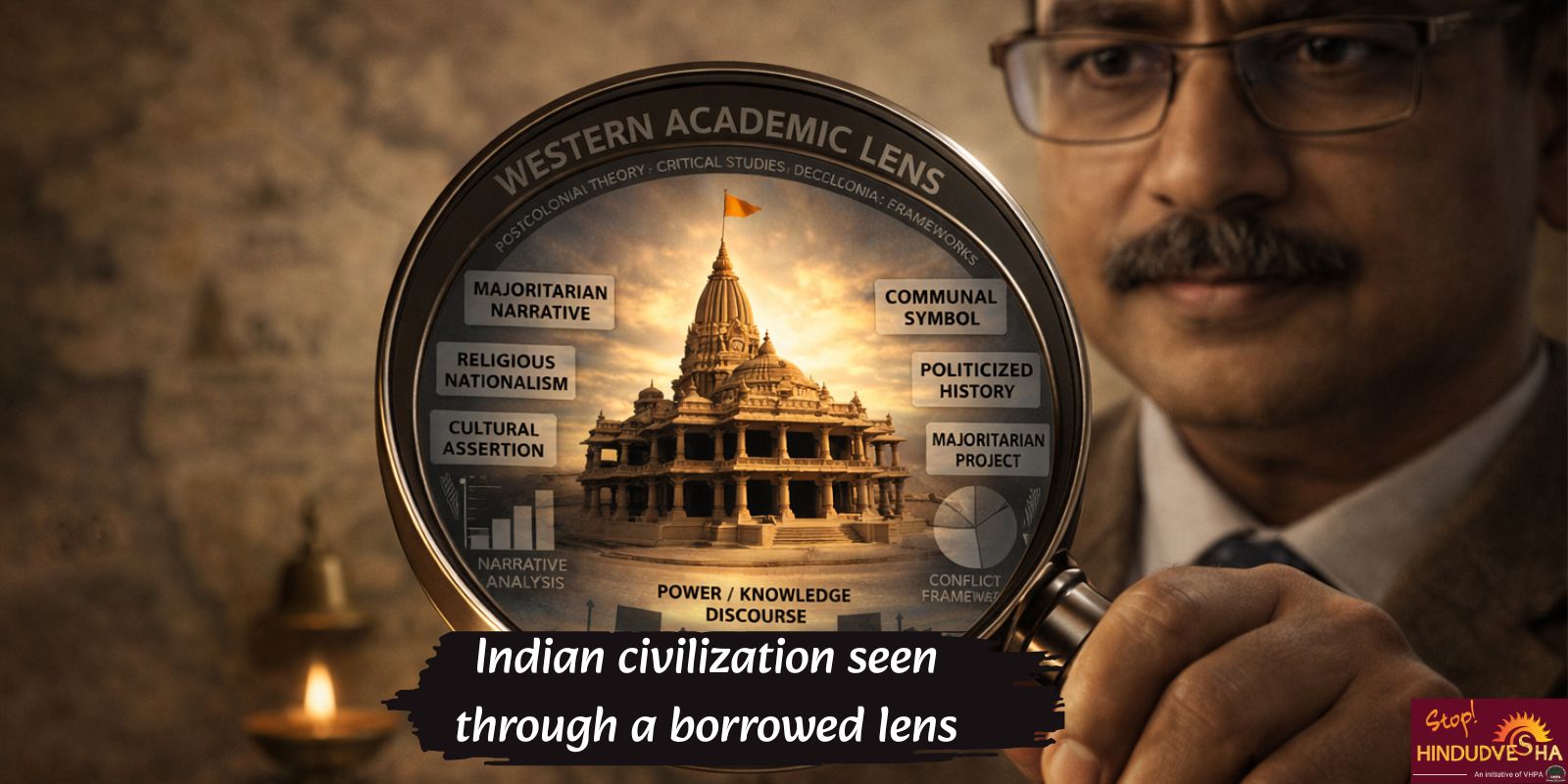
Summary
This article argues that the academic study of Hindutva has been shaped largely by Western frameworks that often misinterpret Hindu civilizational revival as ethnonationalism. It contends that Indian universities have replicated these frameworks without much scrutiny, sidelining indigenous perspectives rooted in Dharma, history, and cultural continuity. As a result, Hindu assertion is frequently analyzed in isolation from the historical experiences, including invasions, temple desecration, and Partition, that inform it. The article highlights how curricula, funding incentives, and global academic networks reinforce these biases. It warns that such distortions weaken indigenous scholarship, narrow academic inquiry, and deepen social polarization. The proposed remedy is not rejection of critique, but the development of intellectually rigorous, civilizationally grounded frameworks for studying Hindutva.
In recent decades, the academic study of Hindutva has been shaped less by India’s own civilizational ideas and more by frameworks developed in Western universities. These approaches, rooted in colonial Indology, orientalist scholarship, postcolonial theory, critical race discourse, and security studies, often interpret Hindu revivalist thought not as a natural response to historical disruption, cultural loss, or a sense of continuity, but as a form of ethnonationalism [1]. Within this lens, expressions of Hindu self-assertion are frequently portrayed as majoritarian aggression, temple restoration as an act of symbolic domination, and civilizational memory as ideological extremism.
The issue, however, is not limited to the West. A more immediate and less examined concern lies within India itself: many Indian universities have begun to replicate these same Western frameworks. Instead of developing approaches rooted in the subcontinent’s own civilizational, historical, and philosophical context, they have often adopted concepts shaped in entirely different intellectual settings. The result is a striking reversal: a native phenomenon is increasingly explained through external lenses, while indigenous ways of understanding are pushed aside, dismissed, or oversimplified.
This article argues that Indian universities have done more than borrow from Western “Hindutva studies”; they have absorbed and repeated its underlying biases. In the process, they risk weakening objective scholarship, eroding cultural self-understanding, and contributing to a broader confusion in how Hindu civilizational resurgence is studied. The concern here is not about whether Hindutva should be critiqued. Any ideology or historical movement must remain open to examination. The real question is whether that examination is being carried out with intellectual fairness and rooted understanding, or whether it is still shaped by inherited assumptions that present themselves as neutral but are not.
The Western Construction of Hindutva as an Academic Object
To understand why Indian universities often repeat distorted models of Hindutva studies, it is important to first look at how these ideas developed in the West. The academic framing of Hindu political and cultural revival did not emerge on its own. It grew out of an intellectual tradition that treated India as something to be classified and explained through outside categories.
Colonial-era scholarship played a major role in this. While it produced valuable linguistic and textual studies, it also tried to fit Indian traditions into European frameworks that often missed their internal logic [2]. Hindu traditions were broken into abstract texts, forced into rigid categories, or judged using Abrahamic ideas of religion, community, and law. In the process, the lived continuity of Dharma was often reduced to labels such as caste oppression, ritualism, or myth [3]. As a result, Hindu self-renewal was not seen as a natural civilizational process, but as something unstable that needed reform or control.
Over time, this approach evolved into newer academic styles. In contemporary Western scholarship, Hindutva is often compared to European fascism, racial supremacy, or religious nationalism. These comparisons are not always based on careful analysis. Instead, they often reflect a tendency to fit very different historical experiences into familiar Western frameworks. As a result, complex developments rooted in India’s own history, including invasions, temple destruction, colonial rule, and partition, are simplified into broad labels like right-wing extremism.
This leads to several distortions [4]. First, Hindutva is separated from indigenous ideas such as Dharma, sacred geography, civilizational continuity, and collective memory. Second, Hindu identity is viewed mainly as a form of power, rather than as a way of belonging shaped by centuries of adaptation and survival. Third, efforts at cultural recovery, such as restoring temples or reviving traditions, are often treated with suspicion. In this view, the assertion of Hindu identity appears threatening, while the historical experiences behind it receive far less attention.
Another important issue is how historical injury is handled. While scholars readily dissect expressions of Hindu assertion, they are far less inclined to examine with equal depth the historical wounds that inform those expressions. For example, temple desecration in the medieval period is sometimes acknowledged but then minimized or heavily qualified. Yet even scholars who challenge exaggerated claims do not deny that such destruction took place in certain contexts. Research, including work by Richard M. Eaton, has documented patterns of temple desecration under some Indo-Muslim rulers, and later scholarship has treated this as a serious historical issue rather than a mere myth [5].
The issue, then, is not just about denying facts, but about an imbalance in how they are interpreted. When Hindu memory recalls desecrated temples, disrupted sacred spaces, and damaged institutions, parts of Hindutva scholarship often respond by questioning that memory itself, rather than examining the events behind it. The result is a reversal: the memory of injury is scrutinized, while the injury itself fades into the background. Over time, a historical wound is treated less as something to be understood and more as something to be explained away.
Partition offers another clear example. The division of India in 1947 led to widespread violence and one of the largest forced migrations in history, with Hindus and Sikhs leaving what became Pakistan, and Muslims moving from parts of North India. Historians widely recognize Partition as a defining trauma of the subcontinent. Yet in many discussions of Hindutva, references to Partition are often viewed with suspicion when invoked by Hindus, rather than being treated as a serious historical experience that deserves careful reflection [6].
This matters because no movement can be properly understood if the experiences that shape its memory are set aside when they become uncomfortable. When scholarship treats Hindu recollection of Partition mainly as a warning sign, without asking what lies behind that memory, it risks moving away from genuine historical inquiry and toward managing or dismissing that memory altogether.
In this sense, the Western academic approach does more than critique Hindutva; it often begins by treating it as a problem. It approaches Hindu resurgence with a degree of built-in suspicion, selects evidence through that lens, and then presents its conclusions as objective. The result is not neutral scholarship but an interpretive framework in which the conclusion is assumed from the start.
From Colonial Knowledge to Postcolonial Repetition in India
One of the striking ironies of post-independence India is that political freedom did not lead to a similar shift in academic thinking. While colonial rule ended, many of the intellectual frameworks used to understand India remained shaped by colonial-era assumptions. This was especially visible in the humanities and social sciences, where Western theories came to dominate, often without questioning their underlying worldview [7].
After independence, the university system was strongly influenced by Nehruvian secularism and Marxist historiography. Both, in different ways, were uneasy with forms of Hindu self-expression rooted in civilizational identity. Nehruvian secularism often saw explicit Hindu language as politically awkward or potentially divisive in a modern nation. Marxist approaches, on the other hand, focused on material and class-based explanations, treating Hindu memory and revival more as ideology than as responses to historical experiences such as conflict, invasion, or cultural loss.
In this environment, Hindutva was rarely studied as a native development emerging from India’s own historical consciousness. Instead, it was often framed as a departure from a secular norm, a communal distortion, or a local version of authoritarian nationalism. In effect, Indian academia adopted the Western tendency to view Hindu resurgence with suspicion but did so within the very society where that resurgence originated.
This pattern is also visible in how certain events are discussed. Take the exodus of Kashmiri Pandits. Even recent scholarship acknowledges both the scale of their displacement and the long-term uncertainty faced by the community. Yet in broader discourse, this episode is often unevenly treated. When it is discussed, it may be viewed less as a humanitarian and civilizational tragedy and more as a politically charged narrative that invites skepticism [8].
Such imbalances have wider consequences. They can create a sense that Hindu experiences of loss must be expressed cautiously, or only within certain accepted frameworks. At the same time, they reinforce a broader habit of treating Hindu memory as inherently ideological, while extending greater empathy to other forms of historical suffering.
This process did not happen through a single decision or policy. It developed gradually through academic practices such as curriculum design, hiring, research priorities, and citation patterns. Many scholars trained in Western institutions brought back established theoretical models and applied them to Indian contexts with little adjustment. Partnerships with global academic networks and the desire for international recognition further encouraged the use of these frameworks. Over time, the study of Hindutva in India became increasingly shaped by external concepts, even while being locally situated.
The result is a clear imbalance. Frameworks drawn from secular, Marxist, liberal, postcolonial, and critical theory traditions are often treated as objective and universal. By contrast, approaches rooted in Dharmic or civilizational perspectives are more likely to be dismissed as biased or political. In this way, Indian academia can present itself as neutral, while sidelining the very frameworks that might help explain Hindu civilization on its own terms.
Mechanisms of Replication in Indian Universities
The adoption of Western frameworks in India has not happened by accident. It has taken shape through several reinforcing processes within the academic system.
Faculty Formation and Academic Socialization
A large part of India’s academic culture has been shaped by scholars trained in Western institutions, or by those working within frameworks developed and validated there. This, in itself, is not a problem. Cross-cultural exchange can strengthen scholarship. The issue arises when these borrowed frameworks begin to carry unquestioned authority.
Scholars trained in areas such as race theory, fascism studies, settler colonialism, or religious nationalism often approach Indian subjects using the same lenses. When applied to Hindu civilizational expression, these frameworks can reshape what they describe. A concept rooted in sacred geography may be reframed as “majoritarian territoriality.” Civilizational memory may be reduced to “mythic nationalism.” Temple restoration may be described as “symbolic violence.” In each case, the framework not only interprets the phenomenon; it also alters its meaning.
Curriculum and Syllabus Construction
University curricula play a central role in shaping how students understand complex issues. In many institutions, readings on Hindu nationalism are drawn largely from scholars who approach the subject with skepticism, with limited representation of civilizational perspectives or traditional voices [9]. As a result, students often encounter Hindutva through the lens of its critics from the outset.
There is relatively little emphasis on engaging with the internal language, historical context, or philosophical ideas that inform Hindu self-expression. This creates a one-sided academic environment. Students are introduced to Hindutva as a subject already defined, rather than one to be explored from multiple angles.
Over time, this leads to a kind of intellectual conditioning. Hindu revival is frequently framed in terms such as danger, exclusion, or regression. Few students are encouraged to question whether these categories are sufficient or whether the frameworks themselves may carry historical or ideological biases.
This imbalance becomes clearer when one considers what is often left out. While university syllabi do include widely cited works by scholars such as Jyotirmaya Sharma and Christophe Jaffrelot, the broader question remains: are students also exposed to the historical experiences that shaped Hindu political consciousness? Do they study episodes such as temple desecration, the trauma of Partition, the long-standing dispute over Ayodhya, or the displacement of Kashmiri Pandits as part of the background [10]?
Without this context, education risks becoming selective. Students learn to identify “majoritarianism” before they fully understand the historical experiences that may have shaped certain forms of assertion. It equips students to recognize expressions of power, but not always to examine the deeper historical layers from which those expressions may emerge.
Research Funding and International Collaborations
A similar pattern appears in global academic and institutional discussions. Some contemporary reports in the West describe Hindutva as a “transnational far-right ideology” or a threat to pluralism and academic freedom. Whether one agrees with these assessments or not, the imbalance is noticeable. Considerable attention is given to the perceived risks of Hindu assertion, while far less focus is placed on the historical experiences, such as temple destruction, civilizational disruption, refugee trauma, or displacement, that shape how many Hindus understand themselves.
This creates a deeper problem. Hindu responses are often studied in isolation, without examining the conditions that produced them [11]. The result is not just a political gap, but an intellectual one.
Academic research is also shaped by incentives. Funding, international partnerships, conferences, and publication networks tend to favor certain themes [12]. When Hindutva is widely recognized in global academia through frameworks like democratic decline, majoritarian politics, or extremism, scholars are more likely to work within those categories. Such work gains more visibility, travels more easily across institutions, and aligns with established conversations.
Over time, this produces a subtle pressure. Research that highlights indigenous frameworks, civilizational memory, or historical trauma, or that views Hindu resurgence as a form of restoration rather than dominance, may receive less attention or be seen as less rigorous. Gradually, what gets funded, published, and cited begins to shape what is considered acceptable or even possible to study.
Textbooks and Public Knowledge
These academic patterns do not stay confined to research. They influence textbooks, classroom teaching, media narratives, and public debate. When historical accounts downplay civilizational conflict while emphasizing the risks of Hindu assertion, they shape how entire generations understand the past. Over time, this can lead to a situation where the majority memory is treated with suspicion, and expressions of grievance are seen as inherently problematic.
This is especially clear in discussions around Ayodhya. For many years, the issue was often presented in elite discourse mainly as a case of religious mobilization, with a focus on why it became politically significant. But legal proceedings and the final judgment by the Supreme Court of India show that the case involved long-standing claims over a site regarded as sacred by Hindus, along with archaeological considerations pointing to an earlier non-Islamic structure beneath the mosque. One need not agree with every political position associated with Ayodhya to recognize that the issue cannot be reduced to a simple example of communal politics [13].
When teaching presents it only as “majoritarianism,” without addressing sacred geography, continuity of worship, and historical memory, it risks creating the very distortion it seeks to critique.
The Dangers of Replicating Distorted Frameworks
The adoption of Western models to study Hindutva in Indian universities is not just an academic issue. It has broader consequences for scholarship, society, and public institutions.
Erosion of Indigenous Scholarship
The most immediate impact is intellectual. When Indian academia studies its own civilizational realities through external frameworks, it limits the space for genuinely indigenous scholarship. Hindutva, whatever one’s political view of it, is shaped by India’s history, sacred geography, collective memory, and long experiences of disruption and renewal. Interpreting it only through borrowed concepts separates it from these roots.
This creates a form of intellectual dependency. The result may gain international visibility, but at the cost of accurately understanding indigenous realities.
Social and Cultural Fragmentation
Academic narratives do not stay confined to classrooms. They influence how society at large understands identity and history. When Hindu identity is repeatedly framed as inherently threatening, even ordinary expressions such as festivals, temple activities, or cultural pride can begin to be viewed with suspicion.
This can deepen mistrust. Minority concerns may be shaped more by simplified portrayals than by nuanced understanding, while many Hindus may feel that their experiences are being misrepresented or dismissed. Instead of encouraging dialogue, this dynamic can harden positions on both sides and make meaningful engagement more difficult.
Suppression of Free Inquiry
A healthy academic space depends on the coexistence of multiple perspectives. However, when only one set of frameworks dominates, other approaches may be sidelined. Scholars or students who explore topics such as temple desecration, civilizational memory, or indigenous concepts of society may find their work dismissed before it is fully considered.
This can lead to self-censorship. The issue is not that ideas are debated or criticized, which is essential in academia, but that some lines of inquiry are discouraged from the outset. In such cases, academic openness may exist in principle, while in practice the range of acceptable debate becomes narrower.
Legal and Policy Consequences
These patterns can also influence how religion is approached in law and policy. For example, research on temple administration has pointed to the significant role of the state in managing many Hindu temples through legal and administrative mechanisms. While there are debates about the need for such oversight, the issue raises a broader question: why are concerns about institutional imbalance often dismissed, even when acknowledged in scholarship [14]?
The concern is not that all such claims should be accepted without question, but that they should be examined fairly. If certain perspectives are treated as inherently suspect, it becomes difficult to maintain a sense of neutrality.
Academic ideas often shape public policy, governance, and legal thinking. If Hindutva is consistently framed as a threat to pluralism, policies related to religious institutions, education, and public life may be influenced by that assumption. This can create uneven standards, where some forms of identity expression are viewed with caution while others are approached more sympathetically.
Over time, such imbalances can weaken trust in institutions. More importantly, they can affect how pluralism itself is understood. A stable plural society requires that all traditions, including those of the majority, are engaged with fairly. When one tradition is treated as uniquely problematic, the language of pluralism risks becoming unevenly applied.
Civilizational Consequences
A civilization is not harmed only by physical destruction; it is also weakened when its memory is reshaped or diluted. When temple desecration is acknowledged but stripped of moral weight, when Partition is recorded but not treated as a deep civilizational trauma, when the Kashmiri Pandit exodus is mentioned yet kept at a distance, and when sacred sites are discussed without reference to lived memory, the result is not balanced scholarship. It becomes a form of managing memory rather than understanding it.
At a deeper level, the repeated use of external frameworks in Indian academia creates a form of intellectual dislocation. It encourages Indians to view their own traditions through categories that did not arise from their civilizational context and often fail to capture its internal logic. A civilization with rich traditions in philosophy, law, ethics, and spirituality is then interpreted through lenses that only partially understand it.
This is not just an academic issue. When a society loses confidence in its own ways of understanding itself, intellectual dependence can continue even after political independence.
Why This Replication Persists
If these distortions are visible, why do they continue?
One reason is institutional continuity. Academic systems tend to reproduce themselves. Hiring practices, mentorship, peer review, and citation networks often reinforce existing frameworks. Younger scholars quickly learn which approaches are rewarded and which carry risks, and this shapes their choices.
A second reason is the prestige attached to Western academia. In many postcolonial contexts, ideas developed in Western institutions are seen as more rigorous or globally relevant. Indigenous frameworks, by contrast, may be viewed as limited or insufficiently theoretical. This imbalance sustains reliance on imported concepts.
A third factor is ideological alignment. For some scholars, critical approaches to Hindutva are not only academic but also political. Established Western frameworks provide a ready vocabulary that aligns with these positions, making them easier to adopt and reproduce.
Finally, alternatives remain underdeveloped. India has not invested enough in institutions that systematically develop civilizational or Dharmic frameworks of analysis. In the absence of strong alternatives, existing models continue to dominate.
Toward an Indigenous Framework for the Study of Hindutva
Addressing these issues does not mean replacing one rigid framework with another. It calls for a more grounded and balanced approach.
A first step is to take Indian categories seriously. Hindutva should be examined in relation to concepts such as Dharma, sacred geography, civilizational continuity, and historical memory, rather than only through modern political labels. This does not prevent critique; it ensures that critique is informed by a deeper understanding.
Universities can also broaden their intellectual environment. Including historians, philosophers, Sanskrit scholars, and traditional thinkers alongside contemporary theorists would create a more balanced academic space. Engaging with indigenous perspectives should be seen as part of rigorous scholarship, not as a departure from it.
Institutional development is equally important. Dedicated centers for civilizational studies, Dharmic political thought, temple history, and colonial knowledge systems could help build stronger frameworks rooted in Indian realities. These institutions should aim for depth and rigor, avoiding both uncritical praise and reflexive rejection.
Public awareness also plays a role. The language used in academic and public discussions shapes how a civilization is understood and judged. Recognizing this helps ensure that debates are informed, rather than driven by inherited assumptions.
Concluding Remarks
A central concern in much of Hindutva scholarship is not simply that it critiques Hindu assertion, but that it often does so after downplaying or sidelining the historical experiences that give that assertion meaning.
The continued reliance on Western frameworks in Indian universities reflects a deeper challenge within postcolonial academia. A phenomenon rooted in India’s own civilizational experience is frequently interpreted through categories that do not fully capture its context. Over time, what began as an external perspective has become widely accepted within India itself.
The effects are significant. Indigenous scholarship is constrained, public discourse becomes more polarized, academic debate narrows, and civilizational self-understanding weakens. In some cases, scholarship risks presenting itself as neutral while operating within fixed assumptions.
Addressing this does not require rejecting criticism. It requires ensuring that criticism is grounded, balanced, and open to multiple frameworks. A more complete academic approach would allow India to study its own traditions with both rigor and intellectual independence.
Citations
[1] Edward W. Said, Orientalism; https://monoskop.org/images/4/4e/Said_Edward_Orientalism_1979.pdf
[2] S. N. Balagangadhara, The Heathen in His Blindness; https://www.researchgate.net/publication/394255747_The_Heathen_in_His_Blindness
[3] Nicholas B. Dirks, Castes of Mind: Colonialism and the Making of Modern India; https://archive.org/details/castesofmindcolo0000dirk
[4] Ronald Inden, Imagining India; https://archive.org/details/imaginingindia0000inde/page/n7/mode/2up
[5] Richard Eaton – Islam in India; https://www.youtube.com/watch?v=romOBHXl8yE
[6] MAKING REFUGEES IN INDIA; https://ora.ox.ac.uk/objects/uuid:a2d3b740-3036-4a24-a1ad-8a10fddb8a88/files/md58379cdab32ed2f49e0c25d0cb20bc9
[7] Partha Chatterjee, Nationalist Thought and the Colonial World: A Derivative Discourse; https://archive.org/details/nationalistthoug0000chat
[8] The Kashmiri diaspora remembers the displacement: Implication and the challenge of healing – Aditi Razdan, 2024; https://journals.sagepub.com/doi/10.1177/17506980241243236
[9] Christophe Jaffrelot, The Hindu Nationalist Movement and Indian Politics; https://archive.org/details/hindunationalist00chri
[10] Asthan City Oudh vs Secretary Of State Of India, Court on 18 March, 1889; https://indiankanoon.org/doc/1916921/
[11] Sovereign Violence: Temple Destruction in India and Shrine Desecration in Iran and Central Asia | Comparative Studies in Society and History | Cambridge Core; https://www.cambridge.org/core/journals/comparative-studies-in-society-and-history/article/abs/sovereign-violence-temple-destruction-in-india-and-shrine-desecration-in-iran-and-central-asia/4E41C52D49B9ECA9678B60AC28AF81E0
[12] Rutgers Center for Security, Race and Rights, “Hindutva in America: A Threat to Equality and Religious Pluralism” (2025); https://csrr.rutgers.edu/issues/hindutva-america/
[13] Bhagwan Sri Rama Virajman At Sri Rama vs Sri Rajendra Singh; https://indiankanoon.org/doc/1692753/
[14] Trustee, State and Stakeholder: Hindu Temple Management in Contemporary India, 1957–2012 – Tetsuya Tanaka, 2020; https://journals.sagepub.com/doi/10.1177/0260107919875590

Donate to HINDUDVESHA
Our Mission is to explore and expose Hindudvesha through research analysis, education and response.
SUPPORT US