

The Parsi Experience: Armaity Ghasvala on India’s Inclusivity
 Dr. Jai G. Bansal · 08/01/2024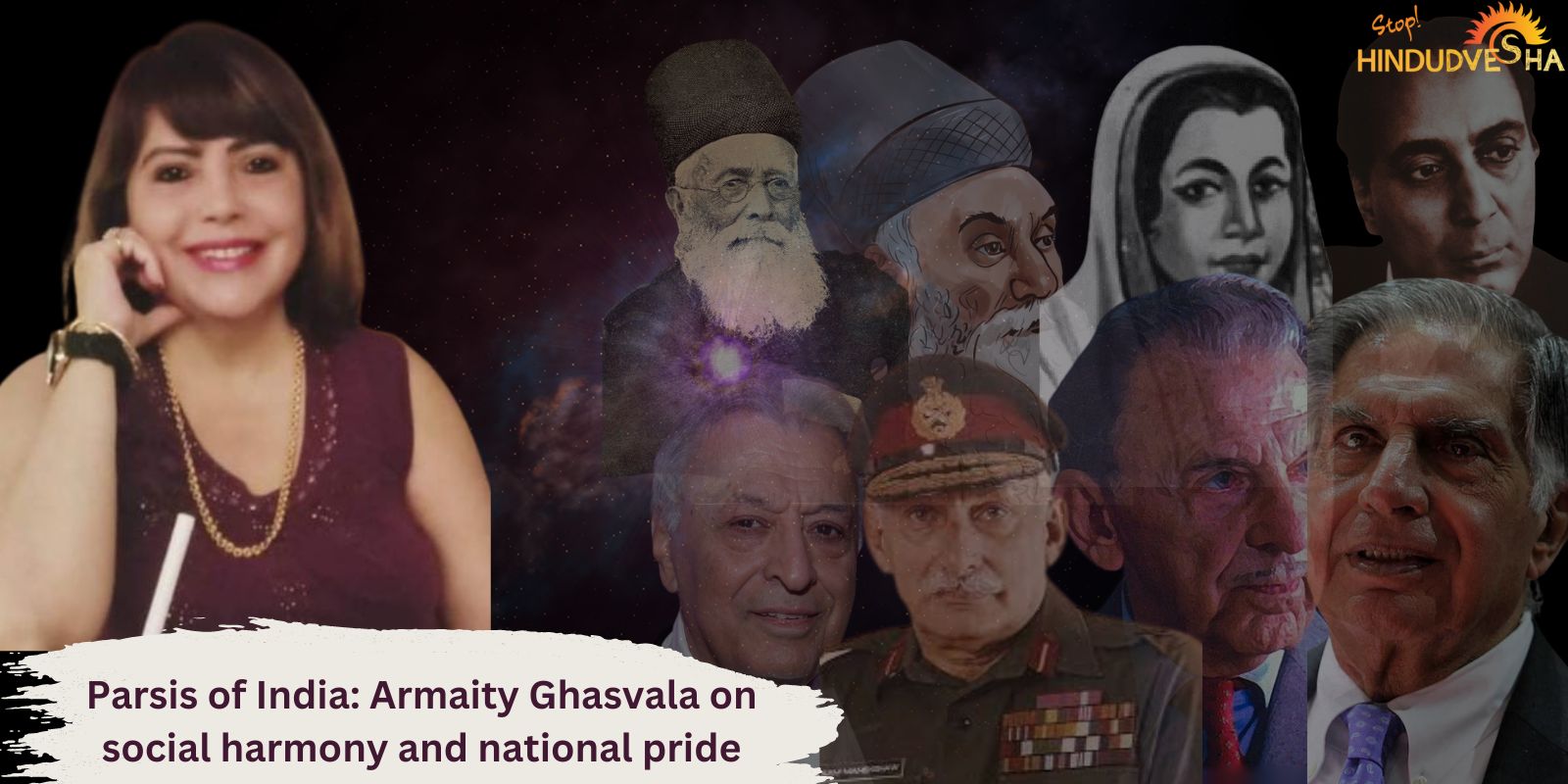
- Armaity Ghasvala shares her upbringing in Navsari, a culturally significant place for the Parsi-s, and her connection to the Parsi community’s traditions and values.
- She recounts the Parsi migration from Persia to India, their harmonious integration into Indian society, and the mutual respect with the Hindu majority.
- Ghasvala provides insights into the Parsi community’s beliefs and practices, emphasizing their societal integration and cultural influence.
- She discusses the positive social reception of the Parsi community in India, highlighting the respect and acceptance they have received from the broader society.
- Reflecting on India’s economic progress and cultural awakening, Ghasvala expresses optimism about the country’s future and the Parsi community’s continued role in its development.
This article is based on an interview on our Dharma Explorers platform with an Indian Zoroastrian (aka Parsi) lady, Armaity Ghasvala Dumasia. She is a homemaker and a married woman raising a daughter in the bustling metropolis of Mumbai. She belongs to one of India’s smallest minorities, the Parsi community. As such, her views represent the perspectives of two important constituencies. First, as a member of the Parsi community, a highly successful minority that has coexisted with the Hindu majority for the last 1,300 years. Second, as a homemaker dealing with life challenges on a daily basis, she is highly attuned to the societal changes affecting ordinary people.
A complete video recording of the interview can be accessed here.
Let’s start with your life story. Can you tell us about your upbringing, where you were born, your family, the community you were raised in, and your education?
I was born and raised in a place called Navsari in Gujarat, which is also known as ‘Dharm ni Tekri’ (Hill of Religion). It’s a sacred place for Parsis, with one of the eight major fire temples in India located there. I completed my schooling in Navsari before moving to Mumbai. Navsari has a significant Parsi community and is considered a central place for us. Growing up in such a culturally rich environment deeply influenced me. Now, while a resident of Mumbai, I still feel a strong connection to my roots in Navsari.
How large is the Parsi community, and what are some of its beliefs and social and religious practices?
Mumbai has a number of Parsi colonies. Indian Parsi community is only about 65,000 strong and is spread across India, with a significant presence in Gujarat. We worship fire and revere natural elements like the sun and water. There are eight major fire temples in India, including four in Mumbai, one in Navsari, two in Surat, and one in Udwada, Gujarat. In addition to these, there are many smaller fire temples across the country. While there are only a few thousand Parsis in Mumbai, our community is also present worldwide, including in the UK, USA, and many other places, making our cultural influence global.
Could you share some information about the history of the Parsi community in India, including where they came from, how and why they migrated, and how they were received by the local rulers and society?
Our ancestors originally lived in Persia, where they practiced Zoroastrianism. When the Arabs invaded in the eighth century, and it became impossible to stay without converting, they decided to leave. After facing many struggles, they arrived on the shores of Diu in Gujarat, near Ahmedabad. From there, they moved to Sanjan, where they sought refuge from the local Rajput king, Jadi Rana. The king initially said his land was full, but our ancestors requested a bowl of milk to explain their intention. When the milk was brought in, they added sugar to it, showing how the sugar dissolved and sweetened the milk. This symbolized how they would integrate into the community without causing disruption, adding value instead. The king was impressed and gave them land to live on. It was our good fortune to have come to this beautiful and hospitable land where we could secure our future. The integration of the Parsis into Indian society has been a harmonious and enriching journey, and we have thrived while contributing significantly to our adopted homeland.
How has the Parsi community been received socially, considering you are a small group with distinct social practices and belief systems living within a predominantly Hindu community?
The people of India have been incredibly kind to us, and this land has given us everything we could ask for.
The people of India have been incredibly kind to us, and this land has given us everything we could ask for. The simple truth is that when you are nice to someone, they are nice to you in return. There’s a proverb that says, “Respect and love the country you live in, or live in the country you love and respect.” I truly love India. We have been given everything here, and we are deeply grateful for it. We have no complaints at all.
What notable individuals from the Parsi community are known for their success and progressiveness, and what are some of their significant accomplishments?
The Parsi community has always contributed significantly to India. You’ve probably heard of Dadabhai Naoroji, the first to hoist the Indian flag on foreign soil, and Field Marshall Sam Manekshaw, a celebrated military leader. Many Parsis have served in the Air Force and Navy. Homi Bhabha was a prominent scientist, and during the COVID-19 pandemic, Adar Poonawalla played a crucial role. Of course, Ratan Tata and the Tata family, including JRD Tata, are well-known for their contributions. Despite our small size, we live by the motto of good thoughts, good words, and good deeds, giving back to this land that has given us so much.
Considering that India has historically been a sanctuary for many communities, such as the Parsis in the seventh century, Jews even earlier, and the Baha’i around 200 years ago, all of whom have thrived, why do you think the Muslim and Christian communities often claim persecution despite their growing numbers, while smaller communities like yours have thrived without such complaints?
India is the world’s largest democracy, and I proudly say that I live in a free country.
India has indeed provided refuge to many communities, including the Chinese. Personally, I have never felt any fear in this country. I can’t speak for the communities you mentioned, but my experience has been very positive. India is the world’s largest democracy, and I proudly say that I live in a free country. People here are free to express their opinions on platforms like Facebook, Twitter, and Instagram. They can criticize even the most prominent personalities without fear of repercussion. It puzzles me when some claim they are scared or persecuted, as my experience has been quite the opposite.
India is a hospitable and wonderful country with a thriving democracy. While some people may complain when things don’t go their way, this doesn’t reflect the reality for most of us. We should appreciate the freedoms we have rather than constantly complaining. In my view, India allows its citizens to live with a sense of security and freedom. I have never felt suppressed or threatened here, and I believe that this is true for others as well.
What are your thoughts on the prevailing media narrative, both in India and the West, that democracy in India is being undermined and the country is slowly moving towards becoming a Hindu Rashtra?
If India is indeed moving towards a Hindu Rashtra, I don’t see why that should be problematic. There are numerous Islamic countries, Christian countries, Buddhist countries, and even a Jewish country. So why not a Hindu country? Why is this a problem? When living as a minority, it’s important to be respectful and kind to the majority. If you go against everyone, naturally, you’ll face pushback.
India is a great country—a hospitable and wonderful country with a thriving democracy. There are always some people who will complain when things don’t go their way, but that doesn’t reflect the reality for most of us. Sometimes, it’s best to ignore these voices and focus on the broader picture.
There are journalists who constantly criticize the government and the country. I often ask them, considering the way they freely express their views on platforms like Facebook and Twitter, if India were a dictatorship, would they be able to write and speak as they do? The answer is clearly no. In a dictatorship, such actions would have severe repercussions. Everyone in India has the liberty to express their opinions, yet some keep complaining. They criticize even the top political leadership without fear of repercussions and then claim there is no freedom. This doesn’t make sense to me.
India is a great country—a hospitable and wonderful country with a thriving democracy. There are always some people who will complain when things don’t go their way, but that doesn’t reflect the reality for most of us. Sometimes, it’s best to ignore these voices and focus on the broader picture.
India allows its citizens to express themselves openly without fear. We should appreciate the freedoms we have rather than constantly complaining. This is a country where democracy thrives, and people live with a sense of security and freedom. The idea that India is moving towards a Hindu Rashtra doesn’t threaten the essence of our democratic and inclusive society. Instead, it reaffirms the cultural identity of the majority while respecting the rights of minorities.
So, are you saying that if India were ever to become a Hindu Rashtra, the Parsi community would not feel threatened?
Mrs. Smriti Irani (an Indian cabinet minister and a Hindu by birth), despite being married to a Parsi, still respects our rule by praying outside our most sacred site. Even Prime Minister Modi respected this tradition by praying outside the fire temple during his visit!
When we were uprooted from Persia (modern-day Iran), we found shelter in this most hospitable and lovely country. Despite being a small community, our customs and rules have been respected for the last 1300 years. For instance, we have a rule that only Parsis are allowed inside our fire temples, a rule that has been honored by everyone. Mrs. Smriti Irani (an Indian cabinet minister and a Hindu by birth), despite being married to a Parsi, still respects our rule by praying outside our most sacred site. Even Prime Minister Modi respected this tradition by praying outside the fire temple during his visit!
These examples illustrate the deep respect and acceptance we have received. We are truly thankful for the kindness and hospitality of this wonderful country. If India were to become a Hindu Rashtra, I see no issue as long as minority rights are protected. We have always felt safe and respected here, and I believe that spirit will continue.
As a homemaker, how do you perceive the changes taking place in society—economically, in terms of respect on the world stage, and social awakening? Could you please share your thoughts on these changes and how they affect you?
The whole world now recognizes that India is the fastest-growing economy and nation. In the next five years, India will continue to advance, becoming a central hub for the world. Our economic growth has been remarkable, and we are very happy with the progress. The inclusive development under “Sabka Saath, Sabka Vikas” has been wonderful. The nation has made so much progress in the last decade that it would take pages to describe all the accomplishments. India’s growth story is truly impressive, and the future looks even brighter.
India’s economy is booming, and its global standing has significantly improved. We are experiencing a social awakening, and people are more aware and prouder of their cultural heritage. These changes are positively shaping our nation’s future. As a homemaker, I see these developments as very promising and am optimistic about where India is headed.
Does the growing awareness and pride within the Hindu community, which makes up about 80% of the population, regarding their civilizational values and narratives bother or threaten you in any way?
On the contrary, I’m happy. It’s high time! If they’re right, this is their country, their soil, and they have the right to express their pride. Why not?
What would you say to the Western press, which often criticizes the resurgence of Hindu ideas and civilization and writes negative narratives, especially in light of the recent inauguration of the Ram Mandir in Ayodhya and ongoing efforts to recover other religious sites like Kashi Vishwanath and Mathura?
We are extremely happy that Ram Mandir was built, and similar developments at other temples are also part of our destiny. Nobody can stop this progress. Let people write what they want. If India is moving forward as a nation, nothing can hinder it. It’s our time now.
Before we close the session, is there any parting message you would like to give our audience?
I would like to tell all the viewers worldwide that India is the largest democracy in the world. We are absolutely free, there is no fear, and nothing is being suppressed. We are extremely happy, so please don’t worry about us. We are doing just fine, thank you.
Thank you!

Donate to HINDUDVESHA
Our Mission is to explore and expose Hindudvesha through research analysis, education and response.
SUPPORT US