

The Pakistan Within – Why Indian Muslims Are Chronically Separatist
 Rakesh Krishnan Simha · 03/24/2025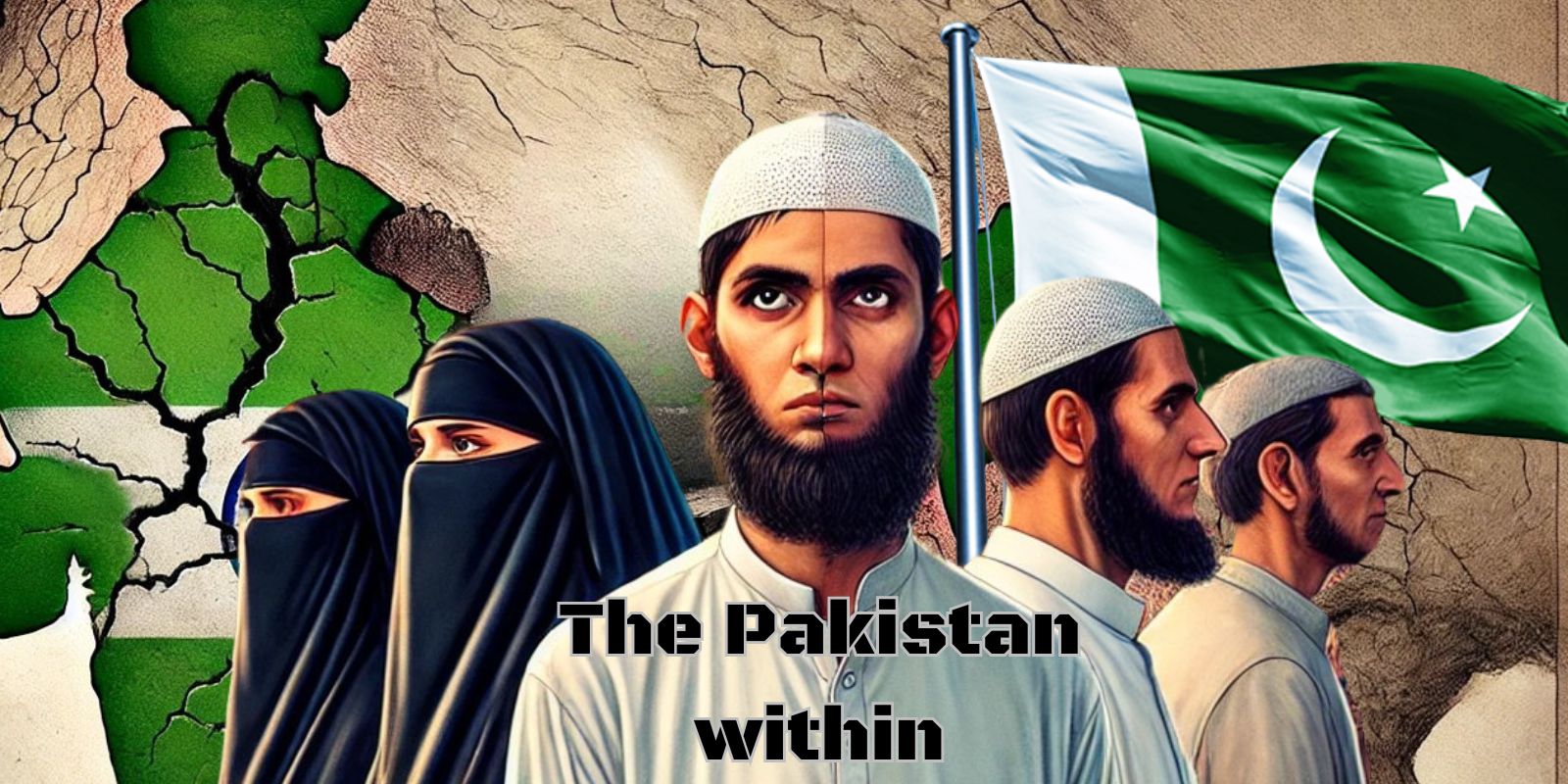
- Muslim separatism in India dates back to the decline of the Mughal Empire and was formalized by thinkers like Syed Ahmed Khan and Muhammad Ali Jinnah through the two-nation theory.
- Incidents of violence, such as attacks on Indian victory parades and Hindu religious figures, suggest a deepening disconnect between segments of the Muslim community and Indian national identity.
- Many Indian Muslims are seen to identify more with Arab, Persian, or Turkish culture than with India’s indigenous heritage, leading to questions about cultural integration.
- Influential Muslim leaders have historically emphasized loyalty to the global Muslim community (ummah) over national identity, fueling suspicion of dual loyalties.
- The article argues that the ideology behind Pakistan persists among Indian Muslims.
Can a Muslim be Indian? Absolutely. There’s nothing preventing Muslims from being loyal, law-abiding citizens of India. But the real question is — do they want to?
Here’s something to think about: Which country does the average Muslim in India support — India or Pakistan? The answer is chillingly clear from the alarming frequency of Muslim attacks on parades celebrating India’s sporting triumphs over Pakistan. But now, their separatism has reached an ominous level. The latest incident occurred on March 9 in Mhow, central India, where Muslims threw stones at a victory parade celebrating India’s ICC Champions Trophy win.[1] Mobs of Muslim rioters burned vehicles and taunted Hindus: “Your car is burning – where is your Ram?”[2] The twist? India wasn’t facing Pakistan — it was New Zealand. This means the Muslims in India are now rooting for anyone but India.
Incidents like these raise concerns about growing divisions and the need for unity and understanding among all communities in India.
But even Hindus, hardened by decades of Muslim attacks on their processions, weren’t prepared for the cowardly plan by Muslims to murder a prominent Hindu lawyer in the town of Sambhal, located three hours east of New Delhi. For those unfamiliar, the 70 percent Muslim-majority town appeared in the national limelight when it was revealed that the local Sambhal Mosque was built on a demolished Hindu temple.[3] This was not acceptable to Muslims, and on November 24, 2024, during the second round of a court-ordered survey of the disputed structure, they threw stones at police, fired on officers, and set vehicles and shops of Hindus ablaze. The chaos left at least 30 police officers injured and four rioters dead.[4]
On February 20, 2025, the local police chief dropped a bombshell — he revealed that what happened on November 24 was not just random violence but a carefully orchestrated attack by Islamic extremists, with the ultimate goal being the murder of Vishnu Shankar Jain, the Hindu lawyer representing the community in a religious dispute over local sites.[5]
The fact is India’s Hindu majority has displayed remarkable patience and restraint in claiming back what belongs to them. The mosques built by Islamic tyrants after demolishing ancient Hindu temples in Hinduism’s holiest cities – Ayodhya, Kashi, and Mathura – are eyesores. Hindus have the numbers to repossess these illegal mosques by force, but being law-abiding people, they have taken the arduous route of litigation, scientific testing, and archaeological and literary verification to support their claims.
However, it is now abundantly clear that the Muslims are not willing to walk the same route. The fact that they sparked a riot and then tried to use that as a cover to ambush and murder a Hindu lawyer – plus his staff, security, and the accompanying media personnel who would have become collateral damage – indicates a new low for Muslims in India. Having attacked Hindus incessantly since 1947, they are now preparing for a violent confrontation against the nation-state.
How it All Started
The separatism of Indian Muslims started when the Mughal Dynasty – the longest-ruling Islamic regime that ruled India – became a vassal of the Maratha Empire in the early 1700s. Nadeem F. Paracha, a cultural critic, and columnist, corroborates that view: “After the complete fall of the Mughal Empire in the 19th century till about the late 1960s, Pakistanis (post-1947) attempted to separate themselves from other religious communities of the region by identifying with those Persian cultural aspects that had reigned supreme in Muslim royal courts in India, especially during the Mughal era.”[6]
There is ample evidence that the Mughal emperors started collaborating with the English invaders to prevent the Marathas, Rajputs, Jats, Sikhs, and other Hindu kingdoms from taking over the country.[7] This was even though the re-establishment of Hindu rule was peaceful, and Muslims lived happily as equal citizens in territories re-conquered by the Hindu kingdoms.
The simple fact is that large sections of subcontinental Muslims are alienated from the land of their birth. A vast majority of them identify more closely with Arab culture—and increasingly with Turkey—than with their non-Muslim fellow citizens. There’s a belief among many that adopting Arabian, Turkish, Persian, or Afghan cultural traits is the path to gaining respect and acceptance within the broader Muslim world. To paraphrase Paracha, Indian Muslims have adopted the cultural dimensions of foreign Muslims such as Arabs, who, ironically, consider them second-class Muslims.
The point is this: A Saudi identifies first as a Saudi. A Jordanian takes pride in being Jordanian. Iraqis often celebrate their connection to the ancient, pre-Islamic Babylonian civilization. Persians honor their non-Muslim ancestors like Xerxes and Cyrus. In contrast, many Muslims from the Indian subcontinent draw their sense of pride not from India’s rich history and heritage but from the wealth of Saudi Arabia, the past glory of the Baghdad Caliphate, and Persian culture—cultures, and histories that are not originally their own.
So, can a Muslim ever be an Indian?
To find the answer, let’s turn to Syed Ahmed Khan, the first person to propose the two-nation theory and who is acknowledged by Muslims of the Indian subcontinent as the father of Pakistan. Khan was the founder of Aligarh Muslim University, which is the fountainhead of Muslim separatism in India. In the year 1881, he said, “I am convinced now that Hindus and Muslims could never become one nation as their religion and way of life was quite distinct from each other.”[8]
During a speech on March 14, 1888, Khan said: “You must remember that although the number of Mahomedans is less than that of the Hindus, and although they contain far fewer people who have received a high English education, yet they must not be thought insignificant or weak. Probably, they would be by themselves enough to maintain their own position. But suppose they were not. Then our Mussalman brothers, the Pathans, would come out as a swarm of locusts from their mountain valleys and make rivers of blood flow from their frontier in the north to the extreme end of Bengal.”
In the same speech, he stated, “Now, suppose that the English community and the army were to leave India… who then would be the rulers of India? Could two nations — the Mohammedans and the Hindus — sit on the same throne and remain equal in power under these circumstances? Most certainly not. One of them must conquer the other. To hope that both could remain equal is to desire the impossible and the inconceivable. But until one nation has conquered the other and made it obedient, peace cannot reign in the land.”
Muhammed Ali Jinnah took Khan’s violent ideology to its logical conclusion when he demanded Pakistan, saying, “Hindus and Muslims belong to two different religious philosophies, social customs and literary traditions. They neither intermarry nor eat together, and indeed they belong to two different civilizations which are based mainly on conflicting ideas and conceptions.”[9]
Contrary to liberal propaganda that belief in the two-nation theory is the exception rather than the rule, the reality is that it is the mainstream view among Muslims in India. Lahore-based F.K. Khan Durrani wrote in his 1944 book “The Meaning of Pakistan” that the Muslims of India must give up their materialistic lifestyle and instead develop “a fierce, fanatical passion for service of our people.” And, he stressed: “Islam and the Muslim nation first, and everything else afterwards. This must now be the attitude of every single Muslim in this country.”[10]
Many leading Muslim leaders across the Indian subcontinent internalized this view. Take Maulana Abul Kalam Azad, who became India’s first education minister. Outlining a view of global Islamism, he declared: “If even a grain of the soul of Islam is alive among its followers, then I should say that if a thorn gets stuck in a Turk’s sole in the battlefield of war, then I swear by the god of Islam, no Muslim of India can be a Muslim until he feels that prick in his heart instead of sole because the Millat-e-Islam (the global Muslim community) is a single body.”[11]
The Maulana again stressed the need for pan-Islamism among Muslims in India: “This biradri (community of Muslims) has been established by God… All relationships in the world can break down but this relationship can never be severed. It is possible a father turns against his son, not impossible that a mother separates her child from her lap; it is possible that one brother becomes the enemy of the other brother… But the relationship that a Chinese Muslim has with an African Muslim, an Arab bedouin has with the Tatar shepherd, and which binds in one soul a neo-Muslim of India with the right-descendant Qureshi of Mecca, there is no power on earth to break it, to cut off this chain…”
Nationalist Muslims
It would, of course, be wrong to describe the entire population of Muslims in India as disloyal or having extra-territorial loyalties. Leaders like the late President APJ Abdul Kalam, Governor Arif Mohammad Khan, and archaeologist KK Muhammed are more nationalist than most Hindus. Even during the Partition crisis, when almost 90 percent of Muslims in India were under the spell of the Muslim League and voted for Pakistan, some remained loyal to India.
For instance, the Raja of Mahmudabad, the Muslim League secretary and Jinnah’s right-hand man for much of the decade before 1947, had never contemplated leaving his native land. Broken by the experience that Partition turned out to be, he resigned from the Muslim League after India’s independence. The party had committed hara-kiri, he said. To keep it alive in India now was a cruel joke. Most of its leaders had run away from India, leaving the Indian Muslims to their fate. These opportunists should now be clear in their minds that they would never be able to mislead the Muslim masses again. “All Indian Muslims would go to war for India, even if they had to go to war against Pakistan,” he said.[12]
Implacable Hostility
Unfortunately, such voices among the Indian Muslim community are rare. In fact, the average Muslim in India looks down upon Kalam because the President used to play the veena (music is haram in Islam) and read the Gita, the holy book of the Hindus.
The mentality that fuels Muslim separatism in India, and exemplified by figures like Maulana Azad, is defined by several key beliefs and attitudes. At its core, this mentality is marked by an unwavering hostility toward Hindus and other smaller religious communities, including Sikhs, Buddhists, Jains, atheists, and Christians. It stems from a belief that India, once part of the Islamic ummah, must be forcibly or demographically reasserted under Muslim control. This vision denies India’s Hindu majority status, refusing to accept the country as a predominantly Hindu nation.
The separatist ideology is further driven by an extreme antagonism toward India’s unity. Proponents of this mentality are willing to go to great lengths, even at the expense of their own well-being, in their pursuit to inflict harm upon India. Their ultimate goal is not just separation but to undermine India’s sovereignty, potentially causing lasting damage in the process. This destructive mindset poses significant challenges to India’s social and political stability, exacerbating tensions and hindering efforts toward national unity and peaceful coexistence.
Back to the Mughal Empire
Pakistan is not a country but a mentality – the mentality of separatism that is the defining characteristic of Muslims in India. Pakistan’s raison d’etre is to re-conquer India. Indian Muslims who moved to Pakistan in 1947 compare their migration with the flight of Mohammed and his followers to Mecca in 622 CE. They also believe that just like the prophet returned victorious to Mecca, the Pakistanis would one day enter Delhi as victors. The narrative in Pakistan is that it is already a rump State – or, as Mohammed Ali Jinnah, the architect of India’s Partition, said, “mutilated, truncated and moth-eaten.”[13] It will be complete only when all of India (and Bangladesh) come under one Islamic flag.
As Durrani put it: “But that India is a geographical unity is also a fact which the Muslims must never forget. There is not an inch of the soil of India that our fathers did not once purchase with their blood. We cannot be false to the blood of our fathers. India, the whole of it, is, therefore, our heritage, and it must be re-conquered for Islam. Expansion in the spiritual sense is an inherent necessity of our faith and implies no hatred or enmity towards the Hindus. Rather, the reverse. Our ultimate ideal should be the unification of India, spiritually as well as politically, under the banner of Islam. The final political salvation of India is not otherwise possible.”[14]
Durrani was abundantly clear about the real purpose of the 60 million Muslims who had been abandoned to their fate in divided India. He observed: “Then there are Muslims who will be left behind in Hindustan after the separate sovereign state of Pakistan has been established. The continued residence of these Muslims in Hindustan, even if they are exposed there to undue hardships, is indispensable for the security and well-being of Pakistan, and the exchange of populations will be harmful not only to Pakistan but also to the ultimate purposes of Islam. All Indian Muslims, whether they live in Pakistan or Hindustan, constitute one nation, and we of Pakistan must always treat our co-religionists in Hindustan as the flesh of our flesh and blood of our blood.”
To translate Durrani, those 60 million Muslims – who have multiplied to around 250 million today – are a fifth column that will weaken India from within and make it easier for Pakistan to conquer it from without.
Conclusion
Among those who understood the mindset of Muslims in India was Rajendra Prasad, who went on to become India’s first President. According to US-based historian Faisal Devji: “Rajendra Prasad, quoting from several books written by Muslim nationalists, shows that none was content to stop at the achievement of an independent state. Instead, they saw Pakistan’s true or ultimate role as the liberation of Muslims oppressed in places like China and Soviet Central Asia, and even to ‘free’ India herself by a process of conversion.”[15]
The simple truth is that Pakistan is India without Islam. Devoid of its vibrant Hindu and Sikh population, the Islamic Republic has become an economic basket case and is known as one of the most dangerous places in the world. It’s a country where poverty and terrorism are ripping apart the fabric of society. Its doppelganger, Bangladesh, is also traveling on the same trajectory toward self-destruction. India must ensure that Muslims are never able to gain control over the levers of power. Otherwise, India will face a civil war that will make Syria, Libya, and Iraq look like a village brawl.
Citations
[1] Madhya Pradesh: CCTV footage from Mhow shows procession to celebrate Indian Champions Trophy win came under attack when they crossed the local mosque (OpIndia); https://www.opindia.com/2025/03/madhya-pradesh-mhow-local-mosque-champions-trophy/
[2] “Your car is burning, where is your Ram?” Jehadi rioters mocked a Hindu family in Mhow, after torching their car (X); https://x.com/ByRakeshSimha/status/1899202955083153554
[3] Sambhal predates Islam, Vishnu temple destroyed in 1526: Yogi
[4] 16th Century Mosque, A City On Fire: Sambhal Violence Explained (NDTV);
[5] Truth Behind Sambhal: Kalki Hari Har Mandir and the Shahi Jama Masjid controversy (Organiser);
https://organiser.org/2024/11/28/267228/bharat/truth-behind-sambhal-kalki-mandir-and-the-shahi-jama-masjid-controversy/
[6] My name is Pakistan, and I am not an Arab (Dawn); https://www.dawn.com/news/1032519
[7] Clash of Civilizations – The Abrahamic Nexus and its Implicit Agenda to Erase Hindu Identity (Stop Hindudvsha); https://stophindudvesha.org/clash-of-civilizations-the-abrahamic-nexus-and-its-implicit-agenda-to-erase-hindu-identity/#:~:text=Ramakrishna%20Mukherjee%20comments%20in%20The,emerged%20as%20a%20strong%20power.%E2%80%9D
[8] Wire ‘journalist’ Arfa Khanum Sherwani wants return of man who coined ‘Two Nation Theory’ so he can direct Muslims in ‘right’ direction, hate exposed (OpIndia); https://www.opindia.com/2024/10/wire-journalist-arfa-khanum-sherwani-two-nation-theory-direct-muslims-sir-syed-ahmed-khan/
[9] How Jinnah’s ideology shapes Pakistan’s identity (BBC); https://www.bbc.com/news/world-asia-40961603
[10] The Meaning of Pakistan (Online Archives); https://archive.org/details/TheMeaningOfPakistan-F.K.KhanDurrani/page/n3/mode/2up?view=theater
[11] Global Islamism, jihadism and Maulana Abul Kalam Azad, my defence lawyer (Firstpost);
[12] Can a Muslim Be an Indian? (Cambridge Universitr Press); https://southasiaoutreach.wisc.edu/wp-content/uploads/sites/757/2017/08/IndianMuslim_Pandey.pdf
[13] East Pakistan: Poor Relation (Time); https://time.com/archive/6806173/east-pakistan-poor-relation/
[14] The Meaning of Pakistan ( Online Archive); https://archive.org/details/TheMeaningOfPakistan-F.K.KhanDurrani/page/n7/mode/2up?view=theater
[15] Muslim Zion – Pakistan as a Political Idea (Online Archive); https://archive.org/details/muslimzionpakist0000devj/page/32/mode/2up?q=rajendra+prasad&view=theater

Donate to HINDUDVESHA
Our Mission is to explore and expose Hindudvesha through research analysis, education and response.
SUPPORT US