

The Hijacking of Dharma: How Mysuru Dasara Became a Case Study in the Erasure of Hindu Faith
 K. Sindhu · 11/03/2025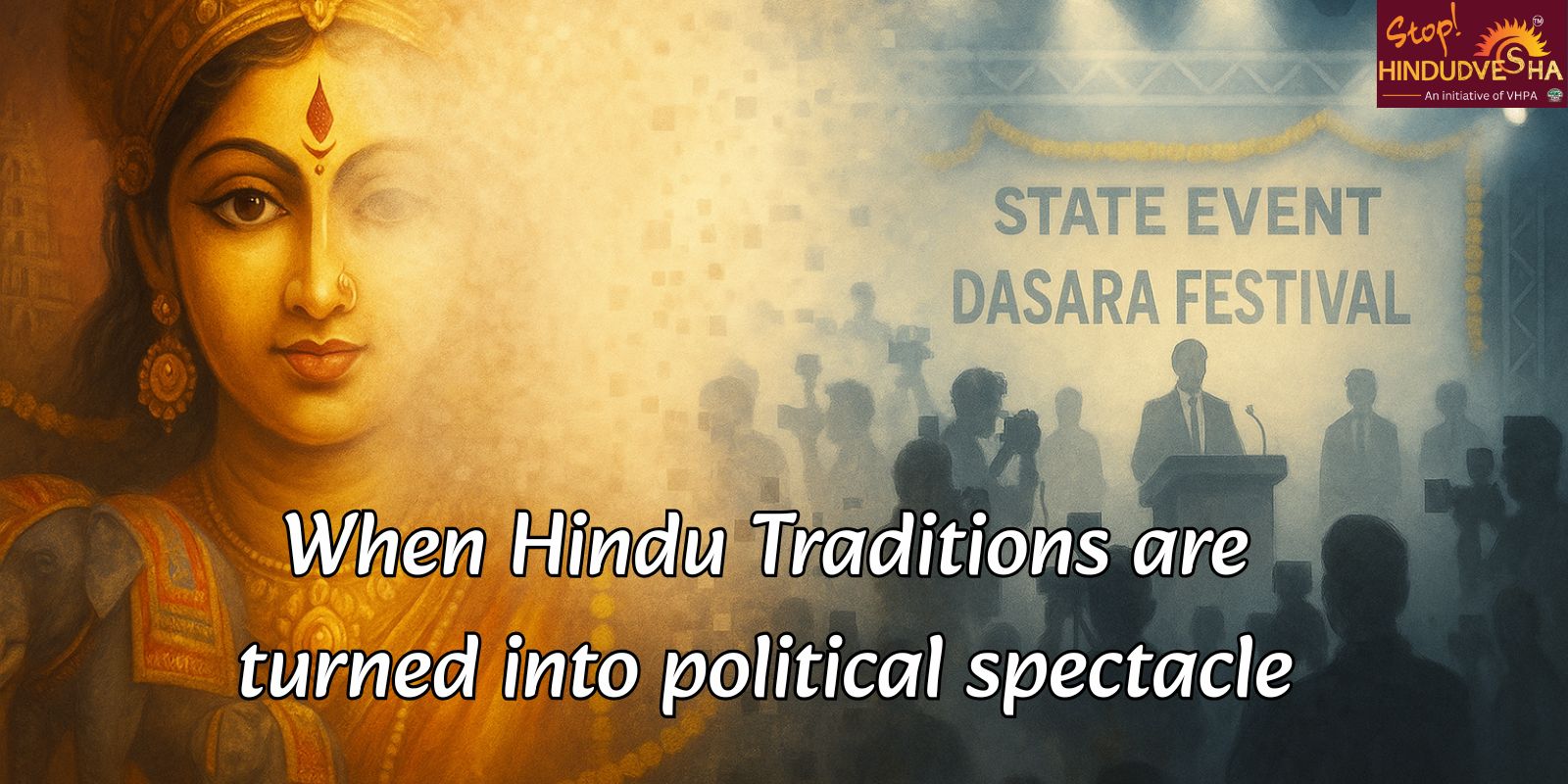
- The Karnataka government’s decision to invite Banu Mushtaq to inaugurate the Mysuru Dasara festival, in the name of inclusivity, intrudes into the sacred space of Hindu worship and disrespects long-standing temple traditions.
- Secularism and equality are being selectively applied to target Hindu practices—weakening Sanatan Dharma while other faiths remain free to manage their own institutions and rituals.
- There is a deliberate push to appropriate Hindu festivals, turning sacred, Dharmic celebrations into political or cultural events designed for optics and vote-bank gains.
- Such interference violates Articles 25, 26, and 29 of the Constitution, which guarantee the freedom to practice, manage, and preserve one’s religion and culture—rights that apply fully to Hindus as well.
- Recognizing Dasara as a state festival is welcome, but erasing its Hindu essence is not. No government has the right to redefine, dilute, or control the spiritual life of Sanatan Hindu Dharma.
Across Bharat, an unsettling transformation is unfolding: the sacred is being recast as “heritage,” and devotion is being packaged as “culture.” Temples once alive with spiritual energy are now curated as tourist destinations; festivals rooted in centuries of worship are reframed as mere “state events” in the name of inclusivity. What once connected the devotee to the divine is now filtered through the language of modern governance and political optics.
This subtle yet systematic secularization of the sacred found its latest expression in the Mysuru Dasara festival, where the Karnataka government invited writer and activist Banu Mushtaq—a vocal critic of Hindu rituals and idol worship—to inaugurate this year’s celebration at Chamundi Temple, a sacred festival dedicated to Goddess Chamundeshwari (Maa Durga). The move sparked outrage among devotees and cultural leaders, who saw it as yet another attempt to strip a profoundly Hindu festival of its religious essence and recast it as a “secular” state event. What might appear as an act of inclusivity is, in reality, part of a deeper ideological effort to appropriate Hindu festivals, weaken temple autonomy, and detach Hindus from their civilizational roots.
This quiet secularization of the sacred is not neutrality; it is appropriation—an attempt to manage the divine under political supervision.
The Mysuru Dasara Controversy: A Festival in Political Crossfire
What began as a traditional celebration of Goddess Chamundeshwari’s victory over Mahishasura turned into a political flashpoint this year when the Karnataka Congress government invited renowned Kannada writer and Booker Prize winner Banu Mushtaq to inaugurate the Mysuru Dasara festivities. The decision sparked outrage across the State and beyond, with critics questioning the government’s intent in selecting a person known for her outspoken views against Hindu rituals, beliefs, and murti puja.
Chief Minister Siddaramaiah defended his move by claiming that “Dussehra is a non-religious festival… a festival for Hindus, Christians, Buddhists, and Jains. Even Hyder Ali and Tipu Sultan celebrated it.[1]” He also cited precedents — including Muslim chief guest Nisar Ahmed in 2017[2] —but such claims are unsustainable. A wrong precedent cannot justify a continued error.
Several Hindu organizations condemned the move, calling it an insult to the Hindu faith and traditions. BJP questioned why the government had ignored Deepa Bhasthi[3], the Hindu translator who translated Banu Mushtaq’s writings and who shared the International Booker Prize with Mushtaq, was not invited. It stated that the issue was not about literature or merit, but about the mindset that mocks Hindu beliefs in the name of secularism. Critics rightly observed, “She may be a public intellectual, even a trophy for the Karnataka government, but she is not a trophy for the Dasara festival. This is not the sort of event where you display your trophies.”[4]
The controversy soon escalated beyond politics. Protests erupted across Mysuru and other parts of Karnataka, with devotees, temple priests, and cultural leaders expressing anguish over what they saw as an affront to Goddess Chamundeshwari and the centuries-old tradition upheld by the Wadiyar royal family of Mysuru. Petitions were filed before the Karnataka High Court[5], and later, before the Supreme Court[6], seeking to restrain the government from allowing Mushtaq —a known detractor of Hindu traditions—to inaugurate a fundamentally Hindu festival. Both courts, however, dismissed the petitions, upholding the state government’s decision.
As tempers rose, the dispute transformed into a symbolic struggle between political secularism and Hindu self-respect. What should have been a celebration of divinity, culture, and devotion instead became a battleground of ideological one-upmanship. The episode exposed how easily sacred traditions can be drawn into political crossfire — where reverence gives way to rhetoric, and governance intrudes into the sanctum of faith. It stands as a case study in how secular politics weaponizes inclusivity — not to unite communities, but to erode Hindu autonomy over their sacred institutions and festivals.
Hindu Festivals: The Pulse of Sanatana Dharma
To understand why the Mysuru controversy struck such a deep chord, one must look beyond politics—into what a festival truly represents in the spiritual and cultural life of Hindu civilization. Hindu festivals are not merely cultural gatherings; they are the living pulse of Sanatana Dharma. Each celebration—whether Diwali, Holi, or Dasara—serves as a sacred bridge between the devotee and the divine. It resonates with centuries of faith, symbolizing the eternal rhythm of Dharma: light triumphing over darkness, humility conquering arrogance, and righteousness prevailing over injustice. These festivals are both spiritual and social expressions of Hindu identity, anchoring communities in shared rituals, art, and divine remembrance. Rooted in ancient history and sacred texts, they offer moments for reflection, devotion, and inner growth. Their true religious significance lies in their power to draw individuals closer to the divine through ritual, contemplation, and the pursuit of moral and spiritual virtues.
On the social front, Hindu festivals serve as unifying occasions that strengthen community bonds, reinforce family ties, and nurture a sense of shared identity. These celebrations also contribute to the economic and cultural vitality of their regions by stimulating trade, tourism, and creative expressions such as dance, music, and art. The intricate interplay between religious practice and social custom exemplifies the holistic nature of Hindu festivals, which function both as spiritual observances and as expressions of cultural cohesion.
In this light, to label Dasara merely as a “cultural” or “state” event, as the Karnataka government insists, is not only misleading but profoundly reductionist. The festival’s essence lies in its religious and spiritual foundations, centered on the worship of Goddess Chamundeshwari, who embodies the triumph of Dharma over Adharma. While people of all faiths may participate and celebrate, that inclusivity does not dilute or erase the festival’s distinctly Hindu character. As R. Raja Chandra Urs, a descendant of the Wadiyar royal family, aptly observed: “Merely because political leaders of all castes and religious backgrounds attend iftar parties today, does that render Ramadan a secular festival?[7] The same logic applies here—Dasara remains a Hindu festival regardless of who participates in it.
There is, of course, nothing wrong with the State recognizing Dasara as a “state festival” — after all, it draws tourism, cultural pride, and public enthusiasm. But recognizing it merely as a state festival while denying its essentially Hindu religious nature is unacceptable. This approach stems from a flawed understanding of secularism — one that confuses respect for diversity with the dilution of identity.
Mushtaq has previously publicly opposed murti worship, haldi-kumkum, and other Hindu ritualistic practices.[8] Her ideological alignment and prior statements make her appointment highly inappropriate for a Hindu sacred event.[9] It is only reasonable to ask how a person who disavows Hindu deities and dismisses ritualistic practice can participate in an act of devotion to Maa Chamundeshwari. Had she expressed genuine respect for the Goddess or retracted her earlier remarks, Hindus might have welcomed her participation — for Hinduism, unlike exclusivist creeds, embraces those who come in reverence. But her silence and the State’s insistence on imposing her as the face of Dasara expose the deeper intention: to desacralize the festival, to turn bhakti (devotion) into bureaucracy, and Dharma into drama.
To label such sacred observances merely as “cultural events” is to drain them of their spiritual lifeblood. When devotion gives way to display, and reverence is replaced by rhetoric, festivals lose their power to transmit Dharma to the next generation. Children grow up seeing Dasara as a spectacle, not as Navratri, the sacred nine days of worship, fasting, and divine reflection. The erosion begins not with open attacks but with subtle redefinitions.
Critics have rightly warned that it is part of a wider ideological project to appropriate the sacred. Senior Advisor Kanchan Gupta aptly described this episode as “appropriation of religion by the State in the name of secularism.[10]” Drawing a parallel with Durga Puja in West Bengal, he noted[11] that the festival — which is historically, civilizationally, and culturally an important Hindu celebration — was being rebranded as merely a cultural marker when UNESCO granted it recognition. “That is where the unraveling begins,” he said, emphasizing how this deliberate recharacterization subtly erases its sacred essence.
Echoing this sentiment, Advocate Vishnu Shankar Jain observed[12] that “a non-believer cannot inaugurate or perform a ceremony that is an essential religious practice.” He drew an analogy to the sensitivities within other faiths, stating that “Muslims would never permit Hindus to take part in or preside over the Waqf management committee — the same principle applies to Hindu rituals and festivals.” Jain’s statement underscores a fundamental truth – Hindu religion is not an open field for experimental inclusivity, especially when the act itself is inherently sacred and rooted in Shraddha (devotion).
Mysuru Dasara – From Devotion to State Spectacle
Dasara is unmistakably a Hindu festival—its sacred lineage reaching deep into the timeless history of Sanatana Dharma.[13] R. Raja Chandra Urs says, “It transcends the mere innovations of the Vijayanagara dynasty or the Wadiyars who followed. The festival embodies something far more ancient and profound.”[14]
The festival’s core rituals — the worship of pattada aane (royal elephant), pattada kudure (royal horse), and pattada hasu (royal cow) — are not ornamental pageantry but living symbols of Indra’s sabha, the divine assembly presided over by the king of the gods himself.[15] These rituals reflect the cosmic order between Dharma and Rajya, between divine power and righteous governance.
Attempts to secularize Dasara are not new. Historical accounts reveal instances of popular resistance, from the 1930s outrage against Diwan Mirza Ismail’s prominent role in the procession to post-1975 incidents when government officials interfered with traditional rituals.[16] Over decades, administrative control, ceremonial redesign, and public spectacle have systematically weakened the festival’s Hindu essence. A brief timeline of systematic secularization can be seen here:[17]
- 1980: The Congress Government led by Chief Minister R. Gundu Rao formalized state control over the Mysuru Dasara festival administration.
- 2001: CM S.M. Krishna performed rituals traditionally reserved for the Wadiyars, the royal family of Mysuru.
- 2005: CM Dharam Singh personally conducted the puja in the golden howdah, sidelining hereditary custodianship and transforming the festival into a government spectacle rather than a community celebration.
- 2013: Under CM Siddaramaiah, poet Chandrashekar Kambar was invited as the chief guest, blending political messaging with religious observance.
- 2025: The Banu Mushtaq invitation represents the latest chapter in a sustained effort to strip the festival of its sacred and cultural depth in Karnataka.
Secularism and the Myth of Inclusivity
The secularist rhetoric often invoked to justify government control over Hindu festivals and temples masks a much deeper and older continuum—a continuum of interference that stretches from colonial administration to contemporary government control over Hindu temples. The ongoing attempt to secularize Hindu festivals is not an isolated act — it is part of a broader ideological project aimed at detaching Hindus from the sacred essence of their faith. This ideological re-engineering has been made possible largely through state control over temples, including the Chamundi temple at Chamundi Hills in Mysuru.
By seizing temple administration and treasury, the State has financially and institutionally weakened Hindu temples, reducing them to government departments rather than autonomous Dharmic spaces. Temple funds, offered by devotees for spiritual and charitable purposes, are absorbed into state machinery. What began as mere “temple management” under government control has quietly expanded into determining who may inaugurate, speak for, and symbolically represent Hindu festivals.
This is precisely what we are witnessing today. With the government now “organizing” Dasara through temple funds, a sacred act of worship is being repackaged as a state-sponsored spectacle. The festival, once conducted by temple priests, trustees, and the royal family who safeguarded its sanctity for centuries, has been taken over entirely by political committees that now dictate its form and message. Under the guise of inclusivity, they proclaim that Dasara is “for all” and “non-religious.”[18] The irony is striking: the very offerings of Hindu devotees are being used to strip their own festival of its Hindu soul.
The government further justifies these actions by invoking principles of equality and secularism, arguing that it cannot discriminate among citizens — whether Hindu, Muslim, Christian, or otherwise — in determining who may inaugurate a festival. But at the same time, it ignores the right to religion for Hindus under Articles 25 and 26 of the Constitution. By claiming that the festival must be “inclusive” to all faiths, it sanctions the appointment or invitation of individuals who openly reject Hindu rituals and beliefs.
This interference also violates the spirit of Article 29 of the Constitution, which guarantees every citizen – including Hindus – the right to conserve their distinct language, script, or culture. Hindu festivals like Dasara are central to the preservation of Hindu cultural and spiritual identity. By taking control of festivals and temples, the State infringes upon this fundamental right, weakening the capacity of Hindus to safeguard and perpetuate their own religious traditions.
Even more telling is the selective application of secularism. Government control extends only to Hindu temples, not to mosques, churches, or other religious institutions. The State would never claim the right to appoint the chief guest of an Eid gathering or a Christmas service, nor would it declare a mosque or church belongs “to everyone.” Yet it continues to tighten its hold on Hindu temples, most recently insisting that Chamundi Hill, home to the ancient Chamundeshwari Temple, is not a Hindu sacred space but “belongs to everyone.”[19] This incident makes one truth unmistakably clear—secularism in India is applied selectively. Such double standards do not promote equality; they systematically dismantle Hindu rights and Dharmic autonomy.
Efforts to secularize Dasara in the name of inclusivity overlook a crucial distinction between participation and appropriation. Hindus have always welcomed people of all faiths to share in their celebrations, but the festival’s sacred essence is not open for negotiation. While Hindu tradition upholds harmony and respect for all paths, it cannot—and should not—accept politically or ideologically driven intrusions into its festivals, temples, or faith.
The ideological project driving the secularization of Hindu Dharma operates on three fronts—control, redefinition, and erasure. By controlling temples, redefining festivals as cultural spectacles, and erasing their religious significance in the name of secularism, the government and self-styled secularists are not merely managing faith—they are reshaping it, even infringing upon constitutional protections such as Articles 25, 26, and 29. The controversy over the Dasara inauguration, therefore, is not about a single invitation or one writer; it is a symptom of a deeper malaise—the systematic hollowing out of Hindu identity under the pretext of inclusivity.
The Civilizational Reckoning
Behind these symbolic acts lies a deeper psychological and ideological agenda—to make Hindus feel alienated from their own traditions. When the government decides who represents Hinduism, who performs its rituals, and who speaks for its institutions, it weakens Hindu civilizational confidence. Control over temples and festivals thus becomes a means of controlling Hindu consciousness itself.
By inviting a non-Hindu who openly opposes Hindu rituals, the government sends an unmistakable message: that Hindu traditions are subordinate to political expedience. This is not respect for diversity; it is deliberate desecration. A government that truly valued pluralism would safeguard the sanctity of every faith equally—not single out one for deracination. Hinduism’s inclusivity does not arise from erasure but from affirmation—from the ability to honor all paths while remaining rooted in one’s own. The Mysuru Dasara controversy should, therefore, serve as a wake-up call: if Hindus do not reclaim their festivals, others will continue to usurp and redefine them.
Conclusion
The attempt to secularize Dasara is a direct assault on Hindu spiritual autonomy—a continuation of a centuries-old effort to detach Hindus from their deities, temples, and traditions.
The Mysuru Dasara controversy is not about one individual or one festival; it is about the fundamental right of Hindus to preserve the sanctity of their faith without external interference. To reduce Dasara to a mere cultural or State event in the name of pluralism is to sever the Hindu community from its Dharmic roots. Genuine pluralism does not demand the denial of Hindu identity; it requires that this identity be allowed to flourish while welcoming respectful participation from all. Erasing the Hindu character of Hindu festivals is not inclusivity—it is coercion disguised as tolerance.
The time has come to reclaim our festivals from bureaucratic control and ideological distortion, and to return them to their rightful custodians—the devotees. Our deities, temples, festivals, and faith are not instruments of political theater or ideological manipulation; they are the living heart of Hindus and of Bharat’s civilization. No government or secularists have the moral or constitutional right to redefine or usurp them.
Citations
[1] Siddaramaiah Defends Invite To Banu Mushtaq For Dasara Opening, Cites Historical Precedents Of Hyder-Tipu Reigns; https://swarajyamag.com/news-brief/siddaramaiah-defends-invite-to-banu-mushtaq-for-dasara-opening-cites-historical-precedents-of-hyder-tipu-reigns
[2] ibid
[3] Mysuru Dasara ‘secular’, ‘cultural’ festival, says Siddaramaiah; Defends invite to Banu Mushtaq; https://economictimes.indiatimes.com/news/politics-and-nation/mysuru-dasara-secular-cultural-festival-says-siddaramaiah-defends-invite-to-banu-mushtaq/articleshow/123614160.cms?from=mdr
[4] SC Rejects Petition Against Invite to Banu Mushtaq for Mysuru Dasara | Karnataka News | News18; https://www.youtube.com/watch?v=FqVGgiyK1wE
[5] “Interfaith participation in religious festivals not against Constitution”; Karnataka High Court dismisses plea against Dasara festivities inauguration by Booker Prize winner Banu Mushtaq;
[6] Supreme Court Dismisses Plea Challenging Karnataka Govt’s Invite To Booker Prize Winner Banu Mushtaq For Dasara Festival; https://www.livelaw.in/top-stories/supreme-court-plea-against-karnataka-govt-invitation-to-banu-mushtaq-for-dasara-festival-304441
[7] Systematic Secularisation: How Congress Hijacked Mysuru Dasara, Diluted Its Hindu Core, and Turned It Into Political Theatre; https://swarajyamag.com/culture/systematic-secularisation-how-congress-hijacked-mysuru-dasara-diluted-its-hindu-core-and-turned-it-into-political-theatre
[8] Banu Mushtaq to inaugurate Mysuru Dasara: Why is the Karnataka Congress government targeting Hindus? ; https://hindupost.in/dharma-religion/banu-mushtaq-to-inaugurate-mysuru-dasara-why-is-the-karnataka-congress-government-targeting-hindus/#
[9] ibid
[10] SC Rejects Petition Against Invite to Banu Mushtaq for Mysuru Dasara | Karnataka News | News18; https://www.youtube.com/watch?v=FqVGgiyK1wE
[11] ibid
[12] ibid
[13] Systematic Secularisation: How Congress Hijacked Mysuru Dasara, Diluted Its Hindu Core, and Turned It Into Political Theatre; https://swarajyamag.com/culture/systematic-secularisation-how-congress-hijacked-mysuru-dasara-diluted-its-hindu-core-and-turned-it-into-political-theatre
[14] ibid
[15] ibid
[16] ibid
[17]ibid
[18] Dussehra is a non-religious festival, appropriate for writer Banu Mushtaq to inaugurate it: Karnataka CM Siddaramaiah; https://www.newindianexpress.com/states/karnataka/2025/Aug/31/dussehra-is-non-religious-festival-appropriate-for-writer-banu-mushtaq-to-inaugurate-it-karnataka-cm-siddaramaiah-2
[19] ‘Chamundi Hill Not Just Hindu property,’ Says DK Shivkumar, BJP Hits Back; https://www.ndtv.com/india- https://www.ndtv.com/india-news/chamundi-hill-not-just-hindu-property-says-karnataka-deputy-chief-minister-dk-shivakumar-bjp-hits-back-9166622

Donate to HINDUDVESHA
Our Mission is to explore and expose Hindudvesha through research analysis, education and response.
SUPPORT US