

Still Chained to the Crown? Why India Must Exit the Commonwealth
 Rakesh Krishnan Simha · 04/09/2025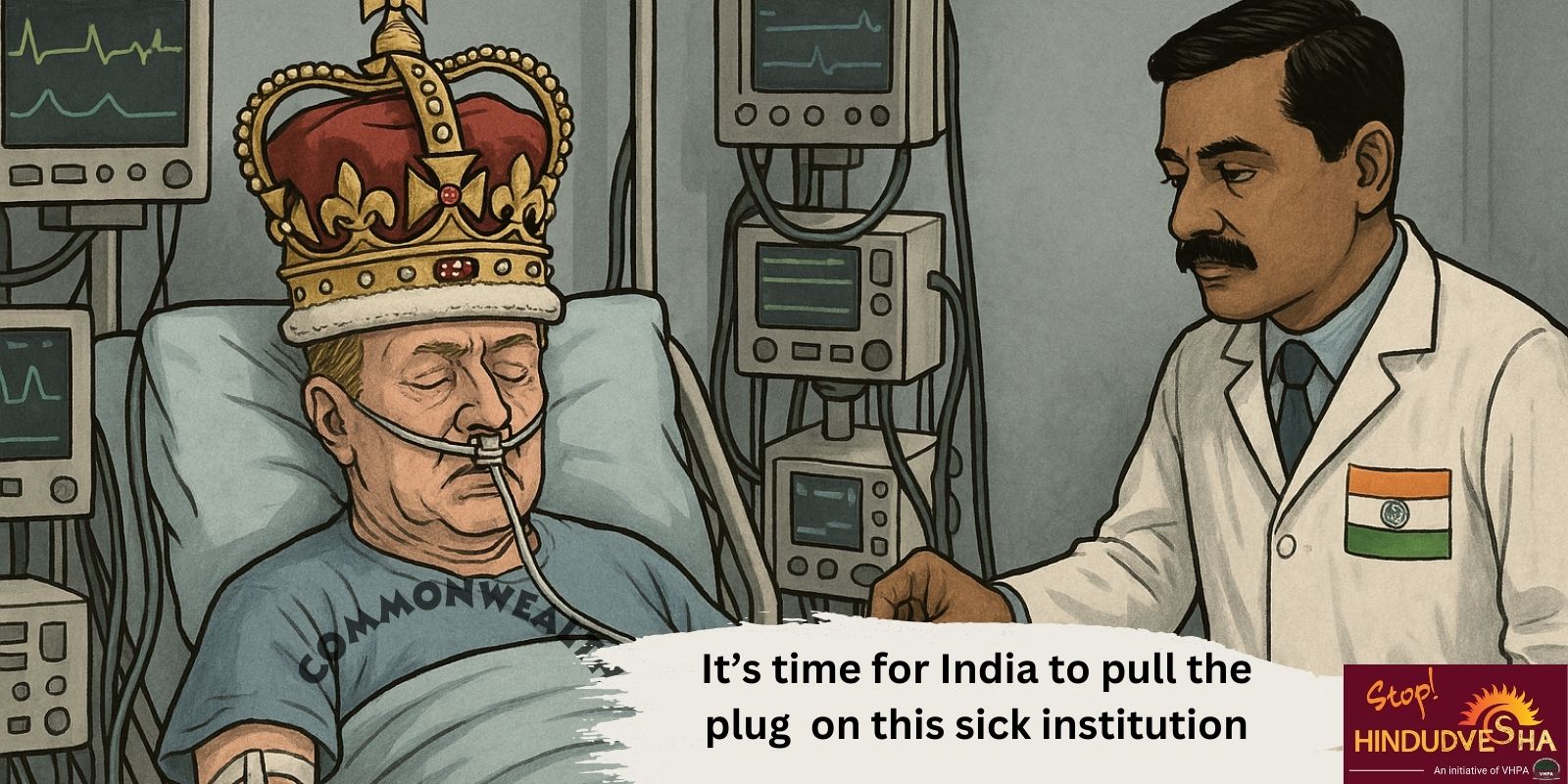
- India’s continued membership in the Commonwealth reflects a lingering colonial mindset that clashes with its current status as a global power.
- The organization serves little purpose beyond preserving British prestige, offering India no tangible economic, strategic, or diplomatic benefits.
- Historical betrayals — such as Britain’s actions during the Kashmir conflict, Goa liberation, and 1965 war — reveal a pattern of undermining India’s interests.
- The UK’s removal of sports like shooting from the Commonwealth Games and rising Hinduphobia in British media highlight ongoing disrespect toward India.
- With strong global partnerships, growing economic clout, and widespread domestic support for COMEXIT, it’s time India ends this outdated association.
On March 20, the media reported that India had submitted its bid to stage the 2030 Commonwealth Games in Gujarat.[1] If the proposal gets accepted, India will host the quadrennial event 20 years after the scandal-hit games in Delhi.[2] If you have never watched these games, count yourself lucky because it is the only sporting event in the world where you can take a nap, get a snack, and still miss nothing.
Here’s what John Oliver, the British host of Last Week Tonight on HBO, said when he heard about it: “What the f*** are the Commonwealth Games? Well, imagine a competition without the US, China, and Russia. Then imagine a track meet dominated by sprinters from Wales, and you have the Commonwealth Games…. The games began in the 1930s just as the British Empire was falling flat on its face, and for some reason continues to this day.”[3]
Just like the coma-inducing Commonwealth Games, the Commonwealth of Nations inexplicably continues on life support to this day. India’s membership in this group, a legacy of British colonial rule, has long been a subject of contention. Unlike other large groups like the European Union, OPEC, and G-20, which have clear-cut aims, the Commonwealth is a club without a role – except to boost Britain’s prestige. For over seventy years, it has barely managed to function, but today, the argument for India to leave the organization is more compelling than ever — driven by long-standing historical grievances, changing economic dynamics, and the organization’s growing irrelevance.
Historical Betrayal
India’s independence came in 1947 after two centuries of exploitation under British rule, during which over 165 million Indians – overwhelmingly Hindus – perished due to engineered famines, wars, reprisal attacks, and systemic neglect.[4] Leaders like Jawaharlal Nehru, India’s first Prime Minister, initially recognized the British Commonwealth for what it was — a symbol of imperial dominance and racism. Yet, in a surprising volte-face, Nehru advocated for India’s inclusion in 1949, persuading Britain and other dominions to amend the rules. The word “British” was dropped from the organization’s name and it was rebranded as simply the “Commonwealth.”[5] This compromise, however, did little to erase the bitter legacy of colonial atrocities.
Nehru’s decision faced fierce opposition at home. Former President and Congress party leader Shankar Dayal Sharma writes that for continuing to be a member of the Commonwealth, Nehru faced intense criticism from the leaders of all parties in India, and in1949, opposition leader Jayaprakash Narain criticized the membership as “suggesting a lack of self-confidence and an implicit commitment to one of the power blocs.”[6]
In 1952, Shyama Prasad Mukherjee, the co-founder of the Jan Sangh, said: “On every critical occasion, the Commonwealth countries have failed to stand by India where India’s stand has been right and just.”[7]
Again, in 1956, all the opposition parties agreed to denounce the Commonwealth in Parliament and ask Nehru to quit it. Acharya J.B. Kripalani said, “Ever since our independence, England has always sided against us.”
Communist leader A.K. Gopalan said: “India’s membership of the Commonwealth gives Britain the prestige which enables it to deceive world public opinion.” Bhupesh Gupta, also from the Communist Party of India, said: “Why should our friends ask us to continue in this association, which has injured our prestige, which has injured our economy, which offends our conscience and our prestige in the world?”[8]
Nehru’s motivations, however, were less about national interest and more about personal convenience. Biographers like Michael Edwards and Geoffrey Tyson suggest that Nehru saw the Commonwealth as a “world stage” for his international grandstanding.[9] His close relationship with Louis Mountbatten, the last Viceroy of India, and his scandalous affair with Mountbatten’s wife Edwina may have further swayed his judgment. Mountbatten had expressed a desire to keep India within the Commonwealth fold. For Nehru, the organization was a convenient package deal — instant allies and a warm, fuzzy sense of security — luxuries he prioritized over the fierce independence championed by leaders like Ho Chi Minh of Vietnam.
Britain’s Motives
Apart from other factors, India’s decision to retain Commonwealth membership was to neutralize the excessive British partiality for Pakistan. According to American political scientist Keith B. Callard, India could not overlook the fact that “British policy on many an occasion had been modified to conciliate the opinion of Indian Muslims…and many British officials and many army officers showed a personal preference for the Muslim Indian rather than the Hindu!”[10]
Again, the decision to stay was because of Nehru’s inherent weakness as a leader. It never occurred to him and his cabinet cronies that the Commonwealth was such a hollow organization and that no amount of collusion between Britain and Pakistan could make an iota of difference on the ground. However, Nehru never went to his own army commanders for advice and on the contrary his decisions – which almost always hurt India’s strategic interests – were influenced by the advice provided by Mountbatten or Edwina.[11]
Also, let’s not forget that the British didn’t colonize India to leave. Their long-term, though unstated, goal was the same as Germany’s lebensraum – living space for white people. During the early colonial years, the British realized that it was the Hindus rather than the Muslims who were offering them the most resistance. The extermination of the majority Hindus was thus necessary. While this plan was thwarted by the resistance of the mostly Hindu kingdoms, the constant and bitterly contested wars created considerable anger against Hindus among the British. Says author Mihir Bose: “For more than 200 years, hatred of Hindus was the default position of many influential people in Britain.”[12]
By the 1940s, when India’s independence became inevitable, Hinduphobia among the British had peaked. During World War II, British Prime Minister Winston Churchill said the Hindus were a foul race, and he wished Arthur Harris, the head of RAF Bomber Command, “could send some of his surplus bombers to destroy them.”[13]
Among the most Hinduphobic members of the British ruling class was Field Marshal Claude Auchinleck, the last Commander-in-Chief of the British Indian Army. Notorious for his pro-Muslim and pro-Pakistan views, he prophesied “a general decentralization and breakup” of India. According to him, “The British tried to consolidate it but achieved nothing permanent. No one can make a nation out of a continent of many nations.”[14]
Since the British Army was undergoing mass demobilization after the end of World War II, officers like Auchinleck were counting on India staying in the Commonwealth so they could keep their jobs. He noted in September 1947: “I have no idea…whether India will stay in the Commonwealth… I and all my senior commanders and staff officers are most anxious at the way in which the politicians (and some of the senior Indian officers) are trying to force the pace of nationalisation [of the Army].”
Britain Needed India – For Power And Prestige
The British ruling class had long recognized the importance of keeping good relations with India in the postwar world. Economically, Britain, and, by extension, the Commonwealth, had become heavily reliant on the Indian Empire’s commercial, industrial, and financial strength, especially during World War II. India’s sterling balances in London were crucial to Britain’s economic stability, and by 1946, Britain owed India over £1,300 million — more than 17 times India’s GDP. This massive debt put immense pressure on the financially strained British government, not only to grant India independence but also to maintain Indian goodwill to secure favorable terms on the debt.[15]
Indeed, without India, Britain would be like a ruler without a kingdom. George Curzon, the viceroy of India, had correctly predicted in 1901: “As long as we rule India, we are the greatest power in the world. If we lose it, we shall drop straightaway to a third-rate power.”[16] As Prime Minister Benjamin Disraeli acknowledged his country’s overwhelming dependence on its colonies, he stated that Britain “was really more an Asiatic power than a European.“[17]
It is in this context that Mountbatten wrote that the main advantage of India staying in the Commonwealth was “The terrific worldwide enhancement of British prestige and the enhancement of the prestige of the present Government.”[18] Labor Party leader Stafford Cripps admitted that having India within the Commonwealth was of ‘‘very great importance to our future position in the world both economically and politically.’’[19]
And why not? With the US and Russia forming their respective military blocs, Britain was having a serious case of FOMO (fear of missing out). Against this backdrop, having a large country like India within the Commonwealth would lessen Britain’s postcolonial blues. Plus, with the US wooing India as a strategic military and economic partner, the cunning English knew that if India could be persuaded to stay in the Commonwealth, the possibility of it joining an American alliance would be slim.
Then, there was the strategic angle. “India was the British anchor in the Far East — without it, their operations in the region would crumble. If India stepped out of the Commonwealth, British control over the North Indian Ocean would weaken, and securing oil from the Persian Gulf would be uncertain. The British envisioned India as a crucial player in a loose Commonwealth defense alliance. India’s military role was clear: at the very least, defend its borders; ideally, actively engage in any Commonwealth conflicts. The British also hoped for India’s support in a Middle Eastern war. In return, India would rely solely on British aid to keep its military strong, offering bases for offensive operations as needed. With these goals in mind, British defense chiefs wanted to use India to serve British interests long after independence.[20]
Nothing for India – Except Hinduphobia
The Commonwealth has 2.5 billion people, 1.5 billion of whom are Indian. In terms of sheer numbers, it is the largest grouping in the world, contributing immensely to Britain’s prestige. If India quits, it will make the Commonwealth irrelevant from day one.
What does India get in return? Nothing but pure, unapologetic contempt!
The British media is arguably the most Hinduphobic in the world, with the government-funded BBC, in particular, portraying Hindus as communal, violent, and barbaric.[21] Khalistanis freely attack the Indian embassy in London, with the British police offering little to no protection against the vandalism and arson unleashed by these separatist goons.[22] Islamic fundamentalists in Britain freely oppose visits from Hindu leaders from India. In 2022, large-scale protests erupted when Hindu monk Sadhvi Ritambhara was in London to speak at an event.[23] In the same year, Rashmi Samant, the first Indian woman to be elected president of the Oxford University Union, faced intense pressure from the Left and Islamists due to her views on social media. She was eventually forced to leave both the university and the country after being targeted by a Leftist faculty member. Despite over 119 British Hindu organizations sending a letter to 10 Downing Street demanding action against the academic for his Hindu hatred and bigoted views, Boris Johnson remained silent.[24]
The problem with the British is that 75 years after their empire imploded, they still haven’t come to terms with that loss. Like a vengeful ex, they continue to meddle in the internal affairs of former colonies in the belief that the people of these countries are still their slaves. It is the Commonwealth that offers the British Parliament and politicians a platform to express concern about various aspects of Indian democracy, including rising nationalism, governance, law and order, gender equality, the youth of India, freedom of the press, and freedom of speech. Such meddling is simply unacceptable.
Dheeraj Sharma, professor at the Indian Institute of Management – Rohtak, explains how Commonwealth membership works against India’s interests: “As far as India is concerned, there is no real advantage in trade. No real benefit as far as travel is concerned. No real advantage as far as defense is concerned. No real advantage as far as support is concerned. The obtuse attitude of the British government towards those who threaten the sovereignty of India is evidence that there is no real advantage in obtaining even advocacy from the Commonwealth secretariat. On the contrary, the Commonwealth charter provides the UK with a pulpit to comment on the internal affairs of other countries.”[25]
Economic Reversal: Who Needs Whom?
In the fragile post-independence years, Nehru’s initial rationale for staying in the Commonwealth hinged on India’s need for British capital, expertise, and military support. He was a weak man who sought comfort in his friendship with the British who betrayed India when it came to the crunch. For instance, during the 1948 India-Pakistan War, Britain persuaded Nehru to declare a ceasefire just when the Indian Army was about to liberate the whole of Kashmir, or the 1961 Goa Liberation campaign, or in the 1965 war when Britain brazenly supported Pakistan and labeled India as the aggressor.
Fast forward to 2025, and the tables have turned dramatically. India is no longer the supplicant; it is an economic powerhouse. Companies like Tata have acquired iconic British brands such as Jaguar, Land Rover, and Corus (formerly British Steel), symbolizing a reversal of colonial hierarchies. India is now the second-largest investor in the UK, creating over 8,664 jobs in 2022 alone.[26] Research by Grant Thornton found that there were 971 Indian-owned companies in the UK in 2024, up from 954 in 2023.[27]
British leaders, from David Cameron to Rishi Sunak, have made repeated pilgrimages to India, seeking investments, markets, and a trade deal. The UK’s desperate bid to sell Eurofighter jets to India during the $10-20 billion fighter jet competition underscored Britain’s reliance on Indian economic might.
Cheating to Top The Medals tally
Britain is not content with keeping India in the Commonwealth – it wants to humiliate Indians too. In 2022, Britain controversially dropped shooting from the Birmingham Commonwealth Games, which sparked strong reactions from Indian athletes and officials. Shooter Heena Sidhu accused the organizers of removing the sport to benefit Britain’s position in the medals tally, mainly targeting events where India had historically excelled. Shooting, which has been a part of every Commonwealth Games for over five decades (except for the 1986 Games in Edinburgh), saw India securing 16 out of its 66 medals in the 2018 Gold Coast Games. With this change, India lost a significant opportunity to continue its dominance in the sport.[28]
The exclusion of shooting was not an isolated case. Archery, another discipline where India has traditionally performed well, was also left out of the 2022 Games, raising concerns about the fairness of the selection process. Indian officials, including IOA President Narendra Batra, were quick to voice their discontent. In a letter to India’s Sports Minister Kiren Rijiju, Batra suggested that India boycott the Games to protest against what he described as “India bashing” in the Commonwealth Games Federation (CGF). He argued that the frequent exclusion of sports where India excels or changes to the competition rules undermines India’s contributions to the Games.
Sidhu expressed her disappointment, warning that without shooting, India’s medal tally would be significantly lower. She supported Batra’s call for a boycott, emphasizing that it was time for India to send a clear message to the CGF that the country would not tolerate being sidelined. Sidhu’s stance reflects the frustration felt by many Indian athletes who see the exclusion of their strengths as an unfair strategy by the Games’ organizers.
Consensus for COMEXIT
The Commonwealth represents a lingering colonial hangover that clashes with India’s identity as a rising global leader. Membership ties the country to a club whose binding thread — shared subjugation under British rule — is a source of shame rather than strength. India’s continued participation risks perpetuating a narrative of subservience at a time when it should be asserting its sovereignty unapologetically.
Quitting the Commonwealth would not isolate India — it would liberate it. India already enjoys robust bilateral ties with countries like Australia and South Africa, independent of the Commonwealth framework. Its economic clout and soft power ensure its global influence. By exiting, India could redirect resources spent on Commonwealth dues and summits toward initiatives that align with its national interests, such as the International Solar Alliance or deeper integration with the BRICS and QUAD.
India’s former foreign secretary, Kanwal Sibal, believes that even if joining the organization was considered a useful thing to do, it is high time to leave. “Quitting the Commonwealth now may give you emotional satisfaction – we have moved ahead; we are a larger economy than Britain itself.”[29]
No argument there. A survey of 2003 students in higher education institutions in India indicates that 94.5 percent of respondents felt India should exit the Commonwealth. Of those who supported the COMEXIT, 72 percent stated it is because India has attained a higher standing on the global stage than the UK; 62 percent because India is the fifth largest economy; 60 percent because India is a large country with self-sufficient resources; and 54 percent believe the Commonwealth as an institution is parochial and a remnant of the colonial era.[30]
Nehru’s decision to stay made little sense in 1949 when the world was wooing it. But in 2025, it makes even less sense. The Commonwealth is an anachronism — a relic of a bygone era. It is time for India to shed this colonial yoke. The question is not why India should leave but why it has stayed so long.
Citations
[1] India Submits Bid To Host 2030 Commonwealth Games: Report (NDTV Sdports); https://sports.ndtv.com/othersports/india-submits-bid-to-host-2030-commonwealth-games-report-7970708
[2] Commonwealth Games Scam (Times of India); https://timesofindia.indiatimes.com/miscellaneous/commonwealth-games-scam/articleshow/56032112.cms
[3] Last Week Tonight: Commonwealth Games (YouTube); https://www.youtube.com/watch?v=-Aj3KZa1ZCM
[4] How British colonialism killed 100 million Indians in 40 years (Al Jazeera); https://www.aljazeera.com/opinions/2022/12/2/how-british-colonial-policy-killed-100-million-indians
[5] Sovereignty After the Empire and the Search for a New Order: India’s Attempt to Negotiate a Common Citizenship in the Commonwealth (1947–1949) (The Journal of Imperial and Commonwealth History, v. 49, 2021); https://www.tandfonline.com/doi/full/10.1080/03086534.2021.1950322#d1e215
[6] Jawaharlal Nehru: His Life, Work and Legacy (S. Chand & Co., 1990), p16; https://eparlib.nic.in/bitstream/123456789/57392/1/Jawaharlal_Nehru_life_English.pdf
[7] Ibid, p 16
[8] Ibid, p 17
[9] India’s Membership of the Commonwealth – Nehru’s Role (The Indian Journal of Political Science, V52, pp 43-53); https://www.jstor.org/stable/41855534
[10] India and the Commonwealth (SC Gangal, Shiva Lal Agarwala and Company, 1970, Page 28); https://ia802907.us.archive.org/20/items/in.ernet.dli.2015.219984/2015.219984.India-And_text.pdf
[11] A Media Expose Special (Thread) that throws light on the least discussed issues by the Darbari Media over the last 5 to 6 decades on the Love Affair between Pandit Nehru and Edwina Mountbatten (X); https://x.com/MediaExpose_/status/1868891675239543197
[12] A Hatred for Hindus – Long before the recent rise in Islamophobia, distrust of Hinduism was rife among Britain’s ruling class (History Today, Dec 2016); https://www.historytoday.com/hatred-hindus
[13] Steven Pinker’s Book Is An Antidote For The Growing Animosity Towards Science (Swarajya Magazine, 2018); https://swarajyamag.com/books/steven-pinkers-book-is-an-antidote-for-the-growing-animosity-towards-science
[14] Mountbatten, Auchinleck and the end of British Indian Army: August-November 1947 (Loughborough University Institutional Repository); https://pdfs.semanticscholar.org/0a55/f148ef0addea9a1f321d236e651fb577b892.pdf
[15] The ‘New Commonwealth’ 1947 – 49: A New Zealand perspective on India joining the Commonwealth(The Tandfonline, 2006); https://www.tandfonline.com/doi/pdf/10.1080/00358530600757276
[16] The Pinnacle of the Empire (The Breakup of the British Empire, Springer Nature); https://link.springer.com/chapter/10.1007/978-1-349-15307-7_1
[17] Britain is part of Europe: but how much a part? (Briefings for Britain, 2020); https://www.briefingsforbritain.co.uk/britain-always-differed-from-continental-europe/
[18] India’s Decision to Remain on the Commonwealth – 1949; A Major Landmark in Foreign Policy (Proceedings of the Indian History Congress, v 70, pp. 1134-1143); https://www.jstor.org/stable/44147757?read-now=1&seq=6#page_scan_tab_contents
[19] The ‘New Commonwealth’ 1947 – 49: A New Zealand perspective on India joining the Commonwealth(The Tandfonline, 2006); https://www.tandfonline.com/doi/pdf/10.1080/00358530600757276
[20] Keeping India in the Commonwealth: British Political and Military Aims, 1947-49 (Journal of Contemporary History, Vol. 20, No. 3, pp. 469-481); https://www.jstor.org/stable/260355?read-now=1&seq=5#page_scan_tab_contents
[21] ‘BBC On Trial’ Maker Pt. Satish Sharma Exposes BBC’s Anti-Hindu Agenda (YouTube); https://www.youtube.com/watch?v=yTVYgeWIrSw
[22] The NIA filed its first charge sheet in the twin violent attacks at the Indian high commission in London last year (Hindustan Times, Sept 2024);
[23] Sadhvi Ritambhara’s event cancelled in London after protests outside temple in Birmingham (India TV News, 2022); https://www.indiatvnews.com/news/india/uk-protests-sadhvi-ritambhara-s-programme-cancelled-in-london-durga-bhawan-temple-smethwick-birmingham-2022-09-22-810468
[24] Oxford Hinduphobia row: Rashmi Samant vindicated as internal investigation confirms how she was vilified, harassed and forced to resign (OpIndia, 2021); https://www.opindia.com/2021/07/oxford-hinduphobia-row-rashmi-samant-internal-investigation-confirms-forced-to-resign/
[25] Understanding Commonwealth: Is it even relevant for a democracy like India? (India Narrative, 2023); https://www.indianarrative.com/opinion-news/understanding-commonwealth-is-it-even-relevant-for-a-democracy-like-india-129438.html
[26] India remains second largest investor in the UK as enhanced trade agreement progresses (Moore, Kingston Smith – Insights; 2022); https://mooreks.co.uk/insights/india-remains-second-largest-investor-in-the-uk-as-enhanced-trade-agreement-progresses/#:~:text=Moore%20Kingston%20Smith’s%20India%20Group,and%20expect%20this%20to%20continue
[27] Indian ownership of British companies (Reuters, 2024); https://www.reuters.com/business/indian-ownership-british-companies-2024-08-12/
[28] Because India is no cheap shot: Why we should shoot down the 2022 Commonwealth Games (Daiyo – Sports, 2019); https://www.dailyo.in/sports/commonwealth-games-2022-shooting-in-cwg-indian-shooters-britain-india-brexit-31909
[29] Because India is no cheap shot: Why we should shoot down the 2022 Commonwealth Games (The India Times; 2024); https://economictimes.indiatimes.com/news/india/high-time-india-quit-commonwealth-says-former-foreign-secretary-kanwal-sibal/articleshow/116081979.cms?utm_source=contentofinterest&utm_medium=text&utm_campaign=cppst
[30] Understanding Commonwealth: Is it even relevant for a democracy like India? (India Narrative, 2023); https://www.indianarrative.com/opinion-news/understanding-commonwealth-is-it-even-relevant-for-a-democracy-like-india-129438.html

Donate to HINDUDVESHA
Our Mission is to explore and expose Hindudvesha through research analysis, education and response.
SUPPORT US