

Rahul Gandhi – A Case of Misplaced Messiah Complex
 Deepak Bajaj · 10/11/2024
- Rahul Gandhi projects himself as the sole redeemer of India, cultivating a savior image that distorts reality to boost his political persona.
- His exaggerated claims of persecution and crisis portray India as a nation in constant turmoil, creating a misleading narrative.
- Gandhi’s rhetoric fuels anti-India sentiments, empowering extremist groups and risking the safety of the Indian diaspora.
- By exploiting societal divisions for political mileage, his actions threaten to deepen the rifts within India rather than offer solutions.
- Rahul Gandhi’s tendency to elevate his role as a ‘hero’ reveals a need for validation, prioritizing his image over India’s unity and stability.
Rahul Gandhi, a scion of the Nehru-Gandhi dynasty, which, much like the Marcos of the Philippines and Franco of Spain, wielded nearly six decades of unchecked power in post-independent India, seems determined to continue his family’s tradition of political irresponsibility. During his recent visit to the United States, he made a series of reckless statements that not only misrepresented India but also found alarming resonance with extremist groups. By fueling such divisive narratives, Rahul Gandhi provided ammunition to anti-India elements, putting the safety of the Indian diaspora at risk. This pattern of behavior is deeply troubling for someone presenting himself as a national leader and raises serious questions about his motives and judgment. It’s unfortunate that someone from a family with such a long history of power would resort to such harmful rhetoric on a global platform.
Throughout his US trip, Rahul Gandhi presented a distorted and exaggerated version of India’s current socio-political landscape. He portrayed the country as one where rights are systematically denied, minorities are persecuted, and democracy is under siege. Yet, these claims fall apart when scrutinized against the facts. His comments on caste and religious discrimination were inflammatory and painted the Hindu majority in a negative light, playing into the hands of those who wish to disrupt India’s social harmony. Instead of addressing real issues, he used divisive rhetoric to gain political mileage, disregarding the repercussions on India’s global image and the safety of its citizens abroad.
Let’s delve into the specifics of his misleading narratives.
Economy
While criticizing India’s current economic situation, Rahul Gandhi said, “India cannot go forward without building a manufacturing base. We’ve handed the entire act of production to the Chinese. India cannot simply run a services-based economy with over a billion people. The real question for the 21st century is: Can the US and India provide a democratic, liberal vision for production and manufacturing?”
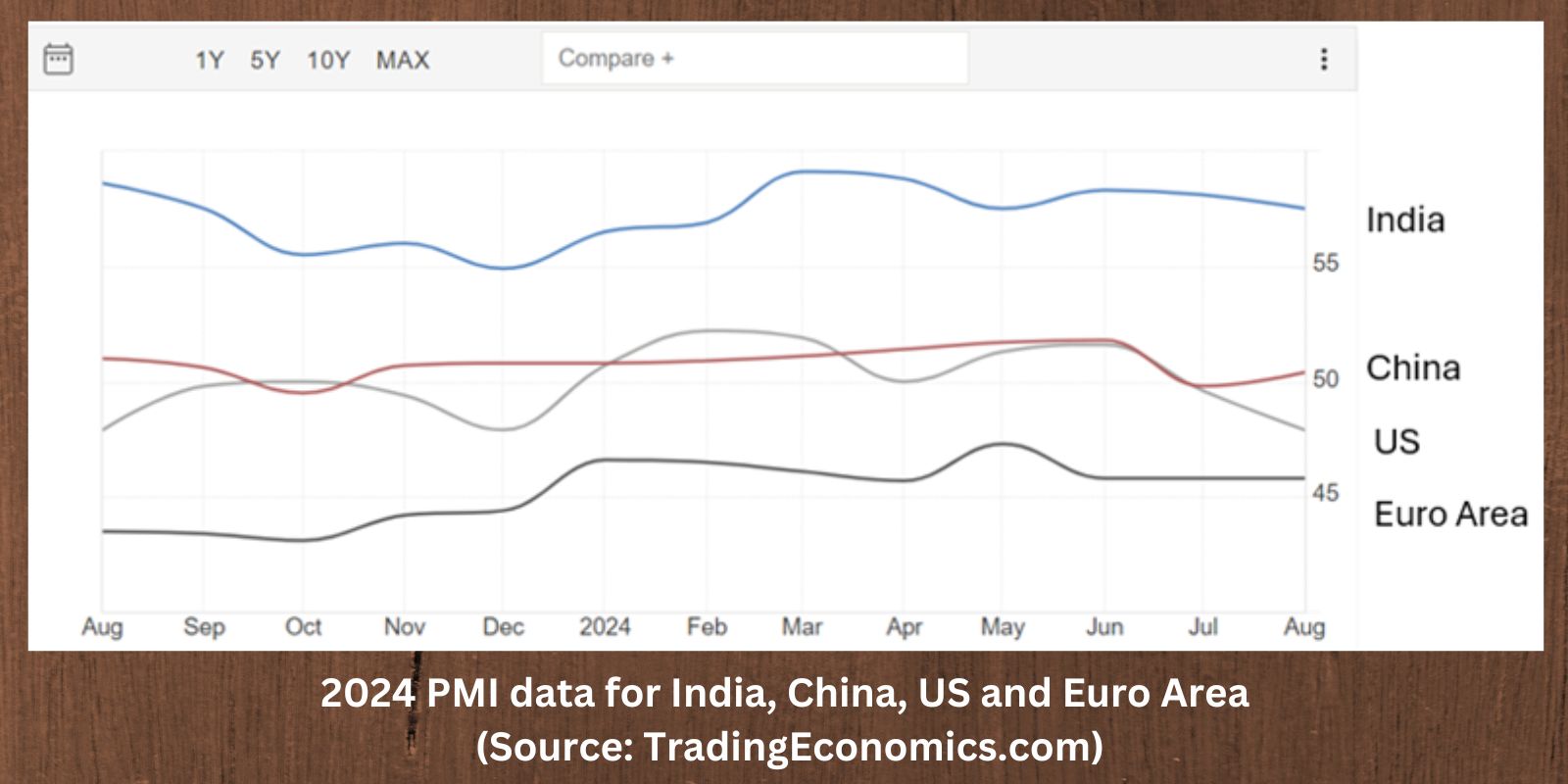
Unfortunately for Mr. Gandhi, the narrative he is trying to promote has no basis in reality. Every key economic indicator shows that India’s manufacturing base is steadily expanding. The PMI (Purchasing Managers’ Index), which is a key economic indicator used to gauge the health of the manufacturing and services sectors within an economy, was consistently above 50 points for India (apart from the Covid downturn in 2020), which indicates expansion or growth in the sector, while below 50 indicates contraction or a decline in the sector.[1] Compare that with the PMI for countries like China, the US, and the European Union, which are either barely touching 50 or hovering much below 50, signaling a contraction of manufacturing in those countries.
- Heavy Vehicles: India enjoys a strong position in the global heavy vehicle market as it is the largest tractor producer, second-largest bus manufacturer, and third-largest heavy truck manufacturer globally. India’s annual production of automobiles in FY23 was 25.9 million vehicles. It is the fourth largest automobile manufacturer globally and employs around 19 million people directly and indirectly.[2]
- Pharmaceuticals: India has now become the largest global supplier of generic medicines, contributing over 20% of global generic exports. It is referred to as the ‘pharmacy of the world’. India’s generous contribution to the global south in helping countries reduce their mortality rates due to COVID-19 by supplying vaccines is well known globally.[3]
- Mobile Phones: India is the world’s second-largest producer of mobile phones, with global manufacturers setting up manufacturing facilities in India, thereby strengthening the domestic mobile manufacturing Industry as well. India’s mobile phone production has grown at a 23% compound annual rate between 2014 and 2022. In 2022, more than 98% of shipments in the Indian market were “Made in India”. The foray into semiconductor factories is another good example. Just this March, a launch ceremony was held for three chip factories with investments totaling around $15 billion. [4]
- Steel: India is a leading steel producer and has witnessed steady growth in its steel manufacturing sector, making it the world’s second-largest steel producer.
- Textiles and Apparel: The Indian textiles and apparel market is currently valued at $220 billion and is expected to grow at a 10% CAGR, reaching $350 billion by 2030. Additionally, India is the 3rd largest exporter of textiles and apparel globally and ranks among the top five exporters in multiple textile categories. Exports are projected to reach $100 billion in the coming years. The textile industry in India is predicted to double its contribution to the GDP, rising from 2.3% to approximately 5% by the end of this decade.[5]
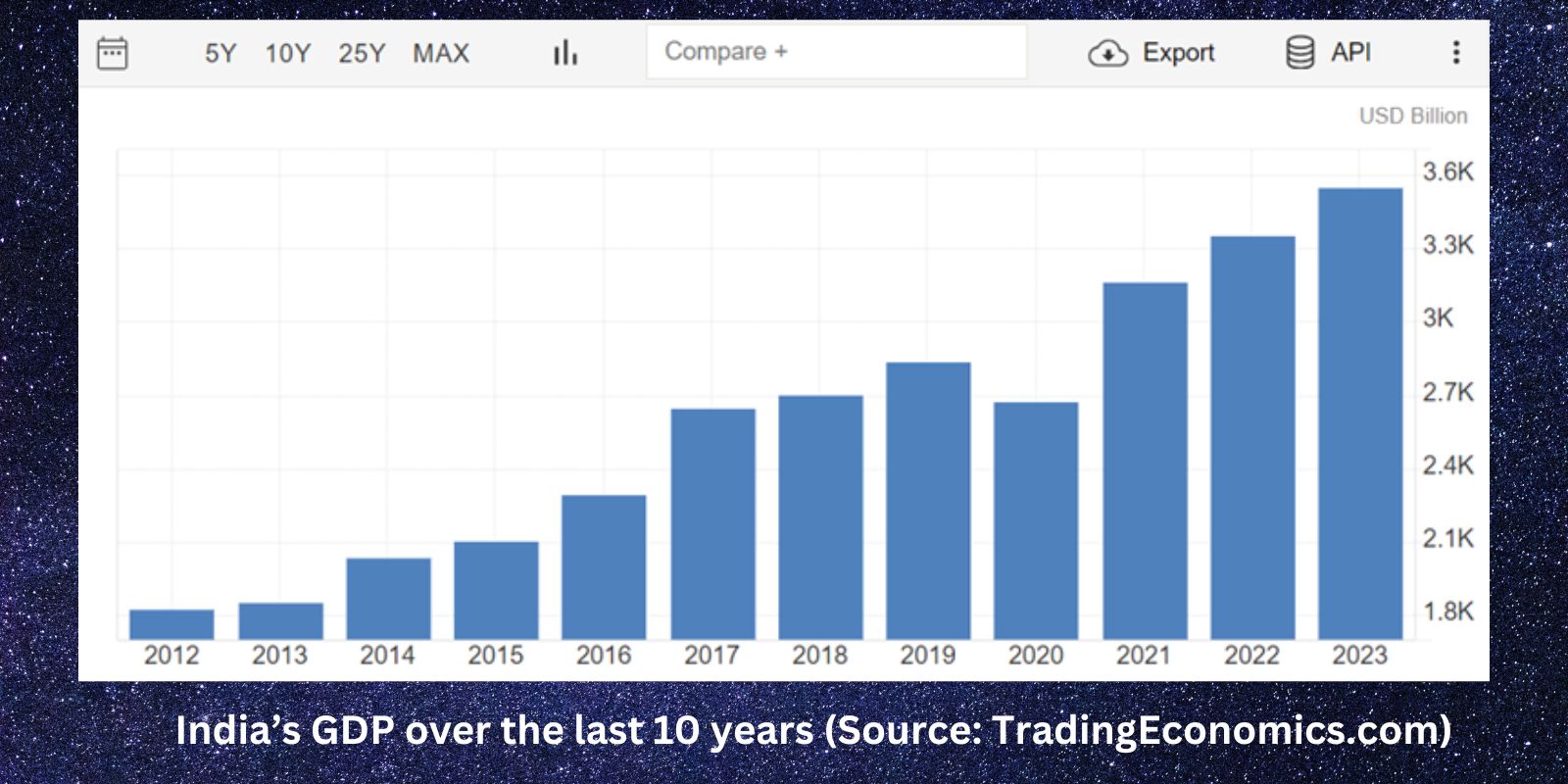
Furthermore, India has successfully eliminated extreme poverty through sustained economic growth policies, according to a report by the leading American think tank, The Brookings Institution, which cited the recently released 2022-23 consumption expenditure data. The article notes, “In the annals of inequality analysis, this decline in extreme poverty is unprecedented, especially considering the high per capita growth.”[6]
According to estimates by the Federation of Indian Export Organizations (FIEO), India’s exports are expected to increase to US$900 billion in 2024-25 due to increased global demand. Further, as production investments and domestic capacity expand, India could export goods worth US$1 trillion by 2030. India’s GDP growth is predicted to make the country a US$5 trillion economy by 2025.[7]
John Chambers, who heads the ‘India US Strategic Partnership Forum’ and is Chairman Emeritus of Cisco, is highly optimistic about the future of the Indian economy and had this to say on September 19 – “India will probably be 90 to 100% larger than China at the end of the century and (by a) 30 to 40% margin of the US. That is the most likely outcome.”[8]
It is evident that Rahul Gandhi is being let down by his research team, leading to unnecessary embarrassment for both India and himself.
Democracy, Bank Accounts, and Unpaid Taxes
Another claim made by Rahul Gandhi is that India’s democracy is essentially dysfunctional. He cited freezing his party’s bank accounts by the Income Tax Tribunal as an example, arguing that it put the Congress party at a disadvantage during the 2024 Lok Sabha elections: “We fought an election with our bank accounts frozen. I don’t know any democracy where that’s happened. Maybe that type of thing happened in Syria or used to happen in Iraq. But we literally sat during our election and spoke to our treasurer, and he says, well, we have no money. Now, you can have a resilient voter. You still need to run campaigns. You still need to have conversations. You still need to have meetings.”
What Rahul Gandhi conveniently left out is that his party had neglected to clear its outstanding taxes since FY 2017-18, amounting to ₹135 crores. In 2021, an additional ₹105 crores was assessed, but they failed to pay even the mandatory 20% of the amount. In May 2023, they filed a second appeal with the Income Tax Tribunal without requesting a stay on the tax demand. By October 2023, only ₹1.72 crores had been paid. [9] Notably, at no point did the party dispute the amount owed. This accountability is a testament to a functioning democratic process, where political parties are held to the same standards as everyone else.
Ironically, the only event that stands out as a direct attack on democracy and the Indian constitution by a political party is when Raul Gandhi’s grandmother, Mrs. Indira Gandhi, imposed an Emergency in India for 21 months from 1975 to 1977. The order bestowed upon the prime minister the authority to rule by decree, allowing elections to be canceled and civil liberties to be suspended. For much of the Emergency, most of Gandhi’s political opponents were imprisoned, and the press was censored. More than 100,000 political opponents, journalists, and dissenters were imprisoned by the Gandhi regime.[10]
The reality of post-independence India is that Rahul Gandhi’s family wielded unchecked political power for nearly six out of the last eight decades. However, their once-dominant influence has significantly waned—a reality Rahul Gandhi seems unwilling to acknowledge fully. To contest elections today, he must comply with the laws of the land—an adjustment he seems unaccustomed to—and ultimately, the people of India will determine who governs the nation.
Sowing the Seeds of Social Discord
During his US visit, Rahul Gandhi shared many highly controversial messages about Indian society. For instance, when questioned about the low female labor participation rate in India, his response was nothing short of a sweeping indictment of Indian society: “It starts with a bad attitude that Indian males have towards women, and I don’t mean every single Indian male, but a large portion of Indian male attitude towards women is just ridiculous. It starts there, and it’s a particular way of thinking about women, and you see it in the political system, the business system, we see it everywhere.”[11]
Given that India is a Hindu-majority nation (with nearly 80% of its population identifying as Hindu), when Rahul Gandhi speaks about “a large portion of Indian males,” it can reasonably be interpreted as a criticism directed primarily at Hindu society. His disparagement didn’t end there. In another interaction during the same trip, pointing to a Sikh gentleman in the audience, he remarked: “First of all, you have to understand what the fight is about. The fight is not about politics. It is superficial. What is your name? The fight is about whether… he, as a Sikh, is going to be allowed to wear his turban in India. Or he, as a Sikh, is going to be allowed to wear a kada in India. Or, a Sikh is going to be able to go to Gurdwara. That’s what the fight is about—and not just for him, but for all religions.”[12] There is no doubt that he is once again blaming India’s Hindu majority for allegedly preventing Sikhs from practicing their faith.
Just recently, in the Parliament, Mr. Gandhi, while continuing his tirade on Hindus, had said – “Jo log apne aapko Hindu kehete hain woh 24 ghanta hinsa, hinsa, hinsa, nafrat, nafrat, nafrat, astya, astya, asatya.” Translation (Those people who call themselves Hindu, for 24 hours daily they indulge in violence, violence, violence, hatred, hatred, hatred, lies, lies, lies.”)[13]
However, once again, the facts are stacked squarely against Mr. Gandhi’s favorite narrative.
Women Empowerment
The percentage of women graduates in Science, Technology, Engineering, and Mathematics (STEM) at the tertiary level in India is the highest globally, higher than in developed countries such as the United States, United Kingdom, Germany, and France[14]:
| Women’s Participation in STEM | |
| India | 43% |
| US | 34% |
| UK | 38% |
| Germany | 27% |
| France | 32% |
There are many other indicators reflecting India’s renewed commitment to reducing rigid social norms and increasing women’s participation in the nation’s growth story:
- From 2015-16 to 2019-20, according to the Gender Parity Index for Higher Education – the ratio of female to male students in higher education – increased from 92 to 101 female students for 100 males. During the same period, it increased from 91 to 105 females for every 100 males in the SCs and from 83 to 97 females for every 100 males in the STs.
- The Female Labor Force Participation Rate (FLFPR) was 24.1% in 1955. It dropped to a low of 22.5% in 2011-2012 under the Gandhi family’s leadership. However, through sustained efforts, it has risen to 37% in 2022-2023, approaching the global average of 50% for women’s labor force participation. Additionally, in the 2022-23 Periodic Labor Force Survey (PLFS), the proportion of self-employed women reached a record high of 70.1%, up from 60% in 2021-22.[15]
- Women’s participation in the Indian Air Force and Navy has doubled compared to the levels seen during the period dominated by the Gandhi family’s leadership.
- India now seeks to reserve 33% of seats in Parliament and state legislatures for women.
On the other hand, there have been numerous instances where spokeswomen from Rahul Gandhi’s political party have experienced abuse within the organization.
- In September 2024, Simi Rosebell John, a member of the Kerala Congress, compared the situation in the Congress with that of a “casting couch” in the film industry. Instead of addressing her concern and punishing the guilty, she was expelled from the party. [16]
- In May 2024, the Congress national media coordinator Radhika Khera alleged facing verbal abuse, heckling, and insults from party leaders in Chhattisgarh. She said, “Women are not safe in the land of Mata Kaushalya. People suffering from male chauvinistic mentality are still trying to crush daughters under their feet. I will expose this.” She had to resign from the party under challenging working conditions.
- In another instance in April 2023, Angkita Dutta had filed a complaint against the Youth Congress president for “harassing and torturing her for the last six months by making sexist comments, using slang words and also threatening her with dire consequences if she keeps complaining against him to senior party office bearers.” Angkita, the party youth wing chief, was expelled for anti-party activities.[17]
Treatment of Sikhs
Rahul Gandhi’s remarks about the treatment of Sikhs in India are especially damaging for a nation celebrated for its vibrant pluralism and freedom of worship. What’s more troubling is how his baseless claim of Sikh persecution immediately struck a chord with a designated terrorist in India, Gurpatwant Singh Pannu, who quickly responded in support of Rahul’s statements, as evidenced in this excerpt from his September 10, 2024, press release[18]:
“When addressing the gathering in Washing DC, where many pro-Khalistan Sikhs were in attendance, Rahul Gandhi justified SFJ’s global Khalistan Referendum campaign when he stated: ‘Fight in India is whether a Sikh will be allowed to wear turban and kada, go to gurudwara.’
Rahul’s statement “existential threat to Sikhs in India” is not only bold and pioneering but is also firmly grounded in the factual history of what Sikhs have been facing under successive regimes in India since 1947.”
Perhaps we should not be too surprised that figures like Pannu warmly received Rahul Gandhi’s comments, considering the Gandhi family’s rather complicated relationship with Khalistani terrorism. In the book Tragedy of Punjab, veteran journalist Kuldip Nayar explains how Bhindranwale, who later led a wave of terrorism, gained prominence in Punjab. According to Nayar, Indira Gandhi’s son and Rahul Gandhi’s uncle, Sanjay Gandhi, proposed backing a “sant” to counter the Akali Dal government in the 1980 Punjab elections. Two Sikh priests were considered for the role, but Bhindranwale was ultimately chosen. Kamal Nath, a close associate of Sanjay Gandhi, told Nayar, “Bhindranwale, strong in tone and tenor, seemed to fit the bill. We provided him financial support from time to time, but we never imagined he would turn into a terrorist.”
This decision had devastating consequences, as Bhindranwale became a symbol of insurgency in Punjab, leading to the deaths of thousands of Hindus and Sikhs. The unrest eventually culminated in the assassination of Prime Minister Indira Gandhi on October 31, 1984, by her Sikh bodyguards. In the aftermath, anti-Sikh riots erupted, reportedly orchestrated by the Gandhi family’s political party, resulting in widespread violence and the tragic loss of many innocent Sikh lives. [19]
Therefore, it is quite ironic that Rahul Gandhi would express solidarity with Sikhs anywhere in the world, given that during his family’s rule, an estimated 3,000 to 5,000 Sikhs were killed in the anti-Sikh riots. Several stalwarts of the Gandhi family’s ruling party were directly implicated in the violence, leading to multiple court cases and some convictions.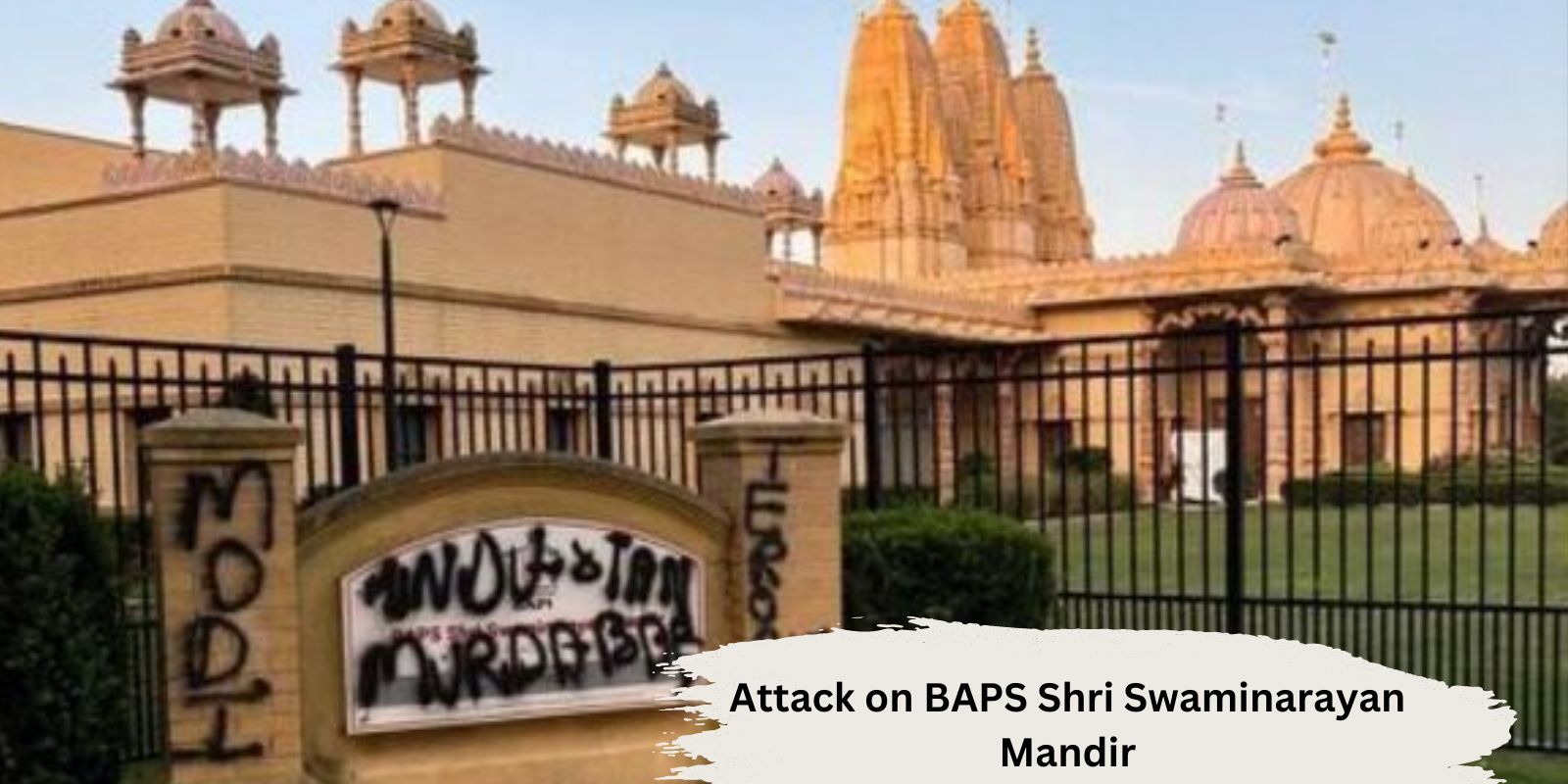
- Sajjan Kumar, a senior leader of Gandhi’s political party, was accused of orchestrating violence against Sikhs in Delhi during the riots. He was convicted in 2018 by the Delhi High Court and sentenced to life imprisonment.
- Kamal Nath, another senior leader of the party, has been accused of involvement in the violence. In 2020, a court dismissed a case against him due to insufficient evidence, but the accusations remain a point of contention.
- Jagdish Tytler, another party stalwart, has faced allegations of instigating violence against Sikhs. He is currently out on bail of Rs. 1 lakh, with the court proceedings to begin in October 2024.[20]
Such false and irresponsible statements from the leader of India’s opposition can have severe consequences for the millions of Indians living in America. On September 16, extremists vandalized the BAPS temple in Melville, New York, specifically targeting a Hindu place of worship. How long before this escalates further, resulting in physical harm to Hindus at the hands of these extremists?
Caste Census and Dalit Messiah
The modern caste system in India is a lingering legacy of British colonial rule, a legacy that continues to divide society. Since independence in 1947, India has implemented extensive affirmative action to address caste-based disparities, yet deep-rooted prejudices persist. Thus, it is reprehensible for any political leader to exploit this deeply divisive issue for political gain. For Rahul Gandhi, amplifying caste discrimination and posing as a champion of Dalit rights seems to be his go-to political strategy.
During an interaction with the students and the faculty of Georgetown University in Washington DC, he said, “The elephant in the room is that 90 percent of India — OBCs, Dalits and Adivasis don’t play the game…Caste census is a simple exercise to know how the lower castes, backward castes, and Dalits are integrated into the system…Out of the top 200 businesses in India, there is almost no ownership of 90 percent of the population of India. In the highest courts of the country, there is almost no participation of 90 per cent of India. In media, there is zero participation of lower castes, OBCs, Dalits…“[21]
Unfortunately for Rahul Gandhi, his pretense of supporting Dalits unravels when one looks at his alliance with the National Conference (NC) in Jammu and Kashmir—a party with a history of systemic discrimination against the Valmiki Samaj.
In 1957, the state government brought the Valmiki Samaj from Punjab to Jammu and Kashmir as sweepers. However, Article 370 and specifically 35A barred them from obtaining Permanent Residency Certificates (PRC), making them outsiders in their own land. For over 60 years, they were confined to low-paying sweeper jobs, unable to diversify or advance in their careers despite their education.
Without PRCs, they couldn’t enroll in professional postgraduate programs as universities required this certificate for admission. Even if they completed their graduation, they remained eligible only for sweeper roles, trapped in generational exploitation. Moreover, the Scheduled Castes and Scheduled Tribes (Prevention of Atrocities) Act, 1989, wasn’t applicable in J&K, making it difficult to address caste-based discrimination. [22] The abrogation of Article 370 on August 5, 2019, finally freed the Valmiki community, granting them equal rights as Indian citizens.
It’s rather telling that Mr. Gandhi chooses to remain in alliance with the NC party, which openly dreams of restoring the discriminatory and anti-Dalit Article 370 if they return to power in J&K. One can’t help but wonder how genuine his commitment to Dalit rights really is.
Conclusion
Rahul Gandhi’s portrayal of India as a nation plagued by caste oppression, religious intolerance, and democratic dysfunction is hardly befitting of someone projecting himself as a potential national leader. Instead of offering meaningful solutions, he appears more intent on exploiting societal divisions for political mileage.
Whether he claims to speak for Dalits, defends Sikhs, or critiques the economy, Rahul Gandhi often distorts reality to reinforce his image as the ultimate problem solver. This tendency to cast himself as a savior for every issue, regardless of context, reflects a growing “messiah complex” — a mindset marked by an inflated sense of self-importance and a belief that he has a unique mission to “save” society. Rooted in narcissism and a craving for validation, this mentality can easily justify extreme actions under the guise of a noble cause.
By persistently portraying India as a nation in constant crisis while positioning himself as its sole redeemer, Mr. Gandhi risks fomenting deeper societal divisions and widespread discontent. In a country like Bharat, governed by a cohesive constitution and a functioning, vibrant democracy, there’s no place or, rather, the need for a “messiah.”
Citations
[1] India Composite PMI (tradingeconomics.com); https://tradingeconomics.com/india/composite-pmi
[2] India’s Automobile Industry: Growth & Trends | IBEF; https://www.ibef.org/industry/india-automobiles
[3] Pharmaceutical Industry in India: Exploring Investment Opportu… (investindia.gov.in); https://www.investindia.gov.in/sector/pharmaceuticals
[4] India mobile manufacturing: India becomes 2nd largest mobile manufacturing nation: Counterpoint – The Economic Times (indiatimes.com); https://economictimes.indiatimes.com/industry/cons-products/electronics/india-becomes-2nd-largest-mobile-manufacturing-nation-counterpoint/articleshow/102715599.cms?from=mdr
[5] Textile Industry in India, Leading Yarn Manufacturers in India – IBEF; https://www.ibef.org/industry/textiles
[6] India has eliminated extreme poverty: Brookings report | Business News – The Indian Express; https://indianexpress.com/article/business/india-eliminated-extreme-poverty-brookings-report-9192018/
[7] India As an Emerging Global Manufacturing Hub (india-briefing.com); https://www.india-briefing.com/news/india-as-an-emerging-global-manufacturing-hub-32736.html/
[8] Indian economy will probably be 90 to 100% larger than China by the end of the century: John Chambers – The Economic Times (indiatimes.com); https://economictimes.indiatimes.com/news/economy/indicators/indian-economy-will-probably-be-90-to-100-larger-than-china-by-end-of-century-john-chambers/articleshow/113497479.cms?from=mdr
[9] No tax relief, Delhi HC dismisses Cong’s plea against recovery of ₹105 crore | Latest News India – Hindustan Times; https://www.hindustantimes.com/india-news/no-tax-relief-delhi-hc-dismisses-congs-plea-against-recovery-of-rs-105-cr-101710321102714.html
[10] The Emergency (India) – Wikipedia; https://en.wikipedia.org/wiki/The_Emergency_(India)
[11] Not just labor participation; it starts with the negative attitude that many Indian men have toward women. I don’t mean every single Indian man, but a… | By Indian National Congress | Facebook; https://www.facebook.com/IndianNationalCongress/videos/not-just-labour-participation-it-starts-with-the-negative-attitude-that-many-ind/1048868883429331/
[12] ‘Fight in India is if a Sikh can wear turban, kada’: Rahul Gandhi in US – The Economic Times Video | ET Now (indiatimes.com); https://economictimes.indiatimes.com/news/politics-and-nation/fight-in-india-is-if-a-sikh-can-wear-turban-kada-rahul-gandhi-in-us/videoshow/113223468.cms
[13] “Hindu Hai To Hinsa Hinsa Hinsa…:” Rahul Gandhi”s Big Statement | #etnow #rahulgandhi #shorts (youtube.com); https://www.youtube.com/shorts/WtMEklvvfy0?app=desktop
[14] More Indian Women Graduate in STEM than US, UK & Other Western Countries (womenentrepreneursreview.com); https://www.womenentrepreneursreview.com/viewpoint/experts-column/more-indian-women-graduate-in-stem-than-us-uk-other-western-countries-nwid-764.html
[15] The female workforce in India: Emerging trends and insights (orfonline.org); https://www.orfonline.org/expert-speak/the-female-workforce-in-india-emerging-trends-and-insights
[16] Simi Rose Bell John, Kerala Congress Casting Couch, Rajeev Chandrasekhar Shameful (ndtv.com); https://www.ndtv.com/india-news/simi-rose-bell-john-kerala-congress-casting-couch-rajeev-chandrasekhar-shameful-6472733
[17] Angkita Dutta: Assam Youth Congress president Angkita Dutta expelled from primary party membership for six years – The Economic Times (indiatimes.com); https://economictimes.indiatimes.com/news/politics-and-nation/assam-youth-congress-president-angkita-dutta-expelled-from-primary-party-membership-for-six-years/articleshow/99694250.cms
[18] https://x.com/ssaratht/status/1833847146174447745
[19] How the Congress propped up Bhindranwale | The Caravan (caravanmagazine.in); https://caravanmagazine.in/conflict/how-the-congress-propped-up-bhindranwale
[20] Congress Leader Jagdish Tytler Pleads ‘Not Guilty’ In 1984 Sikh Riots Case (ndtv.com); https://www.ndtv.com/india-news/congress-leader-jagdish-tytler-pleads-not-guilty-in-1984-sikh-riots-case-6555514
[21] Rahul Gandhi raises caste census issue in US, says will scrap reservation only when India is fair (thenewsminute.com); https://www.thenewsminute.com/news/rahul-gandhi-raises-caste-census-issue-in-us-says-will-scrap-reservation-only-when-india-is-fair
[22] Dalits-of-Jammu-and-Kashmir-The-Case-Study-of-Valmikis-Community-in-the-Jammu-Region.pdf (voiceforvoiceless.in); https://thirdvoice.voiceforvoiceless.in/wp-content/uploads/2023/09/7-Dalits-of-Jammu-and-Kashmir-The-Case-Study-of-Valmikis-Community-in-the-Jammu-Region.pdf

Donate to HINDUDVESHA
Our Mission is to explore and expose Hindudvesha through research analysis, education and response.
SUPPORT US