

Manufactured Victimhood Narrative in the Aftermath of Red Fort Terror Blasts: Islamophobia Accusations Weaponized to Protect Radical Elements
 Rati Agnihotri · 12/12/2025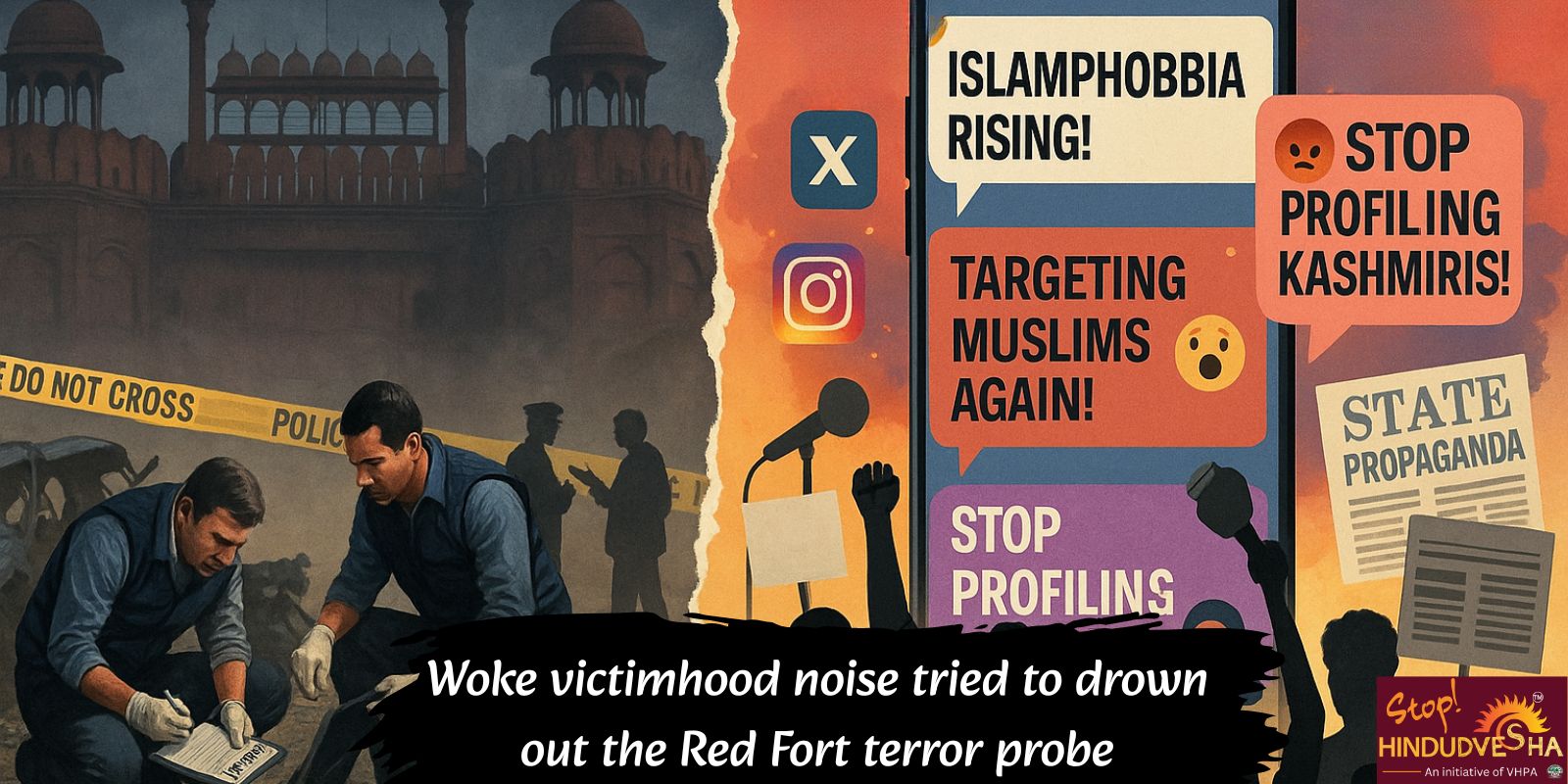
- From the 2025 Pahalgam attacks to the November 10–11 Red Fort blasts, the left-liberal and radical Islamist ecosystem has relied on the same familiar script of exaggerated, self-righteous victimhood.
- Within days of the Red Fort attack and the exposure of jihadist networks and the doctors’ module, social media was flooded with the usual hypocrisy: terror enablers dismissing evidence and crying Islamophobia.
- The Islamophobia narrative surged immediately, with Kashmiri politicians and civil society groups claiming profiling and targeting even as investigations unfolded.
- After every major attack, including Pahalgam and Red Fort, sections of the left-liberal and radical Islamist media amplify this narrative through articles that frame scrutiny of extremism as Islamophobia.
- This manufactured victimhood, combined with longstanding minority-appeasement politics, creates serious obstacles for agencies trying to identify and dismantle sleeper cells across the country.
Victimhood, inflated entitlement, and cancel culture have become defining traits of woke politics. Among these, manufactured victimhood is the most potent weapon in their toolkit. It is used not only to circulate false narratives but also to gaslight legitimate concerns about radicalization, extremism, and terrorism.
From 9/11 to the 2025 Pahalgam attacks and the November 10–11 Red Fort blasts in New Delhi, the same script repeats. Each time, the left-liberal and Islamist ecosystem abandons facts and launches its same familiar script of exaggerated, self-righteous victimhood.
No matter how grave the incident is, how clear the ideological motivation behind it, and how evident the radical networks involved, this ecosystem insists that the public simply look away. The moment a jihadi attack occurs, the victimhood engine switches into high gear. Social media erupts with loud claims of “Islamophobia,” drowning out any honest discussion about the extremism that caused the bloodshed.
This ecosystem spans mainstream media, academia, think tanks, activist networks, and popular culture. Together, they sanitize terrorism and create a protective shield around extremist actors by weaponizing the Islamophobia label. Ordinary citizens, journalists, civil society groups, and even government agencies become targets the moment they ask uncomfortable questions about radical Islamist networks.
Through persistent narrative manipulation, this lobby manufactures sympathy for extremists and obstructs investigations. In the sections ahead, we examine how this familiar “Islamophobia” script is already unfolding after the November 10 Red Fort terror attack that killed at least ten people and injured more than thirty.
Playing the Victim Card Through Social Media
For the left-liberal and the radical Islamist ecosystem, every national or international tragedy becomes an “opportunity” for peddling the victimhood narrative.
Barely a couple of days following the Red Fort terror blasts and the unearthing of the Jihadist networks and the doctors’ module, the social media was abuzz with the hypocrisy of the usual suspects – closet Jihadis and terror enablers crying Islamophobia: “Muslims are being insulted and called terrorists in schools, offices, and online. Terrorism has no religion, and Muslims are its victims too; many died in Delhi blasts. Muslims have shed blood for this land, stood for its unit,y and still face suspicion and persecution. Enough. Stop criminalizing Muslim identity!” – Arfa Khanum on X[1]
Another “journalist” put out a post on X in which she shifted the blame for Muslim radicalization in India onto the Modi government’s Kashmir policy. This follows the familiar Islamist victimhood toolkit, where self-victimization of one’s own community is inflated to the point that all wrongdoing is conveniently transferred to an imagined “oppressor”: “Many Muslims r rightly worried abt radicalisation among educated after Delhi terror incident. Radicalisation doesn’t happen in vacuum or without political trigger. Forget Kashmir issue, educated youth has been pushed to edge after Art370/35A. See no hope for an honorable future.” – Ghazala Wahab on X [2]
In another post, Ghazala Wahab weaponizes her identity to discredit the investigative cycle, subtly insinuating that the findings being unearthed during the investigation seem a conspiracy of the “Hindutva state” and will be perhaps used to harass Muslim “professional class”: “But an even greater worry is the State & larger Hindutva universe, which extends to potential neighbors & employers, will use this to further harass & marginalize the professional class among Muslims, those who aspire to stay in the mainstream, seeking a future in India”.[3]
Saba Naqvi further pushed the Islamophobia victim narrative through her post on X, claiming that Indian Muslims were being unfairly singled out and expected to condemn terrorism: “All Indians must and do condemn all terrorism. I don’t understand why Muslims particularly must do so as if they are all guilty till they apologise. Think back to the identity of the terrorists who assassinated Mahatma Gandhi, Indira Gandhi, Rajiv Gandhi, and recognise that all communities produce fanatics and terrorists who never represent the entire community”. [4]
There are many such examples of social media posts by radical Islamic voices posing as “moderate intellectuals” in the aftermath of the Red Fort blasts. Ironically, it is the same group that has long championed the “Hindutva terror” bogey[5], a claim that continues to circulate despite the acquittal of all accused in the Malegaon case—the very case on which the entire narrative was constructed. Yet this ecosystem immediately cries Islamophobia the moment anyone uses the term “Islamic terrorism,” even though there is an overwhelming body of evidence linking such attacks to global jihadi networks.
Interestingly, several “activist” voices crying Islamophobia after the Red Fort blasts have a long record of insulting and abusing Hindu deities. A perennial Hinduphobic commentator, Rana Ayyub, has repeatedly used her platform to insult Hindu deities, undermine India’s unity, incite hostility against the country, disparage the Indian Army, and even label the 2022 anti-hijab protestors in Karnataka as “Hindu terrorists[6].”
Another far-left commentator, Arfa Khanum, has long been at the forefront of spreading hostile narratives against Hindu Dharma and culture.[7] Yet she readily turns to the Islamophobia victim card whenever it is time to whitewash jihadist violence.
Inside the White-Collar Jihad Network
The white-collar terror module exposed in the Red Fort suicide car bomb investigation revealed a hybrid model of terrorism that operates with tactics far removed from anything investigative agencies have dealt with before.
Faridabad’s Al-Falah University has emerged as the center of this Jihadi network, with many doctors linked to the University being investigated for their alleged role in orchestrating the attacks.[8] Dr. Umar Mohammad, the suicide bomber in the Red Fort incident, openly justified suicide bombings as “martyrdom,” stating, “One of the most misunderstood concepts is what has been labelled suicide bombing. It is a martyrdom operation… known in Islam.”[9]
As the investigation into the white-collar terror module—with networks spread across India—intensifies, the “manufactured victimhood” narrative has surfaced once again. With authorities increasing scrutiny of individuals linked to these networks, predictable outrage has begun to emerge.[10] In a textbook case of playing the “victimhood card,” groups like the Jammu and Kashmir Students Association (JKSA) now allege that Kashmiri students in several northern states are facing increased profiling and eviction after the Red Fort blast, calling the public discourse on Islamic terrorism as “vilification” of the community.[11]
Even the Jammu and Kashmir Chief Minister Omar Abdullah, whose father was in power during the 1990 genocidal exodus of nearly half a million Kashmiri Hindus, claimed that Kashmiris are now being viewed with blanket suspicion after the Red Fort blasts. “A few people are responsible for what happened in Delhi, but a perception is being created where all Kashmiris are being looked at with suspicion,” he said at a local event.[12]
PDP chief Mehbooba Mufti went further, subtly framing the attack as a consequence of government policy. She blamed the Centre for the radicalization of doctors, accusing it of creating a “hate-filled environment” that was supposedly pushing youth “toward a dangerous path.”[13]
The “Hindutva fascist” rhetoric pushed by the left-liberal ecosystem, combined with the Islamophobia victim-card narrative, creates serious obstacles for agencies combating radical Islamist extremism. Manufactured victimhood, reinforced by the politics of minority appeasement, makes it harder for authorities to uncover and dismantle sleeper cells operating in the country.
Even as investigative teams expose new modules by the day, the virtue signaling of the left-liberal and radical Islamist lobby works to whitewash the machinery of jihadist terror.
Islamophobia as a Shield Against Accountability
In the aftermath of major terror incidents such as the Pahalgam attacks or the Red Fort blast, sections of the left-liberal and radical Islamist media often respond with commentary that leans heavily on the Islamophobia narrative. Rather than focusing on rigorous reporting or examining the underlying causes of such violence, these outlets appear more concerned with protecting the perceived sentiments of a particular community, even when credible investigative findings are available.
A recent article in Youth Ki Awaaz, titled “Red Fort Blast’s Media Spectacle, Security Discourse, and Politics of Fear,” is a telling example. While the piece adopts an air of seriousness, it offers little engagement with factual details or investigative evidence. Through broad assertions, the writer implies that the findings in the Red Fort case amount to a state-driven narrative targeting Muslims. In this framing, Islamophobia becomes the central explanation for every development. As the article claims: “The Red Fort incident thus reveals how Islamophobia continues to operate as both a representational frame and a political instrument. The hasty attribution of intent, often directed at Muslim suspects, reproduces long-standing stereotypes of cultural deviance and disloyalty.”[14]
An opinion piece in Maktoob Media titled “When a comment calls for cleaning”[15] laments what it describes as rising Islamophobia on social media after the Red Fort blasts. The writer cites several examples of online hate speech directed at Muslims. Hate speech against any community is unacceptable, but the article’s exclusive focus on online rhetoric—without any acknowledgment of the broader issue of radicalization in the subcontinent—reveals a predetermined narrative. “Genocide begins with unchecked words, not weapons,” the writer asserts, a claim that sets the tone for the piece’s underlying message: real acts of terror receive minimal scrutiny, while the emphasis shifts to an inflated narrative of discursive harm.
The Islamophobia framing has become so dominant in post–Red Fort commentary that a simple search for “Islamophobia after Red Fort terror blasts” yields numerous pieces repeating the same theme of Muslim victimhood. The search even triggers an automated AI-generated summary stating that the November 10, 2025, attack has been followed by reports of increased anti-Muslim sentiment across parts of India, further reinforcing this narrative.
The origins of Islamophobia can be traced to the Christian Crusades of the Middle Ages, when efforts to conquer Muslim-ruled territories shaped early anti-Muslim attitudes. Edward Said’s critique of Orientalism, still influential in academic research examining Western representations of non-Western societies, also incorporates a critique of Islamophobia. Said argued that Western Orientalist scholarship portrayed Islamic society as exotic and primitive, while downplaying the rich and complex intellectual heritage of the Islamic world.[16]
In the 21st century, the term gained prominence after the 9/11 attacks in the United States. However, what began as a set of concerns about profiling and surveillance of Muslims soon evolved into a full-scale narrative industry, where identity politics is frequently used to downplay or obscure the role of extremist networks.
Today’s Islamophobia discourse leaves little room for even measured criticism of radical Islamist ecosystems. By leaning on a constant victimhood posture, this discourse creates new layers of grievance to divert attention from uncomfortable questions about Jihadist ideology.
In India, where Hindus have faced centuries of Islamic invasions and repeated episodes of targeted communal violence, the Islamophobia narrative takes on even more troubling contours. It operates not only to sanitize jihadist violence against Hindus but also to invert reality by promoting a “Hindutva supremacy” storyline that seeks to justify or excuse acts of terror.
UN’s Double Standards
The UN defines Islamophobia as “A fear, prejudice and hatred of Muslims that leads to provocation, hostility and intolerance by means of threatening, harassment, abuse, incitement and intimidation of Muslims and non-Muslims, both in the online and offline world. Motivated by institutional, ideological, political and religious hostility that transcends into structural and cultural racism, it targets the symbols and markers of being a Muslim”.[17]
The definition is so expansive that criticism of radical Islamist groups or extremist indoctrination can be construed as Islamophobic. By this logic, even regulating face coverings in public spaces or adopting a uniform civil code could fall under the label.
The UN has formally recognized Islamophobia and designated March 15 as the International Day to Combat it. Yet its silence on phobias targeting non-Abrahamic faiths, including Hinduism, exposes a clear double standard. It also condemns discrimination against Muslim minorities while saying little about the near absence of minority rights in many Islamic nations.
Wrapping Up
India’s complex political landscape, with its many competing interest groups, makes it difficult for the government to act decisively against terror sympathizers and apologists.
Minority appeasement has long shaped Indian politics, and the tendency of some Kashmiri leaders to downplay or rationalize terrorism fits into that pattern.
With the exposure of the doctors’ module after the Red Fort blasts and the Gujarat Anti-Terrorism Squad’s discovery of a bio-terror plot, jihadist networks have shown how deeply they can embed themselves within society.
As challenging as the situation is, India needs a firm state policy with zero tolerance not only for terrorism but also for those who enable or justify it
Citations
[1] Arfa Khanum Sherwani on X; https://x.com/khanumarfa/status/1988841147574407334
[2] Ghazala Wahab on X; https://x.com/ghazalawahab/status/1988805209859228051
[3] Ghazala Wahab on X; https://x.com/ghazalawahab/status/1988886928104562863
[4] Saba Naqvi on X; https://x.com/_sabanaqvi/status/1988892528435662861
[5] Karnataka Police | Karnataka: Journalist Rana Ayyub booked over ‘Hindu terrorists’ – Telegraph India; https://www.telegraphindia.com/india/karnataka-journalist-rana-ayyub-booked-over-hindu-terrorists/cid/1854599
[6] Karnataka Police | Karnataka: Journalist Rana Ayyub booked over ‘Hindu terrorists’ – Telegraph India; https://www.telegraphindia.com/india/karnataka-journalist-rana-ayyub-booked-over-hindu-terrorists/cid/1854599 https://www.telegraphindia.com/india/karnataka-journalist-rana-ayyub-booked-over-hindu-terrorists/cid/1854599
[7] Police complaint against The Wire’s Arfa Khanum Sherwani over Hinduphobic post replacing Shivling with a dustbin; https://www.opindia.com/2024/08/police-complaint-lodged-against-arfa-khanum-sherwani-over-hinduphobic-post-replacing-shivling-with-a-dustbin/
[8] Explained: Who Did What In White Collar Terror Module Behind Delhi Blast; https://www.ndtv.com/india-news/explained-who-did-what-in-white-collar-terror-module-behind-delhi-blast-9663961
[9] Video: Delhi bomber Dr Umar Mohammad, Umar Nabi Talks About Suicide Bombing, Delhi i20 Car Blast, Red Fort Blast; https://www.ndtv.com/india-news/video-delhi-bomber-dr-umar-mohammad-umar-nabi-talks-about-suicide-bombing-delhi-i20-car-blast-red-fort-blast-9654215
[10] Delhi blast: Faridabad police question over 2,000 Kashmiri students, tenants for possible ‘white collar terror’ links | Today News; https://www.livemint.com/news/india/delhi-blast-faridabad-police-question-over-2-000-kashmiri-students-tenants-for-possible-white-collar-terror-links-11763358853855.html
[11] JKSA alleges ‘collective suspicion’ of Kashmiri students after Delhi blast – The Hindu; https://www.thehindu.com/news/cities/Delhi/jksa-alleges-collective-suspicion-of-kashmiri-students-after-delhi-blast/article70290099.ece
[12] All Kashmiris being looked at with suspicion after Delhi Red Fort blast, Omar says; https://indianexpress.com/article/india/all-kashmiris-looked-suspicion-delhi-red-fort-blast-omar-abdullah-10374895/
[13] ‘Troubles Of Kashmir Echoed At Red Fort’: Mehbooba Mufti’s Shocker On Delhi Car Blast, BJP Reacts | India News – News18; https://www.news18.com/india/mehbooba-mufti-delhi-red-fort-car-blast-remark-troubles-of-kashir-echoed-in-delhi-9712386.html
[14] Red Fort Blast’s Media Spectacle, Security Discourse, And Politics Of Fear; https://www.youthkiawaaz.com/2025/11/trials-tribulation/
[15] When a comment calls for cleansing; https://maktoobmedia.com/opinion/when-a-comment-calls-for-cleansing/
[16] Islamophobia | Meaning, History & Portrayal of Muslims | Britannica; https://www.britannica.com/topic/Islamophobia
[17] International Day to Combat Islamophobia | United Nations; https://www.un.org/en/observances/anti-islamophobia-day

Donate to HINDUDVESHA
Our Mission is to explore and expose Hindudvesha through research analysis, education and response.
SUPPORT US