

January 19, 1990: Remembering the Forced Exodus of Kashmiri Hindus
 Dr. Jai G. Bansal · 01/19/2026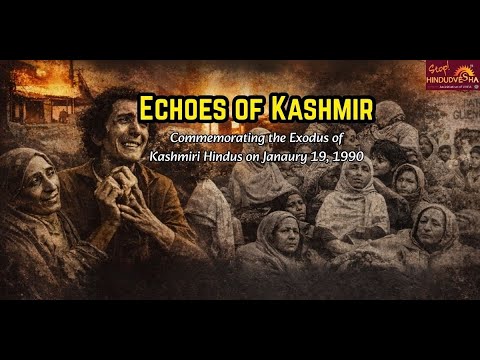
This piece is a paraphrased transcript of a webinar titled Echoes of Kashmir, held on January 19, 2026, to remember one of the darkest chapters in India’s recent history: the forced exile of Kashmiri Hindus in 1990. The discussion took place on the anniversary of the night when fear, targeted violence, and mass intimidation culminated in the expulsion of an entire indigenous community from the Kashmir Valley. Drawing on survivor testimony, historical context, and political analysis, the webinar examined how this tragedy unfolded, how it was later denied or misrepresented, and why its memory remains essential for justice, accountability, and preventing repetition in the future.
The complete video recording of the webinar can be found here: ECHOES OF KASHMIR VIDEO
Moderator (Jai Bansal)
Namaste, Sat Shri Akal, and a very good day to everyone joining us today.
Thank you for being part of this solemn webinar, Echoes of Kashmir. I am your host, Jai Bansal, and I serve as Vice President of Education at Vishwa Hindu Parishad of America.
We are joined today by two eminent panelists who will speak about their lived experiences of the events we are commemorating. Before I formally introduce them, I would like to frame the purpose and context of today’s webinar.
We are here to remember one of the darkest chapters in independent India’s history. The night of January 19, 1990 was a night of terror that forever altered the lives of hundreds of thousands of Kashmiri Hindus. Under open threats, targeted killings, and escalating intimidation, an entire community, whose ancestors had lived in Kashmir for thousands of years, was pushed to the brink.
At that time, there was no elected government in place. The Chief Minister had resigned and fled, leaving Kashmiri Hindus without any political protection. As fear reached its peak and terror closed in, what followed was a sudden and traumatic exodus. Families fled overnight, abandoning their homes, temples, livelihoods, and generations of memories.
That displacement did not end in weeks or months. It became decades of exile, loss, and unresolved grief.
This webinar is not about slogans or retrospective arguments. It is about truth, lived experience, and remembrance. Too often, the Kashmiri Hindu exodus is reduced to statistics or passing references. Today, we seek to restore its human dignity, its reality, the fear that preceded it, and the long silence that followed.
This is a serious and solemn occasion. We request you to listen with seriousness and empathy. Remembering is not only about the past. It is our moral responsibility to understand history and learn from it.
To help us unpack these issues, we have two distinguished panelists.
Dr. Ajay Chrungoo ji is the Chairman of Panun Kashmir, a political movement of Kashmiri Pandits formed in response to the forced exodus and genocide of Hindus in Kashmir. A physician by profession, Dr. Chrungoo is also a well-known political analyst on Jammu and Kashmir affairs and a freelance writer on human rights and terrorism. He is joining us today from Bharat.
Sanjay Kaul Ji is a professional civil engineer and a social and cultural activist based in Boston. He is a founding director of the Multidisciplinary Institute of Teaching and Learning, the American Asian Pacific Islander Action Group, and the Massachusetts Wellness Initiative. He has served as International President of the Kashmiri Overseas Association for two terms. Over the years, he has organized presentations, seminars, and symposiums on Kashmir and has made representations to the Government of India, international leaders, and U.S. Congress members, conveying the views and aspirations of Kashmiri Hindus. Currently, he serves as Joint General Secretary and International Coordinator of Vishwa Hindu Parishad of America.
A very warm welcome to both of you, Ajay Ji and Sanjay Ji.
We will begin with Sanjay Kaul Ji, who will speak about the harrowing experiences that led up to the events of January 19, 1990.
Sanjay Kaul
Thank you, Jai Ji, for that introduction, and thank you to Vishwa Hindu Parishad of America for organizing this seminar under its Global Hindu Division program.
The American author William Faulkner once said, “The past is never dead.” We also know that those who forget their past are bound to repeat it. With that understanding, the purpose behind remembering our exodus is threefold.
First, it is to remind ourselves and to tell our children what was done to us. Second, it is to seek support from well-wishers like those who have joined us today, people who care enough to listen and stand with us.
There is, however, a third and deeply personal reason. Many members of our community are no longer with us. They passed away carrying an unfulfilled longing to return to their homes in Kashmir. It is now our responsibility to keep that longing alive.
When I left Kashmir, it was not just my wife and I. My parents and my grandparents left as well. Three generations were uprooted overnight. Today, neither my grandparents’ generation nor my parents’ generation is alive. Their wish to return remained unfulfilled. That responsibility now rests on our shoulders.
This is also why we organize programs like this: to acknowledge those among us who have worked selflessly for decades, meeting officials, making representations, and speaking relentlessly about our rights and our desire to return and resettle. We take this moment to thank Kashmiri Hindu institutions and organizations across India and the world that continue to preserve our culture, protect our heritage, and speak for us wherever someone is willing to listen.
Now, to the question of where we stand today.
I ask everyone to imagine this: it is a bitterly cold winter night. It is pitch dark and raining heavily. You are driving with zero visibility. You reach a four-way intersection. There is no GPS, no map, and no phone to guide you. How would you feel?
You would feel lost. You would feel helpless, unsure which way to turn.
That is exactly how Kashmiri Pandits feel today.
This year marks thirty-six years since our exodus. In all this time, no political party has truly owned our cause. Governments have changed, Prime Ministers have changed, but our displacement has never been meaningfully addressed. We remain refugees in our own country.
The genocide of Kashmiri Hindus represents one of the starkest faces of evil in independent India, yet it has never been formally acknowledged. I say this with certainty: if this history is not confronted honestly, it will repeat itself elsewhere. We are already witnessing echoes of it in Bangladesh, where Hindus face targeted violence and persecution. If Indian society and the Indian state do not come together, we will once again look back and ask why we failed to act in time.
Many explanations of the Kashmir crisis point to economic deprivation, lack of opportunity, or underdevelopment. I say this plainly: such narratives are either naïve or deliberately misleading. They obscure the reality of a community-wide, militant-backed insurgency against India.
Kashmir has long had one of the highest per capita incomes in the country. Housing, food, and essential services were heavily subsidized. The state’s budget was sustained largely through central grants. In many ways, Kashmir was a pampered region.
In my view, the crisis in Kashmir rests on four fundamental factors. The first is the unfulfilled ideological project of Islamist dominance spanning more than a thousand years. The second is the unresolved conflict between two fundamentally opposing value systems.
India is a secular, democratic republic with a Hindu majority, and coexistence has always been a civilizational value for us. We have lived with diverse cultures, ethnicities, and religions for centuries. In contrast, radical Islamist clerical ideology rejects coexistence with other faiths. That ideological incompatibility played out brutally in Kashmir.
The third major factor is Pakistan’s long-standing obsession with the region. From the moment of Partition, Pakistan viewed Kashmir as unfinished business. When General Zia-ul-Haq became President, this obsession took a more dangerous form. He openly promoted cross-border terrorism and systematically trained, funded, and armed militants to destabilize India. His doctrine was simple and ruthless: if Pakistan could not defeat India in a conventional war, it would bleed India through a thousand cuts. What unfolded in Kashmir from 1989 onward was the direct outcome of this strategy. It became a full-scale terror campaign against India.
Violence in Jammu and Kashmir became open and normalized. The methods were barbaric: rape, murder, and targeted assassinations. Prominent Kashmiri Hindu leaders were killed in broad daylight. Homes were burned, businesses looted, and temples destroyed.
One would expect the police and state machinery to protect citizens under such conditions. Instead, they often worked with or looked away for the separatists. Injured Hindus were refused treatment by hospitals and doctors. The press was silenced. Conditions were deliberately created to make life unsafe and unlivable.
Then came the night of January 19, 1990.
Mosque loudspeakers across Kashmir came alive simultaneously. The message was chillingly clear: “Kashmir mein Islam.” Muslims were ordered onto the streets. Hindus were addressed as kafirs, non-believers. The ultimatum was unmistakable: convert, flee, or die.
Kashmiri Hindu men were told to leave to save their lives but ordered to leave their women behind. That announcement was nothing less than an eviction notice for Hindus from Kashmir.
Imagine thousands, even lakhs, of people flooding the streets, banging on your doors, breaking windows, trying to force their way into your home. You would feel helpless. Trapped. Like prey.
That is how the indigenous Hindu population of Kashmir was driven out. Kashmiri Hindus suffered genocide and ethnic cleansing. The exodus was forced upon us by Islamic terrorism.
Thirty-six years later, we remain in exile. Many of us still live in refugee camps in Jammu, Delhi, and other parts of the country.
Over the years, several false narratives have been promoted to distort the truth. One of the most persistent myths is that Governor Jagmohan forced Kashmiri Hindus to leave. Anyone who has listened to survivor testimonies or spoken to Kashmiri Hindus knows this is false. It was genocide that created the conditions of exodus.
Lists bearing Hindu names were pasted outside mosques. People saw their names and wondered, Am I next? Warning notices appeared on doors. One such notice was pasted on my own home, giving me twenty-four to forty-eight hours to leave Kashmir. This was not an administrative order. It was a threat of death.
Another persistent myth is that Kashmiri Hindus and Muslims lived in perfect harmony under the idea of Kashmiriyat or bhaichara (brotherhood). If any such coexistence existed, it did so largely because of Hindu tolerance.
History tells a very different story. From the arrival of Islam in Kashmir in 1338 until the onset of Dogra rule, Kashmiri Hindus were driven out of the Valley four separate times. Each time, we returned. Each time, we resettled. And each time, we compromised.
It began under Sultan Sikandar, when the chilling slogan “Raliv, Galiv, ya Chaliv” was coined: convert, flee, or die. It continued under the Chak rulers, under the Mughals, and later under Afghan rule.
In the twentieth century, the pattern repeated itself. During the 1931 agitation led by Sheikh Abdullah against the Maharaja, Kashmiri Hindus again bore the brunt of violence. Hindu shops were looted, homes were burned, and many families were forced to flee.
Even in recent memory, the violence did not stop. In 1986, during the tenure of Chief Minister Ghulam Mohammad Shah, Islamist mobs in South Kashmir destroyed more than one hundred temples in a single day, while Hindu homes and businesses were looted and vandalized.
If this is bhaichara or Kashmiriyat, one must honestly ask whether it ever truly existed. The reality is that Hindus survived in Kashmir not because of mutual harmony, but because Hindus tolerated, adjusted, and compromised again and again.
Another false narrative claims that Kashmiri Hindus were a privileged community. The facts clearly disprove this. After the accession of Jammu and Kashmir to India, particularly under National Conference governments, Kashmiri Hindus were systematically reduced to second-class citizens.
Our representation in professional colleges and government jobs was steadily curtailed. Census figures were manipulated to understate our population. Despite being less than five percent of the population, we were denied minority protections on the grounds that Hindus are a majority in India.
There is also the claim that the Government of India unleashed excessive force in Kashmir. The truth is that Kashmiri Muslim separatists viewed their movement as a struggle for freedom from India, whether through merger with Pakistan or the creation of an independent state. Kashmiri Hindus did not join that movement. We remained loyal to India. We stood as visible symbols of Indian nationalism in Kashmir.
For that loyalty, we paid a terrible price.
Even after the exodus, those Kashmiri Hindus who remained in the Valley or resettled in nearby villages were not spared. Massacres continued.
In 1997, in Sangrampura village in Baramulla district, seven members of a single Hindu family were brutally killed. That same year, in Gul village in Ramban district, people were asked their religion and shot dead. In Wandhama, in Ganderbal district, twenty-four Kashmiri Hindus were dragged out of their homes and murdered.
The violence did not end with displacement. It continued as a warning and as a message.
In the year 2000, when President Bill Clinton visited India, terrorist groups sought international attention through coordinated massacres. In Chittisinghpuora, in Anantnag district, thirty-five Sikhs were brutally killed. On the very same day, in Nadimarg in Pulwama district, twenty-four Kashmiri Hindus were massacred. This incident is depicted in The Kashmir Files, but it was not an isolated event. There were many others.
We were not safe anywhere. We were never safe among them.
In total, more than 1,500 Kashmiri Hindus have been killed. Thousands more have endured torture, displacement, and lifelong trauma. Over 5,000 security personnel have also lost their lives. The National Human Rights Commission of India has rightly described the Kashmiri Hindu exodus as akin to genocide. Yet the world has remained largely silent.
Before I conclude, I want to summarize what we seek today and how we understand our situation, through three observations drawn from my own experiences.
My first observation goes back nearly twenty-five years. We organized an Exodus Day seminar in New Jersey. My dear friend Vijay Parimoo was invited to open the program. When he stepped onto the stage, he froze. Tears streamed down his face. When asked what had happened, he said the realization had overwhelmed him: “We are the original inhabitants of Kashmir. Our documented history spans more than 6,000 years. We are nationalistic, democratic, and law-abiding. We have suffered genocide. We are now refugees. And yet, we must beg people to listen to us, to help us.” That moment captured the helplessness of our community.
My second observation comes from a conversation with my father. I once asked him why we would ever want to return to Kashmir. He replied: “It is the land of our forefathers. Our culture and heritage are in the air. The ashes of our ancestors are mixed with that soil. How can we give it up? One day, we must return.”
My third observation comes from a recent email from my dear friend Mr. Ravi Raina, who is also among the participants here today. Now retired, he divides his time between Canada, the United States, and India, and frequently visits Kashmir. He wrote to me that a separate, protected homeland for Kashmiri Hindus is the only viable solution. Nothing else will work. He warned that returning to the pre-1990 situation would make us easy targets once again. Why, he asked, should we knowingly walk back into danger and wait for destruction?
These three observations lead to one unavoidable conclusion: those who do not learn from history are condemned to repeat it. We do not want to repeat what happened to us.
Moderator
Thank you, Sanjay Ji, for sharing this harrowing account of the Kashmiri Hindu exodus. Many of us have watched The Kashmir Files, but hearing these experiences directly from someone who lived through them adds a profoundly human dimension.
I now invite Ajay Ji to speak about what has happened to displaced Kashmiri Hindus over the past thirty-six years: how they have lived in exile, how they have resettled, and the challenges they continue to face.
Dr. Ajay Chrungoo
Before I respond directly to the question, I want to reflect briefly on the theme of this program, Echoes of Kashmir.
The most powerful echo we must confront is this: between 1988 and 1990, a genocidal war against Hindus was unleashed in Kashmir. That campaign reached its immediate objective through mass displacement and has since entered what genocide scholars describe as the phase of denial, followed by consolidation of genocide.
This must be stated without ambiguity. The events of 1989–90 cannot be understood in isolation. Kashmiri Hindus have suffered repeated exoduses over centuries. Sanjay Ji referred to four major expulsions, but many historians identify seven distinct exoduses. What happened in 1990 was the seventh.
Once we accept this, we must also accept a deeper truth: Kashmiri Hindus have been subjected to a continuous genocidal process for nearly seven hundred years. More broadly, Hindus across the subcontinent have faced waves of genocidal violence for over a millennium.
This process did not begin in 1990. It began with early Islamic invasions, intensified under medieval rule, continued through successive regimes, and took on its modern political form during the Partition of India in 1947. Partition itself was a genocidal event. Pakistan was born through the mass killing, displacement, and dispossession of Hindus.
What followed in both West Pakistan and East Pakistan was the continuation of that genocide, a process that has never truly stopped. We are witnessing its consequences even today in Bangladesh. At the time of Partition, Hindus constituted nearly one-third of Bangladesh’s population. Today, that figure has fallen below seven percent. This demographic collapse reflects mass killings, forced conversions, and displacement on a vast scale.
In present-day Pakistan, Hindus once made up around 15% of the population; today, they are fewer than 2%. In Kashmir, Hindus constituted about 5% of the population; today, their presence has been reduced to well below 1%. These figures alone demonstrate that the genocidal process is ongoing.
This brings me to the second echo of Kashmir: genocide that is denied does not disappear; it replicates. Scholars of genocide consistently warn that denial enables repetition. What began in Kashmir spread outward. It moved into Jammu, and today it manifests in different forms across other parts of India. What is often described as “political violence” in places like West Bengal carries unmistakable genocidal features.
The third echo of Kashmir is equally sobering. Where genocidal processes are completed, those regions are permanently lost to indigenous civilization. The loss is not merely territorial. It is cultural, civilizational, and demographic. This process continues in different forms even today.
I also want to correct a crucial misconception. Many believe that something sudden happened on January 19, 1990. That is incorrect. January 19 did not mark the beginning of violence; it marked its culmination.
Targeted killings had already begun. Prominent Hindu figures such as Tika Lal Taploo and Prem Nath Bhat were assassinated before January 19. Fear had already been normalized. Terror had already been institutionalized. January 19 was the moment when genocide announced itself openly and unapologetically.
One of the earliest and most chilling examples was the killing of Justice Neelkanth Ganjoo, a retired Sessions Court judge, in 1989. He was murdered because, as a Sessions Judge, he had convicted Maqbool Bhat, a JKLF terrorist leader, and sentenced him to death. That judgment was later upheld by higher courts.
Justice Ganjoo was deliberately chosen. He was assassinated, and his body was left on the ground with a note warning that it should not be touched. After his cremation, a disturbing justification entered public discourse. Many openly claimed that because this was a so-called “freedom struggle,” Justice Ganjoo deserved to be killed for sentencing one of its leaders.
One critical fact must be underlined. All the witnesses in the Maqbool Bhat case were Muslims. The judge who upheld the sentence in the higher court was also a Muslim. None of them was harmed. Justice Ganjoo alone was killed because he was a Hindu, a Kashmiri Pandit.
By 1988 and 1989, public discourse in Kashmir had been thoroughly poisoned. Kashmiri Hindus were systematically projected as the other. They were portrayed as obstacles to Muslim aspirations, as people who had allegedly usurped Muslim rights. Social profiling was complete. The Kashmiri Hindu was no longer a neighbor. He was the enemy, someone to be eliminated.
The pattern was chillingly familiar. It mirrored the social profiling of Jews in Europe before the Final Solution. By the time mass extermination began, Jews had already been cast as enemies of progress and prosperity. The same process unfolded in Kashmir.
Selective killings began well before 1990. Scholars have offered various estimates. Amal Kole, in The Veil of Silence, notes that of approximately 2,500 Hindus killed, nearly 1,800 were Kashmiri Pandits. Other estimates place the figure between 1,000 and 1,500. Government data states that by October 1993, around 319 targeted killings had occurred.
Now consider the nature of these killings. Even if one accepts the government’s figure of 319 selective assassinations, the brutality was extraordinary. Every known method associated with genocidal violence was employed: hanging, burning alive, strangulation with wires, draining of blood in hospitals, drowning, beating victims to death, dragging bodies through streets, dismemberment, slicing, gouging out eyes, branding with red-hot iron rods, and impalement.
Within this relatively small number of killings, every form of cruelty and sadism was present. That fact alone reveals the depth of hatred driving the violence against Hindus.
At this point, a parallel is unavoidable. After the 9/11 attacks, investigations revealed how Osama bin Laden justified his actions. He believed he was acting with divine sanction. He argued that intense hatred of infidels was not only permitted but required, and that without such hatred, Muslims would become apostates.
When I read those statements, I immediately recognized the same ideological logic behind the killings in Kashmir. The savagery, the symbolism, and the cruelty were not random acts of violence. They were ideologically driven. This is precisely how a genocidal process unfolds. By legal and academic standards, the pattern of killings in Kashmir meets every criterion for genocide.
At the time, it was claimed that this violence was the work of a handful of terrorists from Pakistan, acting without the support of Kashmiri Muslim society. That claim collapses when we examine January 19, 1990.
January 19 was not the beginning of genocide. It was its public endorsement.
On that day, millions of Muslims across the Valley poured onto the streets, from evening until deep into the night. The message was explicit and unambiguous: Kashmiri Hindus must leave. Kashmiri Pandits were not welcome. For six to eight hours, Hindu families lived with the certainty that mobs could break into their homes and burn them at any moment.
The administration was effectively absent. Governor Jagmohan had technically assumed office but had not yet reached Kashmir. In his own writings, he states clearly that the administration refused to cooperate with him. His calls went unanswered.
Terrified Kashmiri Hindus called him repeatedly. In desperation, Jagmohan often told them that the army was on standby. Many Pandits later spoke directly to army officers, who were themselves shocked. Even the Northern Command was unaware of what was unfolding. The Corps Commander in Kashmir did not know either.
Most disturbing of all, there was a standing instruction that the army was not to be deployed under any circumstances.
So what happened on January 19, 1990? The mobs did not come out with guns to kill thousands. They came out in millions to declare something far more decisive: that Kashmiri Hindus had no place in Kashmir.
This was a social sanction. It was society openly endorsing a genocide that had already begun.
Until that day, many Hindus believed that only a small extremist group was responsible for the violence, and that the larger Muslim society consisted of neighbors, friends, and well-wishers. January 19 shattered that illusion.
I am not saying that no Muslim helped the Kashmiri Pandits. Some individuals did, and their courage deserves recognition. But we are discussing a social pattern, not isolated exceptions.
Across the Valley, slogans rang out: Leave your women behind and go. You cannot live here. We will not allow you to stay. Mosque loudspeakers broadcast threats directly addressed to Hindus, echoing across towns and villages.
Selective killings had already begun, following the logic of kill one, terrorize many. January 19 was the day of the proclamation. It was the day society declared its consent to expulsion, ethnic cleansing, and religious purification.
That is why January 19 remains etched in our collective memory.
That is why it became such a defining day for us. Instinctively and unanimously, we understood that this was the day to be remembered, especially if truth were ever to be restored and this tragedy reversed in history.
January 19 revealed something fundamental: the abdication of the state. The state did not merely fail; it was made to abdicate. The secular vision of the country, instead of protecting its citizens, became an insulation, a shield, a smoke screen behind which a genocidal process unfolded in plain sight.
If the army itself did not know what was unfolding, and if the police had completely collapsed, what does that tell us? Jagmohan records in his own account that police stations were not responding at all. Immediately after January 19, police stations had to be guarded by BSF pickets. It took an extended period for both the state and central governments to even begin reactivating the police force.
What we witnessed was not merely administrative paralysis. It was connivance. The political class and the governing machinery aligned, directly or indirectly, with a separatist movement that had already taken a genocidal turn.
This is also where the nation failed at the level of narrative. There was never a “freedom movement” in Kashmir. From the outset, it was a movement against freedom itself. Its objective was not self-determination but the replacement of pluralism with a theologically driven totalitarian state. That process did not end in 1990. It continues, in different forms, even today.
January 19 marks the day when a society publicly declared that it did not want another society to live among it. This cannot be trivialized. It was not simply a matter of people killing people. A thousand individuals can be killed by a small armed group. But what followed in Kashmir was far more expansive. It was not the work of a handful of terrorists.
I have researched this extensively and documented it across the country. I may not have had the resources to make a film, but I carried photographic evidence nationwide. Hundreds of temples were desecrated, destroyed, and defiled. The hatred was such that buckets of human excrement were poured into temple sanctums from upper floors. Obscene slogans were scrawled across temple walls. Temples were dismantled brick by brick.
This level of destruction cannot be carried out by two or three individuals. It requires the participation, consent, or deliberate silence of large sections of society.
Hundreds of Hindu homes were burned. Thousands were looted. Entire Hindu localities were wiped out. The photographic evidence exists. Government reports exist. The destruction of the Hindu habitat in Kashmir is not a matter of opinion; it is a documented fact.
When I studied the pattern closely, one thing became unmistakably clear: wherever Hindu homes were clustered together, they were systematically set on fire. If a Hindu mohalla (neighborhood) had fifty houses, all fifty were burned. This was organized, targeted, and deliberate.
What happened in Kashmir was genocide. And that genocide has not remained confined to Kashmir. It has spread into other parts of India in slower but unmistakable forms. We are not dealing with isolated acts of terrorism. We are confronting a broader civilizational war, a Jihadist war, and it must be recognized and confronted as such.
The return of Kashmiri Hindus to the Valley will not be possible unless two fundamental truths are acknowledged by the Indian state and political class.
First, a genocide took place. We are not migrants. We are genocide victims.
Second, a secure Hindu habitat must be created. Our old homes and neighborhoods no longer exist. A return without protection would be suicidal.
We believe that the reorganization carried out by the present government was only partial. Further reorganization is inevitable if pan-Islamist expansionism is to be defeated. Jammu and Kashmir must be separated. Within the Kashmir region, a clearly defined area, east and north of the Jhelum, must be created where expelled Kashmiri Hindus can be resettled securely.
This is not merely a demand for return. It is a call to reverse, for the first time, a successful genocidal demographic expansion. If the Government of India rises to this challenge, it will not only restore justice to Kashmiri Hindus but also strengthen India’s civilizational future as a whole.
Moderator
Thank you, Ajay Ji, for sharing your insights and lived experience with such honesty, clarity, and conviction. Your passion is deeply understandable.
There are several questions in the Q&A box that I will address shortly. But before that, I realized that we should have done this at the very beginning of the webinar.
Let us take one minute of silence to remember and pay homage to all those who lost their lives in this genocide, and to those who continue to suffer in exile. We are also reminded that this is not merely history. This ideology of terror is spreading even today, as we are witnessing in Bangladesh and elsewhere.
Let us observe a moment of silence.
Om Shanti. Shanti. Shanti.
I will now turn to the questions in the Q&A box. Here’s the first question: Is there a concrete plan of action by the BJP administration for rehabilitating Kashmiri Hindus in their homeland? If it is not safe for Pandits to return now, when will it ever be?
Sanjay Kaul
If the question is whether the BJP has a concrete rehabilitation plan, the honest answer is that we are not aware of any such plan, nor have we seen any evidence of one. There has been no formal outreach to Kashmiri Hindus, no invitation to participate in a structured dialogue with the Government of India, and no transparent roadmap shared with the community.
What has previously been described as a “plan” dates back to the Congress era, when approximately 10,000 government jobs were created for Kashmiri Hindus in the Valley. Those appointed were required to sign undertakings that they would not leave Kashmir and would serve in remote locations. In many cases, even spouses were posted in entirely different districts.
These arrangements amounted to guarded enclaves with locked gates. Yet even there, members of our community were repeatedly targeted and killed by terrorists. If this is what is meant by rehabilitation, then we must state clearly that there is no genuine settlement or return plan in place.
Dr. Ajay Chrungoo
I fully agree. We have consistently criticized the failures of Congress governments following the exodus, but it is equally true that under BJP rule, the fundamental approach to Kashmir has not changed.
The most serious issue is this: the BJP government continues to describe us as migrants. We are not migrants. We are genocide victims. Until the Indian state formally recognizes that genocide occurred, there can be no meaningful or lasting policy for return.
Addressing migration will not work. Addressing genocide is the only legitimate starting point. Without that moral and legal correction, every rehabilitation plan, no matter how well-intentioned, is bound to fail.
Moderator
The next question asks whether we can create a roadmap to achieve Panun Kashmir. It also asks why a common memorial for Kashmiri Hindu martyrs cannot be created in Kashmir itself, and whether Panun Kashmir has a legal team working on criminal cases against the perpetrators. Ajay Ji, given your role, you may be best placed to respond.
Dr. Ajay Chrungoo
A roadmap is required not only for Panun Kashmir, but for anyone serious about reversing genocide.
The first and most fundamental step is recognition. The Indian state must formally acknowledge that genocide took place in Kashmir.
Second, the process of reversing genocide must begin. This requires legislation recognizing genocide as a crime under Indian law, along with provisions for punishment.
Third, the state must acknowledge that the original Hindu habitat no longer exists. If Kashmiri Hindus are to be resettled, the principle of non-refoulement must apply. That means they must be settled in a way that ensures they will never again be forced to flee.
If these conceptual foundations are addressed, many other solutions will naturally follow. We are trying to make the government understand this, ideally before the cost becomes even higher, because genocidal processes do not remain confined. They spread.
Sanjay Kaul
I would like to add to that. The Government of India must formally acknowledge the genocide of Kashmiri Hindus and establish a tribunal to investigate crimes against humanity committed against our community.
Those directly involved in killings, rapes, temple destruction, and illegal occupation of Hindu properties must be prosecuted. Equally important is the investigation of the nexus between political parties and jihadist organizations, including groups like JKLF and the Hurriyat Conference.
If these crimes go unpunished, the state sets a dangerous precedent. It signals that such acts can be repeated elsewhere in India without consequence.
Moderator
There is also a comment from Mohan Sonti Ji, suggesting that figures such as Shah Mir and the early history of Kashmir help explain the deeper roots of the Islamic problem in the region.
Sanjay Kaul
I personally know Sonti ji. He has done extensive work on the history of Kashmir, including the arrival of Islam in the region and its consolidation of power. His research covers the fourteenth century, the role of Shah Mir, the overthrow of Hindu rule, and the violent transitions that followed. We should definitely consider inviting him to a future program.
Moderator
Absolutely. Kashmir’s transformation from a historically Hindu region to an overwhelmingly Muslim one involved centuries of violence, forced conversions, and political upheaval. Revisiting that history is important, not for grievance, but for education. As the saying goes, those who do not learn from history are condemned to repeat it.
On a related point, why do you think accountability for the Kashmiri Hindu exodus has been so lacking, not only within India but also internationally? We often see international outrage over far smaller incidents, yet here we have hundreds of thousands displaced and thousands killed, and still, silence.
Dr. Ajay Chrungoo
You have asked a fundamental question, one that every Hindu must reflect upon.
My belief is that the Indian state, which came into existence after Partition, was founded on an ideological plank of denial of Hindu genocide. The very first response of the Indian leadership in 1947 was that we should not speak about what happened during Partition. Indian leaders and academics consciously fixed this narrative. Millions of Hindus were killed, raped, or displaced during Partition, yet the decision was taken not to address it.
As a result, the Indian state was built on the denial of Hindu genocide, and that denial became a strategic cornerstone of the nation-building process. Wherever atrocities have occurred against Hindus, whether inside India or outside it, the political class has broadly agreed to ignore them, trivialize them, or erase them from public memory.
This basic contradiction must be corrected. If it is not, the Indian state will continue to remain in conflict with Indian civilization itself. The core problem is that the state is not in sync with India’s civilizational reality. The state cannot come into harmony with that civilization unless it first accepts its primary responsibility: to prevent persecution and genocide of Hindus, within India and anywhere in the world.
Sanjay Kaul
I would simply quote former DGP K.P.S. Gill, who summed up the plight of the Kashmiri Hindu community with stark clarity. He wrote:
“The Pandits have become the target and victims of one of the most successful but little-known campaigns of ethnic cleansing in the world. Similar happenings of a far lesser magnitude elsewhere have attracted international attention, censure, and action in support of victims, but the campaign against Kashmiri Pandits has virtually passed unnoticed.”
This silence reflects the failure of the Government of India to own the Kashmiri Hindu tragedy, to prosecute those responsible for genocide, and to create credible narratives, both domestically and internationally, to counter the distortions that were being spread. On all these fronts, the state failed.
Moderator
I have one final question. Sanjay Ji, you touched on this earlier. Violent jihadist behavior is often explained away as the result of deprivation, dispossession, or social marginalization. This narrative is frequently used to excuse or justify genocidal violence.
Kashmiri Hindus, on the other hand, have endured dispossession, exile, loss of family members, and decades of hardship. My question, though pointed, is important: how many Kashmiri Hindus turned to terrorism or criminal violence in response?
Sanjay Kaul
Unfortunately, none.
I say “unfortunately” because one might ask, in moments of despair, why did we not pick up the gun?
The answer lies in who we are. Kashmiri Hindus are largely Brahmins. For thousands of years, Kashmir has been a land of learning, the land of Maa Sharda and the Sharda Peeth. Every Hindu, when rising in the morning, traditionally bows toward the north in reverence to Saraswati. Our civilizational strength has always been scholarship, education, teaching, and research.
That strength saved us. Our mothers and sisters sold whatever little they had to educate their children. Today, if our community is standing on its feet, it is because we invested in education and equipped our children with the tools to rebuild their lives.
When we were forced out of Kashmir, there were open threats that Kashmiri Hindu women would be taken into Muslim households as bonded dependents. Yet, by the grace of the Mother Goddess, we survived, endured, and rebuilt.
We did not pick up the gun. There may have been isolated exceptions, which Ajay Ji may mention, but as a community, we chose a different path.
Dr. Ajay Chrungoo
There is a well-known global pattern: societies rooted in culture and education do not turn criminal. This raises an uncomfortable but necessary question. Why is it that people who migrate from certain regions to Europe or elsewhere, ostensibly seeking better lives, often end up engaging in criminal behavior? The answer lies in the absence of civilizational grounding.
Civilizational and cultural anchoring produce law-abiding societies.
It is also a myth that Kashmiri Hindus did not participate in the resistance to terrorism. If you speak to senior counterinsurgency leaders in Kashmir, they will tell you that some of their most effective collaborators were Kashmiri Pandits. Even today, individuals within Jammu and Kashmir’s BJP leadership were once actively involved in resisting separatism and terrorism.
This work was never publicized. The RSS and BJP are aware of these individuals and also of the treatment they later received. Their sacrifices were quiet, not performative.
What is remarkable is that after exile, despite trauma, our community focused on education and professional training. We rebuilt our lives without turning to crime. And let me be clear: we do not want anyone in India to turn to crime.
Finally, I want to underline one thing. We understand that we are not fighting ordinary Muslims. We are confronting a Jihadist war. That war requires a comprehensive, civilizational, and national response, not fragmentation or denial.
Moderator
Thank you to both of you. I am mindful of the time. We are about fifteen minutes past the hour we had planned, but before we close, I want to sincerely thank both our panelists for sharing their insights and deeply personal experiences of this terrible tragedy, one that has marked not only your lives but also India’s history.
I also want to thank our audience for listening with seriousness and empathy.
Let me clarify one point regarding my earlier question. It was not meant to suggest that Kashmiri Pandits lack fighting spirit. My intention was to challenge a widely promoted myth that oppression, poverty, or dispossession inevitably produces terrorism. That argument is simply false. Kashmiri Pandits suffered dispossession, exile, loss, and trauma on a massive scale. They could have responded with violence, but they did not. It tells us that something far deeper than material conditions drives certain forms of violence.
Another important point raised today is the role of education and culture. I believe that education alone does not automatically civilize behavior; deep cultural grounding, moral frameworks, and civilizational values do shape how communities respond to suffering. Recent terrorist events involving Al Falah University in India remind us that formal education without ethical restraint can coexist with extreme brutality. That tells us that the roots of this problem run much deeper.
We are facing a difficult reality, not only in Bharat but across the world. Many societies are failing to recognize the threat they are accommodating, and in some cases, actively promoting. There is much more to be said on this subject. In future sessions, we will explore the deeper history of Kashmir and also examine the expanding web of terror that originates from the same ideological sources.
On that note, I will move toward closing the session.
Sanjay Kaul
I would like to close with a thought from the nineteenth-century European statesman Otto von Bismarck, who said, “Politics is the art of the possible.”
Our hope from the current BJP government under Prime Minister Modi is that it will make justice possible for us. If it does not happen under this dispensation, it may never happen.
Our aspiration is simple and legitimate: to live and flourish in our homeland with honor and dignity, without fear of being robbed, raped, or killed; with freedom of speech, liberty, justice, and the right to practice our religion freely.
We must be able to manage our own affairs, whether through a structure like Panun Kashmir, a homeland council, or a representative governing body. At the same time, the safety and security of the Hindus who still remain in the Valley must be guaranteed. Even today, we hear of targeted killings.
We must also stop being called migrants. We are internally displaced people, victims of genocide. Properties illegally taken from Kashmiri Hindus must be restored to their rightful owners.
Dr. Ajay Chrungoo
I will conclude with four brief points.
First, everyone listening must recognize that Hindus have been facing an uninterrupted genocidal war for nearly a thousand years. We must respond to it consciously and collectively.
Second, genocide is not merely an event or a statistic. It is a process, a phenomenon, and it must be understood as such.
Third, the most totalitarian ideology operating in the world today is jihadism. There must be widespread education about its nature and methods.
Fourth and finally, jihad and genocide must be defeated. Our preparation must be civilizational and strategic, not limited to elections or routine governance.
Moderator
Thank you once again to both of you for sharing your thoughts with such clarity and courage. And thank you to everyone who joined us today for this deeply educational and emotional session. We will continue this conversation in future forums of this kind.
With that, I formally close this webinar.

Donate to HINDUDVESHA
Our Mission is to explore and expose Hindudvesha through research analysis, education and response.
SUPPORT US