
History Log 2075: The Fate of Women in Balkanized India
 Rati Agnihotri · 10/06/2024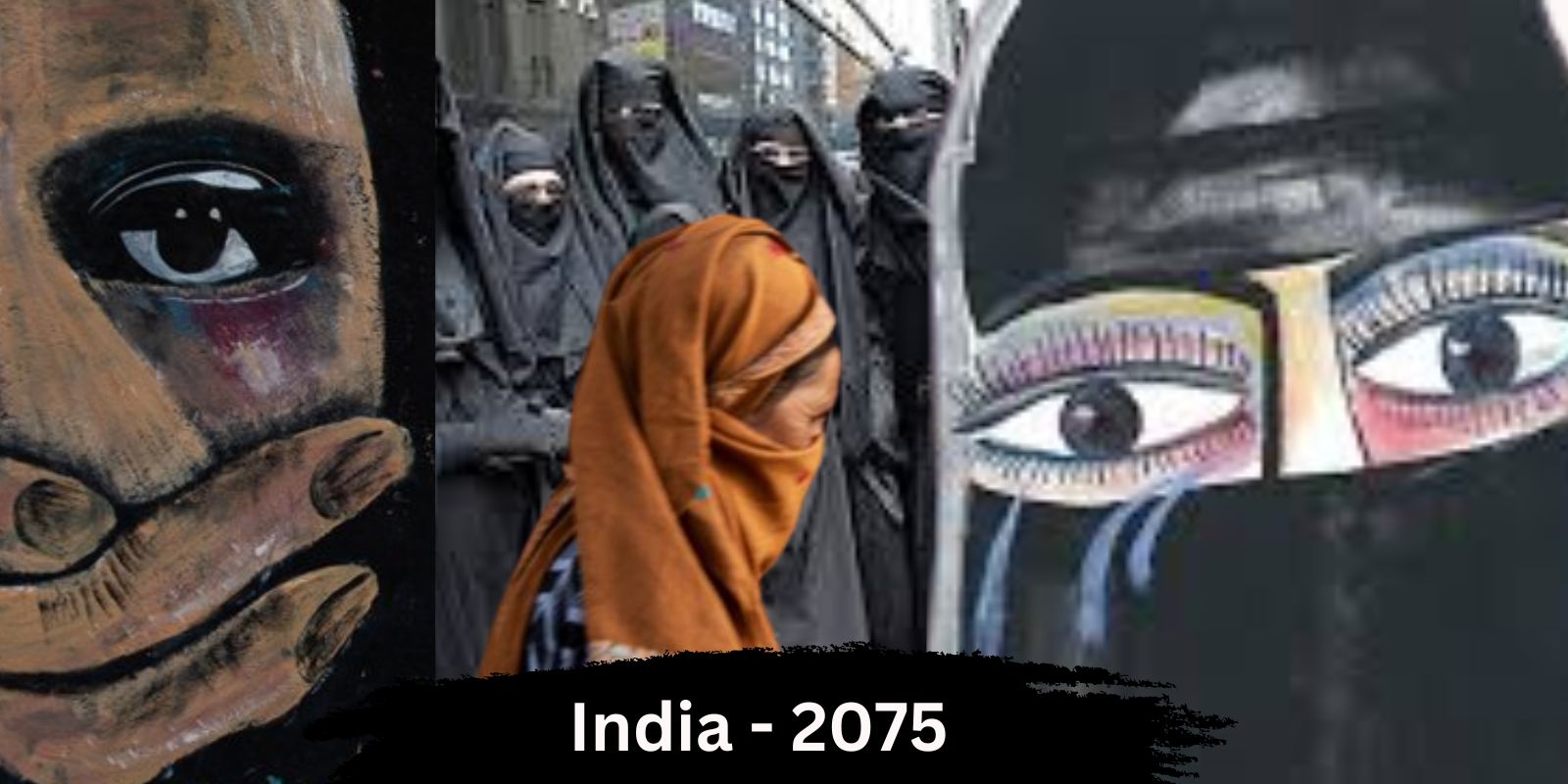
- The once-powerful nation of India has fragmented into smaller, warring states, with women’s rights severely diminished across most regions, particularly under Islamic theocracies.
- The Islamic Federation of Hindustan and other Islamic states have imposed Sharia law, stripping women of basic rights and enforcing oppressive practices similar to those seen in Afghanistan under the Taliban.
- Liberal feminists’ defense of the hijab as a “choice” in the early 21st century inadvertently contributed to the normalization of oppressive Islamic practices, leading to the compulsory hijab in 2075.
- While women in the Republic of Hindustan retain some rights, the situation is dire in Islamic states and chaotic regions like the Dravidian Confederation, where violence against women is rampant.
- The failure of liberal feminists and global leaders to take a stand against radical Islamic practices early on has led to the widespread subjugation of women in the fragmented, dystopian India of 2075.
The year is 2075, and India, the once powerful nation aspiring to be a Vishwa Guru (spiritual leader showing the right path to the whole world), has shrunk to a pale shadow of its former self. The entire subcontinent has been reduced to a sorry collection of Balkanized fragments, representing conflicting identities perennially in a state of confrontation.
Among the many setbacks, the most profound has been in the area of women’s rights. The country that once boasted a galaxy of strong women leaders across politics, education, business, health, beauty, and wellness, has now become a land where women are systematically denied even their basic human rights.
Unsurprisingly, the condition of women is most dire in the Islamic Federation of Hindustan, where Sharia law has been enforced, reminiscent of Afghanistan of the 2020’s. The Islamic Republic of Kashmir and Khalistan follow closely, both having a dismal record when it comes to women’s rights. In the Dravidian Confederation, women theoretically have basic rights, but in practice, the collapse of law and order means that these rights are rarely upheld. The only region where women retain some rights is the Republic of Hindustan. Here, women enjoy the same rights they had 50 years ago, but even this small country lives in constant fear, overshadowed by Islamic fundamentalism in neighboring regions.
The deplorable plight of women in the Balkanized India of 2075 can be traced back to trends that began 50-60 years earlier. It was the time when liberal feminists across the world shouted at the top of their voices that a woman’s decision to wear the Islamic garment “hijab’ was a matter of freedom of choice. In the second decade of the 21st century, it became fashionable amongst liberal Hindu women to come out in support of the “hijab,” insinuating that the “Hindu right” was hell-bent upon denying Muslim women even the most basic of their rights and demonized their religious and cultural practices.[1][2]
Little did they realize that, just 50 years later, they would lose the very “progressive” high ground they once stood on, as they would be forced to cover their bodies from head to toe. What liberal Hindu women and Western radical feminists failed to grasp was that when you support an oppressive practice from the comfort of your own “progressive” lifestyle, the same oppressive practice can eventually consume your own reality. In the end, you no longer have the privilege of being an outsider.
It was like the old adage about creating a Frankenstein that eventually turns on you. The liberal Indian women of the early 21st century didn’t grasp that glorifying anti-women Islamic practices under the banner of wokeism was tantamount to digging their own graves. Over the short span of 50 years, many Hindu women and progressive Muslim women—found themselves trapped in the many Islamic theocracies that now rule the fragmented India. Only those lucky enough to live in the Republic of Hindustan have escaped this fate. But even this new Hindu-majority nation is not without its own problems.
When reflecting on the condition of women in the Balkanized India of 2075, it’s hard not to think of Margaret Atwood’s powerful novel, The Handmaid’s Tale. Gritty, dark, witty, terrifying, and impactful, this dystopian novel was first published in 1985 by the Canadian author. While the book is set in a near-future New England ruled by a Christian fundamentalist regime, the society Atwood portrays closely resembles the treatment of women under Islamic states.
The story is narrated by Offred, a handmaid in this dystopian world, where women are forced to cover themselves from head to toe and are subjected to severe punishment if they dare to disobey the rules. In this bleak universe, women are categorized based on the roles they serve, and handmaids are among the lowest in status. Their sole function is to bear children for wealthy couples, making them akin to purchased slaves. The world of The Handmaid’s Tale is a chilling reflection of the oppression women face in such authoritarian regimes, much like the dystopian societies in the Islamic states of a fragmented future India.
Let’s take a closer look at the plight of women in the Balkanized India of 2075.
Islamic Federation of Hindustan
The Muslim-majority Islamic Federation of Hindustan is governed by strict Sharia law. In this newly formed nation, women have no rights to education, employment, or freedom of speech, assembly, or association. They are not allowed to appear in public without a male guardian. Women must adhere to strict dress codes, covering themselves from head to toe in loose garments, leaving only their eyes visible. The only education permitted for women is the study of the Quran, which must be done within the confines of their homes. The only work women in the Islamic Federation of Hindustan are allowed is household chores and child-bearing.
The dire situation of women in the Islamic Federation of Hindustan bears a striking resemblance to the conditions faced by women under the Taliban regime in Afghanistan during the early 21st century. This newly established Muslim-majority nation has even instituted a Ministry of Virtue and Vice, modeled after the Taliban’s system in Afghanistan. The laws specifically targeting women closely monitor their behavior, not only in public but also in private. Women are forbidden from singing, practicing any form of art, or even listening to music. They are also prohibited from arguing with men or expressing personal opinions on public or private matters. The Ministry of Virtue and Vice enforces strict dress codes and ensures that women comply with Sharia law in every aspect of their lives.
Violating these rules may result in public flogging or stoning. Sadly, this grim reality could have been avoided if the international community had taken the threat of Islamic extremism more seriously. In the 2020s, when the Taliban fully enforced its brutal oppression of women, global leaders offered only mild criticism of the atrocities. However, the international community lacked the courage to take decisive action against the Afghan government or to challenge its legitimacy.
Much like the young protagonist in Atwood’s The Handmaiden’s Tale, who transitions from a modern, progressive life to becoming a child-bearing slave in a dystopian, anti-women society, Afghanistan also underwent a drastic shift. In the 1960s, Afghanistan was a relatively progressive nation in terms of women’s rights. However, after 1992, under the Taliban’s rule, it transformed into an Islamic theocracy where televisions and satellite dishes were destroyed, women were banned from working, and public executions became a routine occurrence. The parallels between these two narratives serve as a stark reminder of how swiftly freedoms can be lost.[3]
In 2001, the United States invaded Afghanistan to destroy the Taliban regime, but the Taliban came back to power in 2021 and, this time, formed a government that the West almost recognized. The international community didn’t take the warning signs seriously enough, and the results are there for all to see now, some 50 years later.
In the Islamic Federation of Hindustan, media access from the outside world is strictly controlled, so very little information about the condition of women reaches beyond its borders. Additionally, with the rise of radical Islamist groups worldwide, the independence of Western media has been severely compromised. Back in the early 21st century, we saw how the Western media became increasingly influenced by “woke” ideologies and how some radical feminists went so far as to defend Sharia law or Islamic rule.
By 2075, this influence has had a significant impact on the Western media, which is now largely controlled and funded by Islamist interest groups. Journalists in the West are frequently threatened, harassed, or even killed if they attempt to expose the atrocities of Islamic regimes. As a result, the Western media, once claiming to be the “critical voice” for global issues, has become a muted version of its former self. It now avoids reporting on the suffering of women in the Islamic Federation of Hindustan.
Islamic Republic of Kashmir
The condition of women in the Islamic Republic of Kashmir is just as terrible, if not worse than in the Islamic Federation of Hindustan. A similar version of Sharia law has been imposed in this Muslim-majority theocracy, stripping women of all civil and personal rights.
While most Hindus from the region fled to the Republic of Hindustan, those who remained lived in constant fear of persecution. Hindu women face horrifying situations, as they are often kidnapped, abused, and forcibly married to Muslim men. Many are sold as sex slaves to other Islamic countries, and minority women in Kashmir fall victim to a thriving sex trafficking industry. Some are even forced into becoming brides for terrorist gangsters, with no hope of escape.
When India abrogated Article 370 in Jammu and Kashmir in 2019, there was a brief period of optimism as peace and stability began to return to the region. However, radical Islamists continued to operate in the background. After elections were held, the situation quickly worsened as local political parties, driven by their thirst for power, fueled radical Islamic sentiments. By 2050, Kashmir was already on its way to becoming a Taliban-like state. By 2060, local jihadi groups, backed by established Islamic terror organizations, seized control of the region, overthrowing the democratically elected government. During this period of India’s fragmentation, Kashmir not only declared independence but also annexed the nearly Buddhist-majority region of Ladakh, leading to the formation of the present-day Islamic Republic of Kashmir.
It’s difficult to believe now, but in the early decades of the 21st century, Kashmiri women were thriving in higher education, starting their own businesses, and making a mark in sports. As ties with the rest of India normalized and tourism increased, the progress of Kashmiri women continued to grow. Conservative dress codes were relaxed, and more women stepped out to work and confidently embraced public life. However, the local politicians’ greed for power, combined with the influence of the external breaking-India forces, led to the slow re-radicalization of the valley. What was once known as “heaven on earth” soon turned into a living hell for women.
Noted writer and social commentator, Arshia Malik shared her personal experience with Sharia law as a Kashmiri Muslim woman. She recalls how the Islamic practice of Triple Talaq ended her mother’s marriage, leaving her with no income and two young daughters to care for. The reason for the divorce was shocking—Arshia’s mother had protested when Arshia’s paternal grandfather attempted to molest her sister.
The ordeal didn’t end there. Arshia describes how Kashmir’s version of Sharia courts blamed her mother for “airing the family’s dirty laundry” and urged her to reconcile with her father if she retracted her allegations. Despite the pressure, Arshia’s mother stood firm, determined to raise her daughters without any support from alimony or maintenance. Eventually, things improved as Arshia became a writer and educator, and her sister became a physician.
However, the injustices continued. When their father fell ill with leukemia, Arshia and her sister took care of him until his death. But when it came to their inheritance, their relatives “used every loophole in Sharia law” to deny the sisters their rightful share. Arshia faced further hardship when, after her own husband’s death at 40 from a heart attack, Sharia law also deprived her of her right to inherit his assets.[4]
Arshia Malik’s tragic personal story is a chilling reminder of the past of Kashmir, which already had ominous signs of what was to follow. Prior to the abrogation of Article 370 in 2019, Kashmir functioned like an Islamic theocracy, the worst victims of which were women. The Indian government had banned the practice of Triple Talaq way back in 2019, but Muslim clerics and radical Islamist groups protested throughout the country, claiming it was an infringement on their right to practice their religion.
The consequences of the greed of local Kashmiri politicians and the misguided actions of the local people, who supported Jihadis that manipulated them emotionally in the name of Islam, are now painfully clear. The newly formed Islamic Republic of Kashmir has become a theocratic state ruled by one of the most extreme versions of Sharia law. Women in this country are not only stripped of their civil and personal rights but they are also subjected to public flogging and stoning for non-compliance or resistance.
Khalistan
In the newly carved country of Khalistan, the Sikh community, historically known for its business values and progressive lifestyle, has taken a 360-degree turn. Khalistan is a Taliban-styled Sikh theocracy where moral police roam the streets, assaulting women who forget to cover their heads.
While the subjugation of women in Khalistan is not as severe as in Taliban-controlled regions, it comes dangerously close. Sikh women can go out in public without a male escort, but they must always follow a strict dress code, wearing loose clothing and covering their heads. Western clothing and lifestyle are no longer allowed. Though Sikh women are permitted to study and work, strict guidelines exist. Public interaction between men and women is tightly regulated, and women must seek permission from a male family member to pursue education or employment.
This drastic erosion of women’s rights is especially shocking given that, just 50 years ago, Sikh women were symbols of liberation and independence. Unlike Muslim women in similar theocracies, Sikh women have always been modern, progressive, and fiercely self-reliant. The Sikh community was known for its dynamism, and its women were no exception.
However, the rise of the radical Islamist-Khalistani alliance in the early 21st century changed everything. Many young Sikhs, unaware of the consequences, eagerly joined the separatist movement. Surprisingly, even modern and progressive Sikh women played a role in supporting the Khalistan cause during that time without fully grasping the oppressive future it would bring.[5] Little did they realize that, 50 years later, their participation in what seemed like a “woke cause” would turn into a trap. They now find themselves living in a country where they are systematically denied even the most basic rights as women.
The situation is even worse for the majority of Sikhs stuck in the newly created country who never wanted the formation of Khalistan in the first place. Many Sikh women try hard to migrate to the Republic of Hindustan, but in the Taliban-styled Sikh theocracy Khalistan, it’s become virtually impossible.
Republic of Hindustan
Due to its Hindu majority and liberal laws, the Republic of Hindustan offers respite to women, especially Hindu women. Hence, women here enjoy all the rights they used to 50 years ago—the right to education, the right to work, the right to dress freely, etc. But the question is, for how long?
The Republic of Hindustan, a small fragment of what was once Bharat, faces constant threats of external interference and internal unrest. Sharing a border with the Islamic Federation of Hindustan, it struggles with the rampant kidnapping and trafficking of Hindu women across the border. This has become a major issue for women’s rights in the Republic of Hindustan, as Hindu women are disappearing at an alarming rate each year, leading to a further decline in the Hindu population.
Additionally, cases of “love jihad,” where Hindu women are targeted through social media by individuals from across the border, are becoming increasingly common. Many women disappear, either ending up in the Islamic Federation of Hindustan or the Islamic Republic of Kashmir. This growing crisis continues to pose a severe challenge to the safety and survival of Hindu women in the Republic of Hindustan.
Dravidian Confederation
The Dravidian Confederation has no formal restrictions on women’s rights. However, with the state constantly torn apart by conflicts between armed Christian, Muslim, and Hindu militias, sexual violence against women has become rampant. Women live in constant fear for their safety. A feudal mindset has re-emerged in the Dravidian Confederation by 2075, where warring factions frequently seek revenge on their enemies by kidnapping, raping, or even killing their women.
The situation resembles that of a Banana Republic, with a powerless government struggling to maintain a semblance of democracy. Violent coups have become increasingly common, leaving women in perpetual fear for their lives.
A Cautionary Tale
The horrifying condition of women in the balkanized India of 2075 could perhaps have been prevented had radical Western and Indian feminists not participated so enthusiastically in the Woke-Islamic project, creating fictitious narratives of women’s oppression in progressive religions like Hinduism and glorifying and white-washing existing narratives of women’s oppression in Abrahamic religions like Islam.
The Western world had ample warning signs in the earlier decades of the 21st century as a powerful country like the UK got caught in the grips of Islamic Sharia courts. Sharia councils, prevalent in the UK in the early parts of the 21st century, did a great disservice to British Muslim women as these became a parallel legal system, leaving vulnerable women trapped in abuse.[6] Also, the West turned a blind eye to the alarmingly rising Muslim population in Europe and elsewhere. A Pew Research Center Report predicted back in 2017 that even with no future migration, Muslims were bound to increase as a share of Europe’s population. The report outlined how the record influx of asylum seekers fleeing conflict-ridden scenarios in predominantly Muslim countries led to an alarming rise in the Muslim population in Europe.[7]
In India, liberal feminists often downplayed the severe oppression women faced in Islamic societies. When 20-year-old Mahsa Amini of Iran tragically died under suspicious circumstances while in the custody of Iran’s morality police—arrested for defying the country’s Hijab mandate—women around the world protested against the Iranian regime. Yet, the liberal feminist groups in India remained largely silent.
Similarly, when the Indian government banned the Islamic practice of Triple Talaq in 2019, which had long been exploitative towards Muslim women, Indian liberal feminists did not celebrate this as a victory. Instead, many of them defended the very practice that harmed women.
While women were being publicly flogged and stoned under Taliban rule in Afghanistan during the 2020s, Indian liberal feminists were more focused on criticizing Hindu festivals like Rakshabandhan and Karvachauth, labeling them as patriarchal. Had these influential feminist voices spoken out more strongly against the deep-rooted oppression of women in Islamic societies, perhaps the situation today would have been different.
The Taliban’s takeover of Afghanistan in 2021 and the subsequent imposition of Sharia law should have been a wake-up call for India’s “woke” activists. The growing radicalization was evident when Indian Muslim women, who had lived comfortably without the hijab for years, suddenly began wearing it and rallying for their “right to wear hijab.” Indian feminists should have been alarmed when the hijab, an oppressive garment that had led to the deaths of many who protested its enforcement in Iran, was being repackaged as a symbol of “freedom of expression” in India.
Unfortunately, lessons were not learned. Fifty years ago, the Indian feminist movement glorified radical Islamic ideologies, insisting on a woman’s right to wear the hijab. Today, in the balkanized India of 2075, wearing the hijab is a compulsion—an oppressive mandate where the alternative is either a life of captivity or death.
Citations
[1] Why it is time to show support with our Muslim sisters in India – Hindus for Human Rights; https://www.hindusforhumanrights.org/en/blog/why-it-is-time-to-show-support-with-our-muslim-sisters-in-india
[2] Wearing the Hijab in Solidarity – What Do We, as Muslim Women, Think About This? https://blog.hautehijab.com/post/wearing-the-hijab-in-solidarity
[3] ‘The Handmaid’s Tale is a Reminder of How Fast Everything Can Change; https://www.vice.com/en/article/the-handmaids-tale-is-a-reminder-of-how-fast-everything-can-change/
[4] Sharia: The Legalized Oppression of Women Under Medieval Islamic Laws – Hindu Dvesha; https://stophindudvesha.org/sharia-the-legalized-oppression-of-women-under-medieval-islamic-laws/
[5] Khalistani supporter Canadian poet Rupi Kaur declines White House Diwali invite to protest the pro-Israel stance of the US; https://hindupost.in/world/khalistani-supporter-canadian-poet-rupi-kaur-declines-white-house-diwali-invite-to-protest-the-pro-israel-stance-of-the-us/
[6] Inside Britain’s Sharia councils: hardline and anti-women – or a dignified way to divorce? | Sharia law |The Guardian; https://www.theguardian.com/law/2017/mar/01/inside-britains-sharia-councils-hardline-and-anti-women-or-a-dignified-way-to-divorce
[7] Muslim Population Growth in Europe | Pew Research Center; https://www.pewresearch.org/religion/2017/11/29/europes-growing-muslim-population/

Donate to HINDUDVESHA
Our Mission is to explore and expose Hindudvesha through research analysis, education and response.
SUPPORT US