

Hindustan Without Hindus? A Dystopian Glimpse into the Future of India
 Nitin Sawant · 09/07/2024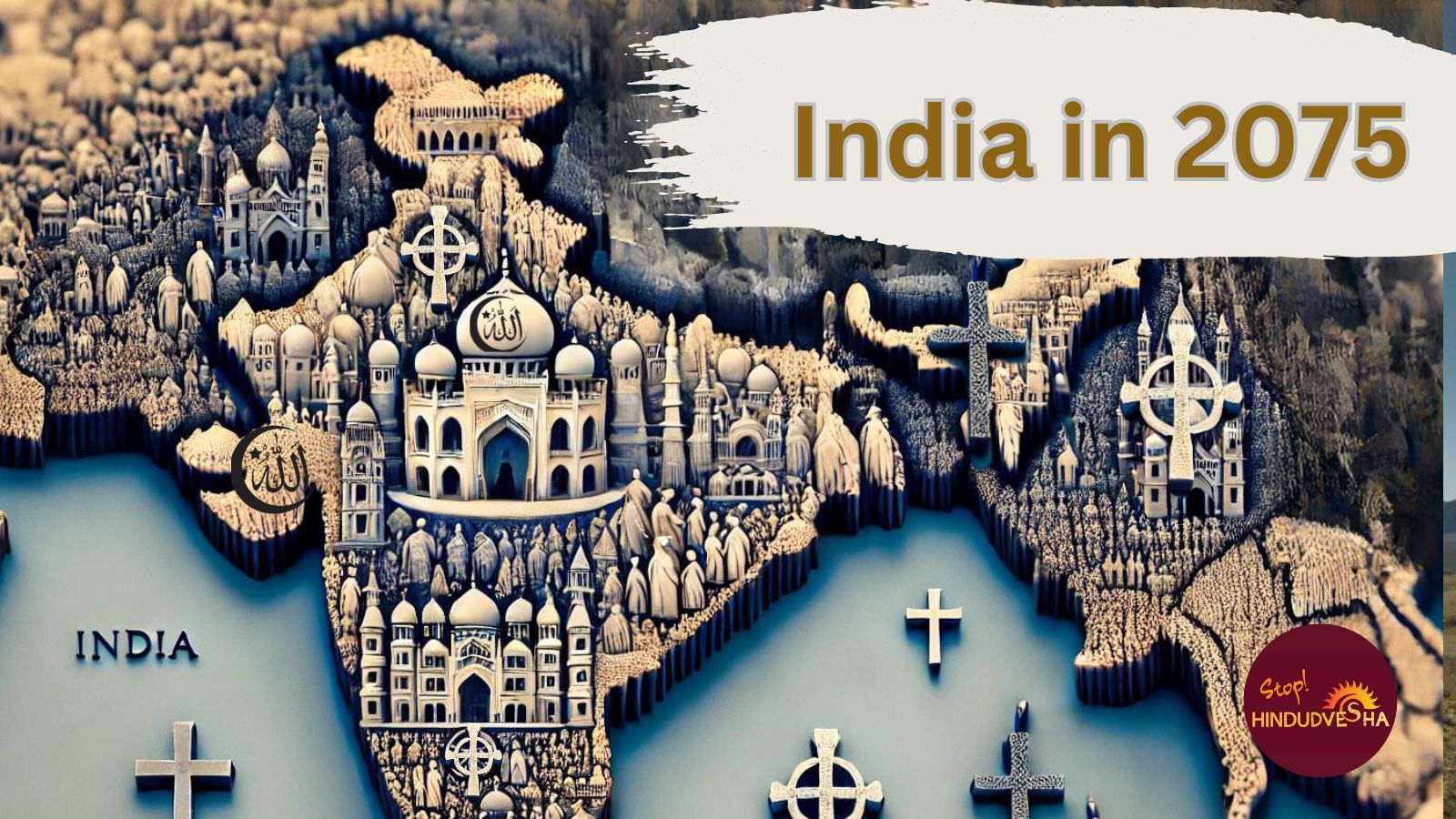
- While Hindu Dharma is growing in parts of the West and Africa, its future in India is uncertain due to changing demographics and political challenges.
- Hindus have become a minority in several Indian states, and continued demographic changes could further threaten Hinduism’s presence over the next 5o years.
- Ancient Hindu kingdoms in Southeast Asia eventually succumbed to Buddhist, Islamic, and Christian forces, highlighting the fragility of Hindu cultural dominance without solid support from India.
- India’s economic progress through projects like ‘Viksit Bharat 2047’ is promising, but economic success alone may not safeguard Hindu Dharma if sectarian strife and demographic shifts continue.
- The time is now for Hindus to take proactive steps to preserve their faith and cultural heritage within India or face a dystopian future similar to Orwell’s vision in Nineteen Eighty-Four.
George Orwell’s dystopian novel, ‘Nineteen Eighty-Four,’ begins with an iconic line, “It was a bright cold day in April, and the clocks were striking thirteen.” Striking thirteen, really? The striking thirteen on the clock does not refer to military time but alludes to an old saying, indicating that an event has challenged previously held beliefs. The unsettling and bleak story follows protagonist Winston Smith, an everyman character who works for the Ministry of Truth, where his job is to rewrite historical documents so they match the constantly changing current political line.
As a satire, ‘Nineteen Eighty-Four’ debuted in 1949 and was set thirty-five years in the future. Did Orwell’s dystopia match the real world, cometh 1984? No, but parts of it could be seen in the practice in various parts of the world, and Orwellian concepts like “Newspeak,” “Doublethink,” and “Big Brother” have since become a part of our everyday political and social lexicon. Although looking at the present state of the UK political and social scene, one could wonder if Orwell would have fared better if he had set his masterpiece fifty-plus years in the future, not thirty-five.
Orwell’s protagonist was based in London, which was then at the center of the so-called civilized world, where the sun had still not fully set on the Ol’ Empire, and London was still the fulcrum around which global geopolitics pivoted. Since then, the global balance has tilted significantly to the South, as “India already surpassed the UK as the fifth largest economy last year, and according to analysts at Morgan Stanley, it’s on track to overtake Japan and Germany and hit the third spot by 2027.”[1]
Could we then cast an Orwellian gaze ahead by 50-odd years – maybe in 2075, and look at what is in store for India, Indians, and Hindus?
Who Wins the 2075 Lottery – Democracy or Demography?
There have already been official attempts by the government of India to mark the path and illustrate the future in its various vision documents. ‘Viksit Bharat 2047’ is a grand vision, wherein ‘Viksit Bharat’ means ‘Developed India’. Viksit Bharat 2047 represents the government’s vision to transform the country into a developed entity by its 100th Independence Day in 2047. The four pillars of Viksit Bharat will be Yuva (Youth), Garib (Poor), Mahilayen (Women) and Annadata (Farmers). India’s Finance Minister has already announced a set of schemes and fund allocations in the Budget 2024 towards achieving this goal.[2] Going by the past performance record of PM Narendra Modi’s administration, many would agree that Project Viksit Bharat 2047 is entirely achievable.
The question, however, is: can India’s social structure survive in order to enable Indians and Hindus to benefit from this grand goal? Just look at India’s neighbor, Bangladesh, and its trials and tribulations. It also had a robust economic vision, which it executed well. It witnessed a steady 6 percent growth between 2011-19, while the retail inflation dropped below 6 percent post-2016. Bangladesh’s GDP per capita doubled from $1,032 in 2011 to $2,154 in 2019 pre-Covid.[3] And it was not just mundane low-cost garment exports; Bangladesh was “fast moving to a high-value, knowledge-intensive society, beyond apparel manufacturing,” according to the then-PM Shaikh Hasina.[4] Yet, social unrest triggered a chaotic regime change in Dhaka, throwing the entire country into turmoil. In a matter of weeks, the economy came under severe strain. Most importantly, civilian life was severely disrupted, with Hindu minorities in Bangladesh facing the brunt of it, with the destruction of their homes and temples, with around 650 killed.[5] Moral of the story: economic marvels can quickly turn into dust in the face of sectarian crises. Hindus in Bangladesh are still looking for some succor from the world at large, although that’s hardly coming.
The simple conclusion is that the peaceful precepts of Hinduism have usually not survived the brute force of sectarian Abrahamic violence. And, whenever and wherever demography had the upper hand, it always triumphed over democracy.
2075 – Utopia or Dystopia for India?
Let’s face the ubiquitous fact first: Hinduism happens to be the only religion in the history of the world that has survived the onslaught of Abrahamic barbarity for more than a millennium. In contrast, once-thriving civilizations like the Roman, Greek, and Egyptian are now reduced to ruins, serving as tourist attractions or displayed in a few rooms of prestigious Western museums. Their Gods and worshiping customs are simply relegated to exotic mythology. However, Hinduism resisted, survived, withstood, and even repelled innumerable attempts at diminishing its status as the faith of millions.
But did they manage to hold on to their sacred geography?
Over the past five centuries – particularly in the last century, the sacred geography of what was once ‘Akhand Bharat’ or unified India has already been reduced by more than half. At least nine independent sovereign nations were carved out by the British and later the Islamists – India, Pakistan, Bangladesh, Bhutan, Afghanistan, Nepal, Myanmar, Sri Lanka, and Maldives.[6] If you look at the contours of the unified Indian region, ‘Akhand Bharat’ could have typically covered an area of 7.13 million square kilometers and could have had a population of 1.89 billion. In economic terms, the nominal GDP of the unified entity could add up to US $4.166 Trillion with a per capita income of US $ 2,204. The area of the unified entity would have been more than double the present 3.29 million sq.Km to 7.13 million Sq.Km.
One can do simple arithmetic to imagine the possibilities of such a vast empire today. In terms of area, the unified entity could have been the third largest geography, next only to the Russian Federation (17.098 million Sq. Km) and China (9.60 million Sq.Km.). Population-wise, the unified entity could have been the largest, leaving China behind by a huge margin. The decline in the population density to 265 would make the unified entity the third most densely populated geography. Economically, ‘Akhand Bharat,’ with a cumulative GDP of US$4.138 Trillion, could have already been the third largest economy in the world, next only to the USA ($24.8 Trillion) and China ($18.46 Trillion).[7]
The reduced landscape has cost India and Hindus dear; apart from the economic gains, imagine the peace and prosperity that the land could have had in the absence of strife and violence, courtesy of Pakistan, Bangladesh, Afghanistan, and Sri Lanka. However, one might think, based on current reality, aren’t Hindus better off in the current republic of India, where the State better protects their Gods, places of worship, and lives, as they hold a far better majority in terms of population numbers? Well, think again!
Only a fool would assume that Hindus have it better in India after the 1947 partition when a bunch of Muslims was given around 30% of the country’s landmass, as they could not live with their fellow Hindu brethren. The demographic change has continued unchallenged within India’s borders since 1947 and is even showing disastrous results on the ground, courtesy of some help from the pseudo-secular governments. According to the 2011 Census, the Hindus are already a minority in eight states population-wise. Look at the pathetic numbers – Lakshadweep (2.5%), Mizoram (2.75%), Nagaland (8.75%), Meghalaya (11.53%), Jammu & Kashmir (28.44%), Arunachal Pradesh (29%), Manipur (31.39%) and Punjab (38.40%).[8] Hindus are already facing a churn in the states of West Bengal and Kerala, and if this trend continues for the next few decades, India might witness a significant drop in the Hindu numbers in half of its states. Besides, once the numbers drop to a critical level, the Abrahamic population in that state typically goes into overdrive to push out the remaining minority Hindus, as witnessed in West Bengal and Northeastern States already.
Ergo, Viksit Bharat might deliver utopian results in terms of economic growth and general prosperity by 2047, but if the demographic shift and desensitization of Hinduism continue unabated, then we are staring at a dystopian holocaust by 2075.
The Fragile Future of Hindu Dharma
Some might logically question this dystopian view with an argument that might go something like this: Hinduism is spreading rapidly outside of India. Hindus are a force in America and Europe now, what with the UK’s last Prime Minister being a practicing Hindu and the USA’s current VP being of part-Hindu ancestry. Besides, Hinduism is growing exponentially in Africa, particularly in Ghana, where it is the fastest-growing religion.[9] The world’s top three biggest Hindu temples exist outside of the Indian borders, in Nepal, Cambodia, and the United States. More and more Hindu immigrants are welcomed in most continents, including the Islamized Middle East, as they are hard-working, cultured, and socially well-adjusted. To forge closer ties with India and Hindus, Abu Dhabi recently inaugurated the largest Hindu temple in West Asia, the first traditional Hindu stone mandir in the Middle East. Should we then really be worried over the gradual diminishing of Hinduism within India?
As compelling as the argument may seem, it’s ultimately wishful thinking. Such a cyclical chain of events takes place every few centuries. However, without the nourishing support of the “mothership Bharat,” these satellite enclaves have no sustainable future. For instance, the concept of the Three Indias was pretty common in pre-industrial Europe. The southern part of South Asia was branded as ‘Greater India,’ ‘Lesser India’ was the northern part of South Asia, and ‘Middle India’ was the region near the Middle East. Greater India, also known as the Indian cultural sphere, comprised several countries in South Asia, East Asia, and Southeast Asia that were historically influenced by Indian culture. Scholars looked at this growing Indianization as “a benevolent ancient Indian cultural colonization of Southeast Asia, in stark contrast to the Western colonialism of the early 20th century”.[10]
A defining characteristic of the cultural link between Southeast Asia and the Indian subcontinent was the adoption of ancient Indian Vedic culture and philosophy in Myanmar, Tibet, Thailand, Indonesia, Malaya, Laos, and Cambodia. These regions were predominantly Hindu then. Indian scripts, too, were prolific in Southeast Asian islands ranging from Sumatra to Java, Bali, South Sulawesi, and the Philippines.
Hindus ruled Southeast Asia for centuries by amalgamating the local traditions and animistic practices into their Sanatan Dharma. Yet, not one kingdom could stand up to the onslaught of Buddhist, Islamic, and Christian evangelical forces. Most of these ancient kingdoms eventually evolved into nation-states with a state religion of Buddhism, Christianity, or Islam. Traces of Hinduism survive in pockets like Bali or Borneo but are fast becoming irrelevant there, too.
However, as mainland India regressed into colonialism, none of these South Asian provinces could hold on to their dharma, nor could they help India in its quest for freedom. Today, Hinduism might be the flavor of the year in far-off lands, but if the sacred geography of India is altered irreversibly, none of them will survive for very long.
Beware of the 2075 Wolf
2075 is barely a generation away, and it’s the repeat of the historical tyranny that Hindus have endured during centuries of subjugation by Abrahamic colonizers. Hindus will have to pay the Jizya tax once more if they want to remain Hindus. Hindus cannot own anything more than their Abrahamic masters and have to behave like dhimmis. Worshiping their Sanatani Gods and undertaking pilgrimages will be strictly forbidden, and their temples will be seized at will. It’s 2075, and whatever has happened in Bangladesh or West Bengal now will be happening in every nook and cranny of India unless, of course, the Hindus wake up now and take civilizational corrective measures. Hinduism in India survived the last 2000 years of Abrahamization because it fought them every step of the way. And it needs to do the same to keep the 2075 wolf at bay.
The best time to fight back is now. The next best time will never be there. Act as if it’s already 2075. As author Ally Condie articulates, “The beauty of dystopia is that it lets us vicariously experience future worlds, but we still have the power to change our own.”
Citations
[1] Inamdar, Nikhil, India’s economy: The good, bad and ugly in six charts (bbc.com); https://www.bbc.com/news/world-asia-india-68823827
[2] Acharya, Mayashree. 2024. “Viksit Bharat 2047: Meaning, Vision, Objective, Registration.” ClearTax. https://cleartax.in/s/viksit-bharat-2047.
[3] Economic Times. 2024. “Hasina’s Bangladesh stitched a blistering tale of growth, and that ended her regime.” ET Online. Hasina’s Bangladesh stitched a blistering tale of growth, and that ended her regime Read more at: https://economictimes.indiatimes.com/news/international/business/in-charts-hasinas-bangladesh-stitched-a-blistering-tale-of-growth-and-that-ended-her-regime/.
[4] Hasina, Sheikh. 2019. “Bangladesh is booming, and here’s why — PM Sheikh Hasina explains.” ThePrint. https://theprint.in/opinion/bangladesh-booming-pm-sheikh-hasina-explains/300843/.
[5] The Hindu. 2024. “Nearly 650 people killed in recent spate of violence in Bangladesh: UN report.” The Hindu. https://www.thehindu.com/news/international/nearly-650-people-killed-in-recent-spate-of-violence-in-bangladesh-un-report/article68535793.ece.
[6] Dasa, Radhika. 2021. “The History of Breaking India.” LinkedIn. https://www.linkedin.com/pulse/history-breaking-india-radhika-gopinatha-dasa/.
[7] Qamar, Furqan. 2022. “Akhand Bharat: 50 shades of grey.” National Herald. https://www.nationalheraldindia.com/opinion/akhand-bharat-50-shades-of-grey.
[8] Loksabha Docs. 2022. “MINORITY TAG TO HINDUS IN VARIOUS STATES IN INDIA.” Loksabha. https://loksabhadocs.nic.in/Refinput/New_Reference_Notes/English/14072022_161133_1021205175.pdf.
[9] Wikipedia. 2017. “Hinduism in Africa.” Hinduism in Africa – Wikipedia. https://en.wikipedia.org/wiki/Hinduism_in_Africa.
[10] Wikipedia. 2016. “Greater India – Wikipedia.” Wikipedia, the free encyclopedia. https://en.wikipedia.org/wiki/Greater_India.

Donate to HINDUDVESHA
Our Mission is to explore and expose Hindudvesha through research analysis, education and response.
SUPPORT US