

Hindu Heritage at Risk: The Case for Recalibration of India’s Democracy
 Rakesh Krishnan Simha · 12/29/2024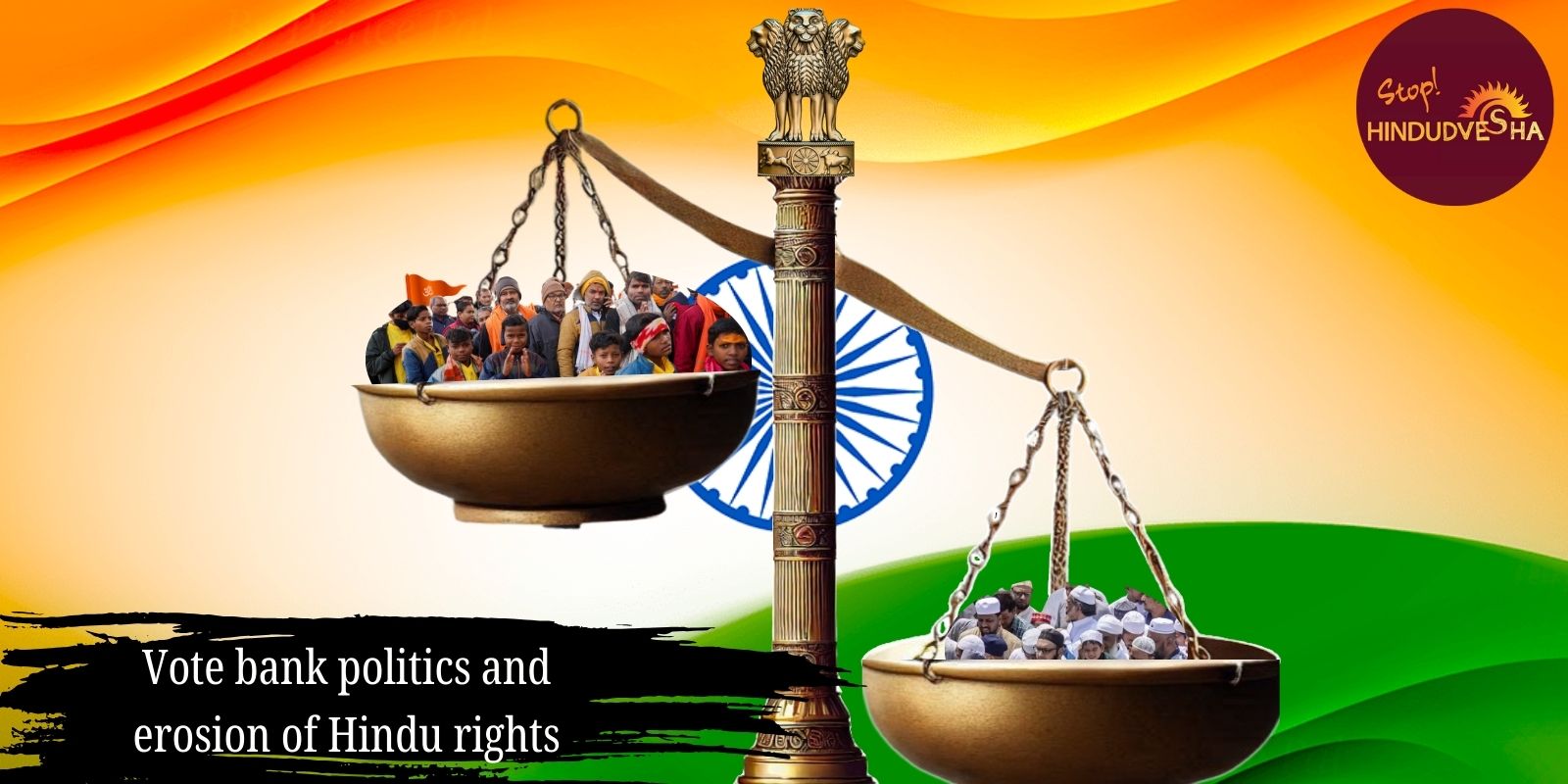
- Ancient Democratic Roots: India’s democratic traditions, dating back over 1,000 years before Athens’ “demokratia” in 507 BCE, are reflected in texts like the Rig Veda and Buddhist literature, showcasing its egalitarian and republican governance.
- Modern Marginalization: Despite an inclusive foundation, India’s current democracy often sidelines Hindu interests through vote-bank politics, excessive minority appeasement, and skewed secularism, leaving Hindus feeling politically and culturally marginalized.
- Neglect of Hindu Heritage: Hindu cultural heritage faces erosion due to reduced academic and public representation, and state control over temples. Political parties avoid Hindu-centric issues, further alienating the majority.
- Religious Threats: Rising Islamic and Christian influences, along with conversion-enabling policies, threaten Hinduism’s dominance, deepening marginalization and fears of cultural loss.
- Need for Democratic Reform: A balanced democracy must honor Hindu culture within the national narrative while safeguarding minority rights, focusing on reforms in vote-bank politics, secularism, religious freedom, and national unity.
“We pray for a spirit of unity; may we discuss and resolve all issues amicably, may we reflect on all matters (of state) without rancor, may we distribute all resources (of the state) to all stakeholders equitably, may we accept our share with humility.” [1] – Rig Veda 10:191:2
India is the true birthplace of democracy. By the time the Greek city-state of Athens had developed the concept of demokratia[2] in 507 BCE, Gana Rajyas, or republics, were being governed by elected representatives in India for over 1,000 years. The Rig Veda – the world’s oldest literature – offers insights into the kingship, state structures, and political organizations in India between 1500 BCE and 1000 BCE.[3] Later, during 600 BCE-200 CE, a period of widespread urbanization, as per Buddhist literature in Pali and Brahminical literature in Sanskrit, the republican system of government was almost universal.[4]
Against this backdrop, many Indians are rightly proud of their country’s ancient democratic and egalitarian ethos. At independence, even as its neighbors chose military dictatorship or totalitarianism, India opted for parliamentary democracy. The country’s current democratic system is uniquely complex, shaped by centuries of history, colonialism, and independence struggles. However, despite its grand democratic ideals, there is an increasing concern among many Hindus that the political system, as it operates today, is failing them and, in some instances, is actively working against their interests. While democracy is meant to offer equality and freedom, the reality for Hindus in India has become more complicated.
Vote Bank Politics
One of the major challenges facing Hindu interests in India today is the overwhelming dominance of “vote bank” politics.[5] This refers to the practice of political parties appealing to specific minority groups to consolidate electoral support. Often, this comes at the expense of Hindus, who, as the majority community, find themselves sidelined in the quest to placate smaller, usually vocal groups.
Political parties routinely prioritize the needs and aspirations of minority communities in their manifestos, funding, and policies, primarily to ensure they win elections. While it is necessary to protect the rights of minorities, the disproportionate focus on minority appeasement leads to the marginalization of Hindu issues. For instance, policies like reservations (affirmative action) that benefit Muslims and Christians in jobs and education are justified on the grounds of social justice, but they inadvertently ignore the complex socio-economic realities faced by Hindus from non-reserved categories. The perception that the political system panders more to minorities often leaves Hindus feeling neglected or underrepresented.
The Secularism Paradox
India’s constitution defines the nation as a “secular” state, meaning the government should not favor any religion. However, in practice, secularism in India often translates into a form of rampant religious discrimination that disproportionately impacts Hindu culture and practices. For example, state funding for religious pilgrimages or religious institutions is sometimes more generous to minority communities, while Hindu temples remain under state control despite being among the most prominent religious institutions in the country. The state control over temples and their properties is a significant financial and cultural loss for the Hindu community. This control contrasts with the autonomy enjoyed by religious institutions of Muslims and Christians.[6]
Author and JNU professor Anand Ranganathan’s assertion that Hindus are “eighth-class citizens” in India stems from his critique of systemic discrimination against the Hindu majority, which he argues is entrenched in the country’s political and legal frameworks. He highlights what he perceives as state-sanctioned apartheid, where policies disproportionately favor minority communities at the expense of Hindus.[7]
Ranganathan traces the roots of this discrimination to historical policies initiated by leaders like Mohandas Gandhi, who he claims promoted a narrative that encouraged Hindus to make sacrifices for the sake of communal harmony, even in the face of violence against them. This has led to a culture of appeasement towards minorities, which has only emboldened their political leaders and exacerbated Hindu marginalization.
Worse, a significant portion of government resources and benefits, such as housing and loans, disproportionately go to Muslim communities despite their smaller population size (approximately 18 percent). For example, 31.3 percent of homes under the Prime Minister’s free housing scheme were allocated to Muslims, raising concerns about fairness and equality in resource distribution.
This type of secularism is not only unfair, it ends up weakening the Hindu religious ecosystem, limiting the autonomy of Hindu institutions that have long served as pillars of the community. The Hindu community is left to contend with a system that, in practice, undermines its cultural and spiritual significance while giving more freedom to other religions.
Hindu Identity and Political Representation
Despite being the largest religious group in the country, Hindus often find their identity diluted in mainstream political discourse. National political parties, in their effort to appeal to all communities, tend to avoid overtly aligning with Hindu issues for fear of being labeled as “communal” or “sectarian.” As a result, issues that matter to Hindus are frequently sidelined in favor of broader, more inclusive narratives that focus on India’s pluralistic identity.
The lack of political representation that directly advocates for Hindu concerns leads to a sense of alienation among many Hindus, who feel that their unique cultural and religious identity is being ignored in favor of a more homogenous, secular vision of India. This erasure of Hindu identity in the political sphere harms the community’s sense of belonging and empowerment.
Threats to Hindu Cultural Heritage
India’s cultural heritage is deeply intertwined with its Hindu roots, yet there is growing concern that the country’s democratic system, in its zeal for modernization and global appeal, is eroding these traditions. The systematic sidelining of Hindu festivals in public life, the underrepresentation of Hindu scholars and thinkers in academia, and the rise of ideologies that challenge traditional Hindu values all contribute to the dilution of India’s cultural heritage.[8]
For instance, the removal of Hindu symbols, names, and references from public spaces, the constant reimagining of Hindu history from a Westernized or Marxist perspective[9], and the denial of Hindu cultural rights – such as the restoration of ancient temples – are all symptoms of a larger trend that undervalues Hindu heritage. The democratic system, in its pursuit of appeasement and consensus, is often complicit in these cultural erasures.
Decline of Hindu Political Movements
Large, established parties like the Indian National Congress and the Bharatiya Janata Party dominate India’s political system. While the BJP, which has roots in Hindu nationalism, has tried to advocate for Hindu issues, it often has to balance these with the needs of other communities to remain in power. This creates a dynamic where the BJP’s commitment to Hindutva (a form of Hindu nationalism) is sometimes watered down by the need to keep coalition partners, which pander to minority communities, satisfied.
Meanwhile, Hindu-centric political movements or smaller parties that advocate for more explicit Hindu interests often struggle to gain traction in the electoral system. This is largely because India’s first-past-the-post electoral system rewards larger parties and creates a political environment where smaller, community-driven movements are unable to flourish. Consequently, Hindus find it challenging to organize around their unique political needs within the current democratic setup.
Islamization and Christianization
Another concern for Hindus in India today is the growing influence of Islamic and Christian ideologies, sometimes facilitated by the democratic system’s tolerance for religious conversion and minority rights. The increasing trend of conversions, especially in rural areas, poses a significant challenge to Hinduism’s survival as a dominant religious force in India. The Indian state’s policies often provide financial incentives or legal protection for religious conversions. For instance, Kerala has a state department that helps people who leave Hinduism and accept Christianity.[10]
Such policies create an environment where Hinduism is being replaced or marginalized in certain regions. The active promotion of the interests of Muslims or Christians makes Hindus feel the democratic system is no longer serving their needs but rather favoring other religions at their expense. This creates a sense of disenchantment and alienation, as many Hindus view the rise of conversion as a threat to their cultural and religious integrity.
Rise of Political Correctness and Censorship
In an attempt to maintain social harmony and avoid communal discord, the Indian political system has sometimes promoted a culture of political correctness that stifles open discussions about Hindu concerns. Criticism of Islam or Christianity is often met with accusations of bigotry or intolerance, while discussions on Hindu issues – such as the protection of temples, the legacy of historical figures, or even the need for a national law to prevent the destruction of Hindu shrines – are often muted or dismissed as “Hindu extremism.”
This climate of censorship, particularly in the media and academia, hinders a candid, open discussion about the challenges facing Hindus in contemporary India. When political correctness overrides genuine dialogue, it hurts the democratic ideal of free speech and stifles the ability of Hindus to voice their grievances.
Limits of Democracy: Insights from Lee Kuan Yew
Lee Kuan Yew, the late Singaporean leader, was a fierce critic of unbridled democracy, especially when it resulted in instability and inefficiency. He argued that democracy’s exuberance could lead to undisciplined, disorderly conditions that impede progress. In his view, “Democratic procedures have no intrinsic value. What matters is good government.”
Lee’s critique of India is telling – he believed that India’s democracy was slowing its progress due to the complexity of its systems and the frequent instability caused by coalition politics. In his book Lee Kuan Yew: The Grand Master’s Insights on China, the United States, and the World, he expressed his disappointment that India’s vast potential had largely gone unfulfilled.[11]
He noted that India’s convoluted political processes – where decisions have to pass through multiple layers of bureaucracy and power-sharing agreements – result in slow, inconsistent governance. Lee’s remarks highlight the flaws of India’s democratic model, which often leads to policy paralysis and delayed action. His advice was simple: good governance, not democracy for its own sake, is the key to a nation’s success. In a country like India, where religious, ethnic, and political tensions frequently spill over into the public domain, this form of governance has failed to bring about a stable and orderly society that can effectively address the needs of Hindus and other communities.
Call for Recalibration
India’s democracy, in its current form, is built on a foundation of inclusion and equality. However, the challenges that Hindus face today – such as the marginalization of their culture, identity, and concerns – are becoming increasingly difficult to ignore. The system’s fixation on minority appeasement, its distorted view of secularism, and the sidelining of Hindu issues all contribute to a sense of disenfranchisement among the majority community.
While democracy is undoubtedly an ideal form of governance, it needs recalibration to ensure it does not inadvertently harm the community that forms the nation’s backbone. India’s political system must offer space for Hindu voices to be heard, their cultural and religious rights protected, and their concerns addressed within the democratic framework. Here are six ways to fix Indian democracy:
- End to Vote Bank Politics: Political parties should stop playing the minority card and taking Hindus for granted. They must provide a platform that more clearly addresses Hindu concerns such as cultural preservation, temple rights, religious education, and the protection of Hindu heritage sites. This doesn’t mean making India a Hindu-only state but ensuring that Hindu cultural and religious concerns receive adequate attention, similar to how other minority communities are represented.
- Reinterpreting Secularism: Secularism in India should be redefined not as state discrimination or neutrality but as the state respecting and supporting the cultural and religious diversity of its people without favoring any one religion. This means recognizing Hindu culture and religion as integral to India’s identity and history rather than sidelining them in the name of secularism.
- Curbing Populism: Populist agendas prioritizing short-term gains over long-term development should be curtailed. A focus on governance that addresses real issues like infrastructure, education, and healthcare can create a more stable and prosperous nation.
- Curriculum Reform: A more balanced and inclusive approach to education should be adopted, where the contributions of Hindu civilization to India’s identity, history, and culture instead of suppressing it. This will help foster a sense of pride and belonging among Hindus.
- Religious Freedom: The state must protect the religious freedom of Hindus by safeguarding their temples, religious practices, and festivals.[12] This could involve addressing legal and bureaucratic hurdles that prevent the smooth functioning of Hindu religious institutions. Stoning of Hindu festivals by Muslims and no-go areas where Muslims don’t allow Hindu religious processions must end. The so-called seculars must understand that the only “Muslim areas” in the Indian subcontinent are Pakistan and Bangladesh.
- Promoting National Unity: The political and intellectual elite should focus on fostering national unity while recognizing and celebrating India’s diversity. A Hindu-centric nation does not mean that other communities will feel alienated; rather, it should mean that Hindus’ cultural and historical contributions are acknowledged in the broader context of India’s pluralistic society. After all, in the past 2,000 years, when Christians, Jews, Zoroastrians, and Muslims sought refuge in India, did they not come to Hindu India? Did they face any religious discrimination? Doesn’t their opposition to a Hindu-centric nation mean they are afraid of losing their special privileges in secular India?
Recalibrating India’s democracy is not about turning away from pluralism or secularism but about adapting them to reflect the country’s reality as a diverse society with deep historical and cultural ties to Hinduism. A balanced approach, where Hindu culture and religion are respected and integrated into the national narrative while ensuring the rights of all communities, can foster a more cohesive India. The goal should be to build a democracy that serves the political aspirations of its people and honors and nurtures its Hindu underlay. Only then can India genuinely become a democracy that serves all its people – without any community feeling left behind.
CITATIONS
[1] Concept of Democracy by Rig Veda (Jagran Josh); https://www.jagranjosh.com/general-knowledge/concept-of-democracy-by-rig-veda-1512382216-1
[2] Ancient Greek Democracy (History.com); https://www.history.com/topics/ancient-greece/ancient-greece-democracy
[3] 1500-1000 BCE: Early Vedic Age (G20 – Capacity Building Commission): https://cbc.gov.in/cbcdev/vedic/early-vedic.html#:~:text=Rig%20Vedic%20polity%20shows%20the,first%20antecedents%20to%20democratic%20polity.
[4] Democracy in ancient India (Voice of India); https://voiceofindia.me/2024/08/15/democracy-in-ancient-india-rakesh-goyal/
[5] How ‘vote bank’ politics works (Deccan Herald); https://www.deccanherald.com/opinion/how-vote-bank-politics-works-695185.htmlhttps://www.deccanherald.com/opinion/how-vote-bank-politics-works-695185.html
[6] Freeing Hindu temples: How did temples come under government control (MoneyControl.com); https://www.moneycontrol.com/news/india/freeing-hindu-temples-how-and-why-did-temples-come-under-government-control-12831109.html
[7] Anand Ranganathan; Hindus – Eightth Class in own country (HinduPost); https://hindupost.in/society-culture/hindus-eighth-class-in-own-country/
[8] Deepawali: Selective Shaming Of Hindu Festivals Must Stop (Swarajya); https://swarajyamag.com/politics/deepawali-selective-shaming-of-hindu-festivals-must-stop
[9] Shaheed Soherwardi; ‘Hindusim’ – A Western Construction or an Influence? (South Asian Studies Research Journal); https://pu.edu.pk/images/journal/csas/PDF/13-Dr.%20Shaheed%20Soherwardi.pdf
[10] Did you know that Kerala has a state department that helps people who leave Hinduism and accept Christianity? (OpIndia); https://www.opindia.com/2019/10/kerala-state-government-department-scheduled-tribe-hindus-converted-to-christianity-welfare-reservation-schemes/
[11] India is a Nation of Unfulfilled Greatness (Harvard Kennedy School); https://www.belfercenter.org/publication/india-nation-unfulfilled-greatness
[12] Shefali Vaidya; Deepawali: Selective Shaming Of Hindu Festivals Must Stop (Swarajya); https://swarajyamag.com/politics/deepawali-selective-shaming-of-hindu-festivals-must-stop

Donate to HINDUDVESHA
Our Mission is to explore and expose Hindudvesha through research analysis, education and response.
SUPPORT US