

Ghar Wapsi: Reversing Conversion, Reclaiming Identity
 Rati Agnihotri · 07/09/2025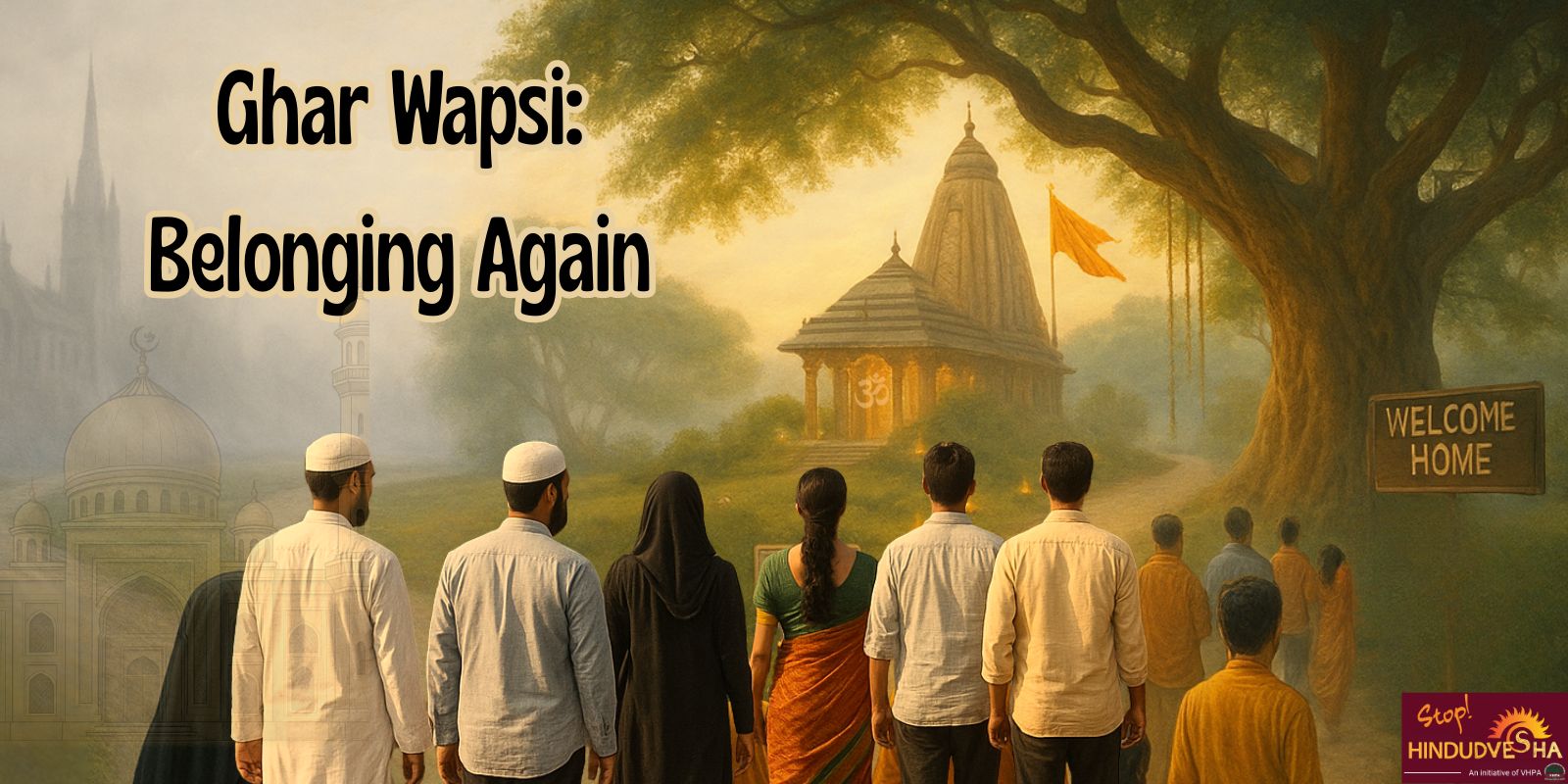
- The act of Ghar Wapsi is akin to undoing the processes of colonization and cultural invasion.
- Communities across India doing Ghar Wapsi on a mass scale in a bid to reclaim their cultural and civilizational roots.
- The resetting of India’s civilizational and cultural narrative over the past decade has given the much-needed courage and confidence to Bharatiyas to reclaim their roots.
- The left-liberal ecosystem, which glorifies illegal and fraudulent conversions of Hindus, aggressively demonizes Ghar Wapsi when Hindus choose to return to their original faith.
- Ghar Wapsi movement is not without challenges – most importantly the issue of cultural assimilation into the mainstream society.
Bharat has been subjected to repeated bouts of invasions and colonization, which, combined with post-independence glorification of colonialism, have left deep scars on the Indian psyche. As a result, many Indians have internalized a sense of cultural confusion and insecurity. This occurs because their civilizational values have been repeatedly challenged and weakened, resulting in an ongoing identity crisis. This crisis is even worse for those who were forced or tricked into changing their religion, whether through violence, threats, or offers of money and benefits.
It is against this backdrop of cultural neurosis that Ghar Wapsi, or the act of coming back to one’s original faith, becomes extremely significant.
The act of Ghar Wapsi is essentially akin to undoing the process of colonization and cultural invasion. It is a powerful possibility—yet a complex one—because the process of reclamation also involves reopening old wounds and confronting one’s own cultural neurosis.
As India’s cultural and civilizational resurgence has gained momentum in the past decade, there has been a remarkable surge in the phenomenon of Ghar Wapsi. A contentious issue in India and abroad, this movement is frequently demonized by the left-liberal ecosystem, which portrays it as a “Hindutva” conspiracy. Yet, despite the avalanche of propaganda and hostile narratives targeting this ‘homecoming’ movement, Indians continue to return to their roots—often on a mass scale.
In the following sections, we delve deeper into the dynamics of this phenomenon: What drives Indians to return to their Dharmic and cultural roots? How does this movement manifest in 21st-century India? And how should one respond to the barrage of anti-Hindu narratives that label this phenomenon a conspiracy against minorities?
Journey Back to Sanatan Roots
In March 2025, 80 families in a village in Rajasthan returned to Sanatan Dharma in a unique event where a church was turned back into a Bhairav Mandir. According to village elders and historical records, a temple dedicated to Bhagwan Bhairav had stood there over 100 years ago. But as Christian missionaries gained influence and local people were converted, the original temple was replaced by a church.[1] Initiated by former pastor Gautam Garasiya, this homecoming movement has become a significant milestone in the cultural and Dharmic reawakening of this place. [2]
In November 2024, 350 individuals in Raipur, Chhattisgarh, returned to Hindu Dharma. Reportedly converted through fraudulent means, they embraced Sanatan Dharma at a Sammelan attended by a prominent Hindu spiritual Guru from South India. Throughout 2024, Chhattisgarh witnessed several reconversion ceremonies, as many families chose to return to their original faith amid a growing spiritual and cultural movement[3] — led by those who have begun to see through the deceit of coercive conversions and now seek to reconnect with their ancestral roots.
In another case of mass reconversion in November 2024, around 150 people in Meerut, Uttar Pradesh, who had earlier converted to Christianity, returned to Hindu Dharma through traditional Vedic rituals. These people had been misled into converting to Christianity just days earlier by a pastor who promised them money and help with wedding expenses. He was later arrested for running a conversion scam in Meerut. The pastor, originally from Kerala, would visit nearby villages and lure poor or uneducated people with financial incentives. Reports say he had converted around 300 families using a scheme similar to network marketing.[4]
However, not just recent converts, but even those who left Hindu Dharma long ago are now bravely returning to their roots after years of forgetting their culture. At the same time, spreading awareness about Ghar Wapsi among new converts is a powerful way to prevent forced and fraudulent conversions.
In another episode in Assam, over 100 people from 35 tribal families returned to Sanatan Dharma, leaving Christianity and reconnecting with their original faith through traditional Tiwa rituals. These families had reportedly converted to Christianity just a few years ago, lured by financial gain.[5]
The community’s decision to return to their roots reflects a growing trend among tribal groups in India to reconnect with their indigenous heritage. Ghar Wapsi is not just about faith—it’s a strong step towards reclaiming culture and identity. It also counters the false claims by Christian missionaries that tribal identity is separate from Hindu Dharma or that Sanatan Dharma has erased tribal traditions.
Reclaiming Lost Traditions
Ghar Wapsi in India is taking place both through community efforts and personal awakenings. Often, one individual takes the first step, inspiring others to follow. When a whole community returns to Sanatan Dharma together, it creates a chain reaction, giving strength and hope to others in similar situations to follow suit.
What’s common in all these examples is a deep desire to reconnect with one’s roots. In recent years, a cultural and civilizational revival has been gaining momentum [6], giving Hindus the confidence to protect their traditions, uphold Dharmic values, and work to reverse the damage inflicted by colonizers and invaders. Ancient Hindu sites are being revived, Dharmic tourism is growing rapidly, and more Hindus are openly embracing and displaying their spiritual symbols in public. School curricula are being decolonized and freed from decades of left-liberal influence. This transformation is sparking profound emotional and psychological reflection among people whose ancestors had abandoned Hindu Dharma due to fear or other pressures.
Ghar Wapsi is driven by a mix of factors. Local Hindu groups and advocacy organizations may help initiate the process, but the core motivation often comes from personal reflection and self-realization, especially in today’s climate, where Hindu culture and civilization are no longer the object of derision.
The openness of Hindu Dharma, especially when compared to the rigid structure of Abrahamic faiths, is another major reason behind the Ghar Wapsi phenomenon.In What is Hinduism, David Frawley describes Abrahamic faiths as closed “belief systems,” while calling Hindu Dharma a “system of inquiry.” He emphasizes that Hindu Dharma is a scientific path that encourages self-reflection and personal search for truth, rather than obedience to fixed dogmas. This flexibility, as Frawley explains, has enabled the peaceful coexistence and flourishing of diverse beliefs and traditions under the broad umbrella of Sanatan Dharma.
Even after years of religious conditioning, many people stay connected with the deep-rooted Hindu values passed down through generations. Growing up with ideals like non-violence, compassion, respect for nature, and the belief that the whole world is one family, they often feel uneasy when confronted with belief systems—such as Islam—that may glorify violence through concepts like Jihad, impose rigid authority, and treat women unequally. Over time, the clash between their natural cultural instincts and the imposed foreign values creates a deep inner conflict, eventually impelling them to return to their true roots.
Left-Liberal Vitriol Against Ghar Wapsi
The demonization of Ghar Wapsi has become a favorite tactic of the left-liberal ecosystem, which eagerly praises conversions of Hindus to other religions—even when done through fraud or coercion—but strongly opposes their return to Sanatan Dharma. A simple Google search of terms like “Ghar Wapsi India” reveals biased narratives claiming Christians are being forcefully converted to Hinduism, framing the movement as a conspiracy by a so-called Hindu majoritarian state and the Sangh Parivar. These critics often portray Christians and Muslims as victims simply because they are minorities, ignoring the well-documented use of money, deceit, and pressure in Christian missionary campaigns and Islamic conversion drives. In truth, Ghar Wapsi is a voluntary and conscious return to one’s ancestral faith, not forced conversion. Let’s check out a few toxic headlines demonizing Ghar Wapsi:
- 120 Christians Forced to Reconvert to Hinduism; June 2024 – International Christian Concern.[7]
- The Real & Insidious Nature of ‘Ghar Wapsi’ Campaign; January 2015 – Peoples Democracy.[8]
- How the RSS ghar wapsi programme actually hurts Hindus; March 2015 – Scroll. [9]
- India Accelerates Forced Conversions; February 2024 – FSSPX News.[10]
- Hindu nationalists make gains among India’s tribes and spur backlash; February 2025 – The Washington Post.[11]
- India: The Politics of Ghar Wapsi about Hindutva drive to “reconvert” Muslims and Christians to Hinduism; January 2015 – Economic and Political Weekly. [12]
- Indian Christians living in fear as claims of ‘forced conversions’ swirl; October 2021 – The Guardian. [13]
- Shamli – Bajrang Dal Activist Force ‘Ghar Wapsi’ On Dalit Man Who Had Converted to Islam; April 2018 – HuffPost.[14]
Many such articles spread blatant anti-Hindu hate under the guise of opposing so-called “forced reconversions,” often relying on false claims and sensationalism. For instance, an article titled “120 Christians Forced to Reconvert to Hinduism” by International Christian Concern alleges that during a Ghar Wapsi ceremony, “radical Hindus forced Christians to drink the blood of a chicken mixed with cow dung.”[15]
Such articles often justify, directly or indirectly, the conversion of Hindus to Christianity and Islam by claiming these are voluntary escapes from the so-called injustices of Hindu Dharma. The caste system is heavily used as a weapon by the left-liberal ecosystem, blaming it entirely for people leaving Hinduism. They ignore or downplay the role of pressure, deceit, and financial temptations in these conversions. As a result, the forced or fraudulent conversion of Hindus is not only defended but sometimes even praised, while Ghar Wapsi—a voluntary return to one’s original faith—is unfairly portrayed as something oppressive or backward.
A common claim is that Christians and Muslims are being forcibly converted to Hinduism by groups like the RSS. However, such accusations rarely come with solid proof. Instead, critics repeat old labels—calling the Modi government “Hindu majoritarian,” the RSS a “paramilitary force,” and painting Ghar Wapsi as a violent project of the so-called “Hindutva” network. Some articles refer to isolated, unverified incidents involving Hindu groups to support the forced conversion claim. Yet these reports often lack context and completely ignore the questionable methods used by Christian missionaries across India.
The hypocrisy of the left-liberal cabal is stark. They go out of their way to justify the forced, deceitful, and sometimes even violent conversion of Hindus to Christianity or Islam—yet completely reject the idea that Ghar Wapsi could stem from personal conviction or inner transformation. In their worldview, “freedom of religion” is a one-way street—available only to missionaries and madrasas, but not to Hindus. An example of this bias is The Washington Post article titled “Hindu nationalists make gains among India’s tribes and spur backlash” [16]. It paints Hindu advocacy groups as aggressive “missionaries” trying to forcibly convert tribal Christians and impose a monolithic Hindu identity on tribal people. The article leans on familiar left-liberal tropes that discredit Hindu Dharma while subtly endorsing Christian evangelical activities in tribal regions. Crucially, it ignores the larger context behind Ghar Wapsi in tribal areas, such as the rapid demographic changes brought about by missionary-led mass conversions and the deep penetration of the Church into tribal communities. It also turns a blind eye to the anti-Hindu propaganda spread by missionaries and instead repeats old “breaking India” narratives that accuse Hindu Dharma of appropriating tribal culture, while erasing the civilizational efforts to preserve and protect India’s indigenous spiritual heritage.
Ghar Wapsi – The Road Ahead
The Ghar Wapsi movement faces several challenges, one of the key ones being the social and cultural integration of those who return to Hindu Dharma. Individuals who have followed Christianity or Islam for many years are often viewed with doubt or hesitation by the larger society.
To address this, Hindu spiritual leaders and advocacy groups must actively build a support system for such individuals. Trust-building should be a priority—helping reconverted individuals feel welcomed, accepted, and gradually reintegrated into the broader Hindu fold. Beyond individual support, efforts should focus on empowering entire Ghar Wapsi communities—socially, culturally, and economically—so they can thrive.
Encouraging marriages within the Ghar Wapsi community can also play a crucial role in strengthening bonds. Facilitating “Roti-Beti ka Rishta” (social and marital ties) will provide a stable support network, ensuring that those who return to their roots are not left isolated but embraced by a caring ecosystem.
Another area of concern is the safety and security of Ghar Wapsi communities or individuals. It’s especially a concern for Indian Muslims who have reconverted to Hindu Dharma. For example, former Shia Board Chairman Wasim Rizvi, who did Ghar Wapsi in 2021, had Fatwas issued against him after the reconversion, as well as being disowned by his family. Wasim Rizvi, now known as Jitendra Narayan Singh Sengar, was eventually legally adopted by Yashwant Kumari Sengar, the mother of Gurukul Kangri University professor Prabhat Singh Sengar, who is a close friend of Rizvi.[17]
Those who return to Sanatan Dharma often face rejection from their former communities and even their own families, resulting in profound emotional distress. When mainstream Hindu society remains indifferent, their struggle becomes even harder. It is vital for Hindu society to acknowledge these challenges. Hindu advocacy groups must actively support Ghar Wapsi communities by creating compassionate systems for their reintegration. Ensuring their safety, dignity, and long-term well-being is key to making their return not just symbolic, but meaningful and lasting.
Wrapping Up
Ghar Wapsi is, at its core, a rejection of the foreign identities imposed through invasions and colonization. By reconnecting with their cultural, civilizational, and Dharmic roots, Ghar Wapsi communities help build a stronger, more self-aware generation of Bhartiyas—less vulnerable to the pressures of religious conversion.
Ghar Wapsi can be both literal and symbolic. Some formally return to Hindu Dharma through ritual initiation, while others begin to embrace Hindu symbols, traditions, and practices in daily life without an official conversion. For Indian Christians and Muslims, even this symbolic return can be difficult due to the constant demonization of Hindu Dharma by missionary networks and madrasa systems, along with the social control these communities often face.
Ultimately, Ghar Wapsi is not just about individual return—it’s about freeing future generations from colonial mindsets and breaking the cycle of cultural confusion and alienation.
Citations
[1] Ghar Wapsi at Sodaladoodha: 80 families embrace Sanatan dharma as church transforms into Bhairav Mandir; https://organiser.org/2025/03/12/281823/bharat/ghar-wapsi-at-sodaladoodha-80-families-embrace-sanatan-dharma-as-church-transforms-into-bhairav-mandir/
[2] Ibid.
[3] Ghar Wapsi: 350 individuals return to Sanatan Dharma after leaving other religions in Chhattisgarh; https://organiser.org/2024/11/11/264629/bharat/ghar-wapsi-350-individuals-return-to-sanatan-dharma-after-leaving-other-religions-in-chhattisgarh/
[4] 150 people do ghar wapsi in Meerut after Pastor Mathew converted them to Christianity; https://www.opindia.com/2024/11/150-people-do-ghar-wapsi-in-meerut-after-pastor-mathew-converted-them-to-christianity/
[5] Ghar Wapsi in Assam; Over 100 people from 35 tribal families revert to Sanatan Dharma through Tiwa rituals; https://organiser.org/2024/08/27/253629/bharat/ghar-wapsi-in-assam-over-100-people-from-35-tribal-families-revert-to-sanatan-dharma-through-tiwa-tribal-rituals/
[6] “Reclaiming India’s heritage: Sambhal’s Key Discoveries”; https://stophindudvesha.org/reclaiming-indias-hindu-heritage-sambhal-discoveries-leading-the-way/
[7] 120 Christians Forced to Reconvert to Hinduism – International Christian Concern; https://www.persecution.org/2024/08/06/120-christians-forced-to-reconvert-to-hinduism/
[8] The Real & Insidious Nature of ‘Ghar Wapsi’ Campaign | Peoples Democracy; https://peoplesdemocracy.in/2015/0125_pd/real-insidious-nature-ghar-wapsi’-campaign
[9] How the RSS ghar wapsi programme actually hurts Hindus; https://scroll.in/article/714103/how-the-rss-ghar-wapsi-programme-actually-hurts-hindus
[10] India Accelerates Forced Conversions | FSSPX News; https://fsspx.news/en/news/india-accelerates-forced-conversions-42406
[11] Hindu nationalists in India make gains among “adivasi” tribes – The Washington Post; https://www.washingtonpost.com/world/2025/01/30/india-hindu-rss-tribals-adivasis/
[12] Communalism Watch: India: The Politics of Ghar Wapsi about Hindutva drive to “reconvert” Muslims and Christians to Hinduism ( Manjari Katju, EPW, Jan 3, 2015); https://communalism.blogspot.com/2015/01/india-politics-of-ghar-wapsi-about.html
[13] India’s Christians living in fear as claims of ‘forced conversions’ swirl | India | The Guardian; https://www.theguardian.com/world/2021/oct/04/india-christians-living-in-fear-claims-forced-conversions
[14] Shamli: Bajrang Dal Activist Force ‘Ghar Wapsi’ On Dalit Man Who Had Converted To Islam | HuffPost News; https://www.huffpost.com/archive/in/entry/shamli-bajrang-dal-activist-force-ghar-wapsi-on-dalit-man-who-had-converted-to-islam_in_5c11fb43e4b0508b2136d92e
[15] 120 Christians Forced to Reconvert to Hinduism – International Christian Concern; https://www.persecution.org/2024/08/06/120-christians-forced-to-reconvert-to-hinduism/
[16] Hindu nationalists in India make gains among “adivasi” tribes – The Washington Post; https://www.washingtonpost.com/world/2025/01/30/india-hindu-rss-tribals-adivasis/
[17] After Conversion to Hinduism, Former Shia Waqf Board Chairman Wasim Rizvi Changes Caste Now | India News – News18; https://www.news18.com/india/from-tyagi-to-thakur-former-shia-waqf-board-chairman-wasim-rizvi-changes-caste-now-9106039.html

Donate to HINDUDVESHA
Our Mission is to explore and expose Hindudvesha through research analysis, education and response.
SUPPORT US