

From Constitutional Safeguards to Political Distortions: Rethinking Who Qualifies as a Minority in India
 K. Sindhu · 11/22/2025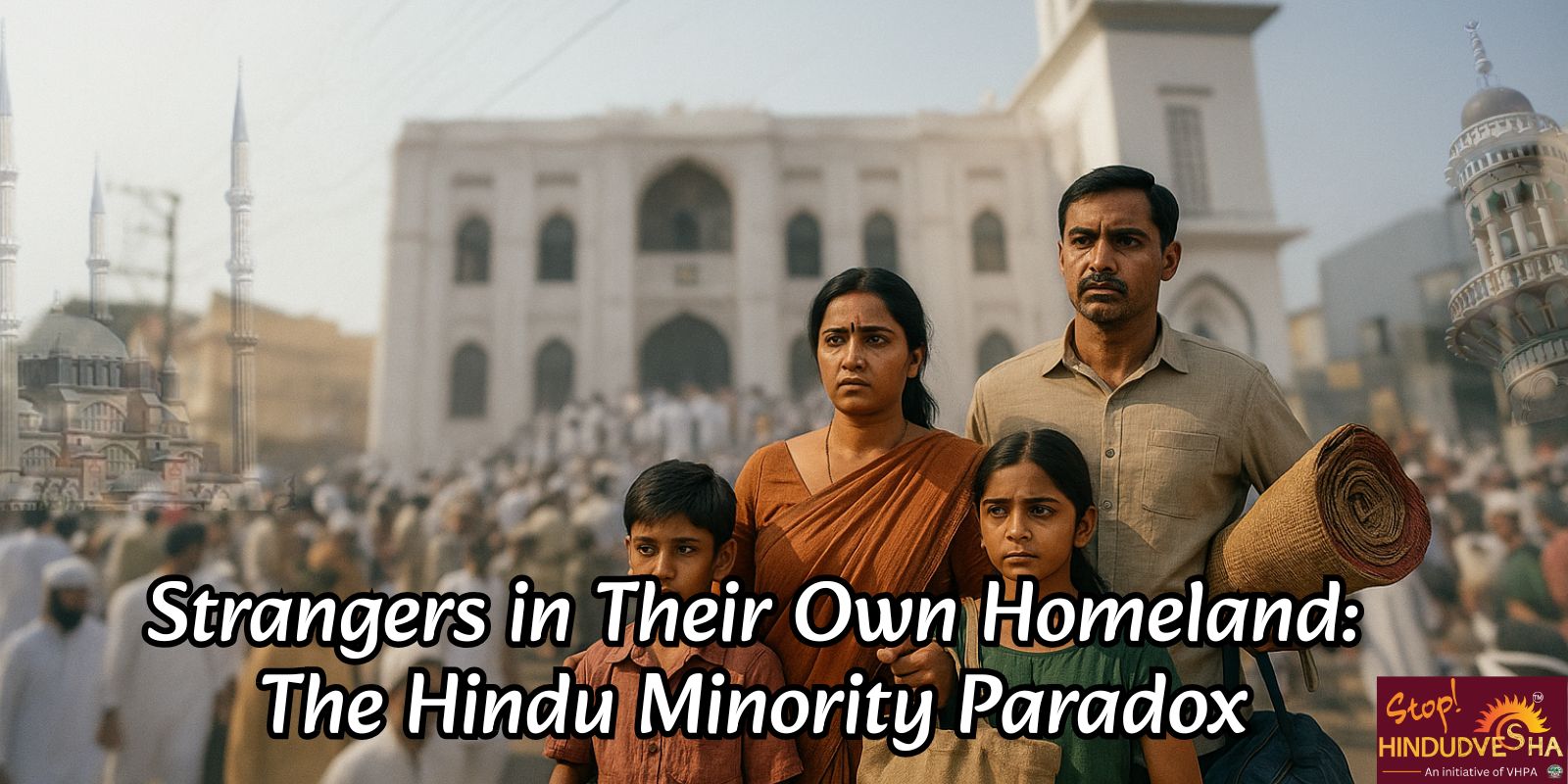
- India’s national-level definition of “minority” has drifted from constitutional intent, creating uneven protections across states.
- Communities that are demographically dominant locally still receive minority benefits, while Hindus in several states remain unprotected.
- Judicial guidance supports state-wise identification, yet national notification persists, producing structural inequality.
- These distortions deprive genuine minorities of resources, encourage identity-based incentives, and unsettle social cohesion.
- A transparent, region-based framework is needed to ensure real equality and restore constitutional balance.
Who counts as a minority in India, and how does the State determine it? These questions may appear procedural, but their consequences are significant. India’s constitutional framework promises equality to every citizen, yet its approach to minority recognition has produced sharp imbalances that now affect both fairness and national cohesion. Six communities — Muslims, Christians, Sikhs, Buddhists, Parsis, and Jains — hold nationwide minority status, along with the accompanying privileges, grants, and institutional autonomy. Hindus, however, are denied similar protections even in regions where they are a shrinking or marginal community. The Hindu demand for minority recognition is not a request for sympathy, but an appeal for constitutional parity. If benefits, safeguards, and autonomy are tied to minority status, there is no reason Hindus should be excluded from them in areas where they are clearly outnumbered.
It is time to reconsider who qualifies as a minority and the criteria used to define it. This article examines how India’s current framework for minority determination and protection has drifted from its constitutional purpose, why recognition must rely on objective measures such as population thresholds and regional demographics, and how restoring this balance is necessary to uphold real equality and justice.
Constitutional Vision and Its Betrayal
To understand the present distortions, it is necessary to return to the moment when minority rights were written into the Constitution. The Constituent Assembly debated these provisions in the shadow of Partition, when communal fractures had devastated the subcontinent.
Many members sought special safeguards for religious and linguistic minorities to reassure those who had chosen to remain in India. Yet the framers firmly rejected proposals such as separate electorates and proportional representation, which had already caused deep harm during colonial rule. Instead, they introduced limited protections under Articles 29 and 30, aimed primarily at cultural preservation and educational freedom.
- Article 29(1)[1] grants the right to “any section of the citizens” to conserve their language, script, or culture — a phrase that is inclusive and applies equally to majority and minority groups wherever they may be.
- Article 30(1)[2] gives “all minorities, whether based on religion or language,” the right to establish and administer educational institutions of their choice.
These provisions were intended to ensure that no linguistic or religious group would lose its identity in the face of a vast national majority. The Supreme Court in Bal Patil v. Union of India (2005) made this explicit: Articles 29 and 30 were designed “to give security to the minds of minorities — Muslims and other religious communities — and thus maintain the integrity of the nation.[3]” The judgment further directed that the National Commission for Minorities should work to reduce the list of notified minorities and ultimately do away with the distinction altogether.[4]
Yet, what we witness today is precisely the opposite — an ever-expanding list of privileges justified in the name of “minority protection,” while the Hindu majority bleeds silently under state control, denial of autonomy, and cultural erasure.
What Constitutes a Minority?
Neither the Constitution nor any statutory law defines “minority” conclusively. The Supreme Court, in the Kerala Education Bill case (1958), touched upon this point but did not resolve it. The Court remarked that even if the question is answered affirmatively that a community with less than 50 percent of the population is a minority, then another question arises: “50 percent of what? The entire population of India or the population of a state forming part of the Union?”[5]
The question was left unanswered.
Later, in T.M.A. Pai Foundation v. State of Karnataka (2002), the Supreme Court clarified that minorities must be identified state-wise, observing that since the reorganization of states in India was linguistic, linguistic minorities should also be considered locally.[6]
Yet, despite this judicial clarity, the Central Government retained a monopoly over the declaration of minorities under Section 2(c) of the National Commission for Minorities Act, 1992, and Section 2(f) of the National Commission for Minority Educational Institutions Act, 2004, and identified them nationally.
The Centre’s power to declare minorities across India, ignoring local demographics, has produced profound inequity. According to the 2011 Census, Hindus have become a minority in Lakshadweep (2.5%), Mizoram (2.75%), Nagaland (8.75%), Meghalaya (11.53%), J&K (28.44%), Arunachal Pradesh (29%), Manipur (31.39%), and Punjab (38.40%).[7] Yet, they are not recognized as a minority community in those regions. On the other hand, Muslims, Christians, and other notified minority communities continue to be treated as minorities, even in states where they are numerically dominant — Christians form the overwhelming majority in Mizoram, Meghalaya, and Nagaland, and hold substantial populations in Kerala, Goa, Tamil Nadu, Manipur, Arunachal Pradesh, and West Bengal. Yet, they continue to be treated as a “minority” in these states.[8] Similarly, Muslims, who constitute 96.20% of Lakshadweep, 68.30% of Jammu & Kashmir, and large segments of Assam (34.20%), West Bengal (27.5%), Kerala (26.60%), Uttar Pradesh (19.30%), and Bihar (18%), also enjoy nationwide minority status.[9]
Giving minority status to Hindus in such regions would allow them to establish and manage educational institutions[10], ensure cultural preservation[11], and fair access to state resources—just as other notified communities do. Under Article 19(1)(g), Hindus can also establish educational institutions, but that is subject to state restrictions under Article 19(6). In contrast, minority-run institutions enjoy greater autonomy under Article 30(1). This has produced a deeply unequal system in which Hindu-run institutions face extensive regulation, while others operate with far fewer restrictions. The imbalance is not merely conceptual. It has concrete, measurable effects. Government grants, recruitment relaxations, and administrative autonomy are more readily available to minority institutions, leaving many Hindu institutions over-regulated and under-supported.
A System Without Objective Standards
Beyond the national-versus-state debate lies a more fundamental question: What proportion of the population should qualify as a minority?
Should a community with 49% population in a state be granted privileges designed for vulnerable sections? Would there be a reasonable threshold — say 1%, 5%, or 10% — below which special protection is justified?[12] The absence of such a benchmark has enabled arbitrary, politically motivated classifications. Furthermore, all criteria used for such recognition must be public, objective, and uniformly applied. Subjectivity and discretion in such matters only fuel appeasement, political manipulation, and religious favoritism. A transparent minority policy will ensure that protection is based on genuine vulnerability—not electoral calculus.
No country in the world grants “minority” status and special privileges to a community numbering 10 or 20 crores. Yet, in Bharat, Muslims — over 20 crores population — are officially recognized as minorities.[13] The same applies to Christians and other notified communities in states where they are dominant. These communities enjoy minority benefits nationwide, while truly small and vulnerable groups are denied recognition, remain unprotected — their pleas unheard, their rights unacknowledged. This inversion of justice makes a mockery of the Preamble’s promise of equality and social justice.
The Cost of a Flawed Minority Policy
Defining minority status solely on the basis of national-level numbers has created serious distortions. It ends up depriving genuine regional minorities of their fair share of educational and developmental opportunities. The principle of equality before the law collapses when demographically dominant groups in one region continue to monopolize benefits originally intended for marginalized groups. One example makes this distortion unmistakably clear. The Union Government once announced 20,000 scholarships in technical education for minority students. In Jammu and Kashmir, where Muslims make up 68.3 percent of the population, 717 of the 753 allotted scholarships went to Muslim students, while not a single Hindu student received one. The justification was the 1993 notification that designates Muslims as a minority at the national level, even in regions where they form an overwhelming majority.[14]
Extending “minority” benefits in Muslim-majority states institutionalizes bias against Hindu students, the real minorities there. The socio-economic result of this biased treatment is predictable: a growing sense of alienation among Hindus in such regions, coupled with the slow erosion of their educational and employment opportunities.
Perhaps the most dangerous consequence of this distorted minority system is the way it incentivizes religious conversion. When minority status becomes a gateway to government scholarships, institutional control, or special rights, the incentive to change identity for economic or other benefits multiplies.[15] A simple example makes this clear.[16] The government offers various monetary benefits to minority students and families. In many regions, Hindu, Muslim, and Christian households face comparable economic hardships, yet only the latter two receive these financial aids because they hold minority status.
What follows is both silent and damaging. Pressed by poverty, some Hindu families begin identifying as Muslim or Christian on official forms simply to access benefits reserved for notified minorities. Over time, this administrative choice becomes psychological. A child who records himself as Muslim or Christian throughout twelve years of schooling gradually internalizes that identity and grows distant from his own civilizational roots. Later, fear of losing benefits or facing scrutiny prevents him from returning to Hindu dharma. He stops celebrating Holi, Diwali, and other Hindu festivals, and instead starts visiting churches or mosques—not out of conviction, but to appear aligned with the community he has claimed on paper. Within a generation, such families lose connection with their original Hindu heritage. Advocate Ashwini Upadhyay calls it government-sponsored indirect conversion[17], in which economic distress is exploited, though unknowingly, to alter demography under the guise of minority protection. The government, by rewarding certain religious identities, has become a participant in dismantling the very civilization it meant to protect. This is not a reflection of social justice but a distortion of democracy. In a secular republic, the government should not have a religious lens in conferring benefits. Yet, India’s political structure has institutionalized religion-based welfare schemes — a constitutional contradiction and moral travesty.
When Hindus Become Invisible Minorities
The recent exodus from Shanichari and Shukrawari localities in Sagar, Madhya Pradesh, is a grim reminder of the ground reality. Over the past decade, the Hindu population there has dropped by 4.88%. Reports show that 41 Hindu families have sold their homes and left in the past five years[18] —63 families (228 people) over the last ten years, while each vacated property has been bought by members of the Muslim community. Many remaining houses still bear “for sale” signs.
This is not migration by choice. It is a movement driven by fear, insecurity, and social pressure. Yet even in districts where Hindus have become a numerical minority, they receive no legal or administrative protection. This is not an isolated episode; it is a warning. The slow, quiet displacement of Hindus from neighbourhoods, towns, and districts echoes patterns earlier seen in Kashmir and parts of West Bengal. Across Bharat, the demographic trends point to a troubling reality. If minority recognition were made state-wise, Hindus would qualify in at least nine states.[19] If it were district-wise, around 200 districts would be eligible for protection.[20] Conversely, in those very areas, Muslim and Christian minority status should logically end.
In this regard, Assam’s Chief Minister Hemanta Biswa Sarma has aptly proposed district-level recognition, citing that Hindus have vanished from nine districts of Assam.[21] Extending this logic, Hindus should be declared minorities in 14 districts of West Bengal, 6 in Bihar, 4 in Jharkhand, and 18 in Uttar Pradesh.[22] The same logic that protects one community’s vulnerability must protect another’s. Equality demands consistency — not convenience. The refusal to acknowledge these realities under the guise of secularism is not correct.
Minority in their Own Land
It is both ironic and tragic that Hindus are seeking minority status in Hindustan — their own civilizational homeland. The very term “minority” becomes an absurdity when applied to those who gave the world its oldest living faith, its pluralistic ethos, and its universal spiritual vocabulary.
Yet within this distorted framework, the descendants of a civilization that is thousands of years old now find themselves seeking—and even fighting legal battles for [23]—minority status and basic protections. Beyond the legal and policy dimensions, this issue carries profound civilizational implications. The continued denial of minority recognition to Hindus in states where they are numerically small is not merely an administrative anomaly — it is part of a larger pattern of erasing Hindu visibility.
For decades, public discourse has been shaped by the narrative that Hindus, being a majority nationally, are by default privileged and incapable of discrimination. But this assumption collapses when examined locally. In states where Hindus are less than 10% of the population, they face the same vulnerabilities — social isolation, cultural marginalization, and institutional exclusion — that any minority would. Yet, they remain unprotected by the very laws that claim to uphold equality.
Concluding Remarks
True secularism does not rest on privileging one group over another. It requires that every community be treated with equal dignity. Equality cannot operate in only one direction, and justice cannot be selective. The State must choose clarity over ambiguity. It must either denotify communities that are no longer minorities in several states or recognize Hindus as minorities wherever they are outnumbered. Anything short of this continues the erosion of both equality and secularism.
Minority rights were never meant to create demographic monopolies. They were envisioned as instruments of inclusion, not exclusion. To restore their legitimacy, the government must evolve a state-wise and need-based model that recognizes minorities where they truly exist, not where political convenience dictates.
The civilization that gave refuge to all cannot be made a refugee in its own land. Recognizing Hindu minorities where they exist is not a concession—it is the restoration of constitutional fairness and civilizational integrity.
Citations
[1] Section 29 – Constitution of India; Protection of interests of minorities; https://indiankanoon.org/doc/1888152/
[2] Article 30 – Constitution of India; Right of minorities to establish and administer educational institutions; https://indiankanoon.org/doc/1983234/
[3] Pandey, J.N.; “Constitutional Law of India” by (Page No. 417-418); https://ia601809.us.archive.org/14/items/jn-pandey.-the-constitutional-law-of-india-edition-tenth/JN%20Pandey.The-Constitutional-Law-Of-India-Edition-Tenth_text.pdf
[4] ibid
[5] The Measure of Justice and Question of Minority Rights in India; https://virtuositylegal.com/the-measure-of-justice-and-the-question-of-minority-rights-in-india/
[6] ibid
[7] Determination of Minority in India; https://www.drishtiias.com/daily-news-analysis/determination-of-minority-in-india
[8]Why don’t Hindus have minority rights in States where they consist only 2% of the population? [Read PIL]; https://lawstreet.co/executive/hindus-minority-rights-population
[9] ibid
[10] Article 30 – Constitution of India; Right of minorities to establish and administer educational institutions; https://indiankanoon.org/doc/1983234/
[11] Section 29 – Constitution of India; Protection of interests of minorities; https://indiankanoon.org/doc/1888152/
[12] Declare Hindus Minority in 8 states, PIL | Legally Speaking; https://www.youtube.com/watch?v=yUAfLYbio3s
[13] Declare Hindus Minority in 8 states, PIL | Legally Speaking; https://www.youtube.com/watch?v=yUAfLYbio3s
[14] Why don’t Hindus have minority rights in States where they consist only 2% of the population? [Read PIL]; https://lawstreet.co/executive/hindus-minority-rights-population
[15] ibid
[16] Deep Insights of Minority Rights In India | Dr.Manish Kumar | Ashwini Upadhyay | CapitalTV; https://www.youtube.com/watch?app=desktop&v=Jto9RrrX3Bg
[17] ibid
[18] Hindus migrating from Shanichari-Shukrawari of Sagar city in Madhya Pradesh: Girls trapped in love jihad by Muslim men, pieces of meat thrown outside houses; https://www.opindia.com/2025/05/mp-muslim-harassment-forces-hindus-to-flee-from-sagar-city-area/
[19] आखिर भारत में कौन है असली Minority? by Ashwini Upadhyay । #akhandhindutva; https://www.youtube.com/watch?v=M5-ogVnD4Q0
[20] आखिर भारत में कौन है असली Minority? by Ashwini Upadhyay । #akhandhindutva; https://www.youtube.com/watch?v=M5-ogVnD4Q0
[21] ibid
[22] ibid
[23] Bal Patil v. Union of India; Ashwini Kumar Upadhyay v. Union of India (Kanoon); https://indiankanoon.org/doc/502741/

Donate to HINDUDVESHA
Our Mission is to explore and expose Hindudvesha through research analysis, education and response.
SUPPORT US