

From Colonial Loot to Global Collections: Two Centuries of Theft, Smuggling, and Market Legitimation of Hindu Sacred Art
 Aditi Joshi · 04/07/2026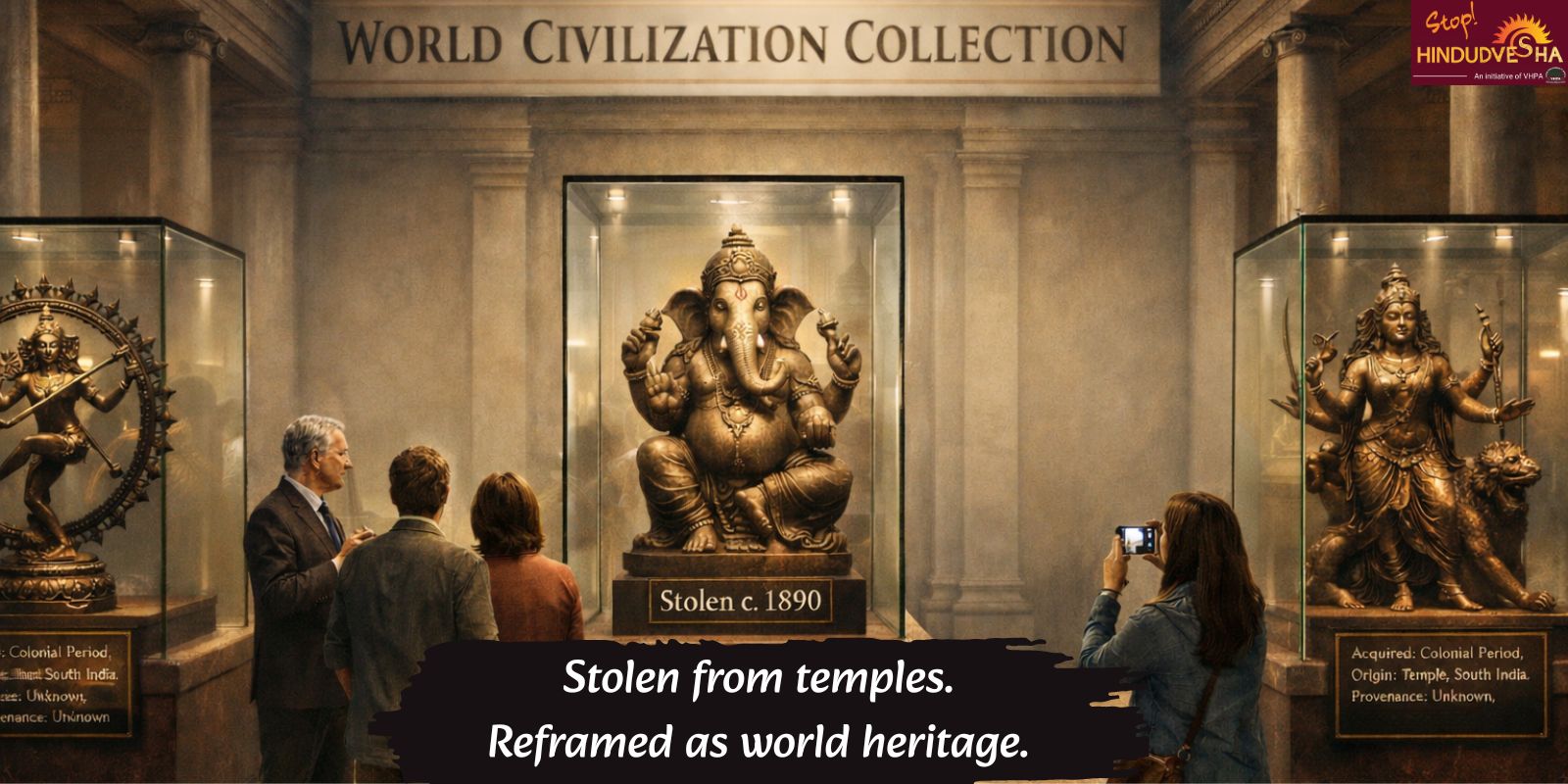
Summary
This essay examines how Hindu temple sculptures and sacred objects entered global museums and art markets through a two-century process shaped by colonial power, antiquarian collecting, smuggling networks, and scholarly reinterpretation. What began under British rule through archaeological surveys and imperial collecting practices gradually evolved into a global system involving dealers, collectors, and major museums. Along the way, sacred icons embedded in living ritual traditions were reclassified as historical artifacts and aesthetic masterpieces. The article argues that this transformation did more than relocate objects; it altered their meaning. Hindu murtis, once approached as living embodiments of divinity, were converted into collectible cultural objects within the global art economy.
“If we started returning everything, the British Museum would be empty.”
This remark, attributed to former British Prime Minister David Cameron, was meant as a practical point about the difficulty of returning looted artifacts. Yet it also hints at something more troubling. If returning these objects would empty the museum halls of Britain, then those halls themselves reflect a long history of systematic extraction. What appears as a collection of world culture begins to resemble something closer to an archive of extraction.
The modern Western museum, especially institutions such as the British Museum, can be seen not only as a place that preserves objects but also as the final stage of a much longer historical process. Inside these galleries lie thousands of sacred items removed from the ritual settings that once gave them meaning. Among them are Hindu murtis, temple sculptures, ritual bronzes, and other sacred pieces that once belonged to living religious traditions across the Indian subcontinent.
Yet describing these objects simply as “colonial plunder” or “smuggled antiquities” understates the scale of the phenomenon. Closer examination reveals not scattered incidents but a sustained system in which sacred Hindu art was removed from temples, reinterpreted through scholarship, moved through imperial networks, and absorbed into the global art market. What emerges is not simply looting, but a system of cultural extraction followed by epistemic transformation.
The Long Architecture of Extraction
The global dispersal of Hindu sacred art becomes clearer when viewed against the institutional structures formed under British administration in the nineteenth century. The transfer of temple icons, sculptures, and sacred objects across regions and continents was not random, nor was it merely the outcome of aesthetic appreciation. It was deeply tied to the growth of colonial institutions that claimed the authority to document, classify, preserve, and ultimately control India’s material past. British imperial expansion in the Indian subcontinent was not limited to military conquest or administrative rule. It also gave rise to an elaborate machinery of archaeological surveys, antiquarian collecting, museum-building, and scholarly interpretation. Through this machinery, Hindu sacred art was gradually separated from the communities that had sustained it for centuries.
A central figure in this process was Alexander Cunningham, the founder of the Archaeological Survey of India. Cunningham and others like him helped create an official framework through which India’s monuments, ruins, temples, and sacred landscapes could be studied and managed by the colonial state. On the surface, this appeared to be an act of preservation.[1] Sites were measured, inscriptions were copied, sculptures were photographed, and monuments were catalogued with bureaucratic precision. But this was never a neutral exercise. The very act of surveying and classifying transformed the way these places and objects were understood. Temples that had long existed as living centers of worship were increasingly recast as “historical sites.” Sculptures that had once been approached with reverence were turned into archaeological data.[2]
In many cases, this process did not stop at documentation. Sacred structures were often partially dismantled, their fragments relocated, and their sculptural elements transferred to museums or government collections. Importantly, these acts were seldom described by colonial officials as removal or dispossession. Instead, they were wrapped in the morally reassuring language of rescue, protection, and conservation. British administrators frequently claimed that temple sculptures were in danger of neglect, weathering, local reuse of stone, or, in dismissive terms, religious decline. By this logic, removing an image from its temple and placing it in a museum in Calcutta, London, or a provincial collection was not an act of appropriation, but of salvation. The museum was cast as a safer and more rational home than the shrine.
Once temple sculptures were removed from their ritual environments, they no longer functioned as sacred embodiments of divinity. In their new settings, they were redefined as objects of study. Scholars and curators approached them as examples of artistic style, evidence of dynastic patronage, or specimens useful for constructing iconographic and chronological taxonomies. A murti that was once encountered as a living presence became, in the colonial archive, an “artefact.”
Orientalism and the Rewriting of Sacred Meaning
Colonial knowledge production played a decisive role in making the transfer of sacred Hindu objects into imperial collections appear legitimate, reasonable, and even necessary. This was not achieved only through military power or administrative authority. It was equally accomplished through systems of knowledge, through catalogs, excavation reports, survey records, scholarly essays, and museum displays, that shaped how these objects were to be seen and understood. In other words, the colonial state did not merely remove sacred art; it also produced the intellectual framework that made such removal appear lawful, enlightened, and culturally beneficial. Through this framework, Hindu civilization was increasingly represented not as a living and continuous religious world, but as an ancient artistic tradition whose greatest significance lay in its value for historical study and aesthetic appreciation.
This shift in representation was profound. Once Hindu civilization was presented primarily as a civilization of the past, its sacred objects could also be redefined accordingly. Temple sculptures were no longer approached as divine embodiments participating in active ritual worlds. They were interpreted instead as remnants, survivals, or relics of a bygone age.[3] In this narrative, the murti was no longer understood through bhakti, darshan, consecration, or temple ritual. It became a fragment of history, a clue to dynastic chronology, a specimen of regional style, or an illustration of iconographic development. The sacred image, once embedded in a network of worship, memory, myth, and community, was recast as an artefact available for scholarly explanation.
This intellectual move had far-reaching consequences, because it transformed the moral meaning of removal itself. So long as an icon was recognized as sacred, its displacement from a temple could be seen as a violation, even a sacrilege. But once it had been reframed as a historical artefact, that same act could be described in much softer and more respectable terms, as preservation, collection, research, or conservation. The act of taking was disguised as the act of saving.[4] Under this logic, museums were claimed to be neutral institutions where such objects could be protected from decay, studied with scientific detachment, and appreciated as part of humanity’s shared heritage. Imperial collections thus presented themselves not as beneficiaries of dispossession, but as custodians of universal culture.
Yet this claim to neutrality was deeply illusory. Museums were never passive or innocent spaces.[5] They were institutions shaped by colonial power, and the knowledge they produced reflected that power at every level. Glass cases, curatorial labels, systems of classification, and the removal of sculpture from shrine all redefined sacred objects. What appeared as objective scholarship was, in fact, a civilizational translation that stripped these works of ritual meaning and placed them within a secular order of display. The murti was no longer a presence before which one stood in reverence, but an object to be observed. Worship yielded to description.
The deeper consequence was the severing of sacred art from the world that had sustained it. Murtis, once bathed, adorned, and invoked as living embodiments of divinity, were recast as aesthetic artifacts. Their meaning no longer flowed from temple ritual or local memory but from curatorship and academic interpretation. In this process, colonial knowledge production did more than interpret Hindu sacred art; it changed its status, turning the devotional into the collectible and the consecrated into the displayable.
The result was a profound change in how the temple itself was imagined. No longer seen primarily as a sacred center of presence and worship, it was increasingly treated as a site of extractable heritage. Its walls, pillars, and sanctums became sources of material for museums, archives, and art historical narratives. In this reduction, the temple ceased to be understood as a living organism of ritual and community. It became, in effect, a quarry of heritage, a place from which the past could be mined, removed, and redistributed under colonial authority.
From the Empire to the Art Market
If the nineteenth century created the physical and intellectual routes through which Hindu sacred objects could be extracted, the twentieth century broadened those routes and folded them into an increasingly global art market. What had once been carried out under the authority of the empire, archaeology, and official preservation did not come to an end with the retreat of colonial rule. Rather, it changed its language, its agents, and its institutional settings. As formal imperial control weakened, a new network of intermediaries rose to prominence: art dealers, private collectors, curators, philanthropists, and international auction houses. Through them, objects that had earlier been removed under the cover of archaeological recovery or imperial custodianship now entered circuits of exchange governed by commercial value, cultural prestige, and museum desire.
What is striking is how seamless this transition was. There was no sharp rupture between the colonial archive and the modern art market. On the contrary, the latter depended heavily upon the classificatory systems produced by the former. Colonial catalogues, excavation reports, museum inventories, and art-historical scholarship had already organized Indian sacred art into recognizable categories, schools, styles, dynasties, regional forms, iconographic types, and chronological periods. This body of knowledge became the intellectual infrastructure of the modern market in Indian art. Dealers could now identify which objects were “important,” which styles were rare or desirable, and which sculptures would appeal to wealthy buyers in Europe and America.[6] Collectors, in turn, did not purchase these objects merely as decorative items; they acquired them as markers of refinement, cosmopolitan taste, and access to a prestigious civilizational past.
Western museums continued to play a pivotal role in this expanding system. Institutions such as the Metropolitan Museum of Art and the Victoria and Albert Museum often participated in them directly or indirectly, acquiring Hindu sculptures through dealers, donors, estate transfers, private collections, and auction houses. The museum’s role in this system was especially powerful because it did more than house the object; it conferred legitimacy upon it. Once an icon entered the museum, its status changed. Questions that might earlier have seemed urgent, such as where exactly it came from, under what circumstances it left its original site, whether consent was ever obtained, and whether the temple was still active, often receded into the background.
The issue of provenance was frequently handled with a striking degree of flexibility. Documentation might be fragmentary, vague, or entirely missing. A sculpture might be described simply as having come from “South India” or “an old European collection,” with little effort to reconstruct the chain of custody. Yet once such an object was displayed within the authoritative environment of a major museum, uncertainty itself was often neutralized. The curated gallery, the scholarly label, the exhibition catalogue, and the museum’s institutional prestige together produced an aura of legitimacy. In effect, the museum served as a laundering mechanism of cultural respectability. What may have entered through ambiguous, even deeply questionable, channels emerged in display as a legitimate work of world art.
Once placed in the museum, the sculpture no longer appeared as a displaced sacred presence. It entered a global narrative in art history in which its value was measured by form, craftsmanship, rarity, and historical placement. The violence of displacement was softened by the elegance of display.
Transforming Sacred Objects
Perhaps the deepest consequence of this system lies not only in the physical removal of sacred objects but also in the conceptual transformation they undergo after their removal. In Hindu traditions, a murti is not merely a visual representation or symbolic image of divinity. Through the ritual of prana-pratishtha, it becomes a consecrated living presence within a sacred environment. Its identity is inseparable from worship. It is bathed, clothed, adorned, offered food, praised through mantra, approached through darshan, and integrated into the temporal rhythms of temple life through festivals, vows, and communal devotion. The murti does not exist in isolation. It belongs to a relational world composed of priests, devotees, ritual procedures, architecture, sacred geography, inherited memory, and embodied acts of reverence.
When a murti is removed from its temple context, the ritual world that sustained it collapses. The icon may remain intact, but the meanings that animated it are severed. Behind museum glass, it loses ritual agency. No longer a presence before whom one stands in devotion, it becomes an object of observation, valued for style, age, or craftsmanship. This is often called preservation, but preserving form is not the same as preserving meaning. What survives is the body of the object, not the life that once flowed through it.
In this process, sacred presence is turned into cultural capital. What once belonged to a living religious world becomes part of a system of prestige, scholarship, and display. The murti is admired and studied but no longer worshipped or served. Its meaning shifts from sacred presence to aesthetic and historical value. This is not merely a change of location but a change in what the object is understood to be.
Western museums have often defended their possession of such objects through the doctrine of universal heritage. According to this view, certain artefacts transcend local or religious belonging and form part of the common inheritance of humanity. Museums, in this argument, are not sites of appropriation but institutions of guardianship. They preserve the achievements of world civilizations and make them accessible to global audiences. At first glance, the argument may appear generous, even noble. Yet it conceals more than it reveals. It says little about the historical conditions under which such objects entered museum collections. It tends to overlook the power asymmetries that enabled the initial transfer, and it often treats questions of sacred belonging as secondary to the museum’s own claim to custodial authority.
When sacred artefacts are removed from living religious environments without consent, and are then displayed as if they were neutral art objects, the universalist argument begins to look less like ethical stewardship and more like imperial entitlement translated into modern vocabulary. The rhetoric has changed, but the underlying assumption remains disturbingly familiar: that powerful institutions in the West possess the authority to determine where the sacred heritage of other civilizations properly belongs. This is especially troubling in the case of Hindu temple art, because many of the sites from which such objects were removed are not dead ruins or abandoned archaeological remnants. They are active temples, living centers of worship, and enduring nodes of civilizational continuity. Their sculptures and ritual objects are not residues of a vanished past. They remain integral to ongoing religious life.[7]
To treat such objects as portable art commodities is therefore not merely an administrative or curatorial mistake. It is a deeper misunderstanding of their nature. It imposes a framework in which sacred embodiment is reduced to a collectible form, and ritual significance is subordinated to visual appreciation. The problem is not only that the object has moved. It is that the categories through which it is understood have been radically altered.
Will Restitution Take Place?
In recent years, demands for the restitution of looted and illicitly exported artefacts have grown more visible and more forceful. Museums, governments, and cultural institutions have, in some cases, begun returning objects once it has been demonstrated that they were stolen, trafficked, or exported in violation of law. These acts are often described as gestures of moral repair, and in many cases, they are indeed significant and necessary.[8] They acknowledge that certain acquisitions were unjust, and they open the possibility of historical accountability. Yet the language of restitution often remains confined within a narrow legal frame. Debate often focuses on proof of theft, documentary gaps, export licenses, ownership records, and chains of possession.
Such legal criteria address only one layer of the problem. They do not fully confront the longer history through which the removal of Hindu sacred art was normalized in the first place. The global circulation of these objects did not begin with modern smuggling rackets alone. It emerged from a much older formation in which imperial conquest, archaeological authority, missionary hostility toward indigenous worship, orientalist scholarship, and market demand worked together to make sacred objects available for extraction. This wider history reveals something more troubling than isolated acts of theft. It reveals a civilizational pattern in which sacred heritage was steadily reclassified as collectible property. The issue, then, is not merely criminality in the narrow legal sense. It is the historical production of legitimacy around dispossession itself.
For this reason, the return of individual artefacts, though essential, cannot by itself resolve the deeper legacy of the system. Repatriation can correct specific wrongs, but it does not automatically undo the conceptual structures that enabled those wrongs. It cannot, on its own, dismantle the long-standing habit of viewing Hindu sacred art through categories that privilege market value over ritual meaning, museum authority over community belonging, and aesthetic admiration over civilizational continuity. A fuller response requires more than the movement of objects back across borders. It requires a rethinking of the frameworks through which sacred objects are classified, displayed, owned, and interpreted.
Ultimately, the debate surrounding Hindu temple art raises a fundamental question of civilizational justice: who has the authority to define the meaning and ownership of sacred objects? More than a legal dispute, it raises fundamental philosophical and civilizational questions. If these artefacts are treated merely as works of art, then their presence in global museums may appear relatively unproblematic. But if they are understood as parts of living religious systems, objects whose significance depends upon ritual life, sacred geography, inherited memory, and communal continuity, then the ethical landscape changes profoundly. Under that understanding, what is often called preservation begins to look far more like dispossession.
The modern art economy continues to aestheticize, commodify, circulate, and display sacred heritage detached from the worlds that gave it life. As long as that system remains unquestioned, the galleries of the world’s great museums will continue to stand not merely as sites of culture, but as silent witnesses to a deeper history of civilizational displacement. Their elegance cannot erase that history, and their labels cannot neutralize it. The provocative remark about empty museum halls may, in the end, contain more truth than its speaker ever intended, for what appears as cultural possession may in fact rest upon a long and unresolved history of sacred loss.
Citations
[1] Custodians of the past: 150 years of the Archaeological Survey of India; https://archive.org/download/custodiansofpast00newd/custodiansofpast00newd.pdf
[2] Early History of the Archaeological Survey of India; https://www.brhat.in/dhiti/early-history-archaeological-survey-of-india
[3] V&A Collections Search: Hindu Temple Sculptures; https://collections.vam.ac.uk/search?images_exist=true&kw_location_type=display&page=1&page_size=15&q=Hindu+temple+sculptures
[4] Devotion, Antiquity, and Colonial Custody of the Hindu Temple in British India* | Modern Asian Studies; https://www.cambridge.org/core/journals/modern-asian-studies/article/devotion-antiquity-and-colonial-custody-of-the-hindu-temple-in-british-india/7331386ACE9BF57E12D9A2B4680A344A
[5] Tantra at the British Museum – Collecting histories; https://www.britishmuseum.org/exhibitions/tantra-enlightenment-revolution/tantra-collecting-histories
[6] Disgraced antiquities dealer Subhash Kapoor sentenced to ten years in prison by Indian court; https://www.theartnewspaper.com/2022/11/02/disgraced-antiquities-dealer-subhash-kapoor-sentenced-to-ten-years-in-prison-by-indian-court
[7] Full article: Decolonising the Rescue Narrative: Antiquarian Usage of Amaravati Sculptures in the British Museum; https://www.tandfonline.com/doi/full/10.1080/02666030.2026.2630477
[8] Smithsonian’s National Museum of Asian Art will return three bronze sculptures to India after provenance review – The Art Newspaper; https://www.theartnewspaper.com/2026/02/10/smithsonian-national-museum-asian-art-repatriation-india-bronzes

Donate to HINDUDVESHA
Our Mission is to explore and expose Hindudvesha through research analysis, education and response.
SUPPORT US