
‘Free Speech for Me, not for Thee’: The Hypocrisy of the Left-Liberal Cabal
 Aditi Joshi · 04/13/2025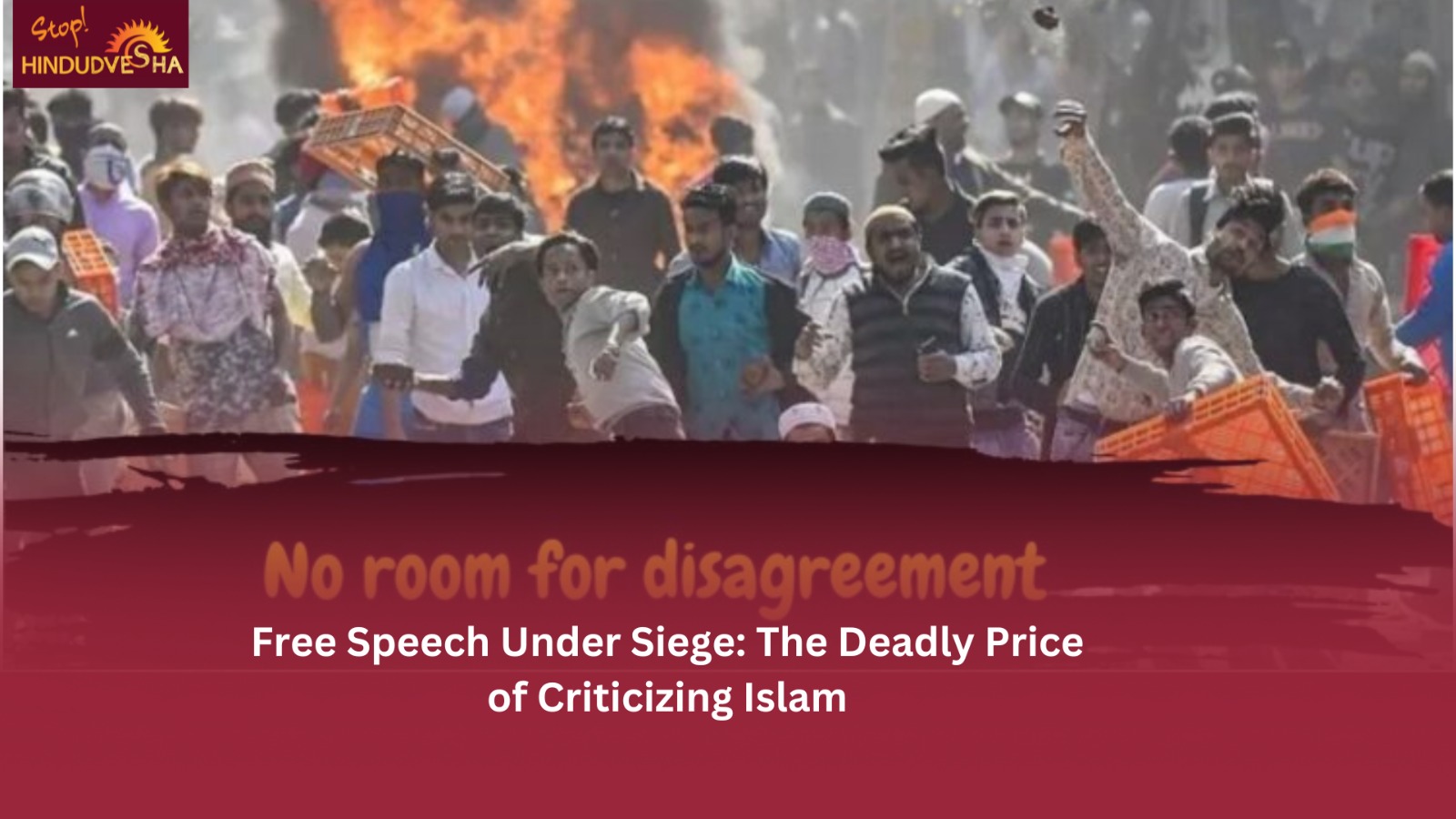
- Liberals often champion free speech only when it supports their ideological leanings, suppressing opposing views under the guise of moral outrage.
- Satirical content is defended when mocking traditional or conservative figures but is condemned when it targets liberal icons or sacred cows.
- Institutions and media dominated by left-leaning voices subtly (or overtly) censor dissenting thoughts by denying platforms and delegitimizing counter-narratives.
- The liberal intelligentsia projects an image of open-mindedness but often reacts with hostility to views that challenge their ideological dominance.
- Progressives’ claim to the moral high ground is undermined by their inability to engage with disagreement, replacing debate with cancellation.
In democratic societies, freedom of speech is often considered a pillar of liberty. Yet, in practice, its champions are not always consistent. In India and globally, the so-called liberal intelligentsia—self-styled defenders of individual rights and constitutional values—have repeatedly shown to be selective in their advocacy. They thunder against censorship when it suits them and fall silent—or worse, become the enforcers—when the speech challenges their worldview.
…they do not believe in freedom of speech as a principle but as a privilege reserved for those who parrot their worldview.
In India and around the globe, a powerful cabal of self-proclaimed liberals—academics, journalists, comedians, activists—has taken up the mantle of defending free speech. However, peeling away the performance, a disturbing truth emerges: they do not believe in freedom of speech as a principle but as a privilege reserved for those who parrot their worldview.
Speech that affirms their grand narrative is hailed as dissent, art, or courage. But the moment a contrary voice rises—be it from a political opponent, a religious critic, or a dissident thinker—they scramble to censor, cancel, or condemn. This hypocrisy, masquerading as moral clarity, is dishonest and dangerous to a democratic society.
Kunal Kamra’s Satire and the Safety of Narrative
Kunal Kamra’s name often tops the list when the liberal intelligentsia mounts the barricades for “freedom of expression.” His brand of anti-establishment humor—sharp, direct, and unapologetically targeting the current ruling political party or its leadership—has earned him both fame and a loyal audience within the left-leaning ecosystem. In 2025, when Kamra released a satirical song ridiculing Maharashtra Deputy Chief Minister Eknath Shinde, it predictably drew the ire of the state’s ruling establishment. Yet just as predictably, a chorus of liberal defenders emerged almost overnight, insisting that “art cannot be muzzled,” that “humor is a form of dissent,” and that “satire must make the powerful uncomfortable.” [1][2][3][4][5]
And truth be told—they are right. Kamra has every Right to criticize political leaders. Artistic freedom is foundational to a democratic society, and political satire has long served as a mirror to the nation’s power structures. The issue, however, is not with Kamra’s speech but with the moral inconsistency of those who champion him.
That passionate defense of satire vanishes the moment the target shifts from the state to sacrosanct identity groups or minorities that the Left-liberal cabal deems untouchable.
Take Varun Grover, another prominent voice in the comedy and screenwriting circles. During the 2019 anti-CAA protests, Grover’s poetry and stand-up bits frequently mocked Hindu religious motifs. In one particular piece, he likened India’s political future to mythical themes from Hindu scripture in a way that many devout Hindus found offensive. Yet this was not met with any serious pushback from liberal circles; instead, he was feted as a brave voice of resistance. “Subversive,” they called him. “A modern-day Kabir.” Social media was flooded with praises about how he was using art to challenge “fascism.” [6][7][8]
But the double standards emerge starkly when one observes the case of Surleen Kaur, a female stand-up comedian who, in 2021, made a passing joke about overzealous religious preachers—not singling out any one faith but pointing to the hypocrisy she had observed across religious domains. The reaction? Immediate backlash. Religious outfits—some Hindu, some Muslim—lashed out. She was hounded online, forced to take down her content, and, most notably, dropped by a health and wellness brand she had partnered with. [9]
One would imagine this would trigger a united front of liberal voices coming to her defense—after all, wasn’t this exactly the sort of cultural censorship they opposed when it affected their own? But no such defense was mounted. There were no open letters from the usual gang of writers, no think pieces in mainstream dailies, and no outrage on prime-time panels about the death of humor. Just silence.
In this silence lies the hypocrisy.
Surleen Kaur was not one of them—not ideologically aligned, not pushing their narrative. Her punchlines didn’t serve their politics. More importantly, she dared to include communities they deemed immune to criticism. The liberal cabal did not stand by her—not because her speech was more offensive or dangerous than Kamra’s or Grover’s but because it didn’t serve their selective framework of who can be mocked and who must be protected at all costs.
What we are witnessing, therefore, is not the defense of free expression but the careful curation of it. When satire is directed at the Hindu faith or Indian traditions, it is “critical thinking.” But the moment the arrow turns toward minority dogmas, religious orthodoxy beyond Hinduism, or the illiberalism within protected groups, suddenly, satire becomes “hate speech,” comedy becomes “communalism,” and the artist is left to fend for themselves.
Speech is not free if its value is decided by whom it offends.
This ideological cherry-picking doesn’t just erode the credibility of liberal defenders; it fractures the very foundation of what free speech is supposed to stand for. Speech is not free if its value is decided by whom it offends. If the Right’s outrage is authoritarian censorship, then the Left’s silence is moral complicity.
True defenders of expression do not retreat when satire is uncomfortable. They stand by artists across the ideological spectrum—not just the ones whose jokes make them laugh but also whose punchlines make them squirm.
Nupur Sharma and the Convenient Outrage Filter
Now, let’s shift to Nupur Sharma’s case. Her comments were part of a heated television debate, not a premeditated hate act. Yet what followed was unprecedented: a global outrage, violent protests, threats to life, and even condemnation by India’s top court. [10][11]
Instead of defending her Right to speak—even while disagreeing with her—the same liberal cabal that defends Kamra on stage celebrated Sharma’s public shaming. No one spoke of the “right to offend” here. For them, her speech wasn’t an expression but a crime.
This selective moral outrage betrays the ideological double standard that underpins the modern liberal discourse. When Hindu beliefs are parodied, distorted, or demonized—whether it’s equating Sita’s Agni Pariksha to modern misogyny, mocking Ganesha’s form in memes, or casually labeling the Manusmriti as Hinduism itself—such speech is heralded as courageous, progressive, and even necessary. Professors in elite universities can denounce the Bhagavad Gita as a “war manual,” and artists can paint Hindu gods in sexually explicit ways—all in the name of artistic freedom or intellectual inquiry.
But, applying the same scrutiny to other faiths, the rules suddenly change. Critique of Islamic doctrine—even if textual and grounded—is branded as Islamophobia. Questioning Christian theology, howsoever historically informed, becomes cultural insensitivity. In this two-tier system, the liberal cabal does not hesitate to call for censorship, legal action, or, at the very least, public shaming.
This is where the Left-liberal establishment reveals its true nature. It isn’t interested in freedom of speech as a universal right. It is only interested in their freedom of speech when it mocks tradition, when it serves a particular ideological narrative, and when it punches up in the ways they define.
Academia’s Intolerance: Selective Pluralism
In universities, the hypocrisy is even more entrenched.
When Professor Kancha Ilaiah, a known left-wing thinker, published “Post-Hindu India,” he received death threats from right-wing outfits.[12] Liberals defended him—and rightly so. But when Dr. Anand Ranganathan, a molecular biologist and political commentator, critiqued Islamic fundamentalism or exposed selective outrage over Hindu festivals, he was routinely trolled, disinvited from panels, and shadow-banned on platforms.
Sai Deepak, a lawyer and author who argues for decoloniality and civilizational consciousness, faces constant ridicule not for flawed logic but for “daring” to articulate a Hindu-centric legal view. His book launches are disrupted, and students are discouraged from engaging with him.
Meanwhile, Audrey Truschke, an American academic who provocatively claimed that Sita ji called Shree Rama a “misogynistic pig” in Valmiki’s Ramayana, is shielded under academic freedom. That no such word exists in the Sanskrit text seems to be a footnote too inconvenient for liberal scholars.[13][14]
Artists and the Boundaries of Acceptable Provocation
Take the case of M.F. Husain, the iconic painter whose nude depictions of Hindu goddesses sparked outrage across large sections of the Hindu public. His work, celebrated in elite art circles and international biennales, was defended as a bold exercise in modernist freedom. “True art offends,” we were told. The fact that millions found it deeply hurtful was brushed off as the reaction of unsophisticated minds unable to grasp abstract aesthetics. When protests erupted and cases were filed, the liberal intelligentsia rose as one—condemning the “Hindu right” for its lack of tolerance. Husain became a martyr to the cause of creative liberty, eventually leaving India but lionized in absentia. [15]
The hypocrisy becomes even more glaring when we turn to Shayara Bano, the courageous woman who fought a legal and social battle against triple talaq—and won. Her story was not just personal; it was societal. The Supreme Court’s landmark judgment in 2017, triggered by her petition, outlawed a regressive practice that had long victimized Muslim women in India. In the years since Bano has continued to speak out for women’s rights and has voiced support for reforms like the Uniform Civil Code. Yet, despite her pioneering role, she has received little recognition from the progressive circles that otherwise champion women’s empowerment. No literary festivals have celebrated her story, no stage adaptations of her struggle have been produced, and no biopics have been pitched to Netflix. Evidently, her narrative is too politically inconvenient to be canonized by India’s liberal intelligentsia.[16][17]
These cases lay bare a consistent and troubling pattern: Speech is only worth defending when it aligns with the Left-liberal worldview. When they challenge conservative Hindu mores, they are elevated as necessary disruptions. But when they critique regressive practices in minority communities or question sacred cows of progressive politics, they are swiftly disowned—or worse, actively suppressed.
This double standard undermines the very ideals the liberal establishment claims to uphold. It reduces “freedom of expression” to a partisan tool, wielded not in service of truth or justice but to reinforce ideological control over cultural narratives. It is not about creating space for all voices but amplifying approved voices and silencing those who threaten the orthodoxy of the so-called avant-garde.
Digital Platforms: The Algorithm of Bias
Take the case of “True Indology,” a popular social media handle that meticulously countered mainstream historical distortions using ancient texts, archaeological records, and colonial-era archives. The page had become a go-to source for those questioning dominant leftist academic narratives. But without warning and with zero transparency, it was suspended. No specific post was cited. No appeal process offered. The vague justification? “Violation of community guidelines.”[18][19]
This isn’t an isolated event. Conservative and Indic voices—from cultural analysts to traditional scholars—routinely find their posts throttled, shadow-banned, or outright removed under ambiguous labels like “hate speech” or “misinformation.” Ironically, many of these posts do little more than cite scriptures or historical facts. Yet, they’re deemed too “provocative” for the digital public square.
Now, contrast that with the unchecked online content that relentlessly mocks Hindu symbols and traditions. Comedians casually joke about Lord Rama’s exile or turn sacred rituals like arati into punchlines. YouTubers publish annual hit-jobs on Diwali and Holi, branding them as regressive, casteist, or environmentally destructive—even as they remain eerily silent about the massive animal slaughter during Bakr-Eid or firework displays on New Year’s Eve. But the tech platforms don’t flag these. Why? Because it’s “satire,” they say. It’s a “progressive critique.”
The double standard couldn’t be clearer when one looks at the example of Sankrant Sanu, an author and entrepreneur who simply pointed out the hypocrisy of banning Diwali firecrackers under the guise of pollution control while making no such demand during Eid festivities that involve animal sacrifice and open slaughter.[20] Sanu’s statement wasn’t abusive or inflammatory—it was an attempt to engage in civil critique. But he was swiftly labeled “Islamophobic.” His post was flagged, engagement throttled, and media platforms ran smear campaigns questioning his motives.
It begs the question: Where does this bias come from if the platforms and algorithms claim neutrality? The answer is simple: bias is baked into the very definitions that shape content moderation. Terms like “hate speech,” “community standards,” or “misinformation” are elastic—stretched or shrunk depending on who’s speaking and what is being said. When liberal activists critique religious practices, it’s called “reform.” When conservatives do the same, it’s labeled “bigotry.”
Moreover, these digital gatekeepers often consult the same ideological echo chambers that dominate academia and media. Their “fact-checkers” and “trust and safety councils” are disproportionately staffed with individuals who toe a particular ideological line, further tilting the balance between what’s allowed and censored.
Liberal Hypocrisy Has No Borders
This moral selectivity is not limited to India—it’s a global affliction. Across the Western world, the so-called champions of liberalism and free speech often reveal themselves to be driven not by universal principles but by ideological and geopolitical convenience. Their outrage is choreographed, and their defense of freedom is conditional.
Consider the case of Salman Rushdie, whose 1988 novel The Satanic Verses triggered a global storm of protest from radical Islamic groups. Ayatollah Khomeini’s fatwa calling for his death was a chilling moment—an open declaration that blasphemy, even in fiction, merited assassination. One would think the liberal world would rally unequivocally to defend Rushdie, a novelist exploring complex questions of identity, exile, and belief. But instead, many prominent voices in the West went mute—or worse, subtly blamed Rushdie for “provoking” sentiments. The common refrain was, “It’s a sensitive matter.” The supposed universal Right to offend, to critique religion through art or literature, was shelved because it clashed with the delicate balance of multicultural politics.[21]
Now contrast that with Charlie Hebdo, the French satirical magazine that regularly mocks religious symbols, particularly Christianity and the Catholic Church. When it lampooned the Pope or depicted Jesus in vulgar caricature, it was hailed as a bastion of free speech. “Satire must be fearless,” said Western commentators. The attack on the Charlie Hebdo office in 2015, which resulted in the massacre of 12 people by Islamist terrorists, rightly provoked horror. But even then, some liberal voices hedged their support. “Yes, but Charlie Hebdo was punching down,” they murmured, as if murder could somehow be morally contextualized by editorial choice.[22]
The contradictions became even starker in 2023 when Salwan Momika, a Swedish-Iraqi activist, publicly burned a copy of the Quran as a protest against Islamist extremism. His act, while provocative, was framed by him as a political statement against religious totalitarianism. Yet the liberal response was swift and unforgiving—he was denounced for “hate speech,” arrested, and many called for legal penalties. Suddenly, the very people who defended blasphemous art and literature as brave resistance were demanding censorship and prosecution.[23]
What changed? Just the object of critique!
Now recall Andres Serrano’s notorious 1987 artwork Piss Christ, a photograph of a crucifix submerged in a jar of the artist’s urine. It sparked enormous controversy and public outrage from Christians in the U.S. and beyond. Yet it was vigorously defended by the liberal establishment as “provocative” and “important,” winning awards and being displayed in major galleries. Those offended were dismissed as fundamentalists unable to appreciate conceptual art. In short, Christian outrage was something to be mocked, while Muslim outrage became a red line not to be crossed.
This double standard exposes a fundamental truth: for many Western liberals, freedom of expression is not about principle but power dynamics. If the subject of critique is Christianity, Western civilization, or traditionalist Western structures, then it is framed as righteous rebellion. But if the same lens is turned toward Islamist extremism or regressive practices within minority communities, it suddenly becomes “hate,” “Islamophobia,” or “racism.”
Thus, the global liberal order stands exposed—not as defenders of truth or liberty but as curators of permissible dissent.
Even more ironically, this posturing often aligns liberals with the very forces—religious orthodoxy, authoritarianism, and censorship—they claim to oppose. In their eagerness to display cultural sensitivity, they end up abandoning intellectual honesty.
Thus, the global liberal order stands exposed—not as defenders of truth or liberty but as curators of permissible dissent. They do not seek freedom for all but privilege for some. Their commitment is not to expression but to the narrative—one that can silence dissent, justify hypocrisy, and weaponize outrage—so long as it aligns with their ideological project.
Ironically, this selective outrage undermines genuine liberalism. When liberals silence inconvenient voices, they empower the very forces they claim to oppose. They breed cynicism among the public, and their moral grandstanding begins to sound like hollow propaganda.
By championing freedom only for their allies, the Left-liberal cabal turns “freedom of speech” into a partisan slogan, not a universal right. It becomes “freedom of speech—for me, not for thee.”
A Plea for Consistency, Not Conformity
A society that picks and chooses whose voice deserves protection is not liberal. It is authoritarian in disguise.
A genuine commitment to free speech means defending it for the unpopular, the inconvenient, and the ideologically opposite. Whether it’s a right-wing nationalist, a religious critic, or a traditionalist thinker—so long as the speech does not incite violence, it must be defended as fiercely as one would defend a liberal poet or comedian.
The Left-liberal cabal’s hypocrisy stands exposed—not just for its double standards but for endangering the very ideals of liberty and pluralism it claims to cherish. It’s time to call this out, not for revenge but for the health of our democracy.
The Left-liberal cabal in India and beyond has shown that its commitment to free speech is highly conditional. They invoke it selectively to protect their own voices and ruthlessly silence those who challenge their ideology. Far from being defenders of democracy, they are its most insidious threat—because they erode the very principle they pretend to uphold.
True freedom of speech must apply across the board: to comedians and clerics, to critics of majoritarianism and minority extremism alike. Until this hypocrisy is called out and corrected, democracy will continue to be held hostage not by censorship alone but by those who pretend to resist it while practicing it themselves.
Citations
[1] The selective outrage factory: Mumbai vandalism over Kunal Kamra’s show condemned, Nagpur violence by Muslim mobs rationalized as a reaction to Aurangzeb protests; https://www.opindia.com/2025/03/the-selective-outrage-factory-mumbai-vandalism-over-kunal-kamra-condemned-nagpur-violence-by-muslim-mobs-rationalised/
[2] Kunal Kamra row: People shouldn’t misuse their rights in a democracy, says Eknath Shinde; https://www.thehindu.com/news/national/kunal-kamra-row-people-shouldnt-misuse-their-rights-in-a-democracy-says-shinde/article69416943.ece
[3] ‘Waste of time’: Kunal Kamra on cops visit to his Mumbai home; https://timesofindia.indiatimes.com/india/waste-of-time-kunal-kamra-on-cops-visit-to-his-mumbai-home/articleshow/119811100.cms
[4] Kunal Kamra’s latest post targets government amid ‘gaddar’ joke row: ‘How to kill an artist democratically’; https://www.hindustantimes.com/india-news/kunal-kamras-latest-post-targets-government-amid-gaddar-joke-row-how-to-kill-an-artist-democratically-101743498879754.html
[5] Kunal Kamra appears before Madras High Court, alleges cops trying to arrest him; https://www.indiatoday.in/india/law-news/story/kunal-kamra-bail-madras-high-court-2702366-2025-04-01
[6] ‘Hum Kaagaz Nahi Dikhayenge’: Varun Grover’s anti-NRC poem wins support online; https://indianexpress.com/article/trending/trending-in-india/hum-kaagaz-nahi-dikhayenge-varun-grovers-anti-nrc-poem-6179815/
[7] Poetry and songs have become the soul of the nation-wide protests against the new citizenship law; https://indianexpress.com/article/express-sunday-eye/singing-about-the-dark-times-protest-poetry-songs-citizenship-law-jamia-jnu-6208245/
[8] ‘Kaagaz nahi dikhayenge’ fame comedian all set to give fingerprints and all documents to Trump government in U.S.; https://www.opindia.com/2020/01/varun-grover-us-tour-kaagaz-nahin-dikhayenge/
[9] ISKCON USA supports complaint against Surleen Kaur, says Sanatana Dharma followers hurt by comedian’s remarks; https://www.timesnownews.com/india/article/iskcon-usa-supports-complaint-against-surleen-kaur-says-sanatana-dharma-followers-hurt-by-comedians-remarks/600138?fbclid=IwY2xjawJe7hhleHRuA2FlbQIxMQABHhFOnAY6WgeeltuF_y6dV8QwI86OBZCI330jnF7vP8NGLCGMYNAdc3tRmYmJ_aem_ipd0PN8j-YBiP5vUVZ603A
[10] Free Speech Under Siege: The Deadly Price of Criticizing Islam; https://stophindudvesha.org/free-speech-under-siege-the-deadly-price-of-criticizing-islam/#bookmark=id.dpjnvkpohpfe
[11] Explained: Evolution of the Nupur Sharma controversy; https://www.deccanherald.com/india/explained-evolution-of-the-nupur-sharma-controversy-1115742.html
[12] Proposed Ban on Kancha Ilaiah Shepherd’s Books in DU Raises Questions about the Future of Critical Thought; https://www.epw.in/engage/article/proposed-ban-kancha-ilaiah-shepherd-book-delhi-university-questions-future-critical-thought
[13] The Scholar Whom Audrey Truschke Cites Finds Her Tweet ‘Shocking’; https://swarajyamag.com/culture/the-scholar-whom-audrey-truschke-cites-finds-her-tweet-shocking?fbclid=IwY2xjawJe-ypleHRuA2FlbQIxMQABHqnoiU7q4H_nrxCr_WWIZlGQPeBwMYdCiS-Z_7LQCS8IaRh3ymZKw-eppb6i_aem_pZN_CCmf9hXTZLB_sIMvWg
[14] The Unscholarly Dishonesty of Audrey Truschke; https://www.newslaundry.com/2018/04/30/the-unscholarly-dishonesty-of-audrey-truschke
[15] How MF Husain’s paintings are courting controversy again; https://www.firstpost.com/explainers/mf-husain-paintings-controversy-delhi-court-13855604.html
[16] Triple Talaq: Supreme Court to hear petitions challenging Muslim Women Act in March 2024; https://indialegallive.com/cause-list/triple-talaq-supreme-court-petitions-march-2024/?utm_source=chatgpt.com
[17] Anti-triple talaq crusader Shayara Bano gets minister rank in Uttarakhand; https://economictimes.indiatimes.com/news/politics-and-nation/anti-triple-talaq-crusader-shayara-bano-gets-minister-rank-in-uttarakhand/articleshow/78783186.cms?utm_source=chatgpt.com&from=mdr
[18] Twitter locks account of True Indology as it exposed NDTV’s distorted claims of communal harmony in Jammu and Kashmir; https://www.opindia.com/2019/01/twitter-locks-account-of-true-indology-as-it-exposed-ndtvs-distorted-claims-of-communal-harmony-in-jammu-and-kashmir/?utm_source=chatgpt.com
[19] Repeated suspension of True Indology from Twitter is symptomatic of a deeper malaise; https://hindupost.in/dharma-religion/true-indology-twitter-suspension-deeper-issues/?utm_source=chatgpt.com
[20] PETA India chooses ‘peace’ this Bakri Eid, stays away from festival shaming unlike during Hindu festivals !; https://sanatanprabhat.org/english/60496.html?utm_source=chatgpt.com
[21] Salman Rushdie’s The Satanic Verses available in India; https://www.thehindu.com/books/salman-rushdies-the-satanic-verses-returns-to-india-after-a-36-year-ban/article69026653.ece#:~:text=It%20was%20banned%20by%20the,following%20furore%20over%20its%20content&text=British%2DIndian%20novelist%20Salman%20Rushdie,by%20the%20Rajiv%20Gandhi%20government.
[22] Charlie Hebdo shooting; https://www.britannica.com/event/Charlie-Hebdo-shooting
[23] Salwan Momika, Iraqi man who burned Quran in Sweden, killed in shooting; https://www.aljazeera.com/news/2025/1/30/iraqi-man-who-burned-quran-in-swedish-protests-shot-dead

Donate to HINDUDVESHA
Our Mission is to explore and expose Hindudvesha through research analysis, education and response.
SUPPORT US