

Erasing Hindu Suffering in Bangladesh: Elite Media and the Art of Narrative Deflection
 Rati Agnihotri · 01/28/2026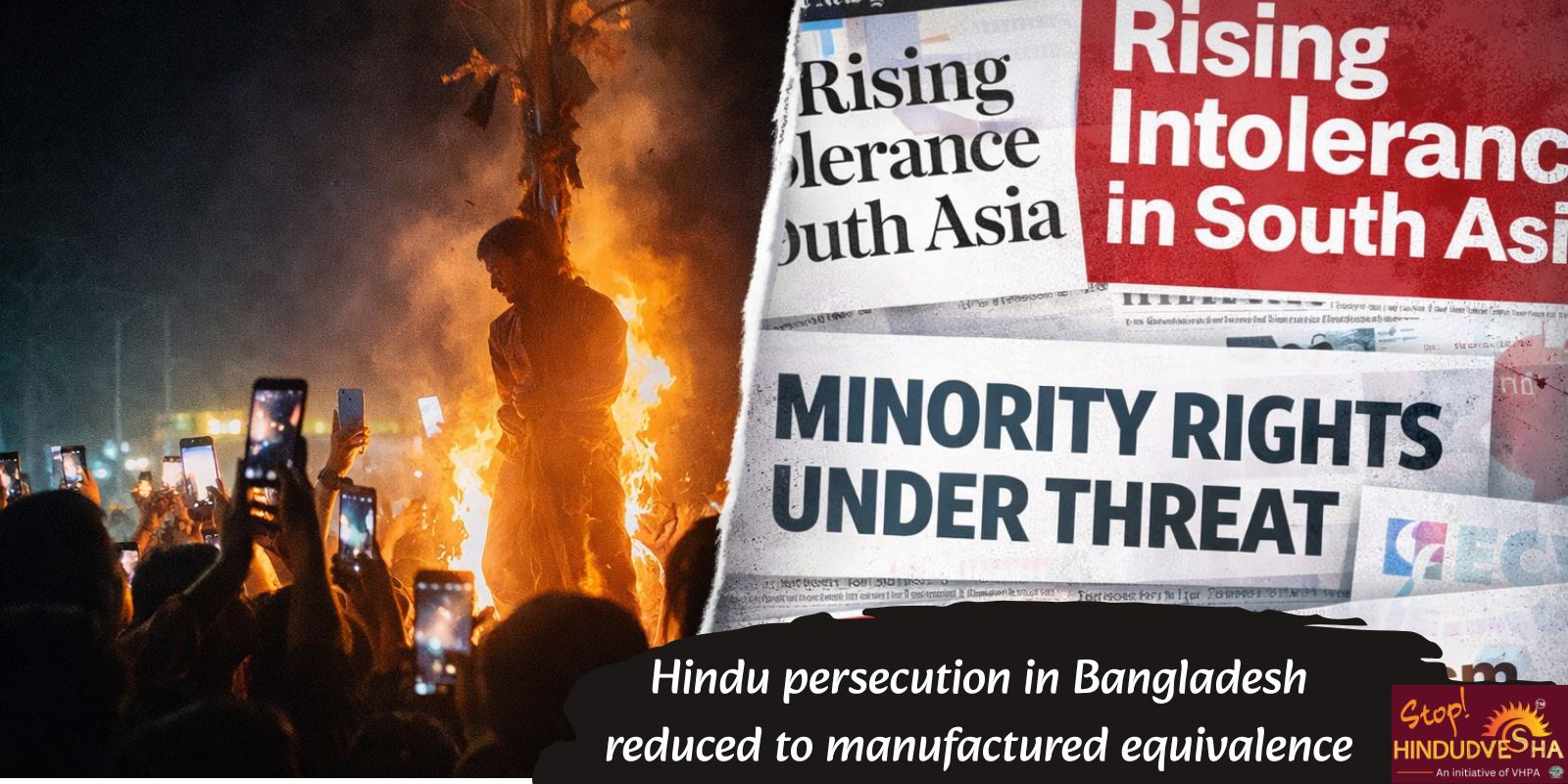
- The left-liberal ecosystem dilutes the severity of Hindu persecution in Bangladesh by reframing it within a vague narrative of “rising intolerance in South Asia,” avoiding direct engagement with targeted anti-Hindu violence.
- A parallel narrative of minority oppression in India is constructed to undermine the suffering of Bangladeshi Hindus and to delegitimize public advocacy on Hindu issues.
- The mob lynching of Dipu Chandra Das by a radical Islamist mob in Bangladesh received minimal direct coverage from mainstream Western media; where reported, notably by The New York Times, it was framed by placing India, Pakistan, and Bangladesh on a similar moral plane.
- This framing creates false equivalence, diverting attention from the specific and systemic nature of anti-Hindu persecution in Bangladesh.
- Claims of minority persecution in India contradict demographic trends, as the Hindu population has declined since independence while minority populations, especially Muslims, have grown significantly.
Colonial-era discourse in India perfected a moral inversion that recast victims as oppressors. Hindu society as a whole was subjected to conquest, economic extraction, famine, and sustained humiliation under British rule. Yet colonial Indologists, European missionaries, and the imperial establishment produced a steady stream of atrocity literature portraying Hindu Dharma and its followers as the true perpetrators. The “natives” were framed as morally defective and in need of rescue for their own good, even as they endured systematic oppression.
Contemporary discourse targeting Hindus follows the same pattern. The continued persecution of Hindus in Islamic countries such as Bangladesh and Pakistan is routinely gaslighted or quietly justified through the propagation of hostile narratives about Hindus and India. Rather than confronting Hindu victimhood, attention is redirected, and responsibility diffused.
Over the past decade, one of the most pernicious narratives promoted by the left-liberal ecosystem has been the claim of rising Hindu fundamentalism and minority oppression in India. Motivated religious freedom reports, selective indices, and biased Western media coverage frame India’s civilizational self-assertion as “Hindu majoritarianism,” ensuring that Hindus remain perennially on the defensive.
The brutal lynching of Dipu Chandra Das in Bangladesh, following allegations of blasphemy, has once again exposed this pattern. In fact, a newer and more dangerous tactic has now emerged: collapsing India, Pakistan, and Bangladesh into a single narrative of “South Asian intolerance.” This framing does more than obscure violence. It covertly justifies it, while denying Hindus the right to organize, speak publicly, or advocate politically without being branded anti-minority. Hindu unity itself becomes the target, used to neutralize both ongoing persecution abroad and growing civilizational confidence at home.
Manufacturing Moral Equivalence: Media Coverage of the Violence in Bangladesh
StopHindudvesha has extensively documented the bias in Western media coverage of the Bangladesh crisis that followed the resignation of then Prime Minister Sheikh Hasina and her departure to India. As radical Islamist mobs unleashed widespread violence on the streets of Bangladesh, with Hindu minorities bearing the brunt of targeted attacks, many influential Western outlets either failed to report the violence altogether or minimized its severity. In several cases, the unrest was reframed as a bilateral political issue between India and Bangladesh rather than acknowledged as anti-Hindu communal violence. Attacks on Hindus were misleadingly presented as isolated incidents against alleged supporters of Hasina’s party, while a more insidious narrative took shape suggesting that India’s so-called “Hindu majoritarian” government was exaggerating Hindu persecution to serve its own political ends[1].
This framing has since evolved into something more aggressive. In its coverage of the brutal lynching of Dipu Chandra Das by a radical Islamist mob, The New York Times described the killing as “the latest in a wider pattern of religious intolerance in the South Asia region.” By collapsing India’s democratic system into the same category as the Islamist-dominated environments of Pakistan and Bangladesh, the report introduced claims that “Hindu vigilantes have targeted Muslims and other minorities,” particularly over accusations related to beef[2]. This deliberate parallel creates a fictitious symmetry, shifting focus away from the specific and systemic persecution of Hindus in Bangladesh by embedding it within a generalized regional narrative.
While much of the report’s factual description of the lynching is accurate, the insertion of the “Hindu fundamentalism in India” angle appears forced and revealing. The contrast in tone is striking. Allegations involving minority targeting in India are typically covered by Western media with emphatic moral condemnation and sweeping language, often in the absence of conclusive evidence. Yet the coverage of a Hindu man being lynched in Bangladesh, his body tied to a tree and set on fire in public while onlookers filmed the spectacle[3], is subdued and restrained. There is no serious engagement with the historical record of Hindu persecution in Bangladesh, including recurring violence during festivals such as Durga Puja and Diwali, routine temple vandalism, or the systematic desecration of Moortis. The only moment of visible moral urgency in the piece emerges when the focus shifts back to India and alleged cow vigilantism.
As a result, the report, despite detailing the immediate crime, ultimately dilutes the gravity of targeted Hindu persecution in Bangladesh. By omitting historical continuity and reframing the violence within a vague “South Asian intolerance” construct, it trivializes an ongoing civilizational crisis. A commentary published by The Organiser has sharply highlighted this hypocrisy, noting that outlets such as The Washington Post, BBC, CNN, and The Guardian maintained a near-total silence on Dipu Chandra Das’s killing. Even when coverage did occur, it revealed less about the crime itself and more about the ideological blind spots that now shape much of contemporary Western journalism[4].
Deflection and Selective Silence After Dipu Das’s Lynching
As footage of Dipu Chandra Das’s lynching by a radical Islamist mob in Bangladesh circulated on social media, left-leaning commentators, journalists, and self-described intellectuals in India shifted attention toward alleged atrocities against minorities in India. Instead of engaging with the killing of a Hindu minority member in Bangladesh, they began amplifying claims of rising intolerance within India.
The timing was striking. Against the backdrop of increasing reports of Hindu persecution in Bangladesh, this ecosystem remained largely silent on the human rights of Hindu minorities there. Instead, it intensified familiar narrative frames such as “cow vigilantism,” “Hindu majoritarianism,” “saffron terror,” and “Hindutva fanaticism.” Discussion of violence in Bangladesh was displaced by renewed focus on India as the central site of concern.
Several left-leaning activists known for Hinduphobic commentary ignored Dipu Das’s lynching while actively highlighting the torching of a newspaper office in Bangladesh[5]. News of vandalized media offices and harassment of journalists was widely shared, while the public lynching of a Hindu man, recorded and circulated by onlookers, received little to no attention. The contrast in emphasis underscored a broader pattern of selective visibility. At the same time, social media was used to construct a parallel narrative of minority persecution in India, drawing on the Western media template of “rising intolerance in South Asia.” Hinduphobic commentator Rana Ayyub shared a 2024 article of hers published in The Washington Post, writing this on X: “Mob lynchings in India, Pakistan and Bangladesh are not failures of society alone, they are failures of leadership. When those in power legitimise religious fundamentalism, mobs turn executioners”. [6]
Journalist Saba Naqvi echoed a similar approach, sharing an earlier column published in the Deccan Herald and presenting unrest in Bangladesh as part of a broader South Asian pattern. Her framing placed India, Pakistan, and Bangladesh within a common rubric, while offering no direct engagement with the targeting of Hindus in Bangladesh[7].
The Deccan Herald article, published in August 2024, followed the same template. It raised concerns about the “mistreatment” of minorities in India while remaining silent on the radical Islamist ecosystem that has repeatedly targeted Hindu minorities in Bangladesh. The article did not address the fact that minorities in India have held the highest constitutional offices and enjoy extensive legal protections. In the column, Naqvi asserted that Indian Muslims have faced communal violence and discrimination, adding that their safety is ensured because India is not legally a Hindu Rashtra[8].
Far-left academic Apoorvanand similarly avoided commenting on anti-Hindu violence in Bangladesh while expressing concern about rising anti-Bangladesh sentiment in India: “It must worry us, but should we be surprised by anti-India feelings in BD? Haven’t our leaders and the ruling party been injecting anti-BD sentiments into the Indian minds for more than a decade, at least?” (Apporvanand on X) [9]
Incidentally, the Delhi University professor has previously been accused by a witness of involvement in the conspiracy behind the February 2020 Delhi violence[10]. He has also been among those who downplayed anti-Hindu violence in Bangladesh following the 2024 protests that led to Sheikh Hasina’s ouster. In an August 2024 piece published by Frontline, he described the events in Bangladesh as a “lesson in secularism,” [11] presenting a narrative of Hindu-Muslim unity that stood in contrast to reports of widespread violence against Hindus.
Building Majoritarian Narratives from Isolated Events
The left-liberal media frequently relies on selective omission and inclusion when reporting on incidents involving minorities in India. Coverage of Muslims allegedly being targeted or missionaries facing resistance often excludes relevant context, including the presence of radical Islamist networks, the organized “love jihad” ecosystem, large-scale fraudulent religious conversions of Hindus in tribal regions, and the sustained denigration of Hindu Dharma and culture by sections of the Abrahamic ecosystem. At the same time, the continued targeting, intimidation, and ideological pressure faced by Hindus from well-funded religious lobbies, often supported by foreign funding, receives little sustained attention. Instead, isolated acts of vandalism attributed to Hindu groups are amplified to construct a narrative of Hindu majoritarianism and minority persecution.
A similar pattern emerged in the aftermath of Dipu Chandra Das’s mob lynching in Bangladesh. Even as reports of Hindu torture and intimidation continued to surface there, the left-liberal ecosystem in India shifted focus within days to alleged instances of Christian intimidation inside India. Reports highlighted the arrest of members of a Hindu group accused of vandalizing Christmas decorations at a school in Assam on Christmas Eve[12]. Comparable reports from Raipur, Chhattisgarh, flagged the alleged vandalization of Christmas decorations in a local mall by members of a Hindu group[13]. These incidents quickly became central to the media cycle.
Violence or intimidation against any community is condemnable, and such acts have no place in a constitutional democracy. However, the selective elevation of a handful of incidents to build a broader narrative of Hindu fundamentalism raises questions. When members of minority communities are accused of coerced conversions or harassment of Hindus, sometimes involving intimidation or violence, media coverage often frames the episode through the lens of minority victimhood. In such cases, complainants are frequently scrutinized or portrayed as advancing a Hindutva agenda, while resistance to conversion efforts is framed as ideological hostility. The framing shifts depending on the identity of the alleged perpetrator, creating a visible inconsistency in standards.
Media reports throughout 2025 repeatedly highlighted a small number of incidents involving vandalized Christmas decorations across different parts of the country, presenting them as evidence of widespread Christian persecution. This perception was reinforced by sustained amplification, while largely peaceful Christmas celebrations across India received minimal attention. In many parts of the country, celebrations passed without incident, with Hindu families participating openly by decorating trees or dressing children as Santa Claus. These scenes rarely featured in coverage. Instead, selective incidents were foregrounded in ways that framed public Hindu expression and advocacy as socially suspect.
Within this media environment, Christmas-related incidents were positioned in a manner that coincided with the escalation of violence against Hindus in Bangladesh. Days after Dipu Chandra Das’s killing, news and social media cycles in India became dominated by discussions of minority persecution within India. The resulting narrative displaced attention from events in Bangladesh and reframed Hindu responses to those events as morally compromised. Claims of Hindutva extremism were repeatedly invoked, positioning Hindu mobilization or protest as inherently suspect.
This approach extended beyond religious incidents. The death of Angel Chakma, a 24-year-old student who died after being attacked following objections to alleged racial slurs, was also drawn into the same narrative framework. Sections of the left-leaning media presented the case as further evidence of resurgent majoritarianism seeking to anchor national identity in a singular civilizational narrative[14].
Across these episodes, a consistent pattern emerges: isolated incidents are amplified into broader ideological narratives, while more systematic violence, especially against Hindus, is minimized or ignored. Context is applied selectively, resulting in uneven emphasis and differing interpretations of similar acts based on the identities involved.
Dismantling the Minority Suppression Narrative
Irony reached a tipping point when Pakistan recently voiced concern over what it described as “vigilante attacks targeting Christians and Muslims in India.” Pakistan’s foreign office spokesperson claimed that minorities in India were being subjected to violence and vandalism, and called upon the international community to intervene to protect these “vulnerable communities.”[15]
India formally rejected the remarks, pointing to Pakistan’s well-documented treatment of its minorities. Responding to the statement, External Affairs Ministry spokesperson Randhir Jaiswal said Pakistan’s “horrific and systemic victimisation of minorities of various faiths is a well-established fact,” adding that no amount of finger-pointing could obscure that reality[16].
Statistical data further complicates allegations of minority persecution in India. A study conducted by the Economic Advisory Council to the Prime Minister documented long-term demographic trends across South Asia. According to the survey, the share of Hindus in India’s population declined by 7.8 percent between 1950 and 2015. During the same period, however, the population share of religious minorities increased. The Muslim population in India grew by 43.15 percent, while the Christian population rose by 5.3 percent[17] [18].
The same study recorded far steeper demographic changes in neighboring countries. In Bangladesh, the Hindu population declined by 66 percent between 1950 and 2015. Hindus, who made up roughly 23 percent of the population in 1950, were reduced to about 8 percent by 2015. In Pakistan, the decline was even sharper. Hindus fell from approximately 13 percent of the population in 1950 to around 2 percent in 2015, representing an 80 percent reduction over the same period[19].
The Indian government has cited illegal infiltration from Bangladesh and Pakistan as one of the factors contributing to demographic and security challenges over time[20]. However, sections of the left-liberal ecosystem have portrayed government action against illegal immigration as targeting Muslims[21].
These narratives persist even as the Hindu population in India continues to decline and Hindus in Bangladesh face sustained communal violence following the ouster of Sheikh Hasina in 2024. Reports of attacks on Hindu homes, businesses, and places of worship in Bangladesh have coincided with the continued projection of India as the primary site of minority oppression.
Against this backdrop, India finds itself in a security environment shaped by cross-border terrorism, illegal infiltration, and the movement of radicalized individuals from neighboring states. Administrative measures undertaken to address these concerns are frequently interpreted through an ideological lens, recast as attacks on minorities rather than routine actions tied to border management and internal security.
Wrapping Up
Taken together, the episodes examined in this article reveal a consistent pattern in how Hindu persecution in Bangladesh is addressed, or more often, displaced. Sustained violence against Hindus is rarely confronted on its own terms. Instead, it is reframed through regional abstractions, moral equivalence, or parallel narratives centered on India, which divert attention from the specific realities faced by Bangladeshi Hindus. Media coverage and activist commentary repeatedly shift focus away from ongoing attacks, while selectively amplifying unrelated or isolated incidents elsewhere.
In this context, the VHP’s demand for urgent United Nations intervention to protect the human rights of Hindus in Bangladesh[22] stands out as one of the few efforts seeking direct accountability. Yet even this call is met with silence or dismissal, while Hindu advocacy is routinely recast as majoritarianism or extremism. The result is a discourse that obscures responsibility, weakens international scrutiny, and narrows the space for legitimate representation of Hindu concerns. As long as such narrative substitution persists, the scale and continuity of anti-Hindu violence in Bangladesh will remain inadequately acknowledged.
Citations
[1] StopHinduDvesha; “Targeted persecuted: Bangladeshi Hindus, Violence, apathy”; https://stophindudvesha.org/targeted-persecuted-ignored-hindus-in-bangladesh-face-violence-and-global-apathy/
[2] The New York Times; “Lynching of a Hindu in Bangladesh Fans Fears of Rising Intolerance”; https://www.nytimes.com/2025/12/22/world/asia/bangladesh-hindu-muslim-lynching.html
[3] OpIndia; “Bangladesh: Hindu man Dipu Das lynched by a Muslim mob in Bhaluka, body tied up and set on fire over the claims of blasphemy”; https://www.opindia.com/news-updates/bangladesh-hindu-man-dipu-chandra-das-lynched-by-a-muslim-mob-in-bhaluka-body-tied-up-and-set-on-fire-over-the-claims-of-blasphemy/
[4] Organiser; “How western media framing diluted brutal killing of Dipu Chandra Das in Bangladesh: The NYT Case”; https://organiser.org/2025/12/24/331813/world/how-western-media-framing-diluted-brutal-killing-of-dipu-chandra-das-in-bangladesh-the-nyt-case/
[5] Arfa Khanum Sherwani on X; https://x.com/khanumarfa/status/2002018460331880450
[6] Rana Ayyub on X; https://x.com/RanaAyyub/status/2001999254479626341
[7] Saba Naqvi on X; https://x.com/_sabanaqvi/status/2002280673252684221
[8] Deccan Herald; “Five political lessons for South Asia from Bangladesh’s unrest”; https://www.deccanherald.com/opinion/five-political-lessons-for-south-asia-from-bangladeshs-unrest-3146850
[9] Apoorvanand on X; https://x.com/Apoorvanand__/status/2002179011796181282
[10] OpIndia; “The charade of ‘secularism’: DU Professor accused of inciting Delhi anti-Hindu Riots by a witness cries hoarse as Hindus legally want their temple back”; https://www.opindia.com/2023/12/du-professor-apoorvanand-delhi-riots-secularism-gyanvapi-title-suit-hypocrisy/
[11] Frontline; “How Bangladesh’s Revolution Defies Expectations”; https://frontline.thehindu.com/world-affairs/bangladesh-student-protests-revolution-communal-sectarian-violence-secularism/article68520556.ece
[12] Telegraph India; “Assam Christmas vandalism | Assam Christmas vandalism: Four VHP, Bajrang Dal members arrested after school attack”; https://www.telegraphindia.com/north-east/assam-christmas-vandalism-four-vhp-bajrang-dal-members-arrested-after-school-attack-prnt/cid/2139615
[13] The Indian Express; “7 Bajrang Dal men who barged into Raipur mall and vandalised Christmas decorations denied bail”; https://indianexpress.com/article/india/bajrang-dal-men-raipur-mall-christmas-decorations-bail-10445190/
[14] The Wire; “Whose Life Counts? Anjel Chakma’s Death and the Idea of India Today”; https://thewire.in/rights/whose-life-counts-anjel-chakmas-death-and-the-idea-of-india-today
[15] Arab News; “Islamabad expresses concern over vigilante attacks targeting Christians, Muslims in India”; https://www.arabnews.com/node/2627734/pakistan
[16] India News; “’Abysmal record’: India rejects Pakistan’s comment on persecution of minorities”; https://www.hindustantimes.com/india-news/abysmal-record-india-rejects-pakistan-s-comment-on-persecution-of-minorities-101767023319038.html
[17] HinduPost; “Hindu population in Bharat declined by 7.8 percent, decline of Hindu population most shocking in Bangladesh and Pakistan where Hindus shrunk by 66 percent and 80 percent”; https://hindupost.in/society-culture/hindu-population-in-bharat-declined-by-7-8-percent-decline-of-hindu-population-most-shocking-in-bangladesh-and-pakistan-where-hindus-shrunk-by-66-percent-and-80-percent-respectively-pms-eco/#
[18] Economic Advisory Council of the PM; “Share of Religious Minorities: A Cross-Country Analysis (1950-2015)”; https://eacpm.gov.in/wp-content/uploads/2024/05/Share-of-Religious-Minorities-EAC-PM-Working-Paper.pdf
[19] Ibid.
[20] OpIndia; “Amit Shah says rise in Muslim population due to infiltration, not fertility”; https://www.opindia.com/news-updates/amit-shah-blames-illegal-infiltration-from-pakistan-and-bangladesh-for-demographic-changes-says-congress-failed-minorities-under-nehru-liaquat-pact/
[21] Human Rights Watch; “India: Hundreds of Muslims Unlawfully Expelled to Bangladesh”; https://www.hrw.org/news/2025/07/23/india-hundreds-of-muslims-unlawfully-expelled-to-bangladesh
[22] ANI News; ““UN should intervene immediately”: VHP’s Vinod Bansal on violence against Hindu minorities in Bangladesh”; https://www.aninews.in/news/national/general-news/un-should-intervene-immediately-vhps-vinod-bansal-on-violence-against-hindu-minorities-in-bangladesh20251226122204/

Donate to HINDUDVESHA
Our Mission is to explore and expose Hindudvesha through research analysis, education and response.
SUPPORT US