

Dr. Jai Bansal’s closing remarks at the international conference on Hindudvesha in Delhi
 Stop Hindudvesha · 04/01/2023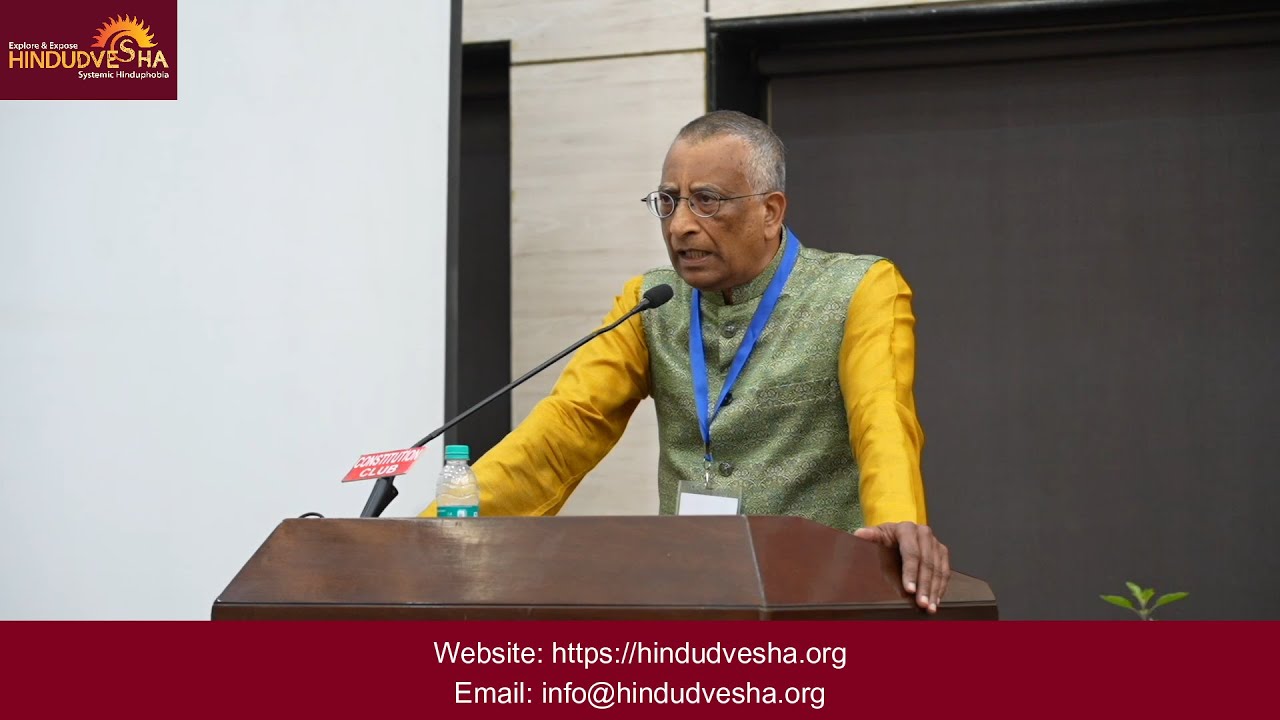
Paraphrased Transcript of the Closing Speech
We have been listening to so many learned people all day long. We have covered a vast range of topics. There is really no way I can do justice to summarizing what has been said today. So, let me take a slightly different tack.
First of all, how many of you believe it has been a long day? Please raise your hands (Not many hands were raised).
How many of you believe it has not been a long day? (Again, very few hands went up)
Well, I believe it has been a long day. But more importantly, how many of you think you have learned something useful and important today? (Almost all the hands went up)
How many of you think it has been a waste of time? (No one raised their hand)
Okay. So, based on this thoroughly unscientific survey and the fact that it is close to six o’clock and many of you are still here, I declare this conference an unqualified success.
Let me begin by acknowledging and thanking some of the organizing partners for this event. My own organization, the Vishwa Hindu Parishad of America, has undoubtedly been a significant part of this effort. The Hindu University of America as well. They were going to be more active than they ultimately ended up being, but nevertheless, they are an excellent institution operating here in America and imparting very important cultural and civilizational knowledge to the Hindu diaspora.
It is an online university, and it is not just about Hinduism. It is about the worldview of Hinduism and many other aspects of it. Anyone who wants to learn about that entire system, I would highly recommend that you look them up. Because it is online, anyone can participate.
And last but certainly not least, the Kashi Foundation. They have been the ground team. I like to say that for every show, there are actually two shows. One takes place in front of the curtain, and the other takes place behind the curtain. Behind the curtain, it is always a bit chaotic, intense, and very demanding. That is where the Kashi Foundation has been.
They have been working very hard for a very long time. Last night I was with them until quite late. I do not know exactly how many of them were there, but it was a large number. It has been a monumental effort, and I want to thank them from the bottom of my heart for doing such a great job.
Remarks on the Conference Content
Now, there are a few things I want to say about this topic. I want to share something personal with you.
A few months ago, I turned seventy-five. This kind of work is not my professional background. I am actually a chemical engineer by training. But this is something I felt was required in the world we are living in today. For the last nine years, I have dedicated essentially 100% of my time to this work.
So why do you think I am doing this? Why do you think, at the age of seventy-five, after being retired for nine years, I should be spending my time traveling all over the world and working so hard on this?
It is certainly not for my generation. Obviously, it is for your generation.
I do not want my generation to be ashamed of the fact that we saw the warning signs and did not make you aware of them. There are warning signs. You have heard today about what is happening in the world. And I believe it is our duty to tell the next generation, and the generation after that, that they need to be alert.
This is a war of narrative. But more than a war of narrative, it is a war of existence.
We love democracy. We cherish democracy. We are proud to be a democratic country. That is all very fine. But look at the map. Look at the western border of Bharat and then look all the way to the Mediterranean. Count how many countries you see and point me to one that is a functioning democracy.
This democracy exists because Bharat is still a Hindu-majority country. When that changes, the game is over.
This is a war of Kurukshetra, the battle of the Mahabharata. No one can be neutral. Either you are on one side or the other. You have to be a soldier. You have to play a part in this battle.
A lot of people spoke today about Vasudhaiva Kutumbakam. That is important. But Vasudhaiva Kutumbakam should not take away your shatru-bodh, your awareness of the adversary. This question was settled long ago on the battlefield of Kurukshetra.
If there were ever a family conflict, it would be the Mahabharata war. The question of whether family relations should override the protection of dharma was answered in the Bhagavad Gita. Seven hundred shlokas make it clear that when there is a conflict between family and dharma, dharma must take priority.
We must always vote for dharma.
So how do we fight this? There are many ways. Awareness is one. But what I would specifically urge is this: many of you here are scholars. You are writers. You are doing your master’s degrees and PhDs in social sciences and political sciences. You know how to write on these subjects.
I invite all of you who have the energy to work on this to begin writing. Be aware of what is happening around you, and start writing about it.
We have created a platform for this. I manage a website called Hindudvesha.org. You can write to me at [email protected], and we can connect that way. If you have something to say, something to write, we will publish it and help propagate it.
With that, I am going to close. It has been a very fertile and productive day for me personally, and I hope it has been the same for many of you as well. Thank you for your patience and perseverance.
And I will not stand any longer between you and the tea break.
On that note, thank you very much for being here.
Namaste.

Donate to HINDUDVESHA
Our Mission is to explore and expose Hindudvesha through research analysis, education and response.
SUPPORT US