

Brown Sahibs in Charge: Congress and the Repackaged Colonial State
 Aditi Joshi · 09/26/2025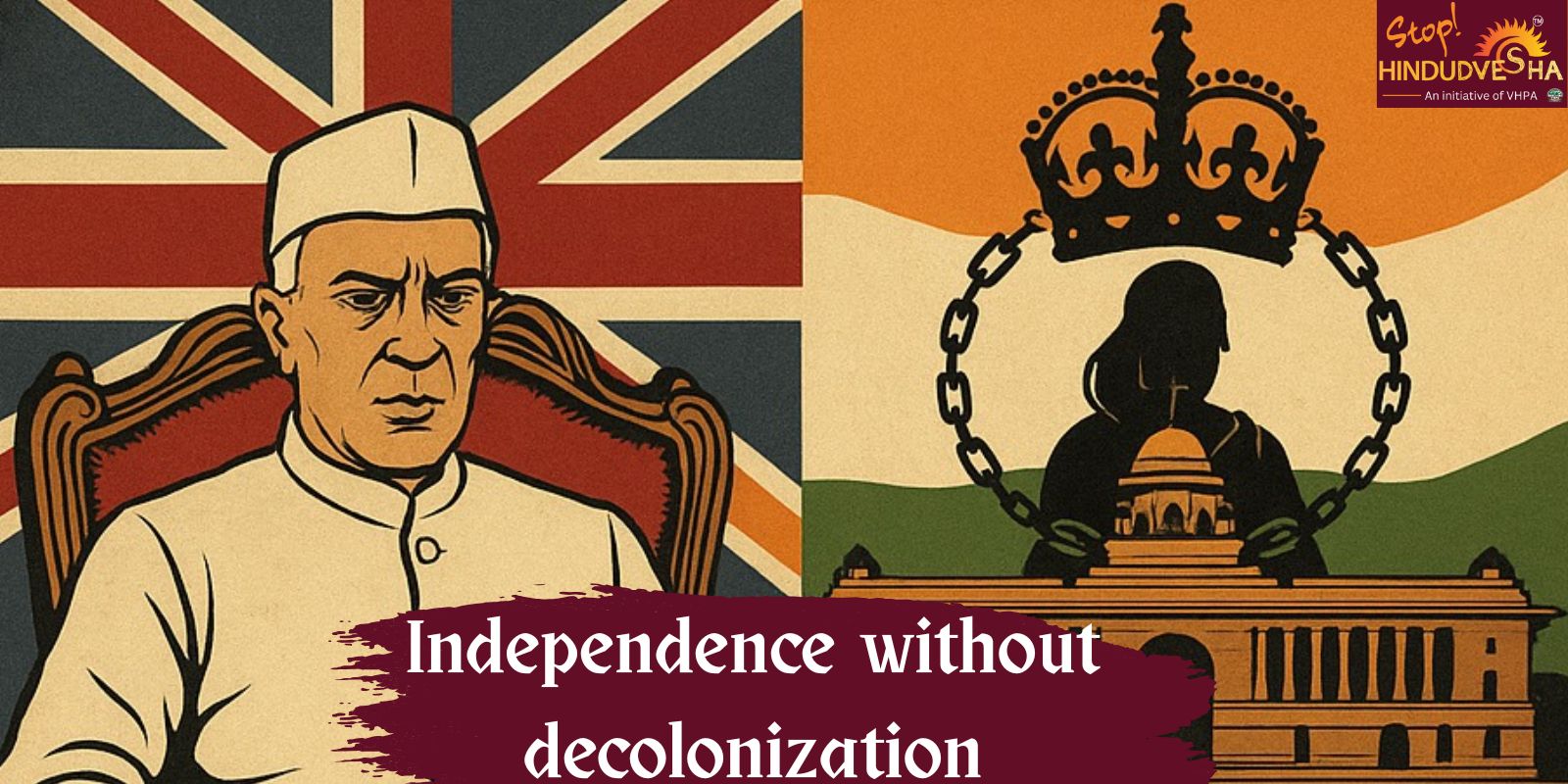
- Independence in 1947 transferred sovereignty but retained the colonial state, with Congress repackaging the Raj under Indian leadership.
- Nehru’s Anglicized worldview, governance style, and embrace of imperial symbols reflected continuity, not decolonization.
- Colonial structures—laws, centralized bureaucracy, and English dominance—remained intact, keeping power elitist and inaccessible.
- Congress replicated authoritarian reflexes of the Raj, from suppressing dissent to tolerating collective punishment and delaying democratic reforms.
- Dynastic succession entrenched a political aristocracy, ensuring that India gained political independence without genuine civilizational renewal.
The Indian National Congress (INC), having positioned itself as the vanguard of India’s anti-colonial struggle, entered independence in 1947 not merely as a political party but as the natural custodian of the new state. To the masses, Congress symbolized sacrifice, resistance, and the promise of swaraj. Yet, the reality of governance under the Congress leadership was starkly different. Far from dismantling the colonial state apparatus, the INC chose to preserve, repurpose, and in many cases reinforce its structures. The colonial legal codes, the centralized bureaucracy, and the elitist patterns of administration were all retained with minimal alteration. What was expected to be the birth of a new political civilization was instead the continuation of the old imperial machinery, with sovereignty transferred only in name.
At the center of this continuity stood Jawaharlal Nehru, India’s first Prime Minister and the towering figure of the early Republic. Nehru embodied the paradox of independence: a leader who purportedly fought colonial subjugation yet internalized its idioms of governance. His preference for centralized authority, his Anglicized lifestyle, and his embrace of Western political idioms reflected a mindset still tethered to colonial modernity. The Congress under his stewardship inherited not just the institutions of the Raj, but also its authoritarian reflexes, silencing dissent, suppressing regional aspirations, and elevating an elite political class above the masses.
This phenomenon may be described as colonial continuity: a postcolonial political order where the outer skin of power was Indian, but its inner mechanics remained colonial. The Raj was not dismantled; it was domesticated. Instead of a radical transformation towards Indic modes of governance rooted in village autonomy, dharmic traditions, and linguistic-cultural plurality, India witnessed the re-entrenchment of the colonial state under the Congress banner. In this sense, 1947 represented less a rupture with empire and more a transfer of custodianship from white rulers to their Indian successors.
Preservation of Colonial Structures
The expectation in 1947 was that independence would usher not merely in political freedom, but in civilizational renewal. For millions who had struggled, suffered, and sacrificed, independence was supposed to mean the revival of India’s indigenous modes of governance, economic self-reliance, and cultural self-confidence. Instead, what emerged was a Republic where the colonial skeleton was left intact, only draped in the tricolor. The Indian National Congress, under Nehru’s leadership, transplanted the colonial framework wholesale into the newly independent state.
- Retention of Colonial Laws: One of the starkest markers of continuity was the retention of colonial legal instruments. The Indian Penal Code of 1860,[1] crafted by Lord Macaulay’s commission to control a colonized people, remained the backbone of criminal law. Most notably, Section 124A (sedition law),[2] originally designed to crush nationalist leaders like Tilak and Gandhi, was preserved in independent India. Ironically, it was now employed by the Congress governments against Indian citizens critical of their own elected leaders. Thus, the very tools once condemned as instruments of oppression were repurposed as instruments of postcolonial authority.
- Centralized Bureaucracy: The Indian Civil Service (ICS), the so-called “steel frame” of the Raj, was reconstituted as the Indian Administrative Service (IAS).[3] The irony, however, is that under his leadership, the ICS was merely repackaged as the IAS without any substantive transformation. While the name changed, the ethos remained the same: elitist, insulated, and oriented toward command rather than service.
The IAS was barely “Indian” in civilizational ethos; it continued to function in English, uphold colonial legal codes, and reproduce Western bureaucratic values. It was scarcely “civil,” as its attitude toward the masses remained paternalistic and detached, perpetuating the culture of aloof officers inherited from the colonial Raj. And it was hardly a “service,” for instead of empowering the people, it entrenched centralized control, serving the state rather than society.
Rather than realizing Gandhi’s vision of Panchayati swaraj (village self-rule), Congress doubled down on bureaucratic centralism. Decision-making was concentrated in Delhi and filtered through a hierarchy of English-educated administrators who often had little empathy with, or connection to, the socio-cultural fabric of rural Bharat. In practice, the IAS preserved the colonial model of governance, where distance from the governed was a mark of prestige, and authority flowed from the state downward rather than from the community upward.
- Language as Power: The Congress regime also perpetuated English as the language of power. While regional languages flourished socially, English retained its monopoly in administration, law, higher education, and diplomacy. This entrenched a linguistic elitism that kept governance inaccessible to the masses and consolidated privilege in the hands of the urban, English-speaking class. In effect, independence deepened the very divide the British had fostered between rulers and ruled.
- Centralization of Political Power: Constitutional mechanisms, particularly Article 356, became tools of central domination. Congress governments repeatedly dismissed elected state legislatures, invoking charges of “misrule”, an uncanny echo of the British policy of dethroning native princes under the “Doctrine of Lapse” or “paramountcy.”[4] The numbers are striking. Between 1950 and 1994, Article 356 was invoked over 90 times, and nearly 80 of these dismissals occurred under Congress governments.[5] [6] Far from the constitutional safeguard of last resort, it became a partisan tool. Some landmark examples include:
-
- Kerala (1959): The world’s first democratically elected Communist government, led by E. M. S. Namboodiripad, was dismissed by the Nehru government under pressure from vested interests and the “Liberation Struggle”.[7] This set a precedent for using Article 356 against ideological opponents.
- Andhra Pradesh (1973): Indira Gandhi dismissed Chief Minister P. V. Narasimha Rao’s government amid political turmoil, replacing him with her loyalists.
- Tamil Nadu (1976): The DMK government led by M. Karunanidhi was dismissed during the Emergency, a move widely criticized as politically motivated.
- Nineteen dismissals by Indira Gandhi: During her tenure (1966–1977, 1980–1984), Article 356 was invoked nearly 50 times, making her the most frequent user of this provision. Her interventions often targeted states ruled by non-Congress parties.[8]
- Economic Controls: Economically, too, the Congress reproduced colonial habits, merely repackaging them in the idiom of Fabian socialism.[9] Rather than revitalizing indigenous economic models, village industries, artisan guilds, and cooperative networks, the state embraced central planning, licensing, and state monopolies.
Borrowing heavily from British economic institutions and Soviet-style central planning, the Congress leadership under Nehru inaugurated the experiment of the Five-Year Plans (beginning in 1951).[10] These plans were envisioned as instruments of rapid industrialization and modernization, yet they consistently failed to meet their stated targets. For instance, the Second Five-Year Plan (1956–1961), modeled on the Soviet paradigm, fell drastically short of its industrial and agricultural goals.[11] Subsequent plans met similar fates, producing an economy burdened with shortages, inefficiency, and stagnation.
Rather than fostering Gandhian self-reliance through village industries and cooperative models, or encouraging dynamic industrial freedom through competitive enterprise, Nehruvian economics entrenched statist monopolies. The state became both producer and regulator, concentrating power in sprawling public sector undertakings, while private enterprise was smothered by controls. The result was the notorious “License-Permit-Quota Raj”, where entrepreneurs required state approval for everything from capacity expansion to imports.
This model, far from liberating India economically, reproduced the command-and-control mentality of colonial rule, a small elite directing economic life from Delhi, while the masses remained outside the engines of prosperity. By the 1970s, India was derisively labeled as part of the “Hindu rate of growth” economy, where average GDP growth stagnated around 3–3.5% per annum, barely keeping pace with population growth.[12]
- Cultivation of a Political Elite: Finally, the Congress nurtured a new political aristocracy, indistinguishable in outlook from the colonial ruling class. Many of its leaders were Oxbridge-educated, fluent in English parliamentary idioms, and more at home in international salons than in India’s villages. Clad in symbolic khadi but culturally distant, these “brown sahibs” became the custodians of power.[13] Detached from Bharat’s civilizational roots, they embodied a continuation of colonial governance, an insulated elite ruling over a disempowered populace.
Nehru’s Imperial Tastes
Jawaharlal Nehru, India’s first Prime Minister, is often hailed as the architect of modern India. Yet many of his choices ended up reinforcing the very colonial legacies he claimed to transcend. His governance style, cultural leanings, and political symbols did not mark a radical break from the Raj. Instead, they reflected its reconstitution under Indian leadership, preserving continuity where a decisive decolonization was expected.
- Imperial Residences: Nehru’s decision to reside at Teen Murti House, the former residence of the British Commander-in-Chief, symbolized the unbroken chain of colonial privilege.[14] The seat of imperial authority was seamlessly transferred to the Congress leadership, sending a message of continuity rather than rupture. What might have been an opportunity to signal decolonization, by moving into a more modest or symbolically Bharatiya residence, was instead used to reinforce the aura of imperial grandeur.
- Anglicized Lifestyle: Personally, Nehru cultivated an Anglicized worldview.[15] His tailored suits, Westernized dining habits, and aristocratic mannerisms bore the stamp of European education and elite upbringing. While he occasionally donned khadi for symbolic purposes, his natural cultural environment remained closer to that of a European liberal aristocrat than a dharmic statesman rooted in India’s traditions. This lifestyle was not incidental; it shaped his political imagination, orienting him toward Western models of modernity and governance.
- Disdain for Indigenous Traditions: Nehru’s intellectual outlook carried an implicit contempt for indigenous knowledge systems. He often dismissed India’s civilizational sciences, philosophies, and community practices as “obscurantist” or “medieval,” privileging instead Western categories of rationality and progress. This was an internalized colonial bias, echoing Macaulay’s disdain for Indic learning. Rather than leading a renaissance of India’s knowledge traditions, Nehru sought to reforge India in the mold of Europe.
- Darbar-Style Leadership: His mode of mass politics replicated older patterns of hierarchical spectacle. Large Congress rallies and public meetings resembled Mughal and British durbars [16], with the leader elevated on a stage, distant from the people, rather than immersed in participatory dialogue. The symbolic distance between leader and masses reflected not Gandhian intimacy but imperial aloofness. Nehru’s charisma was thus projected through grandeur and hierarchy, much like the rulers he replaced.
Foreign Policy Elitism
In foreign affairs, Nehru championed the Non-Aligned Movement, a project couched in the language of Western liberal internationalism.[17] While presented as a bold assertion of independence, its idioms and frameworks were derived from European diplomatic traditions rather than Indic statecraft. Ancient concepts like Rajadharma (the ethical duties of rulers) or Vasudhaiva Kutumbakam (the world as one family) were largely absent in his articulation. His foreign policy, though ostensibly independent, reflected a continuation of colonial epistemology.
Symbolism also revealed this continuity. India remained a member of the Commonwealth under the British Crown, effectively acknowledging the monarch of its former colonizer as a symbolic head. Colonial-era honors, bureaucratic rituals, and laws were preserved. Rather than constructing new civilizational symbols of freedom, the Nehruvian state chose to perpetuate colonial ones, signaling not decolonization but cultural submission.
Colonial Reflex in Suppressing Dissent
If colonial continuity could be observed in the structures Congress preserved, it was equally evident in the manner the party dealt with opposition and dissent. Instead of nurturing a democratic culture of debate and pluralism, the Congress often replicated the colonial state’s authoritarian reflexes, treating dissent as sedition, criticism as treachery, and communities as dispensable.
- Post-Gandhi Assassination Pogroms (1948): The assassination of Mahatma Gandhi by Nathuram Godse in January 1948[18] unleashed a wave of retaliatory violence, particularly in Maharashtra, where Chitpawan Brahmins as a community were collectively targeted.[19] Houses were burnt, properties looted, and individuals assaulted, not because of individual guilt but because of their caste identity.[20] This resembled the logic of colonial collective punishment, where entire villages or groups were penalized for the actions of a few.[21] Instead of restraining mob fury and upholding justice, Congress governments allowed the pogrom to fester, revealing both political opportunism and disregard for civilizational values of fairness (nyaya).
- Censorship and Repression: A second pattern was the stifling of intellectual freedom. Newspapers faced restrictions, and writers were harassed for straying beyond the boundaries of Congress-defined nationalism. A telling example is the case of Majrooh Sultanpuri, a celebrated Urdu poet. In 1949, he publicly recited a poem that suggested Nehru, despite his democratic façade, was no less a tyrant than Churchill or Hitler. Nehru, perceiving this as a personal insult, invoked the colonial-era sedition law (IPC 124A). Majrooh was arrested and imprisoned for nearly two years.[22] This incident underscores how Congress, rather than dismantling colonial legal instruments, used them to silence dissenting voices, mirroring the very methods once used against nationalist leaders.
- Democratic Deficit: Perhaps the most striking illustration of Congress’s anti-democratic tendencies was its handling of electoral processes. Though India prided itself on being the world’s largest democracy, a finalized national voter list was not completed until 1993, a staggering forty-six years after independence. For decades, elections were conducted on the basis of provisional or incomplete rolls, leaving large sections of the population disenfranchised. This delay cannot be seen as mere administrative inertia; it reflected the Congress’s unwillingness to democratize the polity while it enjoyed unchallenged dominance fully. The party prioritized the consolidation of centralized power over the empowerment of the electorate.
- Dynasticism and Autocratic Tendencies: The internal structure of the Indian National Congress revealed a striking dissonance between its democratic rhetoric and its monarchical practice. Far from being a party governed by open contestation and merit, Congress evolved into a dynastic institution where leadership was treated as a hereditary entitlement.
The trajectory of Congress leadership, from Jawaharlal Nehru to Indira Gandhi, to Rajiv Gandhi, and later Sonia Gandhi and Rahul Gandhi, resembles the lineal succession of a royal household more than the democratic transfer of authority within a political party. Each generation consolidated power not through institutional processes but through the symbolic legitimacy of family lineage. This hereditary consolidation entrenched a political aristocracy at the heart of India’s democratic system, blurring the distinction between modern republicanism and feudal monarchy.[23] In effect, the Congress party functioned as a political dynasty cloaked in democratic form, perpetuating the colonial tradition of concentrated authority in a ruling elite.
This dynastic consolidation was complemented by autocratic tendencies in governance. A telling example emerged during the UPA era, when Prime Minister Manmohan Singh, constitutionally the head of government, was relegated to a secondary role. On multiple occasions, it was Sonia Gandhi, the ‘Rajmata’ of the Nehru dynasty, who met visiting heads of state and conducted high-level political negotiations, effectively reducing the Prime Minister to a ceremonial figure.[24] This arrangement blurred constitutional propriety and resembled the colonial system, where the Viceroy held real power while Indian administrators served as intermediaries. Such practices underscored the persistence of a shadow power structure, where authority flowed not from institutions but from personal networks and dynastic legitimacy.
Wrapping up
Independence in 1947 did not dismantle the colonial state; it merely transferred ownership. The Indian National Congress inherited and preserved the Raj’s political framework, its laws, centralized bureaucracy, and elitist ethos, while layering dynastic succession upon it. Rather than ushering in civilizational renewal, Congress entrenched colonial governance in Indian garb.
Jawaharlal Nehru embodied this paradox. He retained colonial laws such as sedition, privileged English as the language of power, and perpetuated bureaucratic centralism through the IAS. Economic planning borrowed heavily from British and Soviet precedents, producing monopolies and red tape instead of Gandhian self-reliance. Nehru’s Anglicized lifestyle, disdain for indigenous traditions, and acceptance of imperial symbols like the Commonwealth deepened this continuity: India was sovereign in form but colonial in substance.
Congress’s authoritarian reflexes mirrored those of the Raj. The post-Gandhi assassination pogroms against Brahmins, the sedition trial of poet Majrooh Sultanpuri, and decades-long delays in finalizing voter rolls revealed a state unwilling to nurture democracy. Dynastic succession, from Nehru to Indira, Rajiv, Sonia, and Rahul Gandhi, reduced leadership to hereditary entitlement.
Thus, the Congress was not an agent of decolonization but the custodian of empire. India’s true freedom remains incomplete until it dismantles colonial structures and reclaims governance rooted in its own civilizational ethos.
Citations
[1] The Indian Penal Code, 1860 Act No. 45 of 1860 1* [6th October, 1860.] Chapter I Introduction; https://www.indiacode.nic.in/bitstream/123456789/4219/1/THE-INDIAN-PENAL-CODE-1860.pdf
[2] Section 124A in The Indian Penal Code, 1860; https://indiankanoon.org/doc/1641007/
[3] National Civil Services Day: Is the IAS, India’s so-called steel frame, rusting? – The Economic Times; https://economictimes.indiatimes.com/jobs/government-jobs/national-civil-services-day-is-the-ias-indias-so-called-steel-frame-rusting/articleshow/99667494.cms?from=mdr
[4] The Doctrine of Lapse: The Case of Jhansi | INDIAN CULTURE; https://indianculture.gov.in/digital-district-repository/district-repository/doctrine-lapse-case-jhansi
[5] Austin Granville, Working a Democratic Constitution: A History of the Indian Experience, Oxford University Press, 1999; https://archive.org/details/workingdemocrati0000aust/page/426/mode/2up
[6] A. G. Noorani, Article 356: Proclamation of Emergency. Oxford University Press, 2000.
[7] Austin Granville, Working a Democratic Constitution: A History of the Indian Experience, Oxford University Press, 1999; https://archive.org/details/workingdemocrati0000aust/page/426/mode/2up
[8] Subhash C. Kashyap, Our Constitution, National Book Trust, 1991; https://cdn.bookey.app/files/pdf/book/en/our-constitution.pdf
[9] The Fabian Society: A clique of Bourgeois Socialists? – Radical Tea Towel; https://radicalteatowel.co.uk/radical-history-blog/the-fabian-society-a-clique-of-bourgeois-socialists/
[10] Explained: What was the Licence Raj and why is India better off without it?; https://www.business-standard.com/india-news/explained-what-was-licence-raj-and-why-is-india-better-off-without-it-123080900215_1.html
[11] Arvind Panagariya, India: The Emerging Giant, Oxford University Press, 2008; https://archive.org/details/indiaemerginggia0000pana
[12] Sabyasachi Bhagwati, Jagdish & Arvind Panagariya, India’s Tryst with Destiny, Collins Business, 2013; https://www.academia.edu/69631393/The_Unburdening_of_Lack_of_Evidence_A_Review_of_Jagdish_Bhagwati_and_Arvind_Panagariya_Indias_Tryst_with_Destiny
[13] The Brown Sahibs, blind criticism of the nation, and the subjugation of a people: How finally, it is ‘India that is ruling India’; https://www.opindia.com/2024/07/brown-sahibs-blind-criticism-subjugation-of-a-people-colonialism-english-language-culture/
[14] Teen Murti Bhavan Museum: What Nehruvians Can Learn From Lee Kuan Yew; https://swarajyamag.com/politics/what-nehruvians-can-learn-from-lee-kuan-yew
[15] The end of Nehruvium and the Anglicised-Hindu Class (Part-1 of 3) – The Unknown Srivaishnava; https://unknownsrivaishnava.in/2025/02/17/the-end-of-nehruvium-and-the-anglicised-hindu-class-part-1-of-2/
[16] 5. Tryst with Destiny: Nehru’s and Gandhi’s Mughal Monuments; https://muse.jhu.edu/pub/4/oa_monograph/chapter/2279124
[17] History and Evolution of Non-Aligned Movement; https://www.mea.gov.in/Speeches-Statements.htm? dtl/20349/History+and+Evolution+of+NonAligned+Movement#:~:text=The%20movement%20has%20succeeded%20to,peace%20and%20security%20for%20mankind.
[18] The REAL Truth About Gandhi’s Assassination (YouTube); https://www.youtube.com/watch?v=jZskeD_WFXI
[19] India’s Forgotten 1948 Chitpavan Brahmin Massacre; https://stophindudvesha.org/indias-forgotten-pogrom-revisiting-the-1948-chitpavan-brahmin-massacre/
[20] Congress officials orchestrated anti-Brahmin pogrom after Gandhi’s death; no cases were filed: Vikram Sampath | India News; https://www.timesnownews.com/india/article/congress-officials-orchestrated-anti-brahmin-pogrom-after-gandhi-s-death-no-cases-were-filed-vikram-sampath/789834
[21] It is about time we talk about the 1948 genocide of Maharashtrian Brahmins that followed M K Gandhi’s assassination; https://www.opindia.com/2022/01/maharashtra-brahmin-massacre-nathuram-godse-gandhi-assassination/
[22] Jailed for anti-Nehru poem & celebrated for Bollywood songs, Majrooh Sultanpuri had it all; https://theprint.in/theprint-profile/jailed-for-anti-nehru-poem-celebrated-for-bollywood-songs-majrooh-sultanpuri-had-it-all/299167/
[23] Another Gandhi enters Parliament: The legacy of Nehru-Gandhi family in Indian politics | India News – Times of India; https://timesofindia.indiatimes.com/india/another-gandhi-enters-parliament-the-legacy-of-nehru-gandhi-family-in-indian-politics-priyanka-gandhi-indira-gandhi-rahul-sanjay-rajeev-jawahar-lal/articleshow/115701998.cms
[24] Congress humiliated Manmohan Singh by making Sonia Gandhi ‘super PM’: BJP | India News; https://timesofindia.indiatimes.com/india/congress-humiliated-manmohan-singh-by-making-sonia-gandhi-super-pm-bjp/articleshow/116751859.cms

Donate to HINDUDVESHA
Our Mission is to explore and expose Hindudvesha through research analysis, education and response.
SUPPORT US