

Ayodhya Ram Mandir Turns One: Celebrating a Year of Hindu Cultural Resurgence
 Aditi Joshi · 01/29/2025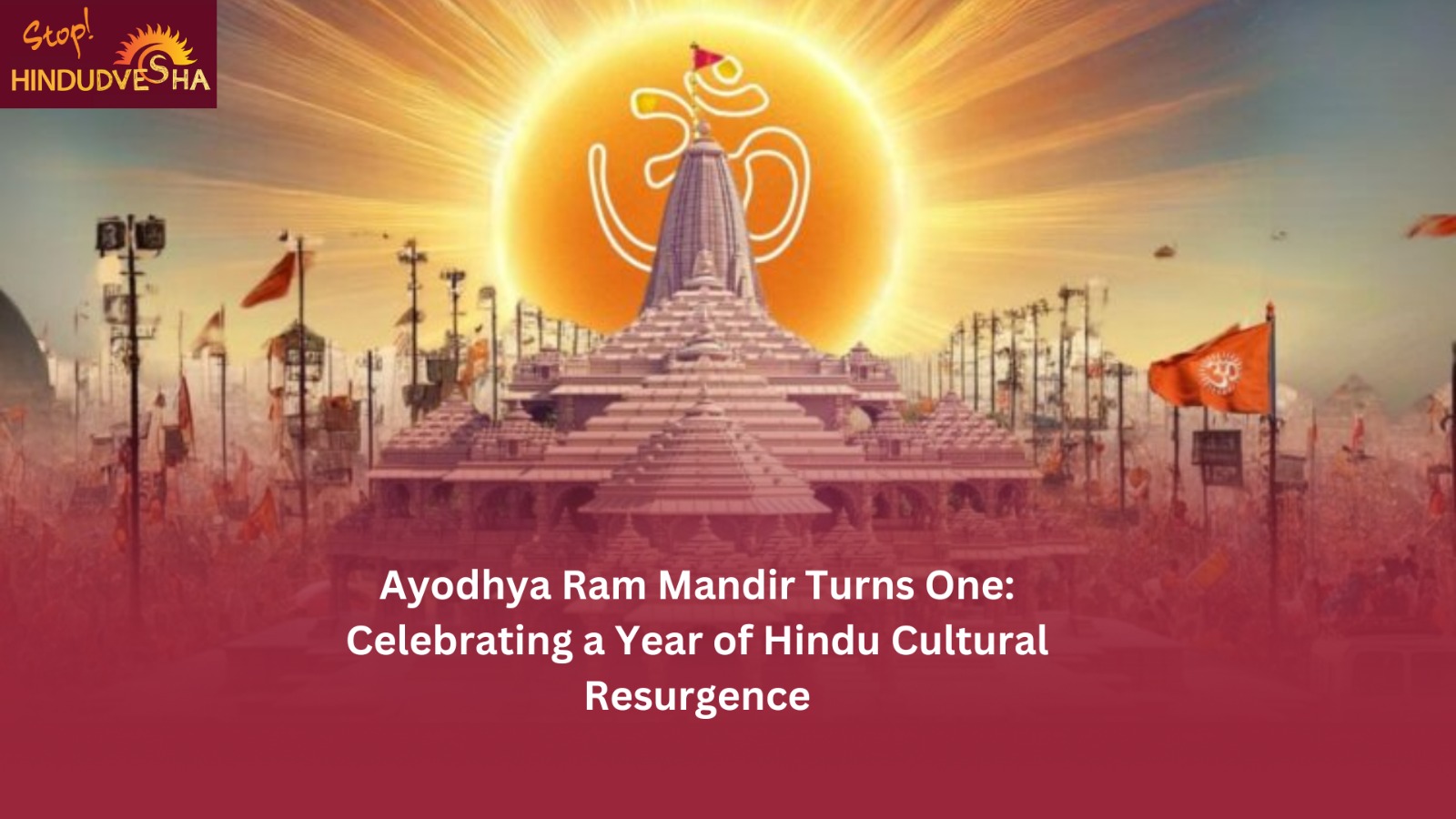
- The 500-year battle to reclaim the Ram Mandir reflects an enduring effort to preserve Hindu values and assert cultural identity.
- The Ram Mandir movement has sparked a rediscovery of Hindu values, encouraging Hindus to reconnect with ancient spiritual practices and philosophical traditions.
- The struggle for the Ram Mandir marks the beginning of a modern Hindu renaissance, revitalizing cultural pride, values, and self-awareness globally.
- The Ram Mandir’s significance extends beyond India, inspiring global Hindu communities to embrace their heritage and solidify cultural unity and strength.
The Ram Mandir in Ayodhya stands as a profound symbol of faith and cultural heritage, representing more than a sacred site for millions of Hindus worldwide. Its significance transcends religious devotion, embodying a powerful assertion of Hindu identity and a renewed sense of cultural pride. The struggle to reclaim this sacred space, which began with the destruction of the original temple in the 16th century, was not merely a contest over a physical structure but a deeper endeavor to reaffirm Hindu values and traditions. For centuries, this struggle united Hindus in their commitment to preserving their heritage despite persistent external challenges.
With the first anniversary of the Ram Mandir’s inauguration now behind us, it is an opportune moment to reflect on its lasting impact and the resurgence it has inspired within Hindu civilization. The temple’s completion marks a pivotal chapter in the broader Hindu renaissance—an ongoing effort to reclaim and celebrate the depth of Hindu philosophy and cultural identity. Over the past year, the temple has emerged as a beacon of unity, strengthening the spiritual and cultural fabric of Hindu society globally.
Beyond its architectural grandeur, the Ram Mandir’s inauguration represents the revitalization of Hindu culture and self-awareness. It symbolizes the restoration of a long-lost heritage and the resurgence of Hindu pride across India and the global diaspora. This renewed confidence signals the emergence of a unified Hindu community that proudly upholds its ancient traditions while embracing contemporary challenges.
Historical Context
In the early 16th century, during the reign of the Mughal invader Babur, the original temple at Ram Janmabhoomi was demolished and replaced by the Babri Masjid by Babur’s general, Mir Baqi.[1]
This historic event left a festering wound on the Hindu psyche, instilling a deep and persistent aspiration to reclaim the sacred land and revive its lost heritage. In the years following the demolition of the original temple, efforts to reclaim the site took many forms, from petitions to local rulers to public demonstrations. For the Hindus, the struggle was not just about restoring a temple; it represented a broader endeavor to restore their pride and cultural identity.[2]
A Legacy Reclaimed[3]
Over time, the demand for the temple evolved into a major rallying point for Hindus across the nation, inspiring generations to strive for its restoration. By the mid-19th century, tensions intensified when, on November 30, 1858, Nihang Sikhs performed rituals inside the Babri Masjid, asserting their claim to the sacred site. In response to the escalating conflicts, the British colonial administration, in 1859, erected a wall to divide the inner courtyard, allocated for Muslim use, from the outer courtyard, where Hindus were permitted to continue their worship.
Legal disputes over the site commenced in 1885 when Mahant Raghubar Das of the Nirmohi Akhara filed the first court petition, requesting permission to construct a structure on the chabutra—an elevated platform in the outer courtyard where Hindus were allowed to worship. While the court acknowledged the mosque stood on a site revered by Hindus, it denied the request, citing the long-standing nature of the issue.
A significant turning point occurred in December 1949 when idols of Ram Lalla mysteriously appeared inside the mosque following a Ramayana recital. Muslims alleged that the idols were placed by Hindu leaders, leading to heightened tensions. Prime Minister Jawaharlal Nehru ordered their removal, but local authorities refused to comply, further complicating the situation.
The movement to reclaim the site gained momentum in 1964 with the establishment of the Vishwa Hindu Parishad (VHP), which made the restoration of the Ram Mandir one of its key missions. In 1984, the VHP launched the Ram Janmabhoomi Mukti Yagya Samiti, and in 1989, they set a date for the mandir’s reconstruction, escalating the dispute to a national level.
By the mid-1980s, Indian courts allowed Hindus to worship there for the first time in nearly 50 years. The demand for a temple grew stronger in the 1990s as escalating political pressure culminated in violent clashes between activists and government forces.
On December 6, 1992, a massive rally organized by the Vishwa Hindu Parishad (VHP) drew over 150,000 supporters to the disputed site. Despite a heavy police presence to safeguard the mosque, the crowd overpowered the barricades, and within hours, the Babri Masjid was reduced to rubble. The demolition triggered widespread communal riots across India, resulting in the loss of more than 2,000 lives. The incident had far-reaching consequences beyond India’s borders, fuelling terrorist attacks within the country and prompting retaliatory assaults on Hindu temples in Pakistan, Bangladesh, and Afghanistan by enraged Muslim mobs.
In the years that followed, the Supreme Court of India dealt with multiple legal cases raised by both Hindu and Muslim litigants regarding land acquisition and ownership. In 2010, the Allahabad High Court delivered a compromise verdict, dividing the disputed 2.77-acre land into three equal parts—one each for Hindus, Muslims, and the Nirmohi Akhara. However, neither side accepted the decision.
Finally, in 2019, the Supreme Court delivered its landmark verdict, marking a pivotal moment in India’s legal and religious landscape. The unanimous ruling granted the disputed land in Ayodhya for the construction of a Ram Mandir while directing the allocation of five acres of alternate land to establish a mosque.[4] Grounded in extensive archaeological, historical, and legal evidence[5], the judgment affirmed the site as the birthplace of Lord Ram, formally recognizing the Hindu community’s enduring claims.
Beyond its legal implications, the ruling had profound symbolic importance. It signified the affirmation of Hindu heritage and marked a crucial milestone in the reclamation of a revered legacy.
The planning and construction of Shri Ram Mandir commenced almost immediately following the Supreme Court verdict, with the first phase of the project completed in time for its grand inauguration on January 22, 2024. This monumental undertaking, deeply embedded in historical and cultural significance, was executed with meticulous precision and dedication, embodying the collective aspirations of millions of Hindus across the globe. Designed in the Māru-Gurjara style of Nagara architecture[6], the architectural grandeur of the Ram Mandir stands as a remarkable testament to the ingenuity and ethos of Hindu traditions, seamlessly blending ancient traditions with contemporary aspirations.
The temple’s inauguration on January 22, 2024, marked the culmination of a 500-year-long journey, uniting Hindus worldwide and ushering in a new era of cultural resurgence.[7] [8] The grand celebrations, attended by millions from India and abroad, marked the restoration of a long-contested sacred site and the fulfillment of collective aspiration, symbolizing the triumph of faith and the recognition of long-denied rights. [9] [10]
Catalyst for Hindu Renaissance
The inauguration of the Ram Mandir ushered in a broader Hindu renaissance, marked by renewed cultural pride and a growing interest in Hindu philosophy. It has united the global Hindu diaspora, fostering a renewed sense of cultural identity and confidence. Celebrations have been organized by temples and cultural centers across the United States, Canada, the United Kingdom, and Australia, highlighting the temple’s global significance.[11] It has elevated Hinduism’s international profile, symbolizing resilience and cultural revival while being widely recognized as a transformative initiative with profound spiritual and cultural importance.[12]
One tangible evidence of increased interest in Hindu culture is the significant rise in Dharmic tourism across India, with Ayodhya emerging as a major global pilgrimage destination.[13] In 2024 alone, Ayodhya welcomed over 137.7 million visitors, significantly boosting local businesses, hospitality, and retail industries.[14] Reports suggest that in 2024, the number of visitors to the Ram Mandir surpassed those to the Taj Mahal[15]. The significant increase in tourism has enhanced Ayodhya’s prominence, positioning it alongside renowned global religious destinations such as Mecca and the Vatican.[16] To address the growing influx of pilgrims and visitors, extensive infrastructural investments have been undertaken, with an allocation of $10 billion aimed at transforming the city. Key projects, such as a new airport, aim to enhance Ayodhya’s accessibility and reinforce its status as a global spiritual destination.[17]
Prayagraj and Mathura have also emerged as prominent spiritual destinations Media reports indicate a growing interest in spiritual tourism[18], with notable increases in searches for “spiritual destinations in India” and a surge in both domestic and international visitors to sacred sites, further amplified by the Ram Mandir’s inauguration.
The inauguration of the Ram Mandir has not only generated significant economic benefits but has also revitalized interest in ancient traditions, leading to a resurgence in Vedic education, Sanskrit scholarship, and traditional practices such as yoga, Ayurveda, and classical Indian arts. This cultural revival has extended to the study of sacred scriptures, including the Ramayana and the Vedas, with educational initiatives and workshops gaining momentum globally. The increasing popularity of Sanskrit recitation competitions and Ramayana-themed performances in music and dance reflects a growing appreciation for India’s rich cultural heritage. Celebrations such as Maharashtra Deepotsav, featuring the lighting of millions of lamps[19], have garnered international attention, reaffirming the spiritual and cultural significance of Hindu traditions on a global scale.
The first Diwali in Ayodhya, following the temple’s inauguration, was celebrated with unparalleled grandeur, garnering two Guinness World Records.[20] Ayodhya was adorned with millions of diyas, creating a breathtaking spectacle that immersed the city in an atmosphere of devotion and festivity. The vibrant decorations, cultural performances, and spiritual fervor symbolized the revival of Ayodhya’s spiritual and cultural legacy. Chief Minister Yogi Adityanath aptly captured the moment, stating, “For the first time in 500 years, Lord Ram is celebrating Diwali in his rightful abode.”
Hindu Identity in the Global Context
Ram Mandir has also become a focal point for discourse on Hindu philosophy and spirituality, serving as a catalyst for a broader cultural renaissance that encourages the integration of faith into daily life and promotes a greater global understanding of Hindu traditions.[21] The architectural magnificence of the Mandir has received widespread acclaim for its intricate carvings and exquisite design, captivating scholars and enthusiasts worldwide.[22]
Domestically, the Ram Mandir has played a crucial role in fostering a collective identity rooted in shared values and heritage. Pilgrimages to Ayodhya have brought together individuals from diverse linguistic and cultural backgrounds, reinforcing a sense of unity. Organizations such as the Vishwa Hindu Parishad (VHP) have leveraged the temple’s significance to encourage dialogue among various Hindu sampradayas (traditions), fostering a collective narrative of pride and cultural continuity.[23] Festivals and rituals associated with Lord Ram have become unifying occasions, celebrating the diversity and richness of India’s pan-Hindu identity.
Internationally, the temple has inspired seminars, publications, and discussions that reclaim the Hindu narrative with intellectual rigor. The universal themes of the Ramayana—dharma, duty, and justice—have resonated across the globe, inspiring literary works, performances, and cinematic adaptations. Additionally, the Mandir has sparked a revival in Vedic education, with increased interest in gurukuls and Sanskrit learning, ensuring the continued transmission of Hindu philosophy and values to future generations.
The Ram Mandir stands as a unifying symbol for Hindus worldwide, rekindling their connection to their cultural roots. Diaspora communities have embraced the temple’s spiritual and cultural significance through events featuring prayers, Ramayana recitations, and lighting ceremonies. Its influence has encouraged Hindu youth to engage actively in cultural organizations, temples, and educational programs, fostering a sense of belonging and pride.
Wrapping up
The Ram Mandir stands as a profound testament to the enduring resilience of a civilization that, while deeply rooted in its past, confidently forges its future. It has united Hindus across the globe, fostering a renewed dedication to the preservation and celebration of their cultural heritage. This cultural resurgence transcends mere communal triumph; it signifies the revival of a civilization that continues to serve as an enduring source of inspiration for humanity.
The successful completion of the Ram Mandir has catalyzed similar restoration and preservation initiatives across India, underscoring the significance of safeguarding sacred sites. These efforts not only honor the country’s rich civilizational heritage but also contribute to its sustained cultural continuity and vibrancy.
As future generations traverse the sacred grounds of the Ram Mandir, they will inherit a legacy of resilience and pride, carrying forward the timeless values of Hindu thought, culture, and identity. This marks the commencement of a new chapter in India’s civilizational journey—one that connects the past and the future with a sense of pride and purpose.
Citations
[1] Abdul Gafoor Abdul Majeed Noorani, The Babri Masjid Question, 1528-2003: A Matter of National Honour, Volume 1, Page xvii
[2] https://www-vhp-org.translate.goog/faq/1/?_x_tr_sl=en&_x_tr_tl=hi&_x_tr_hl=hi&_x_tr_pto=tc
[3] The 500-year history of Ayodhya Ram Mandir (StopHinduDvesha.Org); https://stophindudvesha.org/the-500-year-history-of-ayodhya-ram-mandir/
[4] The 2019 Supreme Court verdict (www.livelaw.in); https://www.livelaw.in/pdf_upload/pdf_upload-367790.pdf
[5] Ram temple existed before Babri mosque in Ayodhya: Archaeologist KK Mohammed; https://timesofindia.indiatimes.com/india/ram-temple-existed-before-babri-mosque-in-ayodhya-archaeologist-kk-muhammed/articleshow/71391712.cms
[6] Chandrakant Sompura, designer of Ayodhya’s Shri. Ram Mandir, to be conferred with Honorary Fellowship by Indian Institute of Architects; https://architecture.live/chandrakant-sompura-designer-of-ayodhyas-shri-ram-mandir-to-be-conferred-with-honorary-fellowship-by-indian-institute-of-architects/#:~:text=Shri%20Ram%20Mandir%20at%20Ayodhya,temple%20is%20161%20feet%20high.
[7] From pilgrimage to progress: Ayodhya’s transformation through the eyes of its people; https://etedge-insights.com/featured-insights/from-pilgrimage-to-progress-ayodhyas-transformation-through-the-eyes-of-its-people/
[8] Ram is the foundation, the faith of India: PM Modi’s Ram Navami post asserts the glorious occasion that has arrived after 500 years; https://www.opindia.com/2024/04/pm-modis-ram-navami-post-asserts-the-glorious-occasion-that-has-arrived-after-500-years/
[9] Times Square in New York turns saffron: Chants of ‘Jai Shree Ram’ and beat of dhols fill the air as Hindu devotees gather to celebrate Pran Pratishtha; https://www.opindia.com/2024/01/times-square-new-york-lord-ram-hindus/
[10] Watch: First images of 51-inch-tall Ram Lalla idol installed in Ram Mandir Garbhagriha released ; https://www.opindia.com/2024/01/images-of-ram-lalla-idol-installed-in-ram-mandir-garbhagriha-released/
[11] Times Square in New York turns saffron: Chants of ‘Jai Shree Ram’ and beat of dhols fill the air as Hindu devotees gather to celebrate Pran Pratishtha; https://www.opindia.com/2024/01/times-square-new-york-lord-ram-hindus/
[12] The Ram Mandir in Ayodhya: A Transformative Initiative with …BPAS Journalshttps://bpasjournals.com
[13] New Year’s Day sees record crowds of devotees in Ayodhya and Varanasi; https://timesofindia.indiatimes.com/india/new-years-day-sees-record-crowds-of-devotees-in-ayodhya-and-varanasi/photostory/116861683.cms
[14] Ayodhya’s Economic Renaissance: How Ram Mandir’s spiritual power is revitalizing the city and fueling prosperity; https://organiser.org/2025/01/07/272483/bharat/ayodhyas-economic-renaissance-how-ram-mandirs-spiritual-power-is-revitalising-the-city-and-fueling-prosperity/
[15] Ayodhya overtakes Taj Mahal, becomes UP’s top tourist destination in 2024 | India News – Business Standard; https://www.business-standard.com/india-news/uttar-pradesh-tourism-ayodhya-record-visit-spiritual-tourism-2024-124122000418_1.html
[16] How Ayodhya Ram Mandir can become India’s Mecca and Vatican of domestic and global tourist hub; https://m.economictimes.com/industry/services/travel/how-ayodhya-ram-mandir-can-become-indias-mecca-and-vatican-of-domestic-and-global-tourist-hub/articleshow/107043232.cms
[17] Beyond Pilgrimage: Unveiling the Ram Mandir’s Potential as a Global Cultural Hub; https://moderndiplomacy.eu/2024/02/17/beyond-pilgrimage-unveiling-the-ram-mandirs-potential-as-a-global-cultural-hub/
[18] MakeMyTrip sees 97% surge in spiritual tourism, Ayodhya in limelight ahead of Ram Mandir inauguration – India Today; https://www.indiatoday.in/business/story/makemytrip-spiritual-tourism-rise-ram-mandir-consecration-ceremony-ayodhya-pm-modi-2488029-2024-01-12
[19] Guinness World Record: Over 33000 diyas lit up in Maharashtra ahead of Ram Mandir Pran Pratishtha to write ‘Siyavar Ramchandra Ki Jai’; https://www.opindia.com/2024/01/33000-diyas-maharashtra-ram-mandir-pran-pratishtha-world-record/
[20] Ayodhya’s Record-Breaking Deepotsav: A Spectacular Sight; https://www.jagranjosh.com/general-knowledge/ayodhya-sets-two-new-world-records-check-details-here-1730450664-1
[20] The Ram Mandir Symbolizes a New Form of Hinduism; https://thediplomat.com/2024/01/the-ram-mandir-symbolizes-a-new-form-of-hinduism/
[22] The Architectural Brilliance of Ayodhya Ram Mandir; https://dwello.in/news/the-architectural-brilliance-of-ayodhya-ram-mandir
[23] VHP Is Right On Ram Mandir Trust; It Must Lead The Movement To Free All Temples From Govt Control; https://swarajyamag.com/politics/vhp-is-right-on-ram-mandir-trust-it-must-lead-the-movement-to-free-all-temples-from-govt-control

Donate to HINDUDVESHA
Our Mission is to explore and expose Hindudvesha through research analysis, education and response.
SUPPORT US