

Indra Nooyi’s India Is Fifty Years Out of Date
 Dr. Jai G. Bansal · 07/12/2026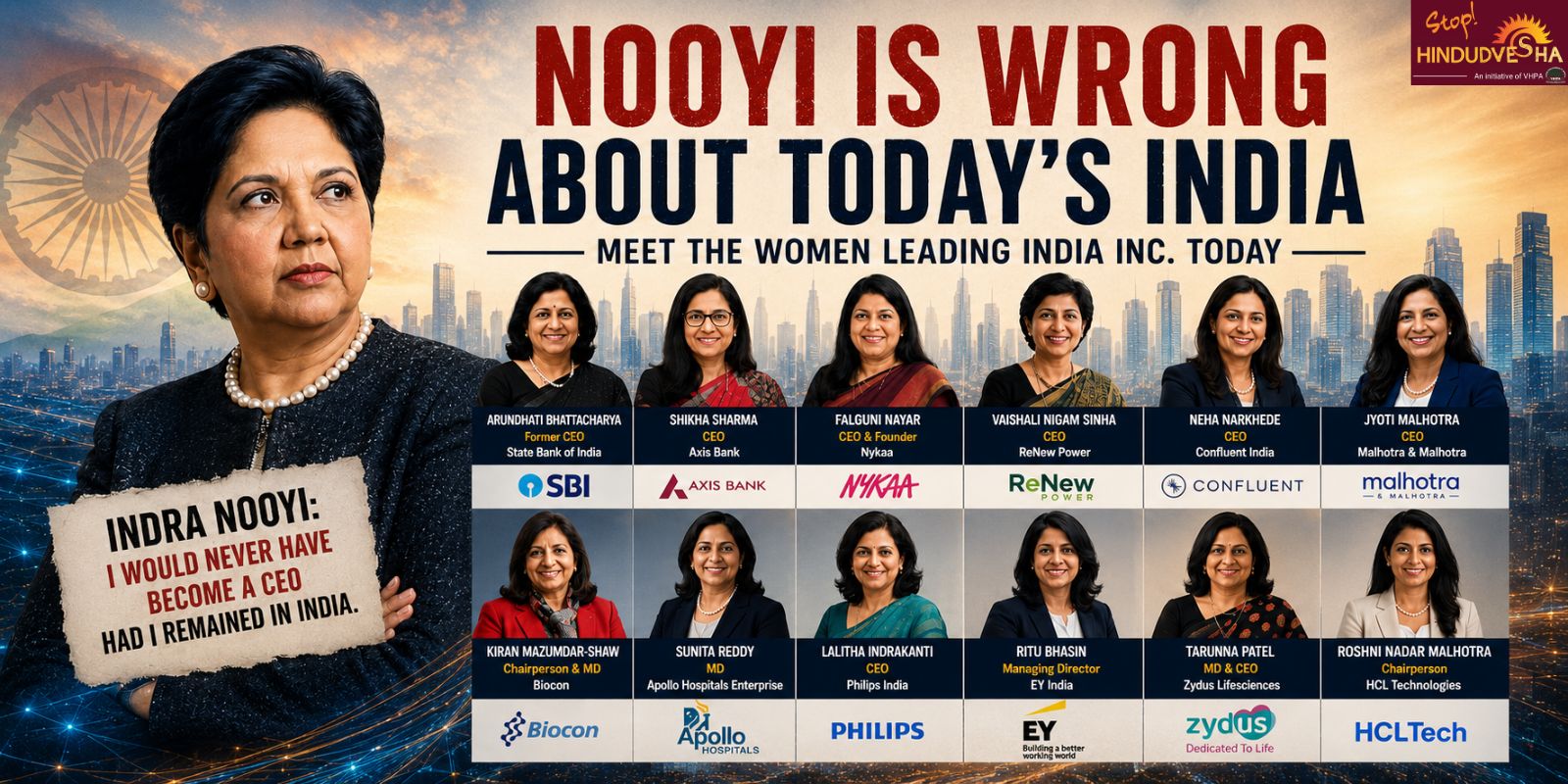
Summary
When Indra Nooyi recently suggested she would never have become a CEO had she remained in India, her remarks reignited a familiar narrative about women and corporate leadership. Her experience in India in the 1970s was real, but it is no longer representative of India today. Since economic liberalization, India’s corporate landscape has undergone a profound transformation, creating unprecedented opportunities for professional women to lead major enterprises. At the same time, the glass ceiling remains a global challenge, with women still significantly underrepresented among CEOs across major economies, including the United States. The growing number of women leading India’s largest companies tells a different story, one that challenges outdated assumptions and reflects the realities of a modern, increasingly merit-driven corporate India.
When former PepsiCo CEO Indra Nooyi remarked that she would never have become a CEO had she remained in India, the comment sparked immediate debate. [1] Coming from one of the world’s most accomplished business leaders, it carried weight. Nooyi’s journey from Chennai to PepsiCo’s corner office is one of the defining corporate success stories of our time.
Her observation reflects the India of the 1970s — the License Raj era of heavy regulation and severely limited opportunities for women in professional leadership. In that context, she is probably right about her own career path.
The problem is that her statement casts unfair aspersions on today’s India. By presenting her personal experience as broadly representative, she risks misleading audiences into believing that the India of 2026 remains as constrained as the one she left decades ago. This ill-informed extrapolation does a disservice to the country’s profound transformations. [2] Given her global stature and decades of leadership experience, we should expect a more nuanced view from her — one that clearly distinguishes the India of yesterday from the India of today.
Countries evolve. Economies expand. Institutions mature. Few would judge present-day Germany by 1945 or South Korea by the 1960s. Yet too many discussions about India still rely on impressions formed decades ago, overlooking the profound changes that have reshaped the country.
None of this means India has solved gender equality. Women still face workplace bias, family-related career interruptions, and underrepresentation in senior roles — genuine concerns shared by virtually every major economy.
The real issue is not whether barriers to women’s leadership still exist — they clearly do. The far more important question is whether modern India offers far greater opportunities for talented women than it did fifty years ago. The answer is visible in the country’s boardrooms, where women now lead major banks, consumer companies, healthcare networks, pharmaceutical firms, financial institutions, and technology businesses.
Indra Nooyi may have been right about the India she left behind, but she is certainly not right about the India of today.
Glass Ceilings Are a Global Phenomenon
Nooyi’s observation also reflects a broader assumption that deserves scrutiny: that while India remains constrained by gender barriers, countries like the United States have largely overcome them.
That assumption does not withstand scrutiny.
The corporate glass ceiling remains one of the most persistent realities of modern business. Despite decades of equal opportunity legislation, diversity initiatives, leadership programs, and public commitments to inclusion, women remain underrepresented in the executive suites of nearly every major economy. The problem is not unique to India — it is global.
The United States illustrates this paradox clearly. It has produced standout women leaders, including Indra Nooyi, Mary Barra, Ginni Rometty, Rosalind Brewer, and Safra Catz. Their achievements deserve full recognition. Yet they also highlight a stubborn reality: only about one in ten S&P 500 companies is led by a woman, despite decades of sustained efforts to improve gender diversity in corporate leadership.[3]
The reasons are well documented. Women still shoulder a disproportionate share of family and caregiving responsibilities during the peak career-building years. Differences in access to influential networks, mentors, high-profile assignments, and sponsorship persist. Even in organizations with strong policies, unconscious bias continues to shape decisions.
Europe faces similar challenges. Japan and South Korea have struggled even more. No major economy has fully cracked the problem of equal representation at the highest levels of corporate leadership.
This broader context is crucial. Barriers to women’s ascent into top leadership persist worldwide. The real question is not whether India has a glass ceiling, but whether its ceiling is uniquely impenetrable or simply part of the same global challenge every major economy continues to confront.
From License Raj to Meritocracy
The transformation of India’s economy over the past three decades did far more than boost GDP or attract foreign investment. It fundamentally changed how Indian companies are built, managed, and led.
During the License Raj, India’s private sector was small, heavily regulated, and dominated by family-controlled businesses. Professional managers existed, but opportunities to reach the very top were limited. The pool of leadership positions was small, and career paths were often shaped as much by ownership as by merit.
Economic liberalization dramatically changed that equation.
Over the following three decades, India witnessed the rise of hundreds of professionally managed companies competing both domestically and globally. Entire industries — information technology, pharmaceuticals, financial services, biotechnology, telecommunications, digital commerce, and advanced manufacturing — expanded at an unprecedented speed. Large Indian corporations became multinationals, while global firms built major operations across the country.
As businesses grew larger and more competitive, the criteria for leadership shifted. Boards began seeking executives who could manage billion-dollar enterprises, navigate global markets, attract investors, and deliver consistent results. Competence, execution, and strategic vision became decisive. Gender became progressively less relevant than the ability to outperform competitors.
This shift was reinforced by stronger corporate governance. Publicly listed companies now face intense scrutiny from institutional investors, regulators, independent directors, and financial markets. Appointing a CEO is a high-stakes decision with little room for symbolism. Capital is indifferent to gender. It rewards performance. Boards have a fiduciary duty to choose the best leader for long-term value creation.
At the same time, the talent pipeline has expanded dramatically. Women now account for nearly half of all students enrolled in higher education in India, and female enrollment has increased significantly over the past decade. They are graduating from the country’s leading universities and professional institutions in far greater numbers than previous generations. Many have accumulated decades of experience leading complex organizations in India and abroad, creating a far deeper pool of potential corporate leaders than existed a generation ago. [4]
None of this suggests that gender bias is no longer a matter of concern. Like their counterparts around the world, Indian women continue to face hurdles arising from family responsibilities, social expectations, unequal access to influential networks, and lingering unconscious bias. What has changed, however, is the fundamental incentive structure of modern corporations. In an increasingly competitive global marketplace, boards place greater emphasis on competence, execution, and strategic vision. The question they increasingly ask is the one that matters most: Who is the best person to lead this company?
India’s Corner Office Is No Longer Male-Only Territory
If the claim is that women cannot realistically become CEOs in India, the best place to test it is not in opinion polls or social media debates. It is in the boardrooms of India’s largest companies.
The evidence is difficult to ignore.
Across the Indian economy, women today lead organizations that employ hundreds of thousands of people, generate billions in revenue, and compete in some of the world’s most demanding industries. They are not confined to traditional sectors or family businesses. They head publicly listed companies, multinational subsidiaries, financial institutions, healthcare networks, manufacturing firms, and high-growth technology businesses. [5]
In consumer goods, one of India’s most competitive sectors, Priya Nair leads Hindustan Unilever and Prabha Narasimhan heads Colgate-Palmolive India. In financial services, Vibha Padalkar steers HDFC Life, A. Manimekhalai leads Union Bank of India, and Parminder Chopra heads Power Finance Corporation. In healthcare and biotechnology, Suneeta Reddy has built Apollo Hospitals into the country’s largest integrated private healthcare network, while Kiran Mazumdar-Shaw transformed Biocon from a garage startup into a global biotechnology leader. In the startup world, Falguni Nayar founded Nykaa after a successful banking career and built it into a major consumer technology success.
These examples represent only the visible summit of a larger transformation. Women now serve as chief executives, managing directors, founders, and board chairs across banking, insurance, manufacturing, hospitality, logistics, retail, pharmaceuticals, renewable energy, and information technology. What was once rare has become an increasingly normal feature of India’s corporate landscape.
Critics may correctly note that women remain underrepresented in CEO positions. That is true and deserves continued attention. But underrepresentation is fundamentally different from exclusion. The trajectory is clear: the number of women in the corner office continues to grow.
Every such appointment makes the next one easier. Success quietly overturns old assumptions until they lose their power. That is how real, lasting change happens.
Why Does This Narrative Persist?
If the evidence shows a growing number of women leading India’s largest companies, why did Indra Nooyi’s remark resonate so widely?
Part of the answer lies in the power of personal experience. Nooyi’s formative years unfolded in an India where opportunities for women in corporate leadership were far more limited than they are today. Her observation is understandable as a reflection on the country she left.
The deeper reason lies in confirmation bias reinforced by long-standing historical narratives. For much of the colonial era, India was portrayed by many Western writers as a society uniquely burdened by social backwardness, particularly in its treatment of women. Those portrayals often served to justify the colonial “civilizing mission.” While India has changed dramatically since independence, elements of that narrative continue to shape international perceptions. Stories of gender inequality, violence against women, workplace discrimination, and social conservatism receive extensive international attention, while evidence of India’s progress or comparative data that challenge these perceptions often receive far less notice. For example, despite the widespread perception that India is exceptionally unsafe for women, international crime statistics do not place it among the countries with the highest reported rape rates, and a number of Western countries rank substantially higher.[6] Unfortunately, once a narrative becomes entrenched, evidence that reinforces it tends to be amplified, while evidence that complicates it is frequently overlooked.
Progress is a quieter story than failure. The steady appointment of women CEOs rarely generates the same headlines as a single controversial remark or a shocking incident. Over time, this creates a perception gap: the world remains familiar with India’s shortcomings while becoming less aware of its rapid progress.
Indra Nooyi’s comments also illustrate how some members of the Indian diaspora can unintentionally reinforce outdated perceptions of India by viewing it through memories formed decades earlier. Those experiences may be authentic, but they have little relevance to the realities of today’s India.
Conclusion
Indra Nooyi’s achievements deserve universal admiration. She overcame genuine barriers and reached the pinnacle of global business through exceptional talent, perseverance, and leadership. Nothing in this discussion diminishes that accomplishment.
But personal experience, however remarkable, should not become a sweeping judgment about a country that has undergone profound transformation. Whether Nooyi herself would have become a CEO had she remained in India is ultimately unknowable. The more relevant question is whether talented women can become CEOs in India today.
The evidence leaves little room for doubt. Women now lead major Indian banks, pharmaceutical companies, technology firms, consumer businesses, healthcare networks, financial institutions, and multinational corporations. They are not exceptions created for symbolism. They are products of a corporate ecosystem that has become more competitive, more professional, and increasingly merit-driven.
The real lesson is larger than one individual’s career. Countries evolve, institutions mature, and opportunities expand. Judging today’s India through the lens of the 1970s does a disservice not only to India’s remarkable transformation but also to the thousands of talented women redefining corporate leadership today. The India Indra Nooyi left behind is not the India that exists today, and our narratives should evolve as quickly as the country itself.
Citations
[1] Moneycontrol News, “Indra Nooyi Says ‘She Could Never Have Become CEO in India’; Praises America’s Meritocracy,” Moneycontrol, July 1, 2026, https://www.moneycontrol.com/world/indra-nooyi-says-she-could-never-have-become-ceo-in-india-praises-america-s-meritocracy-article-13964315.html
[2] Arvind Panagariya, India: The Emerging Giant (New York: Oxford University Press, 2008)
[3] Catalyst. “Women CEOs.” Catalyst.org. Last modified 2025. https://www.catalyst.org/insights/featured/women-ceos
[4] Government of India. All India Survey on Higher Education (AISHE) 2022-2023. Ministry of Education. https://aishe.gov.in/
[5] Deloitte. Women in the Boardroom: A Global Perspective. 8th ed. Deloitte Global, 2024/2025. https://www.deloitte.com/in/en/issues/trust/women-in-the-boardroom-a-global-perspective.html
[6] Rakesh Krishnan Simha, “Rape Capital: It’s the West, Not India, That Leads in Sex Crimes,” Stop Hindudvesha, June 6, 2023, https://stophindudvesha.org/rape-capital-its-the-west-not-india-that-leads-in-sex-crimes/

Donate to HINDUDVESHA
Our Mission is to explore and expose Hindudvesha through research analysis, education and response.
SUPPORT US