

The Intolerant Minority: Political Islam’s War with the Democratic Order
 Som Misha · 06/10/2026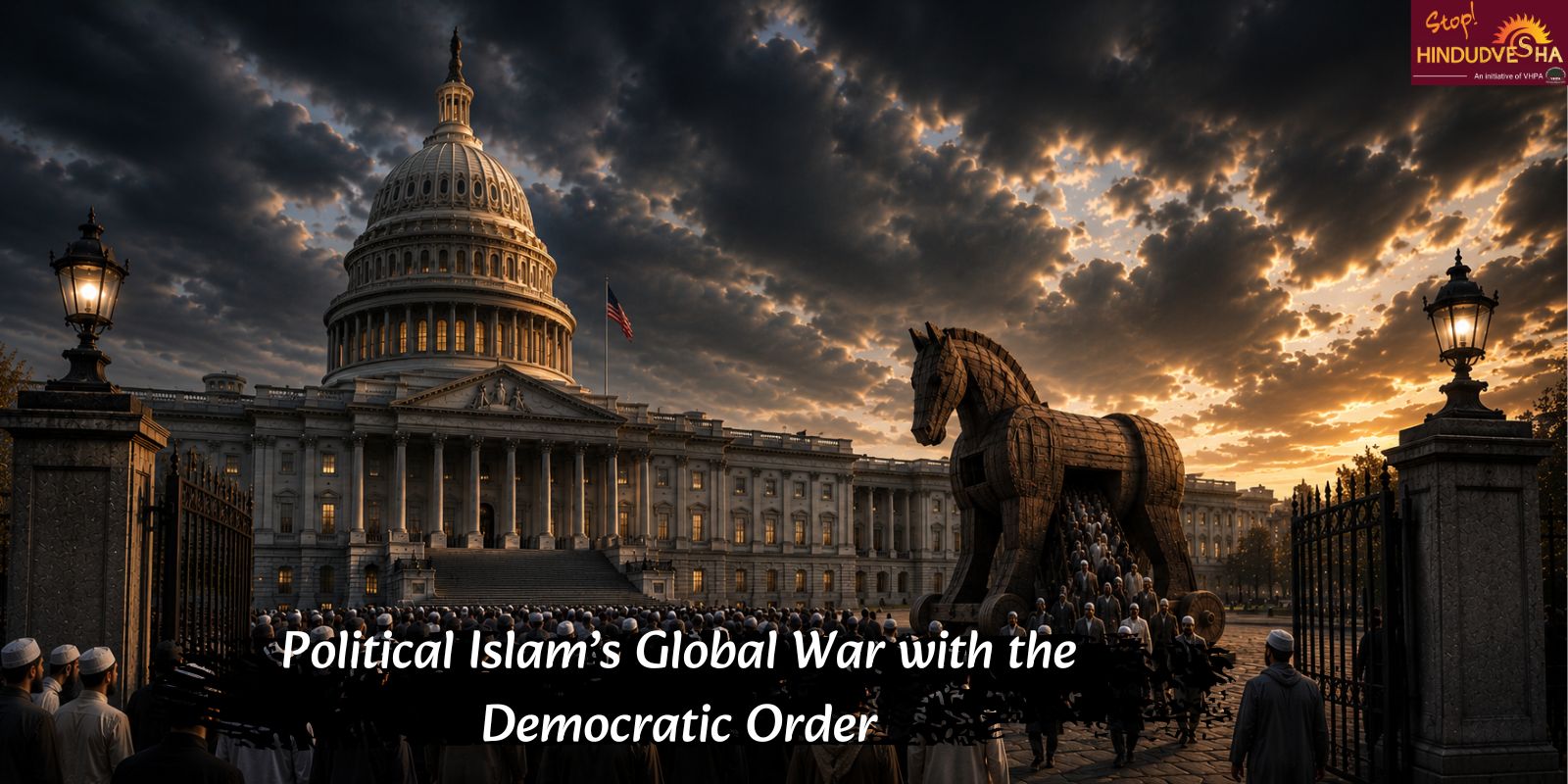
Summary
Political Islam is presented as a transnational ideological system that often places religious authority above secular citizenship and democratic norms. Through examples such as former U.S. intelligence officer Monica Witt’s defection to Iran, Pakistan’s formation through the Two-Nation Theory, and Lebanon’s gradual sectarian transformation, the discussion traces how religious identity, demographic change, and organized Islamist movements can reshape states and institutions. Classical Islamic political concepts, including the integration of religion and governance, are examined alongside contemporary polling on support for Sharia and the role of organizations such as the Muslim Brotherhood. The piece also explores prison conversions, radicalization, and parallel legal systems in Western societies, concluding with policy recommendations centered on immigration screening, institutional safeguards, legal uniformity, counter-radicalization, and support for reformist Muslim voices.
There is a passage in Sayyid Qutb’s Milestones — the Egyptian Islamist theorist’s 1964 manifesto, still required reading in radical circles from Cairo to Cologne — that cuts to the heart of the problem. “Islam is not a heritage of any particular race or country,” Qutb wrote. “It is God’s message to the whole world.” [1] The book was written in an Egyptian prison cell, where Qutb would eventually be hanged by Nasser’s government. But the idea survived him. It survived because it is not merely a political grievance dressed in theology. It is a claim about the very structure of legitimate authority — a claim that is fundamentally incompatible with the pluralist democratic order that the post-Enlightenment West has constructed over three centuries of blood and revision.
This is the conversation the West keeps refusing to have honestly: that a significant current within Islam — not a marginal fringe, but a documented, institutionally organized, and in some cases majority-supported current — does not recognize the separation of religion and state, does not grant equal standing to non-Muslims or apostates under its preferred legal order, and does not accept national citizenship as a final loyalty. This is not a claim against Muslim people. It is a claim about an ideology — one that has demonstrable consequences when it operates inside liberal democracies, as the case of Monica Elfriede Witt makes painfully clear.
Monica Witt and the Transfer of Allegiance
Born and raised in Texas, Monica Witt became infatuated with the Quran after a six-month deployment to Iraq in 2005. That is how one account describes the beginning of the most consequential defection in recent American intelligence history. Witt was, by all accounts, a skilled and trusted officer. She was a counterintelligence officer who worked with the US Air Force Office of Special Investigation between 2003 and 2008, with assignments mostly in the Middle East. She had been entrusted with some of the most sensitive secrets in the American national security apparatus. Then, gradually, she changed. [2]
Witt converted to Islam in a ceremony that was broadcast on Iranian television in February 2012. In May 2012, the FBI warned her that she was a target for recruitment by Iranian intelligence services. Witt responded that if she ever returned to Iran, she would refuse to provide any information about her work. That promise did not hold. According to a 2019 federal indictment unsealed in Washington, D.C., Witt provided Iran with details on a highly classified U.S. intelligence collection program and helped identify former U.S. colleagues for targeting. She also assisted Iranian hackers in cyberattacks against American intelligence personnel. [3]
The FBI official Jay Tabb, executive assistant director for national security, told reporters that Witt’s “primary motive appears to be ideological.” When she defected, she wrote to her Iranian contact: “I’m signing off and heading out! Coming home.” Tehran, not Texas, was home now. The FBI connects Witt’s alleged activity directly to the Islamic Revolutionary Guard Corps, a powerful Iranian military and intelligence organization involved in intelligence collection, unconventional warfare and support for groups designated by Washington as terrorist organizations targeting Americans. [4]
The FBI is now offering a $200,000 reward for information leading to her capture, underscoring ongoing U.S. concerns over one of the most damaging espionage cases involving an American intelligence insider in recent memory. [5]
What makes the Witt case philosophically important — beyond the operational damage, which was severe — is the window it opens onto a specific dynamic that Western security services are only beginning to articulate clearly. For Witt, conversion to Islam was not the adoption of private devotional practices. It was, by her own actions, a transfer of civilizational allegiance. The ummah — the global community of believers that classical Islamic political theory recognizes as the primary political unit — superseded the United States Constitution. When she wrote “coming home” to a handler in Tehran, she was expressing something that Qutb had theorized and that the Muslim Brotherhood had operationalized: that a Muslim’s true homeland is not a nation-state but a community of faith that transcends borders.
To state this is not to suggest that every Muslim convert is a spy, or even a potential one. Perhaps the vast majority are not. But the Witt case is a stress test of a specific assumption that liberal democracies make: that ideological commitments are always subordinate to civic ones. For most religions, in their modern Western instantiations, that assumption holds. For a significant strand of political Islam, it does not — and the consequences can be catastrophic.
What Political Islam Actually Claims
The distinction between “Islam” and “political Islam” is real and important, but it is often weaponized to avoid a harder conversation. Political Islam — Islamism — is not some recent aberration grafted onto an otherwise apolitical faith. It draws from classical Islamic jurisprudence (fiqh), from the foundational texts, and from fourteen centuries of praxis in which the din (religion) and dawla (state) were explicitly unified. Muhammad, the prophet of Islam, was not only a spiritual leader; he was a political and military commander. The early caliphates were theocracies. The Quran contains not only spiritual guidance but also property law, criminal punishment (hudud), rules of war, and the governance of non-Muslim communities (dhimmi).
The political import of this is not subtle. Classical Sharia designates the world as divided between Dar al-Islam (the house of submission) and Dar al-Harb (the house of war). [6] Apostasy — leaving Islam — is punishable by death in four of the five major legal schools. Non-Muslims under traditional Sharia pay a special tax (jizya) and are afforded lesser legal standing. Women’s inheritance and testimony rights are, under strict interpretation, half those of men. None of this is secret or disputed. It is in the primary texts.
The polling evidence suggests that these are not merely ancient curiosities. A 2013 Pew Research survey across 39 countries found overwhelming majorities in many Muslim-majority countries favoring Sharia as official law, including its criminal punishments. [7] In Western Muslim communities, the numbers are lower but not negligible, and in some European countries, among younger generations, they have moved in the wrong direction. These are not fringe views held by violent extremists. They are, in many contexts, mainstream ones.
Into this landscape arrives the Muslim Brotherhood, whose strategic ambitions for the West were laid bare not by its enemies but by its own documents. The Muslim Brotherhood’s Explanatory Memorandum on the General Strategic Goal for the Group in North America articulates a long-term vision for embedding the Brotherhood within U.S. and Canadian societies through a process termed “settlement,” framed as a non-violent “civilizational jihad” aimed at gradually transforming Western institutions from within and ultimately supplanting secular democratic norms with an Islamist framework. The document states, in terms that have been read into the federal court record: “The Ikhwan must understand that their work in America is a kind of grand jihad in eliminating and destroying the Western civilization from within and ‘sabotaging’ its miserable house by their hands and the hands of the believers so that it is eliminated and God’s religion is made victorious over all other religions.” [8]
The memorandum — an 18-page internal memo drafted in May 1991 — was seized by FBI agents from the home of Ismail Elbarasse, whom prosecutors describe as the “archivist” for the Muslim Brotherhood in America, and was entered into evidence in the Holy Land Foundation terrorism financing trial. It is worth noting that some analysts dispute the document’s operational significance, and the Georgetown University Bridge Initiative has argued that it was not formally adopted Brotherhood policy. That debate is legitimate. What is not debatable is that the document exists, was preserved by a Brotherhood official, was produced in a Brotherhood context, and articulates a logic — gradualist institutional infiltration of democratic societies — that is entirely consistent with Brotherhood behavior in Europe and America over the following three decades. [9]
Jinnah and the Democratic Mechanism of Exclusion
The Monica Witt case illustrates what political Islam can do to an individual’s allegiance. The partition of British India illustrates what it can do to a civilization — and how it can use democracy as its instrument.
Muhammad Ali Jinnah is a contested figure, and it would be dishonest to present him simply as a “radical Muslim.” For most of his life, he sought to achieve equality for Muslims within an undivided Hindu-majority India. He was, for decades, an Anglicized barrister who drank whiskey, ate pork [10], wore Savile Row suits, and was celebrated as an “ambassador of Hindu-Muslim unity.” But the trajectory of his later career — and the country it produced — tells a different and darker story. [11]
From 1937 onwards, Jinnah started using Islamic symbolism and began directing his addresses to the underprivileged. Those scholars who have painted the later Jinnah as secular have misread his speeches which must be read in the context of Islamic history and culture. By 1940, his Lahore Resolution articulated the “Two-Nation Theory” in terms that made the subsequent catastrophe almost inevitable. In his presidential address at Lahore in 1940, Jinnah stated: “The Hindus and Muslims belong to two different religious philosophies, social customs, literatures. They neither intermarry nor interdine together and, indeed, they belong to two different civilizations which are based mainly on conflicting ideas and conceptions.” [12]
The Two-Nation Theory is the political theology of Muslim separatism expressed in democratic language. It used the vocabulary of minority rights and self-determination — the intellectual currency of postwar liberal order — to argue for a state whose organizing principle was religious exclusion. The song sung at Muslim League conferences of the period was less diplomatically phrased [13]:
“Let there be in Pakistan, the separate center of Islam,
We shall not in Pakistan have to look at faces of non-Muslims,
The abode of the Muslim nation will brighten up only,
When in Pakistan there remain no idolatrous thorns.”
The result was one of the largest forced migrations in human history — and a state that, whatever its founder’s complex intentions, has followed the logic of its founding principle to its conclusion. Ideology and religion are divisive forces in Pakistan today, from sectarian violence against Shia Muslims to the state’s blasphemy laws that authorize a death sentence for anyone who insults Islam. According to Pew Research statistics, 75 percent of Pakistanis say blasphemy laws are necessary to protect Islam, while only 6 percent say blasphemy laws unfairly target minorities. Christians, Ahmadis, Hindus, and other minorities live under legal and social structures that formally diminish their standing. [14]
The lesson of Pakistan is not that Jinnah was uniquely villainous. It is when political Islam captures a state’s founding logic that the formal democratic architecture becomes a mechanism for minoritarian oppression, not protection. Democracy — majority rule — is only liberal when it is constrained by universal rights norms that protect minorities. Political Islam, by design, does not accept that constraint.
The Mirror: Lebanon and the Slow Replacement
If Pakistan shows the catastrophic birth of a state founded on Islamic supremacism, Lebanon shows the slow-motion transformation of an existing pluralist society into something else. It is the story that the world, especially European commentators, need to study most carefully, because its mechanisms are the most familiar to Western conditions.
Lebanon was, within living memory, the most cosmopolitan society in the Arab world. After World War II, Lebanon was a wealthy country thanks to its banks and commerce, a peaceful, multiethnic, multireligious nation under a Christian majority. Beirut was rightly called the “Paris of the Middle East.” Its political system was built on a carefully negotiated sectarian balance. The 1943 National Pact reserved the presidency for a Maronite Christian, the prime ministership for a Sunni Muslim, and the parliamentary speakership for a Shia Muslim — a framework designed to balance influence between Christians and Muslims. [15]
That balance did not survive. Christians were a majority until the 1980s; today, they are roughly one-third, living under growing pressure from a Muslim majority. The mechanisms of change were multiple and compounding: Palestinian refugee influxes after 1948 and 1970, differential birth rates, emigration of Christians, the Lebanese Civil War, and the rise of Hezbollah in the early 1980s. Inspired by the Iranian Revolution of 1979 and Ayatollah Khomeini’s model of Islamic governance, Hezbollah maintains strong ties with Iran and the IRGC. [16]
The group’s strategy was a patient application of the same logic that animates the Muslim Brotherhood memorandum: use legitimate political processes as long as they serve your ends, maintain parallel military power to ensure they eventually do. When Christian forces disarmed after the war, Hezbollah kept its weapons under the excuse of “resistance.” Over time, it captured the state, the army, and all key institutions. Christian politicians may officially hold reserved positions in the Lebanese government, but they are often little more than fronts and puppets for Islamic terror groups. [17]
In recent years, Lebanon’s prolonged economic collapse has disproportionately affected middle-class and professional populations, among whom Christians have historically been well represented, contributing to a renewed wave of emigration and continuing a long-term demographic trend that has gradually reduced the relative share of Christians in the country. [18]
Lebanon is not a metaphor or a thought experiment. It is a documented case study in what happens when a pluralist democracy fails to defend itself against a political movement that does not share its foundational commitments — and that is patient enough to use the democracy’s own instruments against it.
The Pattern: Converts, Prisons, and Parallel Societies
The Witt case is not an anomaly in the landscape of radicalization. Studies of Western foreign fighters and terrorism-related arrests consistently find converts to Islam significantly overrepresented relative to their small share of the overall Muslim population. The phenomenon reflects something structural about conversion to a politically totalizing ideology: it provides a complete civilizational identity to people who feel alienated from the one they were born into.
Richard Reid, the “shoe bomber” who in 2001 attempted to detonate explosives concealed in his footwear on a transatlantic flight, was a British convert. [19] Germaine Lindsay, one of the four bombers who killed 52 people on London’s transit system on July 7, 2005, was a Jamaican-born convert. [20] The pattern extends across Europe: converted radicalization in Germany, France, the Netherlands, and Belgium has been well-documented by terrorism researchers.
In the United States, prison conversion has been a documented pathway. [21] The combination of alienation, an ideology that explains the convert’s suffering as the fault of an enemy civilization, and the social structure of a brotherhood — ummah, produces a particular kind of radicalization that is, paradoxically, often more intense than that of individuals raised in the faith.
The broader phenomenon of parallel societies — communities operating under norms that diverge from, and in some cases contradict, the secular law of the host state — is documented throughout Western Europe. France has officially identified hundreds of “sensitive urban zones” where the effective authority of secular law is contested. Sharia councils operating in family law in the United Kingdom have been the subject of repeated parliamentary inquiries. [22] Honor killings, female genital mutilation, and forced marriages — practices prohibited by law — persist within communities where the authority of religious custom is placed above that of the state.
What Democracies Owe Themselves
None of the foregoing requires accepting that the problem is Muslims — people — rather than political Islam, an ideology. Liberal democracies are not defenseless against ideological threats; they have dealt with communism, fascism, and other totalizing movements without abandoning their foundational commitments. The question is whether they have the institutional will to do so.
Several policy lines deserve serious consideration.
- Immigration and ideological vetting: Liberal democracies have always reserved the right to exclude those who seek to use their freedoms to destroy them. This is not bigotry; it is the elementary logic of self-preservation. Visa and asylum systems should include rigorous screening for applicants who advocate the supremacy of religious law over secular constitutions, support for violence against apostates or religious minorities, or affiliation with organizations like the Muslim Brotherhood. This is not collective punishment of a religion; it is the same screening that would be applied to adherents of any ideology that openly declares its intention to subvert the host society.
- Foreign funding of mosques and religious institutions: Saudi Arabia and Qatar have spent billions of dollars funding mosques, madrasas, and imams across the Western world, often promoting the most doctrinally conservative Wahhabi or Salafi interpretations of Islam. Transparency requirements and restrictions on foreign funding for domestic religious and political institutions — the same rules that apply to foreign political donations — are a straightforward and non-discriminatory mechanism.
- The rule of law, applied without cultural exception: Sharia councils that adjudicate family matters — divorce, inheritance, child custody — operate in parallel to the secular legal system and routinely disadvantage women who participate in them under social pressure. These are not “alternative dispute resolution mechanisms.” They are parallel legal systems operating in defiance of the liberal state’s foundational commitment to equal rights under secular law. Shutting them down is not Islamophobia. It is equal justice.
- Counter-radicalization that names its target: Western counter-extremism programs have been notably reluctant to identify Islamist ideology explicitly, preferring generic frameworks about “violent extremism” that could apply equally to any political movement. This avoidance is counterproductive. Effective counter-radicalization — as former extremists like Maajid Nawaz have argued — requires engaging the specific theological and ideological claims of Islamism directly, empowering reformist voices within Muslim communities, and creating genuine off-ramps from radicalization.
- Supporting genuine reform within Islam: There are serious, courageous Muslim scholars and intellectuals — in Egypt, in Morocco, in Turkey, in Indonesia, and in Western diaspora communities — who are doing the hard work of arguing for interpretations of Islamic theology that are compatible with pluralism, universal rights, and secular governance. They deserve vigorous support. Too often, Western governments have engaged instead with Brotherhood-affiliated organizations that present themselves as moderate, but whose underlying agenda is identical to that of the memorandum.
The Conversation We Keep Avoiding
Every time a Western politician or journalist says that political Islam “has nothing to do with Islam,” they are being strategically dishonest in a way that has concrete costs: it forecloses the internal Islamic reform debate, empowers Islamists who claim that any Western criticism is simply anti-Muslim bigotry, and prevents democracies from developing coherent policies.
The Monica Witts of the world are a warning. The Lebanon of the 1970s — cosmopolitan, pluralist, and unprepared — is a warning. The ‘Pakistan’ created from the democratic machinery of India is a warning. These are not warnings about Muslim people. They are warnings about what happens when a political ideology that does not accept the rules of pluralist coexistence is admitted to the arena of pluralist coexistence and is treated as though it were merely a private faith.
Democracy has a genius that authoritarianism lacks: it can examine itself honestly and change. But that genius is wasted if the examination is suppressed in the name of sensitivity. The first obligation of any political order is to preserve itself. That requires, at minimum, the willingness to look clearly at the forces that wish to consume it — and to say so plainly, without apology, without rancor, and with the full weight of evidence.
Islam deserves no special privileges. It is a political ideology that seeks to dominate the world and should therefore be treated like any other group that plots against the state. How the free world should deal with political Islam is a conversation that is long overdue.
Citations
[1] Qutb, Sayyid. Milestones. PDF document. Kalamullah.com. https://www.kalamullah.com/Books/MILESTONES.pdf
[2] “Air Force Veteran Allegedly Spied for Iran.” Yahoo News. https://www.yahoo.com/news/articles/air-force-veteran-allegedly-spied-120000924.html?guccounter=1
[3] “FBI Reward in Monica Witt Espionage Case.” International Business Times Australia. https://www.ibtimes.com.au/fbi-reward-monica-witt-espionage-case-1868851
[4] “Former Air Force Officer Accused of Spying for Iran Converted to Islam.” Washington Examiner. https://www.washingtonexaminer.com/news/256331/former-air-force-officer-accused-of-spying-for-iran-converted-to-islam
[5] “FBI Reward in Monica Witt Espionage Case.” International Business Times Australia. https://www.ibtimes.com.au/fbi-reward-monica-witt-espionage-case-1868851
[6] “Islamic Archaeology Glossary.” Brown University. https://webhelper.brown.edu/joukowsky/courses/islamicarchaeologyglossary2007/4005.html
[7] Pew Research Center. “The World’s Muslims: Religion, Politics and Society Overview.” April 30, 2013. https://www.pewresearch.org/religion/2013/04/30/the-worlds-muslims-religion-politics-society-overview/
[8] “Muslim Brotherhood Memorandum (1991).” Justapedia. https://justapedia.org/Muslim_Brotherhood_memorandum_(1991)
[9] “Explanatory Memorandum: Detractors Ignore Evidence.” Middle East Forum. https://www.meforum.org/islamist-watch/explanatory-memorandum-detractors-ignore-evidence
[10] “Pakistan’s Jinnah and Jinnah’s Pakistan.” Institute of Contemporary Pakistan Studies (ICPS). https://icpsnet.org/comments/Pakistans-Jinnah-and-Jinnahs-Pakistan-130823
[11] Jalal, Ayesha. “At 75, Pakistan Has Moved Far from the Secular and Democratic Vision of Its Founder Mohammad Ali Jinnah.” The Conversation, August 12, 2022. https://theconversation.com/at-75-pakistan-has-moved-far-from-the-secular-and-democratic-vision-of-its-founder-mohammad-ali-jinnah-187238
[12] “Jinnah’s Vision and Pakistan’s Ideological Evolution.” International Journal of History. PDF document. https://www.historyjournal.net/article/407/7-5-6-659.pdf
[13] “How Jinnah Divided Muslims.” Open. https://openthemagazine.com/essay/how-jinnah-divided-muslims#google_vignette
[14] Jalal, Ayesha. “At 75, Pakistan Has Moved Far from the Secular and Democratic Vision of Its Founder Mohammad Ali Jinnah.” The Conversation, August 12, 2022. https://theconversation.com/at-75-pakistan-has-moved-far-from-the-secular-and-democratic-vision-of-its-founder-mohammad-ali-jinnah-187238
[15] “Continued Dangers for Lebanese Christian Population, Political Leadership.” International Christian Concern, April 9, 2026. https://persecution.org/2026/04/09/continued-dangers-for-lebanese-christian-population-political-leadership/
[16] Dreher, Rod. “From Christian to Majority-Muslim: Lebanon’s Cautionary Tale for Europe.” The European Conservative. https://europeanconservative.com/articles/analysis/from-christian-to-majority-muslim-lebanons-cautionary-tale-for-europe/
[17] ibid
[18] “Continued Dangers for Lebanese Christian Population, Political Leadership.” International Christian Concern, April 9, 2026. https://persecution.org/2026/04/09/continued-dangers-for-lebanese-christian-population-political-leadership/
[19] “Shoe Bomber Leaves Behind a Legacy.” CBS News, December 22, 2008. https://www.cbsnews.com/news/shoe-bomber-leaves-behind-a-legacy/
[20] Dodd, Vikram, and Matthew Taylor. “July 7 Bombers: The Road to London.” The Guardian, July 16, 2005. https://www.theguardian.com/uk/2005/jul/16/july7.uksecurity6
[21] “Why Are Muslims Overrepresented in Western Prisons?” Stop Hindu Dvesha. https://stophindudvesha.org/why-are-muslims-overrepresented-in-western-prisons/
[22] “British Sharia Courts Come Under Scrutiny.” The Times of Israel. https://www.timesofisrael.com/british-sharia-courts-come-under-scrutiny/

Donate to HINDUDVESHA
Our Mission is to explore and expose Hindudvesha through research analysis, education and response.
SUPPORT US