

Not Targeted, But Still Dying – The Complex Reality Behind Indian Student Deaths in the US
 Som Misha · 06/04/2026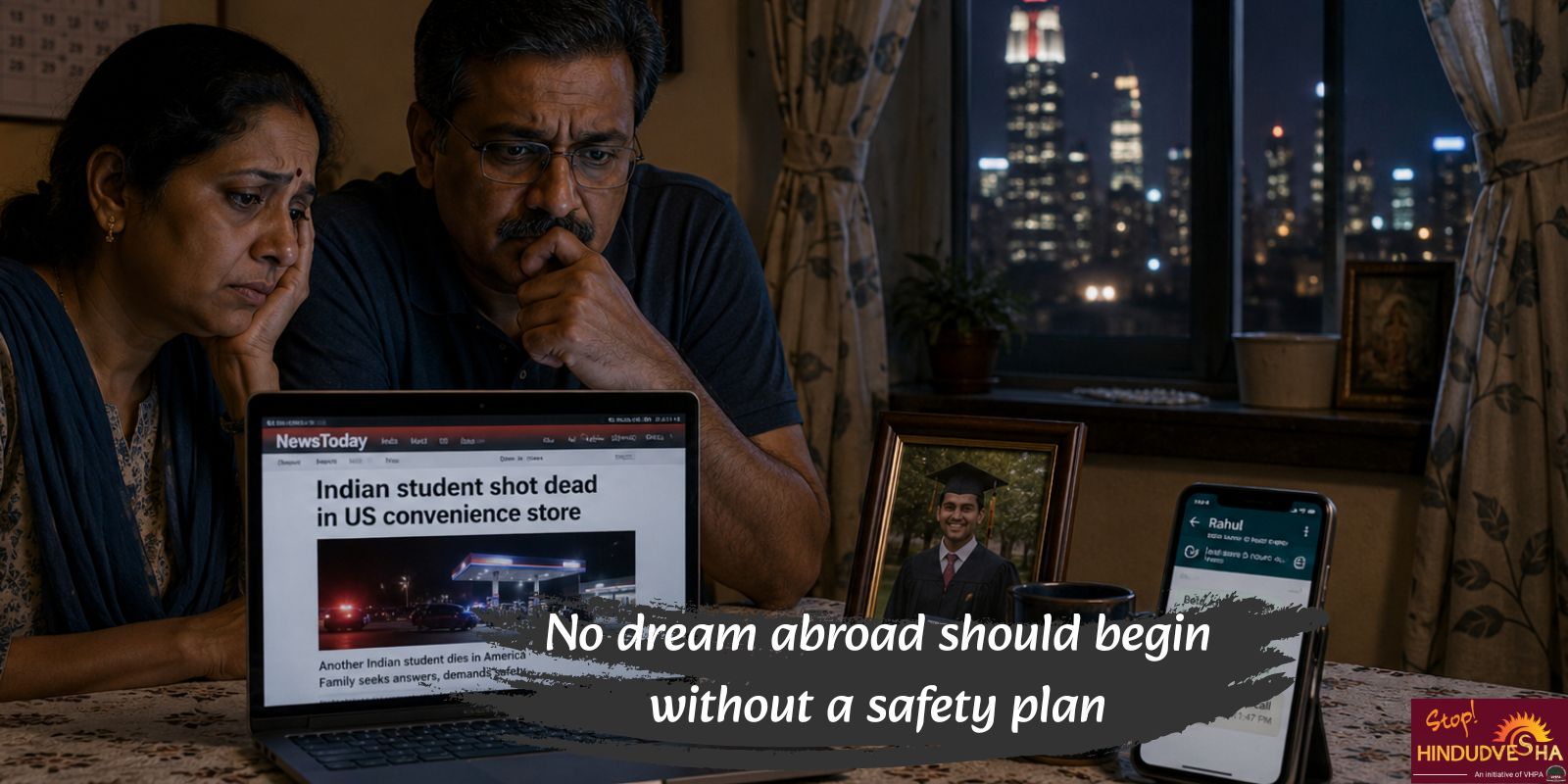
Summary
For hundreds of thousands of Indian students, the United States remains a land of extraordinary opportunity, world-class education, and professional ambition. Yet alongside stories of success, a growing number of student deaths, violent incidents, mental health struggles, accidents, and safety concerns have unsettled families in India and prompted difficult questions about the risks of studying abroad. This article examines the changing reality facing Indian students in America, separating fear from fact while exploring the deeper vulnerabilities of life far from home. From crime and isolation to cultural adjustment and emotional strain, it argues that success abroad increasingly demands more than academic excellence. For Indian families, the American dream remains alive, but it is now viewed through a more cautious lens of preparation, resilience, and safety.
For generations of Indian students, the United States has represented ambition in its purest form — a place where laboratories gleam late into the night, campuses resemble miniature republics, and a degree can redraw the trajectory of an entire family. But beneath that promise lies another America: one shadowed by violence, loneliness, exhaustion, and the peculiar vulnerabilities of being young and foreign in an immense country that often feels both welcoming and indifferent.
It is a journey that has followed a familiar script for decades. A student from Hyderabad, Delhi, Ahmedabad, or Bengaluru boards a flight with two suitcases, a folder of immigration documents, and the accumulated expectations of an extended family. Parents borrow against land, pensions, or savings. WhatsApp groups bloom with advice about winter jackets, internships, and “safe neighborhoods.” Somewhere in the imagination, America is still a place of picture-perfect campuses, Silicon Valley salaries, and reinvention.
The numbers still support the dream. According to the Open Doors 2025 report, there were 363,019 Indian students enrolled in the U.S. in 2024-25 — a 10 percent increase from the year before — making India the leading country of origin for foreign students for the second consecutive year, surpassing China for the first time in fifteen years. [1] Yet woven through this vast migration is another, darker narrative — one that resurfaces every few years through headlines announcing the death of another Indian student in a dormitory, apartment, parking lot, roadside motel, or convenience store.
These deaths arrive in clusters, creating the impression of an organized menace. Indian television channels assemble them into grim montages, complete with ominous graphics and anxious studio debates about whether Indians are being “targeted” in America. Relatives speak to reporters through tears from villages in Telangana or Andhra Pradesh. Politicians demand investigations. Social media transforms fragments of information into elaborate conspiracies.
But the reality, investigators say repeatedly, is usually more fragmented — and tragically ordinary.
Many of these deaths emerge not from a coordinated campaign against Indians but from the wider crises of contemporary American life: gun violence, untreated mental illness, drug abuse, robbery, isolation, harsh weather, and the precariousness of immigrant existence. That distinction offers limited comfort to parents staring at photographs of children who left home with university acceptance letters and returned in coffins.
The Gas Station at 2 A.M.
 In October 2025, anxiety sharpened again. Chandrashekar Pole, a 27-year-old from Hyderabad who had completed a master’s degree in data analytics at the University of North Texas, was shot dead during a robbery at a Fort Worth gas station where he worked part-time while looking for a full-time job. [2] A suspect, Richard Damion Florez, was arrested two days later after a rampage that included firing at a second vehicle and crashing into a residential gate. [3] The Consulate General of India in Houston stepped in to help the family repatriate the body.
The setting — fluorescent lights humming at 2 a.m., a lone cashier behind reinforced glass, highways stretching into darkness — has become almost archetypal in the immigrant imagination. Such jobs occupy a peculiar place in the economy of international education. Universities advertise intellectual opportunity; survival depends on labor invisible to brochures: stocking shelves, driving delivery cars, cleaning cafeterias, working overnight shifts at convenience stores. Students accept these risks because tuition bills do not pause for exhaustion.
Yet even amid such tragedies, it is important to remember that they represent a small fraction of the experience of hundreds of thousands of Indian students who study in the United States safely each year. Most complete their degrees, build professional networks, and go on to successful careers, often describing their years in America as transformative despite the challenges.
The Terrible Cluster of 2024
The panic surrounding these incidents intensified in early 2024, when a succession of deaths involving Indian and Indian-origin students generated relentless media attention.
In Georgia, Vivek Saini, a 25-year-old MBA graduate from Haryana, was working a night shift at a Lithonia convenience store when he asked a homeless man he and his colleagues had been feeding and sheltering for days to leave the premises. The man, Julian Faulkner, responded with a hammer. A “substantial amount of blood spatter” was found on the floor. Saini had been scheduled to fly home to India ten days later. The details felt almost allegorical: kindness answered with random violence. [4]
At Purdue University, Neel Acharya, a 19-year-old double-majoring in computer science and data science — described by his department head as “driven and academically talented,” by his roommate as “a loving, charismatic soul” — was found dead outside a campus laboratory on a January morning. The coroner ruled the death accidental: asphyxia, with cold exposure and alcohol intoxication as contributing factors. No foul play. No homicide. Just a Midwestern winter doing what Midwestern winters do. [5]
Another student, Akul Dhawan, at the University of Illinois Urbana-Champaign, also died of apparent hypothermia. To many Indian families raised in climates where winter means a mild evening breeze, the cold of the American interior possesses an almost abstract quality — until tragedy gives it terrifying specificity. [6]
Then came the death of Sameer Kamath, a doctoral student at Purdue, whose death was ruled a suicide by self-inflicted gunshot wound. The case punctured another persistent myth: that academic achievement inoculates young people against psychological collapse. [7]
Other names circulated online with growing unease: Shreyas Reddy Benigeri, Mohammed Abdul Arfath, Uma Satya Sai Gadde, Abhijeeth Paruchuru. Some deaths involved robberies; others remained unresolved or ambiguous for months. [8] In one widely discussed case near Boston, a body was found inside an abandoned vehicle, prompting allegations from relatives that foul play had been ignored. Amarnath Ghosh, another Indian-origin individual, was fatally shot off-campus, adding to the growing perception of insecurity. [9]
The accumulation of incidents created a mood larger than the facts themselves. Indian officials eventually described the deaths as “multicausal” — reflecting overlapping phenomena including crime, mental health crises, accidents, substance abuse, and America’s broader struggles with violence — rather than a coordinated anti-Indian campaign.
When Bias Becomes a Bullet
Still, there have been unmistakable moments when xenophobia moved from background atmosphere to explicit violence.
The most infamous example remains the 2017 killing of Srinivas Kuchibhotla in Olathe, Kansas. Kuchibhotla, a 32-year-old engineer at Garmin, was at Austin’s Bar and Grill with a colleague after work when Adam Purinton approached them, demanded to know whether their “status was legal,” and called them terrorists. [10] Bar staff escorted Purinton out. He came back with a gun. He shouted “Get out of my country!” before opening fire, killing Kuchibhotla and wounding his friend and a third man who tried to intervene. Purinton later told police he had killed “two Middle Eastern men.” He had mistaken them for Iranians. He was sentenced to three consecutive life terms after pleading guilty to federal hate-crime charges. [11]
In India, Kuchibhotla’s name became shorthand for the fear that immigrants had become collateral damage in a newly toxic political climate. The case lingered because it crystallized something many immigrants already sensed: that belonging in America could feel conditional — vulnerable to sudden eruptions of suspicion or rage.
Earlier Warnings Nobody Wanted to Hear
Long before the recent headlines, however, earlier tragedies had already exposed the vulnerabilities of student life abroad.
In December 2007, two doctoral students from Andhra Pradesh — Chandrasekhar Reddy Komma and Allam Kiran Kumar — were found murdered in an apartment near Louisiana State University. One had been strangled with a computer cable and shot; the other shot execution-style. The apartment complex reportedly sat in a neighborhood known for chronic crime and break-ins. The case dragged on for years, producing arrests but little closure — deepening a longstanding distrust, among Indian families, of distant legal systems and police bureaucracies. [12]
Another unsettling case emerged in 2008, when Akkaldevi Srinivas, a medical trainee in Pennsylvania, was found dead from stab wounds. Authorities ruled the death a suicide after discovering a message written on a mirror. His family fiercely disputed the conclusion, insisting the evidence did not align with his circumstances or state of mind. [13][13]
At Duke University, graduate student Abhijit Mahato was shot dead in his apartment in Durham. Prosecutors later linked the suspects to a broader pattern of violent robberies — including the murder of student-body president Eve Carson at the University of North Carolina at Chapel Hill. The violence appeared random rather than ethnically motivated. Randomness itself became part of the terror. [14]
The Architecture of Vulnerability
What ties these disparate stories together is not a single conspiracy but a recurring collision between aspiration and vulnerability.
International students occupy a uniquely pressurized space. They live thousands of miles from their support systems. Their visas are tied to enrollment. Failure carries enormous financial and emotional consequences for entire families. Many come from cultures where counseling remains stigmatized and emotional distress is translated into silence, insomnia, or relentless overwork.
Indian students frequently live off campus because rents are cheaper. [15] They work night shifts because tuition is expensive. They arrive with extraordinary academic preparation but little familiarity with firearms, opioids, urban homelessness, or the geography of American danger.
Like many large societies, the United States contains deep contrasts. Alongside world-class universities and opportunities exist serious social challenges, including gun violence, drug abuse, untreated mental illness, and pockets of urban insecurity that many international students are unprepared to navigate. [16]
The Bigger Picture
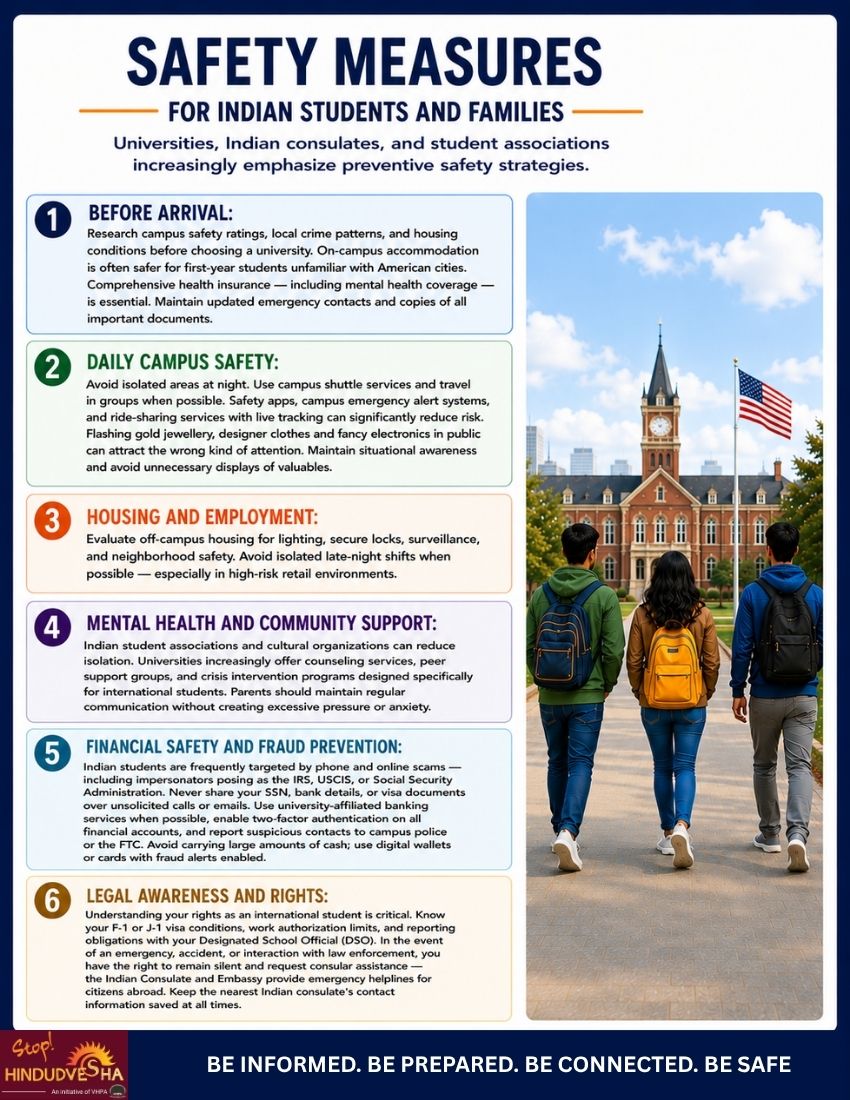
The broader picture is more complicated than the headlines suggest. The overwhelming majority of Indian students in the U.S. complete their degrees safely, form communities, build careers, and eventually become professors, entrepreneurs, engineers, physicians, and researchers. [17] Universities have expanded surveillance systems, emergency-alert infrastructure, counseling services, and campus policing in response to decades of nationwide shootings and student deaths. Indian consulates have become more proactive, issuing advisories and strengthening outreach to student associations.
Still, the recurring tragedies have forced a subtle recalibration of the immigrant imagination. The American dream no longer looks like a frictionless escalator to success. It looks instead like a negotiation — between opportunity and uncertainty, ambition and loneliness, freedom and exposure.
For Indian families, that realization can be difficult to absorb. Education abroad has long been imagined as a purely academic undertaking — a matter of rankings and resumes. But survival in another country, especially in parts of the U.S. where opportunity often coexists with crime, social disorder, and economic insecurity, also demands emotional resilience, street awareness, cultural adaptation, and the ability to navigate isolation without collapsing beneath it.
The story of Indian students in America is, therefore, not solely about victimhood or fear. It remains, fundamentally, a story about hope — millions of people still betting that knowledge can reorder destiny. But it is also a reminder that migration, even at its most aspirational, carries risk.
Sometimes the distance between a commencement ceremony and catastrophe is no greater than a lonely winter night, a wrong neighborhood, an untreated depression, or a stranger with a gun.
Citations
[1] Open Doors. “International Students: Key Findings.” Open Doors Data. https://opendoorsdata.org/annual-release/international-students/#key-findings
[2] Business Standard. “Indian Student Chandrashekar Pole Shot Dead in Texas, Hyderabad Family Awaits Repatriation.” Business Standard. https://www.business-standard.com/india-news/indian-student-chandrashekar-pole-shot-dead-texas-hyderabad-family-repatriation-125100500096_1.html
[3] Business Standard. “Indian Student Chandrashekar Pole Shot Dead in Texas, Suspect Arrested.” Business Standard. https://www.business-standard.com/india-news/indian-student-chandrashekar-pole-shot-dead-texas-suspect-arrested-125100700122_1.html
[4] The Indian Panorama. “Indian-Origin Student Killed by Homeless Man in Georgia.” The Indian Panorama. https://www.theindianpanorama.news/indian-origin-student-killed-by-homeless-man-in-georgia/indian-origin-student-killed-by-homeless-man-in-georgia/
[5] Purdue Exponent. “Neel Acharya Died of Asphyxia, Coroner Says.” Purdue Exponent. https://www.purdueexponent.org/campus/neel-acharya-died-of-asphyxia-coroner-says/article_7119f2b8-d7ed-11ee-8dfb-7f268439bd0f.html
[6] NDTV. “Akul Dhawan: What Cops Said on the Indian-Origin Student Who Froze to Death at University of Illinois Urbana-Champaign.” NDTV. https://www.ndtv.com/indians-abroad/akul-dhawan-what-cops-said-on-the-indian-origin-student-who-froze-to-death-in-us-university-of-illinois-urbana-champaign-5110911
[7] The Times of India. “A PIO Doctoral Student Found Dead, an IT Pupil Attacked in US.” The Times of India. https://timesofindia.indiatimes.com/world/us/a-pio-doctoral-student-found-dead-an-it-pupil-attacked-in-us/articleshow/107506847.cms
[8] The Indian Express. “Who Was Shreyas Reddy Benigeri, Indian-Origin Student Found Dead in Ohio?” The Indian Express. https://indianexpress.com/article/who-is/shreyas-reddy-benigeri-indian-origin-student-dead-ohio-9140383/
[9] The Indian Express. “Who Was Amarnath Ghosh, Indian Dancer Shot Dead in US?” The Indian Express. https://indianexpress.com/article/who-is/amarnath-ghosh-indian-dancer-shot-dead-us-9192083/
[10] BBC News. “Kansas Shooting: Indian Engineer Srinivas Kuchibhotla Killed in US Bar Attack.” BBC News. https://www.bbc.com/news/world-us-canada-39108060
[11] PBS NewsHour. “Kansas Man Sentenced to Life in Prison for 2017 Shooting That Targeted Indian Men.” PBS NewsHour. https://www.pbs.org/newshour/nation/kansas-man-sentenced-to-life-in-prison-for-2017-shooting-that-targeted-indian-men
[12] Embassy of India, Washington, D.C. “Archive Details.” Embassy of India, USA. https://indianembassyusa.gov.in/ArchivesDetails?id=809
[13] The Times of India. “Indian Student in US May Have Committed Suicide.” The Times of India. https://timesofindia.indiatimes.com/world/us/indian-student-in-us-may-have-committed-suicide/articleshow/2840841.cms
[14] WRAL News. “Student Killing Linked to Robbery Spree.” WRAL News. https://www.wral.com/news/local/asset_gallery/2619378/
[15] YouTube. “Video on Indian Students Living Off Campus in the U.S.” YouTube. https://www.youtube.com/watch?v=UZiMuJWgCF8
[16] Lucas Chancel et al. World Inequality Report 2022. World Inequality Lab, 2021. PDF. https://wir2022.wid.world/www-site/uploads/2021/12/WorldInequalityReport2022_Full_Report.pdf
[17] The Times of India. “Fewer Students Arrive, More Hang On: What U.S. Numbers and India’s Rise Tell Us About the American Dream.” The Times of India. https://timesofindia.indiatimes.com/education/news/fewer-students-arrive-more-hang-on-what-us-numbers-and-indias-rise-tell-us-about-american-dream/articleshow/125402646.cms

Donate to HINDUDVESHA
Our Mission is to explore and expose Hindudvesha through research analysis, education and response.
SUPPORT US