

Cheers in Iran, Tears in India: Why Indian Muslims Mourned an Islamic Tyrant While Iranians Celebrated
 Som Misha · 05/14/2026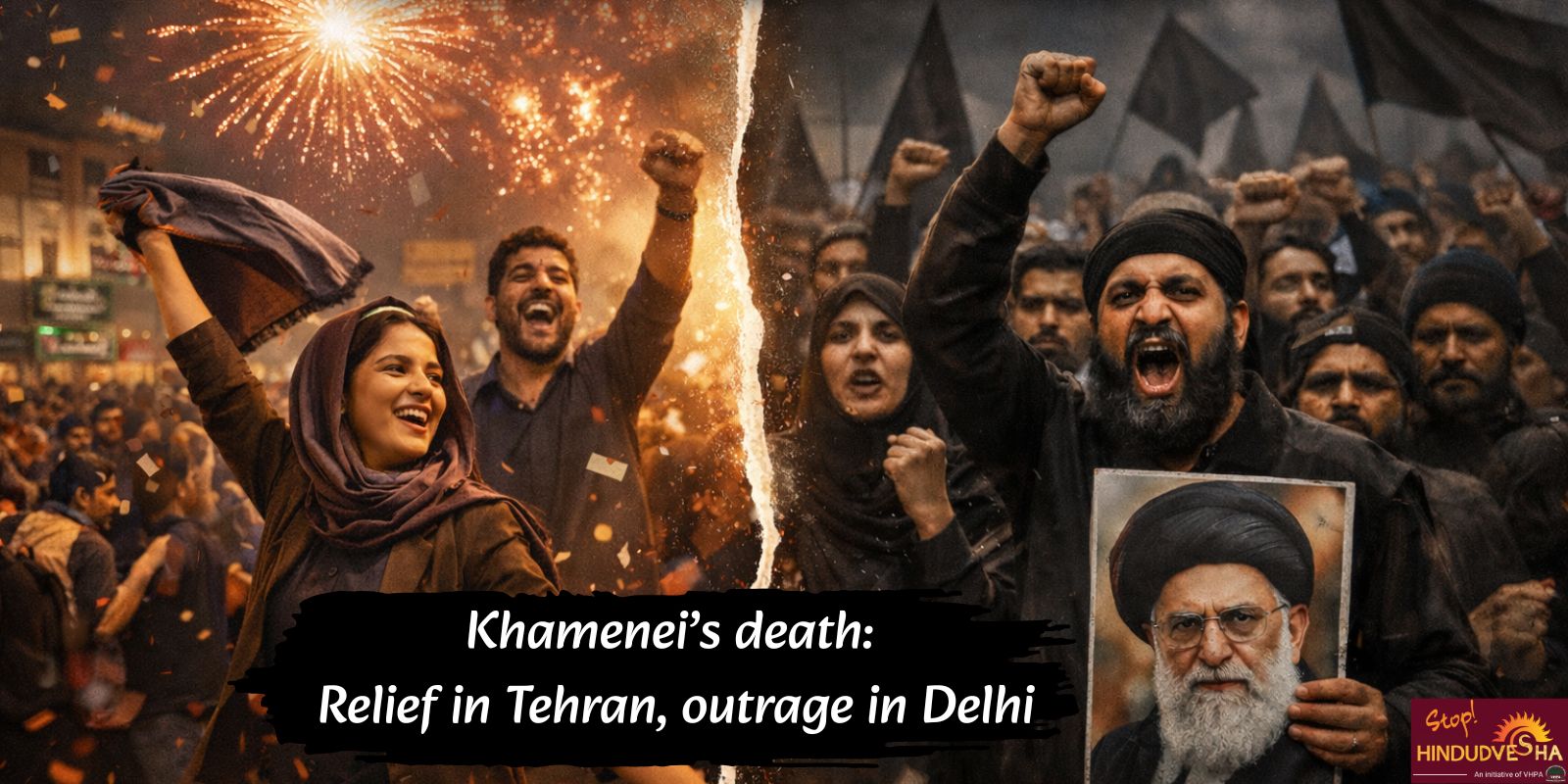
Summary
Iran’s streets erupted in celebration after Ayatollah Khamenei’s death, marking the fall of a repressive theocracy. Across much of the Arab world, governments responded with quiet relief and strategic calculation. In India, however, protests and mourning exposed a starkly different instinct. Sections of the Muslim community framed the event not through national interest, but as an attack on the global ummah, despite Iran’s consistent hostility toward India and alignment with Pakistan. This divergence is not incidental; it reflects a deeper mindset shaped by historical memory, minority insecurity, and enduring pan-Islamic identity. At a time when much of the Muslim world is moving toward pragmatic statecraft, parts of Indian Muslim discourse remain anchored in transnational loyalty, raising uncomfortable questions about integration, alignment, and the limits of democratic cohesion.
In the narrow lanes of Tehran’s Grand Bazaar and the sun-baked squares of Isfahan, footage that slipped past the regime’s internet blackout showed something unthinkable only weeks earlier: young Iranians dancing under fireworks, women tossing off compulsory headscarves, men shouting “Khamenei is dead — freedom at last!” [1] The Supreme Leader’s assassination in a joint American-Israeli strike on February 28, 2026, had not merely decapitated the Islamic Republic; for many inside Iran and across its vast diaspora, it felt like the final, long-delayed exhalation after decades of suffocation. Across cities including Karaj, Qazvin, Shiraz, Kermanshah, Isfahan, and Sanandaj, ordinary Iranians were dancing and celebrating. [2] “I’m crying, laughing, screaming and experiencing every feeling in the world in three seconds,” wrote an Iranian on social media. [3]
Half a world away, in the shadow of Delhi’s Jantar Mantar observatory, the scene was inverted. Thousands of Indian Shia Muslims gathered in black, waving portraits of Ayatollah Ali Khamenei, chanting “Death to America, death to Israel.” [4] Similar rallies erupted in Lucknow’s old city, Srinagar’s Budgam district, Hyderabad, Bhopal, and scores of smaller towns. An independent mapping effort documented demonstrations in more than 95 locations across the country in the first week alone. [5] Women in chadors vowed “martyrdom” for Iran; some publicly declared they would travel to fight if Prime Minister Narendra Modi would only grant them passports. All-India Muslim Personal Law Board leaders demanded UN intervention; former Jammu & Kashmir Chief Minister Mehbooba Mufti burned effigies of Donald Trump and Benjamin Netanyahu. [6]
Kashmiri Muslims, rallying to aid war-hit Iran, donated a massive Rs 600 crore in just two days. Contributions ranged from cash and cheques to gold ornaments, silverware, copper utensils, a tipper truck, motor bikes, and livestock. Women parted with treasured heirlooms, while children brought their piggy banks to collection centers. [7] To place that in perspective, there is no record of Kashmiris organizing similar donation drives for India during national emergencies.
Indian Muslims – More Islamic Than the Arabs
The contrast could hardly be starker. While large segments of the Iranian people — and, crucially, many Arab governments — viewed the strikes as a potential deliverance from a theocratic nightmare that had killed tens of thousands of its own citizens for the crime of wearing jeans or refusing the hijab, a significant slice of India’s Muslim minority treated Khamenei’s death as a personal and communal catastrophe. To understand this disconnect is to peer into the peculiar evolution of Indian Islam: a community shaped by minority status, historical memory, and an unusually resilient strain of pan-Islamic sentiment that persists even when the object of that sentiment has spent decades undermining India at the United Nations and cultivating Pakistan. [8]
The events of late February 2026 did not arise in a vacuum. Since December 2025, Iran has been convulsed by its largest anti-regime protests since 1979 — sparked by economic collapse, currency free-fall, and the regime’s brutal response. [9] Security forces killed thousands; the internet was blacked out; mass graves were dug. Khamenei’s death, delivered by precision American and Israeli munitions that also eliminated much of the Revolutionary Guard’s high command, arrived amid those protests like a match to dry tinder. Inside Iran, the reaction split along familiar lines: regime loyalists mourned a “martyr,” while ordinary citizens and the diaspora celebrated what they hoped was the beginning of the end. [10]
Response of India’s Muslim community revealed a different calculus. The protests were overwhelmingly — though not exclusively — Shia. India is home to roughly 40 million Shia Muslims, one of the largest concentrations outside Iran and Iraq. For many, Khamenei was not merely a foreign head of state but a Marja-e-Taqlid, a source of emulation whose religious authority transcended borders. In Lucknow, the historic center of Indian Shiism, condolence meetings turned into political rallies. In Kashmir’s Shia pockets, women marched in chadors chanting against “Zionist aggression.” Viral videos captured protesters in Delhi declaring, “If Modi allows, we will go fight for Iran.” [11]
Ummah vs India
The emotions of Indian Muslims sat uneasily with the cold geopolitical reality. Iran has repeatedly sided with Pakistan against India, particularly on Kashmir. [12] In 2019, after India revoked Article 370, Tehran’s parliament condemned the move; Khamenei himself repeatedly inserted himself into Indian domestic affairs. During the 2020 Delhi riots triggered by the Citizenship Amendment Act (CAA) — a law that fast-tracked citizenship for non-Muslim refugees from neighboring countries — Iran’s Supreme Leader tweeted that India must “confront extremist Hindus” or face “isolation from the world of Islam.” He later equated India’s treatment of Muslims with that of Gaza and Myanmar. Each time, India summoned Tehran’s ambassador and rejected the interference as unacceptable. [13]
Despite this record, Indian Muslim demonstrators framed the strikes as an attack on the ummah — the global Muslim community — rather than on a hostile foreign power. The disconnect is not merely emotional; it is structural. It reveals how, for segments of India’s second-largest majority, transnational religious solidarity can eclipse national interest and even personal safety.
Soft Corner for Iran
To grasp why, one must step back into the layered history of Indian Shiism. Lucknow’s Shia nawabs once maintained cultural ties to Safavid and Qajar Iran; seminaries in Qom still draw Kashmiri and Hyderabadi students. [14][14] Iranian soft power — resistance literature, satellite television, clerical networks — has cultivated a genuine ideological affinity. When Saudi Arabia executed Shia cleric Nimr al-Nimr in 2016, Indian Shias protested in large numbers. [15][15] The same networks became active after Khamenei’s death. Tehran has actively courted Indian Shia through scholarships, cultural centers, and, in some cases, more shadowy channels. [16] The result is a community that, in moments of crisis, prioritizes loyalty to a foreign theocrat over the democratic republic in which they live.
Pragmatic Arabs — No Tears for Tehran
This tendency stands in sharp contrast to the broader trajectory of the Muslim world outside the Indian Subcontinent. Across much of the Arab Middle East, the reaction to Khamenei’s killing and the subsequent Iranian retaliation was not mourning but strategic alignment against Tehran. Gulf Cooperation Council foreign ministers convened emergency meetings; Saudi Arabia, the UAE, Bahrain, Qatar, Kuwait, and Oman issued statements condemning Iran’s missile barrages on their territories — not the American and Israeli strikes that provoked them.
Riyadh offered “all its capabilities” to support its neighbors; the UAE withdrew its diplomatic mission from Tehran. The 22-nation Arab League denounced Iranian aggression as “a blatant violation of sovereignty.” No Gulf capital called for solidarity with the Islamic Republic; none invoked the ummah against the West. Instead, they quietly welcomed the weakening of a regime that had spent decades exporting revolution through proxies in Yemen, Syria, Lebanon, and Iraq. [17]
The deeper current is unmistakable. Since the Abraham Accords of 2020, a growing arc of Arab states has chosen pragmatic integration with Israel and the West over ideological confrontation. The UAE and Bahrain have built thriving economic and security partnerships with Jerusalem; Morocco and Sudan followed. By late 2025, Kazakhstan had formally joined the Accords, and Somaliland pledged to do so after Israel recognized its independence. Saudi Arabia, while still demanding progress on Palestine, has pursued Vision 2030 reforms — women driving, entertainment cities, reduced clerical power — that would have been unthinkable under the old pan-Islamic rubric. These governments calculate that prosperity and stability matter more than theological fealty to a Persian theocracy that has bankrupted its own people and destabilized the region.
Even in non-Arab Muslim-majority nations, national interest increasingly trumps abstract ummah solidarity. Turkey under Erdogan balances Islamist rhetoric with NATO membership and trade. Indonesia, the world’s largest Muslim democracy, maintains cordial ties with both Israel and the West while focusing on domestic development. Malaysia’s Islamist parties may rail against the “Zionist entity,” but the government prioritizes palm-oil exports and tech investment. The pattern is clear: outside India’s unique minority context, Muslim states are converging on a post-ideological realism. They want peace with Israel when it serves them, closer Western integration for capital and technology, and an end to Iranian adventurism.
Victimhood Syndrome Plus Islamic Hostility
India’s Muslims, however, live in a make-belief world shaped by history and identity. For many Indian Muslims, nurtured on the belief that they were masters of Delhi for a thousand years, the very idea of equality with Hindus seems unfair. Democracy is, therefore, unacceptable, and Hindu majority rule is un-Islamic and must be overthrown one day.
The CAA debates [18], the rebuilding of the Ram Temple in Ayodhya [19], and electoral majoritarianism have reinforced a narrative that the state is hostile. In such an environment, the transnational ummah can function as psychological armor: a larger imagined community that offers dignity and belonging when the nation appears to withhold it. Clerical networks and social media amplify this. When Khamenei criticized Indian policy, he was not seen as meddling but as defending the faithful. The same dynamic explains why protests against Israel’s actions in Gaza routinely dwarf domestic concerns about Muslim-on-Muslim violence in Syria, Yemen, or Pakistan.
Scholars have long debated whether this reflects genuine pan-Islamism or situational solidarity. While seculars claim most Indian Muslims overwhelmingly identify as Indian, reject violence, and support constitutional democracy, that argument is not backed by facts. On the contrary, Muslims in India — particularly in Shia pockets and among Sunni Deobandi and Barelvi networks — retain a stronger pull toward global Islamic causes. [20]
Ummah Above All
The concept of Ummah in Islam refers to the global community of believers, transcending national borders, ethnicity, and citizenship. Islamic doctrine emphasizes fraternity among Muslims as a religious duty, rooted in Quranic verses and Hadith that portray the Ummah as one body. [21] In countries where Muslims form a minority, this often manifests as a primary loyalty to the transnational Ummah over the host nation-state, creating tensions with secular integration.
In India, where Muslims account for about 15% of the population, this propensity is evident historically and sociologically. The 1947 Partition was driven by the two-nation theory, with the Muslim League demanding a separate homeland, Pakistan, reflecting prioritization of Islamic solidarity. Post-independence, many Indian Muslims retained strong emotional and political ties to Pakistan and the global Ummah. [22]
Pew Research (2021) found that 74 percent of Indian Muslims prefer access to Sharia-based courts for family matters alongside secular law, indicating a preference for Islamic norms over uniform civil codes. [23] Surveys and observations show higher endogamy rates, resistance to interfaith marriage (around 80 percent opposing it), and communal mobilization during riots or international Islamic issues, often framing local events through a victimhood lens tied to the Ummah. [24] These foster parallel societies, ghettoization, and dual loyalty — evident in lower identification with “Indian first” in some polls and occasional sympathy for pan-Islamic narratives over national security concerns (such as responses to terror incidents or border conflicts with Pakistan).
While some Muslims contribute loyally as citizens, the doctrinal pull of the Ummah — reinforced by madrasas, global media, and leaders invoking transnational brotherhood — frequently overrides assimilation. This pattern appears in other minority contexts (Europe, US), where polls show elevated support for Sharia and lower national prioritization. In secular democracies, it challenges social cohesion, as religious solidarity can eclipse constitutional patriotism.
The 2026 Iran protests crystallized this fault line. While most Indians noted Iran’s hypocrisy (its own brutal suppression of women, its support for Pakistan), Muslim discourse was dominated by mourning rallies and threats to Israel and America.
The Implications
The implications extend beyond optics. India’s strategic partnership with Israel — involving defense sales, intelligence sharing, and technology transfers — is one of its most valuable foreign-policy assets. Protests that frame American and Israeli actions as anti-Muslim aggression risk poisoning that relationship in the domestic arena. More profoundly, they raise questions about integration. A democracy cannot thrive if a significant community instinctively sides with a foreign theocracy that has consistently opposed national interests. The Iranian regime executed dissidents for “Western” dress, hanged homosexuals, and stoned adulterers — practices that would be crimes under Indian law. Yet segments of Indian Muslim opinion treated Ayatollah Khamenei’s death as a blow to Islam itself. [25]
This is not to paint 200 million citizens with one brush. The broader point is structural: pan-Islamic reflexes remain stronger in India than in much of the Arab or Southeast Asian Muslim world, where state power and economic self-interest have disciplined ideology.
History offers precedents. During the 1979 Iranian Revolution, Indian Shias celebrated the fanatic Ayatollah Khomeini’s rise; during the 1990s Kashmir insurgency, some looked to Tehran for inspiration. The 2026 episode repeats the pattern but in a changed regional landscape. The Islamic world is fragmenting along pragmatic lines. Gulf Arabs, once wary of Israel, now see Iran as the greater threat. Central Asian republics join secular frameworks created by the former Soviet Union. Even Pakistan, Tehran’s traditional partner, has had to navigate its own interests and is offering logistical help to the US in air strikes against Iran. Only among Muslims in India does the old transnational pull retain such visceral force.
What explains the anomaly? Demography and democracy interact in complex ways. As a minority, Indian Muslims lack the state power that disciplines ideology elsewhere. Partition’s legacy, the trauma of 1947, and subsequent communal riots have kept the ummah narrative alive as a defensive identity. Iranian clerical outreach has filled the vacuum created by India’s own secular political parties, which have deliberately prevented the integration of Muslims communities. Social media and Gulf-funded madrasas further globalize local grievances.
Conclusion – The Way Out
Yet the cost is real. When Indian Muslims mourn a leader who equated their country with Gaza and backed Pakistan on Kashmir, they hand ammunition to majoritarian voices who already question their loyalty. The cycle deepens alienation on both sides. The path forward is not more loyalty tests but honest reckoning: with the Iranian regime’s record, with the genuine theological attachments of Indian Muslims, and with the need for Indian Islam to evolve toward the pragmatic realism now visible from Abu Dhabi to Jakarta.
The fall of Khamenei may or may not topple the Islamic Republic; Iran’s future remains uncertain amid ongoing strikes and protests. What is certain is that the episode has exposed a fault line running through the world’s largest Muslim-minority democracy. For many Iranians, the tyrant’s death was liberation. For many Arabs, it was strategic relief. For a visible slice of Indian Muslims, it was mourning. That divergence is not merely geopolitical; it is civilizational. It asks whether faith can coexist with nationhood without one devouring the other.
Citations
[1] “Cheers in Iran as Crowds Celebrate After Strike on Supreme Leader,” CNN, February 28, 2026. https://edition.cnn.com/2026/02/28/world/video/cheers-iran-celebrations-khamenei-supreme-leader-strike-latam-intl
[2] “News,” Ukrainska Pravda, March 1, 2026. https://www.pravda.com.ua/eng/news/2026/03/01/8023317/
[3] “Iran News,” Iran International, February 28, 2026. https://www.iranintl.com/en/202602288551
[4] “News Article,” News.am. https://news.am/eng/news/933160.html
[5] “Video Clip,” YouTube. https://www.youtube.com/shorts/S2RinbNI6Co
[6] “Discussion Thread,” Reddit. https://www.reddit.com/r/IndiaSpeaks/comments/1rjmyn4/following_the_killing_of_irans_supreme_leader_ai/
[7] “Kashmir Rises in Solidarity, Donations for Iran Cross Rs 6000 Crore,” Republic World. https://www.republicworld.com/india/kashmir-rises-in-solidarity-valleys-donations-for-war-hit-iran-cross-rs-6000-crore
[8] “Shah of Iran, Pakistan Military Aid Wars: Documents,” The Indian Express. https://indianexpress.com/article/cities/chandigarh/shah-of-iran-pakistan-military-aid-wars-india-us-documents-10558800/
[9] “Why the Latest Iran Protests Started in the Tehran Bazaar,” Stimson Center, 2026. https://www.stimson.org/2026/why-the-latest-iran-protests-started-in-the-tehran-bazaar/
[10] “Iran Khamenei Celebrations,” The New York Times, February 28, 2026. https://www.nytimes.com/2026/02/28/world/middleeast/iran-khameni-celebrations.html
[11] “Why Ayatollah Ali Khamenei Was Important for Shia Muslims,” NDTV. https://www.ndtv.com/world-news/iran-israel-war-ayatollah-ali-khamenei-why-ayatollah-khamenei-was-so-important-for-shia-muslims-11162710
[12] “Khamenei’s Kashmir Remarks Draw Praise in Pakistan, Rebuke in India,” Middle East Institute. https://mei.edu/publication/khameneis-kashmir-remarks-draw-praise-pakistan-rebuke-india/
[13] “From CAA Criticism to Kashmir Remark: History That Frames India’s Silence,” The Times of India. https://timesofindia.indiatimes.com/india/from-caa-criticism-to-kashmir-remark-history-that-frames-indias-silence-over-khameneis-demise/articleshow/128966016.cms
[14] “Indian Students in Tehran Being Evacuated to Qom,” NDTV. https://www.ndtv.com/world-news/indian-students-in-tehran-being-evacuated-to-qom-amid-israel-iran-conflict-8681898
[15] “Shias Decry Execution of Cleric in Saudi Arabia,” The Hindu. https://www.thehindu.com/news/cities/Hyderabad/Shias-decry-execution-of-cleric-in-Saudi-Arabia/article13979541.ece
[16] “Iran’s Influence Among Shia Communities in India and South Asia Remains Undiminished,” South Asia Monitor. https://southasiamonitor.org/spotlight/irans-influence-among-shia-communities-india-south-asia-remains-undiminished
[17] “Gulf States Tell US Ending War Is Not Enough,” Reuters, March 27, 2026. https://www.reuters.com/world/middle-east/gulf-states-tell-us-ending-war-is-not-enough-irans-capabilities-must-be-degraded-2026-03-27/
[18] “CAA: The Act Preserving Pluralism,” Swarajya. https://swarajyamag.com/ideas/caa-the-act-preserving-pluralism-defending-diversity-and-ensuring-equality
[19] “Press Release,” Press Information Bureau. https://www.pib.gov.in/PressReleasePage.aspx?PRID=2193420®=3&lang=2
[20] “The Truth About Muslim Alienation in India,” Swarajya. https://swarajyamag.com/politics/the-truth-about-muslim-alienation-in-india-its-partly-a-self-inflicted-wound
[21] “The Concept of Ummah: Unity, Significance, and Iqbal’s Vision,” Academia.edu. https://www.academia.edu/127724490/The_Concept_of_Ummah_Unity_Significance_and_Iqbals_Vision_Islamic_World_View_and_Civilization
[22] “Indian Muslim Leaves for Pakistan, Does Not Want to Return,” OpIndia. https://opindia.com/2023/09/indian-muslims-harbour-deep-love-for-pakistan-mohammad-hasnain-who-left-for-pakistan-with-his-son-doesnt-want-to-return/
[23] “80% of Muslims in India Do Not Want Their Women to Marry Non-Muslims,” OpIndia. https://www.opindia.com/2021/06/80-of-muslims-in-india-do-not-want-their-women-to-marry-non-muslims-pew-research/
[24] “Religion in India: Tolerance and Segregation,” Pew Research Center, June 29, 2021. https://www.pewresearch.org/religion/2021/06/29/religion-in-india-tolerance-and-segregation/
[25] “Indian Shia Muslims Protest Against Khamenei’s Death,” Middle East Forum. https://www.meforum.org/mef-observer/indian-shia-muslims-protest-against-khamaneis-death

Donate to HINDUDVESHA
Our Mission is to explore and expose Hindudvesha through research analysis, education and response.
SUPPORT US