

The Silencing of Deepa Karthik—and the Collapse of Equal Protection
 Dr. Jai G. Bansal · 04/25/2026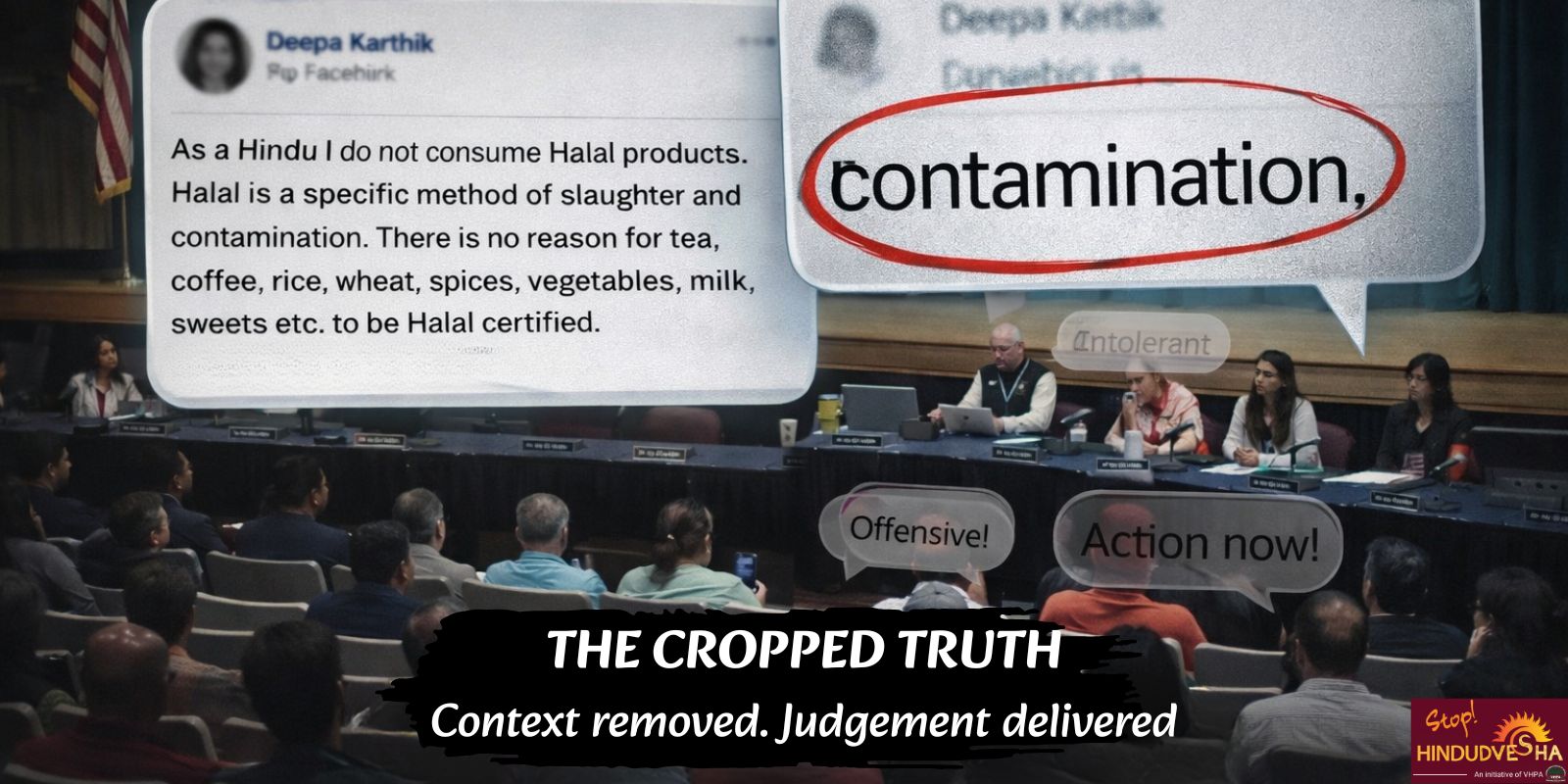
Summary
Deepa Karthik, a Hindu woman and elected school board vice president in New Jersey, faced institutional sanction after expressing a personal religious view on halal-certified products. Her statement, made in a private capacity, was stripped of context, amplified through coordinated pressure, and recast as a public offense. The school board responded not with due process, but with rapid disciplinary action, shaped by selective consultation that excluded Hindu voices. In contrast, established legal precedent in similar cases has consistently protected such personal expression. The disparity reveals a troubling pattern: civil rights protections are applied unevenly, contingent on pressure and identity rather than principle. Karthik’s case underscores the erosion of procedural fairness and raises urgent questions about equal citizenship in practice.
An individual expressing a personal opinion should not be turned into the center of a public controversy that invites organized pressure, institutional capitulation, and lasting personal consequences. Yet that is precisely what unfolded in the case of Deepa Karthik, a well-respected Hindu woman and an elected member serving as Vice President of a Board of Education in New Jersey.
Her experience raises uncomfortable questions about a system that claims to protect individual freedom, pluralism, and equal citizenship. When a personal expression of religious conscience is recast as a public offense and met with a punitive response, the issue extends beyond one individual. It becomes a test of whether constitutional protections are applied consistently, or whether certain beliefs are more easily subjected to institutional sanction.
In a functioning democracy, personal belief should not disqualify individuals from public service, nor should it invite retaliation. The Karthik episode instead reveals how quickly that principle can give way under pressure, and what that erosion means for the credibility of equal rights in a society that professes to uphold them.
The Crime of Belief: How a Personal Dietary Choice Sparked Institutional Fallout
In May 2025, Deepa Karthik shared a brief post on her personal Facebook account explaining why, as a Hindu, she chose not to consume halal-certified products.
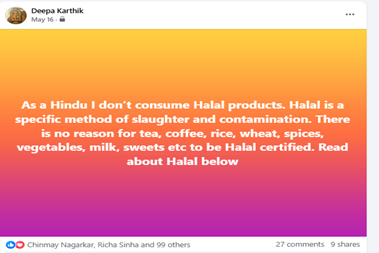 The substance of her post, often cited but rarely presented in full, is central to understanding the controversy:
“As a Hindu, I do not consume Halal products. Halal is a specific method of slaughter and contamination. There is no reason for tea, coffee, rice, wheat, spices, vegetables, milk, sweets, etc. to be Halal certified. Read about Halal below.”
The post did not accuse any community of wrongdoing, call for restrictions, or advocate exclusion. It was framed around her own practices and reservations. However, the context was quickly lost. A single word, “contamination”, was isolated and interpreted in the harshest possible light, while her broader reasoning and personal framing were largely ignored.
In response to the intense backlash, Karthik issued a public apology, clarified her intent, and reaffirmed her respect for Islamic beliefs. Yet these efforts did little to alter the trajectory of the controversy. A personal expression of conscience had already been recast as a public offense, setting the stage for escalating demands for accountability.
The Making of a Public Villain—or How Narratives Are Manufactured
What began as a limited personal statement quickly spiraled into a full-scale public controversy. As Karthik’s post moved beyond its original audience, screenshots spread rapidly across social media and community forums—stripped of context, detached from her explanation, and recirculated in their most inflammatory form.
These fragments were quickly weaponized. Accusatory commentary framed her words as evidence of intolerance, reducing a nuanced, personal expression to a single charged term —“contamination.” Its religious or technical meaning was ignored. Within days, this narrow and hostile interpretation came to dominate the public narrative, crowding out nuance, intent, and even her own voice.
The transformation was swift and unforgiving. What followed was, in effect, a virtual lynching—an intense, collective piling-on in which a single interpretation was amplified, repeated, and hardened into accepted truth. A statement about personal religious practice was recast as a public accusation against an entire community. Once this framing took hold, it became nearly impossible to dislodge. Her clarification and apology struggled to break through a narrative that had already taken on a life of its own.
In this environment, intent ceased to matter. Meaning was no longer derived from what was said, but from how it was portrayed. What Karthik had expressed as an individual choice rooted in faith was widely received as an act of hostility, setting the stage for organized outrage and institutional response.
This selective interpretation becomes even more striking in light of the fact that the American Halal Foundation itself has published guidance discussing “cross-contamination” in halal certification. [1] Yet no such contextual reading was extended to Karthik’s use of the same term. The word was not examined—it was assigned its most damaging meaning.
From Public Outrage to Organized Pressure
As the narrative took hold, the response quickly moved beyond online commentary into organized public mobilization. What initially appeared as spontaneous criticism hardened into a coordinated campaign—petitions, formal complaints, and sustained pressure directed at the school district.
This organized offensive did not emerge spontaneously; it originated within segments of local Muslim community groups and was amplified by advocacy organizations that helped consolidate and enforce a singular, adverse framing of Karthik’s remarks. Petitions were circulated, complaints were filed in quick succession, and coordinated outreach targeted both the Board and Karthik personally, ensuring that the pressure remained constant and unrelenting.
Online spaces mirrored this escalation. Comment sections filled with hostile language, and moral labels were repeatedly affixed to her name, often without any engagement with her explanation or apology. Public meetings grew increasingly tense and confrontational, with organized speakers pressing for visible punishment, turning deliberative forums into arenas of accusation.
What emerged was not mere criticism, but a sustained campaign of pressure—an extension of the earlier virtual lynching into formal institutional spaces. A localized issue was transformed into a relentless drive for punitive action. The focus shifted entirely from understanding the original statement to enforcing consequences under a narrative that had already hardened, leaving little room for dialogue, context, or reconsideration.
Institutional Capitulation and the Silencing of Hindu Voices
As pressure intensified, the South Brunswick Board of Education convened what it described as an “emergency” meeting to adjudicate the matter. Rather than upholding the distinction between personal expression and official duties, the Board moved swiftly to distance itself from Deepa Karthik—formally chastising her and removing her from Board committees under the vague justification of “loss of confidence.”
Board President Laura Hernandez maintained that multiple meetings had been held with community members to review concerns and consider responses. These discussions were presented as evidence of a deliberative process. In reality, the outcome suggests something far more troubling. A visible, symbolic sanction was imposed without a clearly articulated procedural framework—less the result of principled judgment than a clear surrender to a consolidated and aggressively enforced public narrative.
Even more telling was who was included in that process—and who was not. Engagement appears to have been limited to representatives of local Muslim organizations and allied advocacy groups, with no comparable outreach to Hindu parents or community leaders, despite their direct stake in the controversy. A Hindu woman was publicly censured for a faith-based expression, yet Hindu voices were effectively absent from the process.
The claim of “public confidence” was thus constructed through consultation with one constituency, while another was excluded entirely. This selective process allowed one perspective to define both the problem and the acceptable outcome.
What unfolded was not simply an institutional response—it set a precedent. When consultation is selective, decisions are shaped by pressure, and consequences extend beyond the original forum, governance itself is compromised. In this case, institutional surrender did not contain the damage—it accelerated it.
From Public Office to Private Life: The Hounding Intensifies
The consequences of this exclusion did not remain confined to the Board. As the institutional response took shape, the focus of pressure expanded beyond Karthik’s public role into her professional life.
Activists began contacting her employer, circulating screenshots of her post, and framing her as a reputational risk. What followed was not an isolated disciplinary action, but a widening campaign of hounding. According to Karthik’s public statements, these efforts triggered internal reviews and sustained scrutiny, placing her career under continuing uncertainty.
This chain of events has now triggered formal legal scrutiny. The Foundation Against Intolerance and Racism (FAIR) has independently filed a complaint with the U.S. Department of Education’s Office for Civil Rights, alleging violations of Karthik’s civil rights and religious freedom.[2] The complaint argues that the Board’s actions amounted to discriminatory treatment and a failure to uphold constitutional protections. What began as a local controversy has now entered the domain of federal civil rights review.
When Clear Legal Precedent Meets Selective Enforcement
The response to Karthik’s case stands in contrast to how similar issues have been treated under established legal and ethical standards in New Jersey. Decisions of the School Ethics Commission provide a clear benchmark for evaluating when a board member’s speech constitutes an ethical violation.
In Stephanie Siegel v. Sahar Aziz (A-1445-23)[3], Stephanie Siegel filed a complaint against Sahar Aziz, a school board member who had made social media posts accusing Israel of apartheid and Zionist aggression. Despite objections from community members, the Westfield Board of Education did not take disciplinary action. Siegel then brought the matter before the School Ethics Commission. Aziz, a Muslim and a law professor at Rutgers University who teaches subjects such as Islam, secularism, human rights, race, religion, and Critical Race Theory, argued that her statements were made in a personal capacity. The Commission ultimately found her not guilty, concluding that although her remarks were controversial and may have been perceived as offensive or hurtful to members of the Jewish community, they did not relate to the business or operations of the Board. The Commission also found no sufficient connection between her social media activity or academic work and her role as a board member.
A similar pattern appeared in Elisabeth Schwartz v. Fahim Abedrabbo and Feras Awwad (C40-21)[4] involving the Clifton Board of Education in Passaic County. In this case, Fahim Abedrabbo and Feras Awwad made statements during a May 2021 school board meeting that were described as antisemitic. Despite complaints from community members, the Clifton Board of Education did not take action. Elisabeth Schwartz, a parent in the district, filed a complaint with the School Ethics Commission. Here too, the Commission found the respondents not guilty. It acknowledged that the statements could be considered hurtful by some but held that this alone did not constitute a violation of the New Jersey School Ethics Act. The Commission emphasized that existing district policy permits board members to express personal views on any matter, provided they clarify that such opinions do not represent the Board as a whole.
It is against the backdrop of these two rulings that the treatment of Deepa Karthik cannot be credibly defended. The same institutional restraint, the same reliance on established legal principles, and the same tolerance for personal expression were notably absent. Instead of allowing the matter to be assessed under existing standards, the South Brunswick Board moved swiftly to impose punishment.
This divergence exposes a deeper problem: ethical standards are not being applied consistently. Instead, their application becomes contingent contingent—shaped less by principle and more by the intensity of public pressure and the religious identity of the speaker. The standard did not change. Its application did.
When Principles Collapse Under Pressure
The Karthik episode lays bare a failure in the core principles meant to guide public institutions.
Due process was not merely weakened—it was bypassed. No meaningful investigation preceded the Board’s decision, and there is little evidence of structured fact-finding or balanced evaluation.
Viewpoint neutrality was abandoned. A personal expression of religious conscience, unrelated to official duties, was treated as misconduct.
Pluralism was applied selectively. Intense mob pressure from unidentified Muslim groups drove decisive action, while Hindu perspectives were effectively excluded from deliberation.
Institutional decision-making did not follow principle; it followed pressure. When organized campaigns dictate outcomes in the absence of procedural rigor, governance loses credibility and begins to reflect coercion rather than fairness.
Structural Vulnerability of Hindu Americans
Karthik’s experience reflects a broader structural vulnerability faced by Hindu Americans in public life. Unlike other communities, they lack a well-resourced national civil rights infrastructure capable of responding quickly to coordinated pressure. Without organized legal and advocacy support, individuals confronting such situations often do so in isolation.
Civil rights protections do not operate automatically; they depend on timely enforcement. When institutional support is weak or absent, informal pressure can become an effective tool of exclusion.
This vulnerability is reinforced by a persistent imbalance in contemporary diversity discourse. Hindu Americans are often described as a “model minority,” a label that conveys success while obscuring exposure to bias. It fosters the assumption that discrimination is minimal and institutional attention unnecessary.
Cultural unfamiliarity further deepens this gap. In Karthik’s case, her religious reasoning was not examined within its ethical context but was reframed as hostility. Institutional responses reflected this asymmetry, with one set of concerns treated as decisive while Hindu perspectives remained largely absent.
Gender added another layer of complexity. Hindu women in public roles often face heightened scrutiny, with limited tolerance for visible religious difference and limited institutional backing when controversies arise.
Taken together, these factors reveal a system of uneven pluralism in practice. Recognition may be broad, but protection remains inconsistent.
Rights Require Defense: Hindus Must Build Legal Protection
The Deepa Karthik case exposes not just individual vulnerability, but a systemic failure of preparedness. Civil liberties do not sustain themselves on principle alone—they must be defended. In the absence of organized defense, they are easily eroded by coordinated pressure and institutional expediency.
Legal readiness is not optional; it is the first line of defense. Immediate access to experienced civil rights and employment counsel can halt unjust action before it hardens into irreversible damage. Legal defense funds, standing counsel, and disciplined documentation do more than respond to violations—they deter them.
Fragmented responses are no longer sufficient. Organized advocacy must be deliberate and sustained. Coordinated public statements, consistent media engagement, and rapid factual correction are essential to prevent distorted narratives from taking hold. In high-pressure environments, silence is not neutral—it is surrender.
Professional support networks must also be built with intent. Connections with HR specialists, compliance experts, and industry leaders can counter improper employer action and limit the spread of reputational harm.
Equally important is control of the message. Clear, disciplined communication grounded in constitutional principles carries weight; reactive or scattered responses do not.
Above all, solidarity must move beyond sentiment to structure. Legal backing, financial support, and visible public affirmation change the cost calculus for those who rely on pressure tactics.
Civil rights endure only when they are actively defended. Without infrastructure, they remain theoretical—present in law but absent in practice. Without organized defense, rights are not lost—they are selectively applied.
Conclusion: The Larger Principle
Deepa Karthik’s case is not an isolated dispute. It is a revealing instance of how a public servant’s personal expression of religious conscience can trigger institutional sanction and professional exposure.
She did not incite hatred, misuse her office, or target any community. Yet under sustained pressure and a rapid, unguarded response, her standing was actively diminished and her ability to participate on equal terms was effectively curtailed.
The principle at stake extends far beyond this case. A system that conditions participation in public life on the acceptability of one’s beliefs does not preserve pluralism—it steadily contracts it.
Defending such cases is not about group alignment; it is about maintaining constitutional integrity. When personal conscience can be penalized without clear procedural grounding, equal citizenship ceases to be a guarantee and becomes conditional on prevailing pressures rather than being guaranteed by law.
Citations
[1] American Halal Foundation. “Cross-Contamination in Halal Certification.” https://halalfoundation.org/cross-contamination-in-halal-certification/
[2] Foundation Against Intolerance and Racism. “OCR Complaint Against South Brunswick Education Board.” November 18, 2025. https://www.fairforall.org/ocr-complaint-against-south-brunswick-education-board/
[3] Stephanie Siegel vs. Sahar Aziz et al:: 2025:: New Jersey Superior Court, Appellate Division – Unpublished Opinions Decisions:: New Jersey Case Law:: New Jersey Law:: U.S. Law:: Justia; https://law.justia.com/cases/new-jersey/appellate-division-unpublished/2025/a-1445-23.html
[4] Schwartz v. Abedrabbo | No. A-2006-21 | N.J. Super. | Judgment | Law | CaseMine; https://www.casemine.com/judgement/us/652230b42cec034620af71b5

Donate to HINDUDVESHA
Our Mission is to explore and expose Hindudvesha through research analysis, education and response.
SUPPORT US