

Decoding Institutional Apathy: How Anti-Hindu Violence Is Erased, Reframed, and Ignored
 Rati Agnihotri · 05/17/2026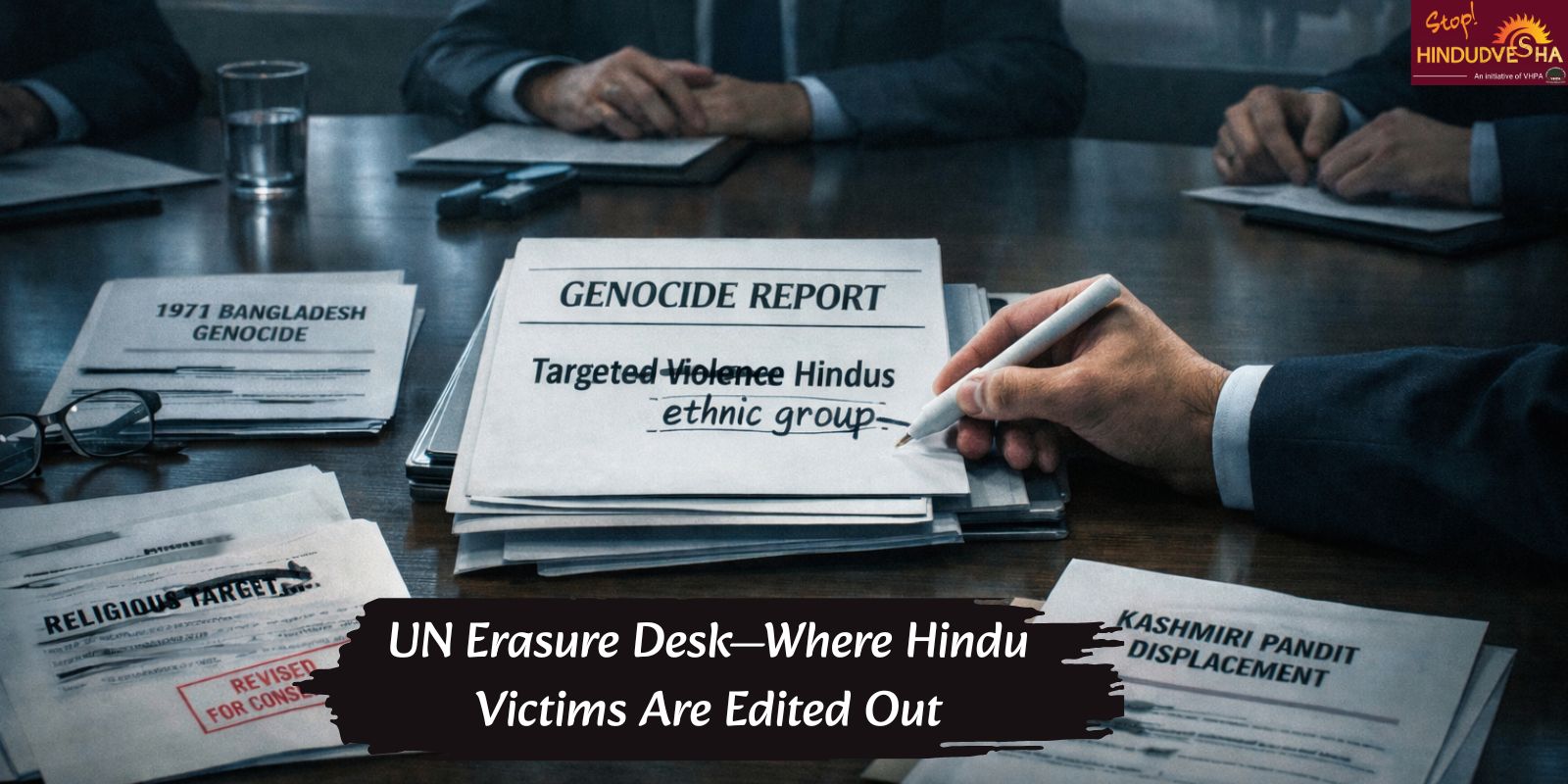
Summary
Hinduphobia is not sustained by isolated incidents but normalized through layered processes of violence, narrative distortion, and institutional neglect. While anti-Hindu hate crimes are increasingly visible, the deeper issue lies in the systematic failure to recognize historically documented atrocities such as the 1971 Bangladesh genocide and the ethnic cleansing of Kashmiri Pandits. These events are frequently reframed or diluted, obscuring clear patterns of ideologically driven targeting. Simultaneously, dominant global narratives—shaped by geopolitical considerations and ideological frameworks—often preclude Hindu victimhood, resulting in selective recognition within human rights discourse. This convergence of narrative exclusion and institutional apathy perpetuates a cycle of invisibility. Breaking this cycle requires formal recognition, legal accountability, and sustained policy commitment to ensure that anti-Hindu violence is neither obscured nor repeated.
Hinduphobia is normalized through multiple, reinforcing layers. The most visible of these is the rise in anti-Hindu hate crimes, including attacks on temples, desecration of moortis, the persecution of Hindu minorities in countries such as Bangladesh and Pakistan, and the growing profiling of Hindu diaspora communities in the West through ideologically driven narratives and caste-linked legal frameworks.
Beneath this surface, however, lies a more complex and less acknowledged reality. Hinduphobia is not merely incidental; it is sustained through sophisticated narrative constructions and institutional indifference that operate with far greater long-term impact. These deeper layers shape perception, policy, and legitimacy in ways that systematically obscure Hindu victimhood while reinforcing its marginalization.
A central feature of this dynamic is the persistent absence of institutional recognition of well-documented historical episodes of anti-Hindu violence. Despite their scale and severity, events such as the 1971 Bangladesh genocide and the ethnic cleansing of Kashmiri Pandits in the 1990s remain inadequately acknowledged in global forums. This asymmetry stands in sharp contrast to the formal recognition extended to other forms of religious discrimination, revealing a pattern of selective moral attention.
Such omissions are not neutral. They influence policy frameworks, shape human rights discourse, and create conditions in which Hindu concerns are persistently sidelined. In this context, recent legislative efforts in the United States to recognize the 1971 genocide may signal an important, though still uncertain, shift toward acknowledgment and accountability.
1971 Bangladesh Genocide: A Classic Case of Anti-Hindu Apathy
The 1971 Bangladesh genocide stands as one of the most devastating episodes of mass violence in the twentieth century, comparable in scale and brutality to the Holocaust and the Rwandan genocide. Initiated on March 25, 1971, the Pakistan army’s military campaign was not merely an attempt to suppress political dissent but a systematic operation that combined ethnic repression with deliberate, identity-based targeting of Hindus. Contemporary documentation leaves little ambiguity about this intent. In a report published in The Sunday Times on June 13, 1971, journalist Anthony Mascarenhas described how Hindus were hunted from door to door and village to village, and “shot off-hand after a cursory ‘short-arm inspection’ showed they were uncircumcised”. [1]
Over a period of nearly nine months, the scale and brutality of the violence reached staggering proportions. Approximately three million Bengalis were killed, with estimates indicating that nearly seventy percent of the victims were Hindus. The campaign was not limited to killings; it also involved systematic and organized sexual violence on an unprecedented scale. Reports suggest that as many as 600,000 Bengali women were raped. Disturbing accounts describe practices such as the alleged fixing of rape quotas by military commanders and the screening of explicit material to incite troops. Further documentation points to the existence of rape camps where abducted women were held in barracks for extended periods and subjected to repeated assault. [2] [3]
Despite the overwhelming body of evidence documenting both the scale and the targeted nature of the violence, the 1971 Bangladesh genocide has not received formal recognition from the United Nations or most national governments. Even where recognition has been extended by certain institutions[4], the framing often dilutes the specificity of the violence. For instance, statements have attributed the genocide broadly to “the perception of Bengalis as a different ethnic, religious, and national group,” thereby subsuming the explicit anti-Hindu targeting within a generalized narrative. A similar pattern is evident in the response of academic bodies such as the International Association of Genocide Scholars, which acknowledge the genocide but interpret it primarily through an ethnic lens, largely overlooking the systematic identification and elimination of Hindus. [5]
Such framing is not merely incomplete; it reshapes the historical record in ways that obscure intent and weaken accountability. By subsuming ideologically driven persecution within broader categories, institutional narratives risk normalizing omission and creating a precedent where targeted communal violence is rendered invisible within global discourse. This dilution also disconnects contemporary patterns of anti-Hindu violence from their historical roots, limiting both understanding and response.
Recent developments, however, suggest the possibility of a corrective shift. Congressman Greg Landsman has introduced a resolution in the United States House of Representatives seeking formal recognition of the 1971 Bangladesh genocide and calling for accountability for those responsible, including the Pakistan army and Jamaat-e-Islami. Significantly, the resolution explicitly acknowledges that while Bengalis of all faiths were targeted, the Hindu community was singled out for extermination through gangrape, forced conversions, mass killings, and expulsion. This explicit recognition marks a departure from earlier institutional formulations that tended to obscure or generalize the nature of the violence. [6] [7]
The resolution further emphasizes the extensive documentation of the genocide by journalists, diplomats, and international observers, underscoring that formal recognition is long overdue. Advocacy organizations have welcomed this development, arguing that acknowledgment is essential not only for historical justice but also for establishing safeguards against future atrocities. Importantly, the resolution also maintains a balanced position by rejecting collective blame against any ethnic or religious group, thereby reinforcing the principle of accountability without generalization. [8] [9]
Parallel political developments within Bangladesh add another dimension to this evolving discourse. Prime Minister Tarique Rahman has described the events of March 25, 1971, as “one of the most heinous genocides in history” and characterized them as a pre-planned massacre carried out under Operation Searchlight.[10] His unequivocal condemnation marks a notable departure from earlier responses that were often perceived as muted or evasive. Rahman has also pledged to ensure safety for citizens of all faiths, signaling a potential shift toward greater acknowledgment of minority concerns.
Taken together, these developments indicate a growing, though still incomplete, recognition of the need to revisit the historical narrative of the 1971 genocide with greater precision. The combination of legislative initiatives abroad and political acknowledgment in Bangladesh creates an opportunity for renewed advocacy to secure broader institutional recognition. Ultimately, such recognition is not merely about historical memory; it is foundational to establishing accountability, shaping global human rights discourse, and ensuring that the ideologically driven targeting of Hindus is neither obscured nor repeated.
Kashmiri Pandits: Ethnic Cleansing Recast as Exodus
The ethnic cleansing of Kashmiri Pandits in the 1990s remains one of the most disturbing and insufficiently acknowledged episodes in modern Indian history. For years, it remained largely absent from mainstream discourse, overshadowed by rhetorical constructs such as “Ganga Jamuni Tehzeeb” and “Kashmiriyat Jamhooriyat Insaniyat,” which masked the lived realities of the victims. Even today, its characterization reflects a pattern of narrative dilution. The violence is routinely described as “exodus” or “displacement,” terminology that minimizes its severity and obscures the role of ideologically driven Islamist militancy in orchestrating targeted anti-Hindu violence against the Pandit community.
A closer examination reveals a far more systematic reality. Between 1989 and 1991, an estimated 350,000 Kashmiri Pandits were driven out, with hundreds killed on the basis of religious identity. Documented accounts detail torture killings, destruction, and occupation of over 20,000 homes, attacks on educational institutions, and widespread looting of businesses and temples. [11]
The publication ikashmir.net presents a stark account of the scale of violence inflicted on the Kashmiri Pandit community during the 1990 exodus. According to its factsheet, at least 1,100 Kashmiri Pandits were victims of torture killings. More than 20,000 houses were burnt, over 105 educational institutions were destroyed, damaged, or forcibly occupied, and at least 14,000 business establishments were looted, burnt, or seized. In addition, more than 100 Hindu religious and cultural institutions were attacked or destroyed, reflecting the breadth and intensity of the violence.[12]
The ethnic cleansing extended far beyond immediate killings or displacement. A sustained climate of terror was created through cycles of rape, torture, forced religious conversions, intimidation, and psychological coercion. The objective was not merely to displace but to ensure that return became unviable. Decades later, the Kashmiri Pandit community remains dispersed across India, with many still living in camp-like conditions. Despite the magnitude and targeted nature of the violence, it remains unrecognized at the institutional level, leaving the community in a perpetual limbo.
The same publication also documents the brutality and inhuman methods employed by militants in targeting the community, underscoring the systematic nature of the violence. [13]
In March 2026, the displacement of Kashmiri Pandits was raised at the 61st session of the United Nations Human Rights Council in Geneva through a submission by the Jammu and Kashmiri Organization for Human Rights (JKHCR). The submission proposed “the return of families to their original localities and seeks to promote reintegration into the traditional social fabric of Kashmir.” [14]
This position was strongly rejected by Youth 4 Panun Kashmir (Y4PK), which termed the submission misleading and an attempt to whitewash the ethnic cleansing. Based in the UK, JKHCR has been criticized, including in reports by The Organiser, for affiliations with groups holding anti-India positions and for framing Kashmir as “Indian occupied Kashmir.” Critics argue that such narratives recast the forced exodus through the lens of “reconciliation,” thereby diluting the historical reality of targeted violence. [15] [16]
The Kashmiri Pandit genocide remains unrecognized by the United Nations, and attempts by motivated groups to raise the issue in international forums through distorted framing risk setting a dangerous precedent. Such efforts contribute to the institutional whitewashing of the targeted anti-Hindu nature of the ethnic cleansing. The Indian government and various Kashmiri Pandit organizations have repeatedly raised the issue across global platforms, including UN-linked forums, yet the international community has largely refrained from formally recognizing the Kashmiri Hindu genocide.
While the exodus of Kashmiri Pandits remains marginal in global policy discourse, the Kashmir issue is often framed through narratives emphasizing alleged oppression of Kashmiri Muslims. A 2019 report by the Office of the United Nations High Commissioner for Human Rights (OHCHR) [17] cited abuses by state and non-state actors across both Indian- and Pakistan-administered regions. The Indian government rejected the report, describing it as selective and as overlooking the role of cross-border terrorism.
The reluctance of international human rights bodies to initiate a substantive discussion on the Kashmiri Pandit genocide, combined with their readiness to amplify contested narratives, risks reinforcing positions that may be leveraged by Pakistan-backed militant networks targeting Hindus and India.
In January 2025, a motion introduced in the United Kingdom Parliament by MP Bob Blackman marked the 35th anniversary of the exodus. Titled “Commemoration of the 35th anniversary of the genocide of Kashmiri Pandit Hindus from Jammu and Kashmir in India,” it referred to “coordinated attacks by cross-border Islamic terrorists and their supporters on the minority Hindu population of Kashmir valley.” The motion urged recognition of January 19 as “Kashmiri Pandit Exodus Day” and called for consideration of the Panun Kashmir Genocide Crime Prevention and Atrocities Prevention Bill. [18]
Similar motions have been introduced earlier as well. However, persistent apathy toward Hindu issues, combined with entrenched geopolitical and ideological influences, has limited their impact in driving concrete policy change globally.
Woke Frameworks and the Erasure of Hindu Victims
The “woke” ecosystem positions itself as a defender of marginalized and subaltern groups, grounding its politics in progressive rhetoric and representation. Yet, this framework reveals a consistent blind spot when it comes to the marginalization of Hindu communities. Much of this discourse is built around portraying Hindus as archetypal oppressors through caste-based frameworks and narratives of “Hindu majoritarianism” and “Hindutva fascism.” Within such a construct, acknowledging Hindus as victims creates a clear narrative dissonance. As a result, Hindu victimhood is not merely overlooked but often excluded from legitimate discourse.
In her article, “Narrative Injustice and the Legal Erasure of Indigeneity: A TWAIL Reframing of the Kashmiri Pandit Case in Postcolonial International Law,” Shilpi Pandey argues that despite meeting the criteria under the United Nations Declaration on the Rights of Indigenous Peoples (UNDRIP) and the Guiding Principles on Internal Displacement, Kashmiri Pandits remain unrecognized as either internally displaced or indigenous. The article further establishes that categories of protection in international law are not applied neutrally but selectively, prioritizing political compatibility over legal principle. It “calls for renewed engagement with epistemic justice and narrative accountability in rethinking indigeneity and displacement in postcolonial contexts.” [19]
At a broader level, prevailing narratives around secularism and minority oppression in India—often shaped by selective emphasis on isolated incidents—contribute to a geopolitical climate where raising concerns about anti-Hindu violence risks being framed as Islamophobia. This creates a structural disincentive for institutional recognition, pushing the issue to the margins of global human rights discourse and policy frameworks.
Even within India, formal acknowledgment has remained limited. In 1995, the National Human Rights Commission (NHRC) described the Kashmiri Pandit exodus as “akin to genocide,” yet more than 200 First Information Reports filed by the community remain unresolved. Official policy continues to classify Kashmiri Pandits as “migrants” rather than internally displaced persons, reflecting a broader hesitation to adopt explicit recognition frameworks. [20]
The continued targeting of Hindu minorities in Bangladesh—through attacks on festivals, vandalization of temples and moortis, arson, looting, targeted killings, and sexual violence—cannot be viewed in isolation from the communal targeting of Bengali Hindus during the 1971 genocide. In the aftermath of Sheikh Hasina’s ouster in 2024, reports of intensified violence, including the lynching of Dipu Das, underscore the persistence of this vulnerability.
Despite expressing concern over minority rights in Bangladesh, the Indian government has largely refrained from more assertive action, given the geopolitical sensitivities. The absence of institutional recognition of both ongoing violence and historical atrocities further narrows the space for meaningful advocacy. Within this environment, the dominant framing of Hindu Dharma as that of an “archetypal oppressor” continues to place Hindu communities at a structural disadvantage in global policy discourse.
Making Institutional Recognition Non-Negotiable
The institutional recognition of Hindu issues can no longer remain optional; it must become central to both advocacy efforts and policy discourse. Formal acknowledgment of historical episodes such as the 1971 Bangladesh Genocide and the Kashmiri Pandit genocide of the 1990s is not merely symbolic. It establishes the basis for institutional intervention and creates an enabling framework through which the rights, security, and dignity of Hindu communities can be meaningfully protected at both national and international levels.
At the same time, recognition must go beyond declaratory statements. It must be accompanied by concrete legal and policy mechanisms that ensure accountability for perpetrators and provide long-term safeguards for affected communities. Without such measures, recognition risks becoming performative rather than substantive, offering visibility without justice. A credible framework must therefore incorporate provisions for investigation, prosecution, reparations, and rehabilitation, alongside institutional safeguards that prevent recurrence.
Kashmiri Pandit groups have consistently called for the official designation of the 1989–90 events as genocide, alongside structural remedies, including the demand for a separate homeland within the Kashmir valley. [21] These demands reflect not only a search for justice but also an attempt to address the long-term consequences of displacement and insecurity. In this context, the Kashmiri Hindu organization Panun Kashmir advanced a legislative approach through the draft “Panun Kashmir Genocide and Atrocities Prevention Bill 2020,” released in December 2019. The proposed legislation sought to criminalize genocide and related acts, including conspiracy, abetment, and participation, with penalties ranging from life imprisonment to capital punishment. It also expanded the conceptual scope of accountability by recognizing forms such as “economic genocide” and “cultural genocide,” thereby acknowledging the broader dimensions of targeted destruction.[22] [23]
Despite its significance, however, the proposal failed to gain traction within mainstream policy debates or public discourse. This lack of engagement is not incidental but reflects a broader structural pattern. Narratives shaped by selective interpretations of secularism and the politics of minority appeasement often work to delegitimize or sideline Hindu concerns. As a result, initiatives aimed at securing recognition and accountability struggle to find institutional support.
This produces a self-reinforcing cycle. The absence of formal recognition constrains the evolution of public and policy narratives, while prevailing narratives continue to inhibit recognition. Breaking this cycle requires more than episodic advocacy; it demands sustained institutional commitment grounded in legal clarity, political will, and a willingness to confront uncomfortable historical truths. Only through such an approach can recognition translate into meaningful accountability and durable safeguards for vulnerable communities.
Citations
[1] 1971 Bangladesh Genocide: Pakistan’s Brutal Legacy; https://stophindudvesha.org/remembering-the-1971-bangladesh-genocide-pakistans-brutal-legacy/
[2] 1971 War’s legacy haunts Bangladesh Hindus; https://stophindudvesha.org/the-unfinished-business-of-the-1971-war-and-its-impact-on-bangladesh-hindus/
[3] Bangladesh – Women’s Media Center; https://womensmediacenter.com/women-under-siege/conflicts/bangladesh
[4] Statement on Bangladesh Genocide of 1971; https://www.lemkininstitute.com/statements-new-page/statement-on-bangladesh-genocide-of-1971
[5] International Association Of Genocide Scholars Resolution; https://genocidescholars.org/wp-content/uploads/2023/10/IAGS-Resolution-Bangladesh-Genocide-2023.pdf
[6] US House resolution seeks formal US recognition of 1971 Bangladesh genocide – India Today; https://www.indiatoday.in/world/story/us-house-resolution-seeks-formal-us-recognition-of-1971-bangladesh-genocide-2885060-2026-03-21
[7] Rep. Greg Landsman introduces Resolution to Recognize 1971 Bangladesh Genocide, Urges Accountability for Pakistan Army and Jamaat-e-Islami; https://www.pgurus.com/rep-greg-landsman-introduces-resolution-to-recognize-1971-bangladesh-genocide-urges-accountability-for-pakistan-army-and-jamaat-e-islami/
[8] Ibid.
[9] US House resolution seeks formal US recognition of 1971 Bangladesh genocide – India Today; https://www.indiatoday.in/world/story/us-house-resolution-seeks-formal-us-recognition-of-1971-bangladesh-genocide-2885060-2026-03-21
[10] Tarique Rahman on India: Tarique Rahman’s genocide message signals shift away from Pakistan? – India Today; https://www.indiatoday.in/world/story/tarique-rahman-bangladesh-1971-genocide-martyrs-day-message-signals-shift-pakistan-yunus-regime-history-2886841-2026-03-25
[11] Kashmir: Justice for Pahalgam; https://www.hinduamerican.org/issues/kashmir-struggle
[12] Kashmir History and Politics; https://ikashmir.net/history/genocide.html
[13] Ibid.
[14] Kashmiri Pandits’ displacement raised at UNHRC session, group highlights return proposal, https://www.knskashmir.com/kashmiri-pandits–displacement-raised-at-unhrc-session–group-highlights-return-proposal-202595
[15] Youth 4 Panun Kashmir Slams JKCHR Statement at United Nations; https://organiser.org/2026/03/09/343302/bharat/youth-4-panun-kashmir-terms-jkchr-statement-at-un-body-as-attempt-to-do-criminal-whitewash-of-kashmiri-hindu-genocide/
[16] Activities – JKCHR; https://jkchr.org/activities
[17] Kashmir: UN Reports Serious Abuses | Human Rights Watch; https://www.hrw.org/news/2019/07/10/kashmir-un-reports-serious-abuses
[18] UK Parliament to commemorate 35th anniversary of Kashmiri Pandit exodus – The Tribune; https://www.tribuneindia.com/news/diaspora/uk-parliament-to-commemorate-35th-anniversary-of-kashmiri-pandit-exodus/
[19] Narrative Injustice and the Legal Erasure of Indigeneity: A TWAIL Reframing of the Kashmiri Pandit Case in Postcolonial International Law; https://www.mdpi.com/2075-471X/14/6/96
[20] Ibid.
[21] Pandits’ body seeks recognition of ‘genocide’, separate homeland in Kashmir – The Tribune; https://www.tribuneindia.com/news/j-k/pandits-body-seeks-recognition-of-genocide-separate-homeland-in-kashmir/
[22] 3 decades after the exodus, Kashmiri Hindus demand Genocide Bill; https://www.opindia.com/2022/03/3-decades-after-the-exodus-kashmiri-hindus-demand-genocide-bill/
[23] Kashmiri Pandit body reiterates demand for ‘genocide’ recognition separate homeland – The Week; https://www.theweek.in/wire-updates/national/2026/01/11/kashmiri-pandit-body-reiterates-demand-for-genocide-recognition-separate-homeland.html

Donate to HINDUDVESHA
Our Mission is to explore and expose Hindudvesha through research analysis, education and response.
SUPPORT US