

Follow the Money: The Real Battle Behind India’s Foreign Funding Clampdown
 Som Misha · 05/05/2026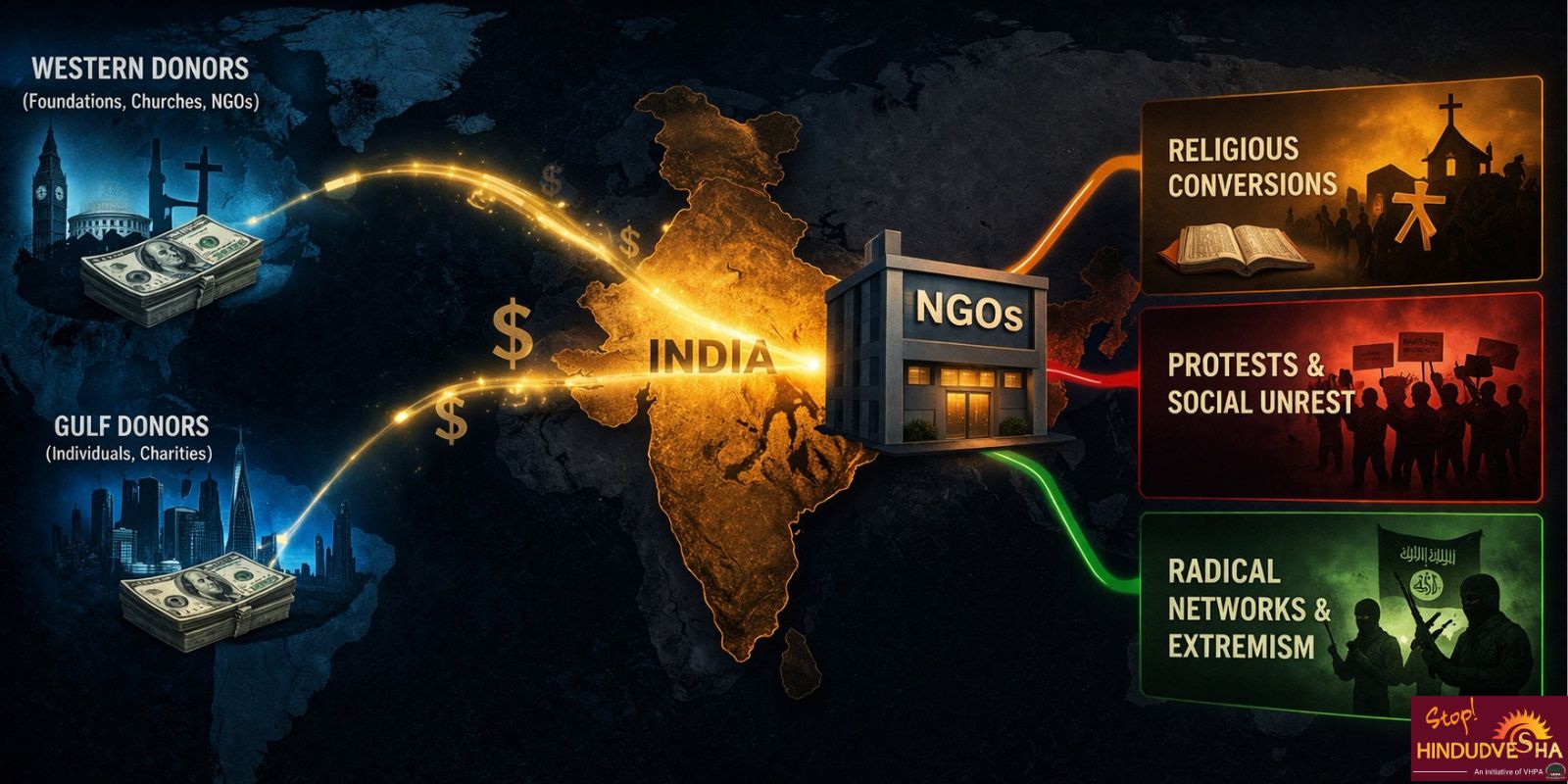
Summary
India’s proposed FCRA amendments, paired with stronger PMLA enforcement, have triggered a sharp political backlash, particularly from church bodies, opposition parties, and NGOs. While critics frame the measures as draconian and anti-democratic, the government argues they are necessary to curb financial misuse, money laundering, and illicit foreign funding. At the center of the debate lies a deeper concern: the intersection of foreign-funded religious conversion networks with extremist ecosystems, including Maoist and Islamist channels. Evidence from investigations, license cancellations, and intelligence inputs suggests that vulnerabilities in the NGO sector have been repeatedly exploited. The resistance, therefore, reflects not only civil society concerns but also competing interests over transparency, influence, and control in India’s evolving national security landscape.
In the spring of 2026, as Kerala prepared for assembly elections, a seemingly technical proposal — the Foreign Contribution Regulation Amendment (FCRA) Bill, 2026 — triggered a political storm that exposed the Christian church’s entrenched sense of entitlement. The bill, briefly introduced and then paused amid backlash, aimed to tighten the Foreign Contribution (Regulation) Act (FCRA) by allowing a designated authority to seize or dispose of assets acquired by NGOs with foreign funds if their registration lapsed or was canceled. Alongside stronger enforcement of the Prevention of Money Laundering Act (PMLA), these measures reflected the government’s effort to plug systemic leaks, curb financial misuse, and restrict illicit flows that could fund activities ranging from religious conversions to insurgent violence [1].
The backlash was immediate, vocal, and highly coordinated. Church bodies — including the KCBC, CBCI, evangelical networks, and the All-India Christian Council — condemned the amendments as “draconian” and “unconstitutional” [2]. Opposition parties and Left groups amplified the protests, portraying the bill as an attack on NGOs and democratic safeguards. Activists and rights groups echoed these concerns, while critics warned of asset seizures threatening church-run institutions built over decades.
What stands out is the breadth of this resistance — an alignment of religious institutions, political actors, advocacy groups, and ideological networks. Beyond the rhetoric of rights and charity, investigators have long pointed to a deeper nexus linking foreign funding, conversion activities, and extremist ecosystems. Evidence from government actions, court records, and intelligence inputs suggests that these measures address real vulnerabilities rather than arbitrary state overreach [3].
The Legal Arsenal: FCRA, PMLA, and the Fight Against Illicit Flows
India’s FCRA, first enacted in 1976 and significantly amended in 2010 and 2020, regulates foreign donations to ensure they serve legitimate social, cultural, economic, or religious purposes without undermining national interest. The 2026 amendments would have expanded government oversight, allowing the seizure of foreign-funded assets upon license lapse — a provision that clergymen have called “loot and theft” of Christian properties [4], but which the Home Ministry framed as closing loopholes exploited by shell entities and diversion networks.
The PMLA, enacted in 2002 and strengthened over the years to align with Financial Action Task Force (FATF) standards, empowers the Enforcement Directorate (ED) to investigate money laundering, attach proceeds of crime, and prosecute offenders. It has been used aggressively not only against corrupt politicians, but also against insurgent financing. ED actions have attached Maoist assets worth crores from extortion rackets targeting coal trucks, contractors, and businesses in Jharkhand, Odisha, and Bihar. NIA probes have exposed parallel networks where front organizations launder funds [5].
Together, these laws address a documented problem: India’s vast NGO sector — over 2 million entities, with thousands receiving foreign contributions totaling billions of dollars annually — has repeatedly been flagged for vulnerabilities to money laundering and terrorist financing. FATF mutual evaluation reports and MHA notifications list diversion for “induced or forceful religious conversion,” links to terrorist or radical organizations, and anti-national activities as grounds for cancellation. Over 20,600 FCRA licenses have been revoked in the past decade, many involving religious NGOs accused of proselytization in tribal belts [6].
Church’s Campaign: Defending the Conversion Pipeline
No group has been more outspoken than India’s Christian leadership. In Kerala, home to a substantial Christian population and a dense network of church-run educational and medical institutions reliant on foreign donations, the KCBC and CBCI issued urgent statements claiming that the bill would enable state takeover of assets, undermine minority rights, and choke welfare work among the poor. Archbishop Joseph Dsouza called it “a Sangh Parivar agenda” aimed at Christian institutions. US-based Latino Christian leaders urged withdrawal, arguing donors intended funds for India’s marginalized, not to “subsidize the Indian state [7].” Dsouza’s contempt for the Indian state is evident in his words.
This is not new. Since 2020, dozens of Christian NGOs — including prominent ones such as the Church of North India and the Evangelical Fellowship of India — have lost FCRA licenses, often cited for activities prejudicial to the public interest or for links to conversions in tribal areas of Jharkhand, Chhattisgarh, and Odisha [8]. In 2020 alone, 13 NGOs had their licenses suspended for religious conversions in tribal zones. Intelligence reports have repeatedly flagged foreign-funded evangelism as contributing to social disharmony, sometimes overlapping with areas of Maoist influence.
Take the People’s Movement Against Nuclear Energy (PMANE), an activist group led by Christian convert S. P. Udayakumar. The NGO has led protests against the Russian-built nuclear power station in Kudankulam, Tamil Nadu, since the early 2010s. The movement has received significant direct support from local Catholic church leaders and parishioners. In February 2012, at the height of the agitation, then-Prime Minister Manmohan Singh uncharacteristically criticized the protesters, stating that NGOs based in the United States and Scandinavian countries were fueling the protests and stalling the commissioning of the nuclear plant [9].
Four months later, the Indian Intelligence Bureau released a report indicating that foreign funds meant for the church were being diverted to support anti-nuclear agitations. In particular, it raised questions about nearly $40,000 deposited into two bank accounts of Udayakumar, convenor of PMANE. The funds were reportedly transferred by Ohio University for providing resources and articles related to Kudankulam [10].
Church leaders frame their work as pure charity — schools for the poor, hospitals for the marginalized. Yet government data and field inquiries point to a more complex picture: inducements such as rice, medical aid, and education tied to baptism, with foreign funding from Western evangelical networks flowing through layered NGOs. Critics within the church itself have occasionally acknowledged “aggressive proselytization” that strains communal harmony. The opposition to FCRA and PMLA is thus not merely about administrative burden; it is also about preserving the financial base for missionary activity that, in sensitive border and tribal regions, has at times intersected with separatist or anti-national currents [11].
Terror Networks, and the NGO Veil
Maoist (Naxalite) groups, active in the “Red Corridor,” rely primarily on domestic extortion — levies on mining, contractors, and businesses — but intelligence agencies have long warned of clandestine foreign support routed through front organizations. MHA statements note Indian Maoist links to international Maoist forums and the possibility of foreign funding via sympathetic NGOs. ED’s PMLA actions have dismantled several such rackets, attaching assets and exposing how “people’s war” financing can blend with legitimate-sounding charities [12].
Notably, some Christian activists have been entangled in these networks. The case of Jesuit priest Stanislaus Lourduswamy (known as Stan Swamy), arrested in 2020 under UAPA for alleged Maoist links in the Bhima Koregaon case, highlighted how human rights advocacy in tribal areas can blur into ideological support [13]. Swamy’s work among tribals overlapped with Maoist strongholds; his death in custody became a rallying point for NGOs and opposition parties decrying the “weaponization” of counter-terror laws. Similar patterns appear in Northeast insurgencies, where foreign-funded Christian missions have, in the past, been accused of nurturing ethnic separatism [14].
Petrodollars and Jihad
On the Islamist side, terrorist financing operates through hawala, gold smuggling, and disguised charities rather than overt FCRA-linked NGOs. Yet the Popular Front of India (PFI) — later banned after NIA probes — exemplified the conversion-terror pipeline [15]. Operating in Kerala and beyond, PFI and its affiliates targeted backward Hindu communities and Christians for mass conversions to Salafist Islam, funneling recruits toward ISIS through educational fronts such as Satyasarini. Over 3,000 conversions were claimed; several Kerala Christian women converted through so-called “love jihad” were later linked to ISIS operatives or arrested in terror probes. NIA investigations revealed Gulf funding routed into radicalization networks [16].
These cases illustrate a broader pattern: religious conversion is not merely spiritual; in resource-scarce or ideologically contested regions, it can serve as a gateway for recruitment and financing. Foreign funds sustain the infrastructure — orphanages, hostels, and clinics — that lower barriers to conversion. Once converted, vulnerable individuals may become susceptible to radical handlers, whether Maoist cadres promising land justice or Islamist networks offering purpose and overseas training.
Ethnic cleansing of Hindus, often through violent means, has at times followed after substantial numbers of Hindus in an area have converted to Christianity. Maoists have also been reported to have killed Hindus who resisted religious conversions [17].
Political Parties and NGOs: Amplifying the Resistance
Opposition parties have seized on the issue for electoral gain. In Kerala, the Congress and CPI(M) united against the bill, with Chief Minister Pinarayi Vijayan writing to the Prime Minister and Leader of the Opposition Rahul Gandhi, decrying threats to Christian welfare. The DMK’s M. K. Stalin called it a “direct attack on Christian NGOs, churches, and minority institutions,” linking it to Waqf-related controversies. Protests in Parliament featured banners decrying the targeting of NGOs [18].
NGOs — many of them foreign-funded — echoed this refrain through reports, petitions, and media campaigns. Amnesty International and Human Rights Watch have long criticized FCRA, PMLA, and UAPA as tools to silence dissent, citing arbitrary cancellations and asset freezes. Yet these critiques often downplay the very abuses the laws are meant to address: diversion of funds for conversions, links to terror networks, or support for Maoist activities. FATF itself has flagged risks within India’s non-profit sector [19].
The coalition is thus strategic: churches protect their institutional ecosystem, Maoist sympathizers shield ideological supply lines, Islamist networks (often through proxies) safeguard radicalization pipelines, political parties seek to consolidate minority vote banks, NGOs defend their funding structures under the banner of “civil society,” and sections of the media amplify these narratives.
Connecting the Dots: Conversion as a Vector for Extremism
The link between religious conversion and terrorism is not merely theoretical; it has been cited in multiple contexts. In Islamist cases, Kerala’s experience is often highlighted. Intelligence and police reports describe “love jihad” tactics in which Christian (and Hindu) girls are allegedly groomed, converted, and drawn into terror modules [20]. Of 21 Kerala ISIS recruits, five were reportedly Christians who had converted to Islam; some converted women were said to have provided logistical support or disappeared into caliphate networks. PFI’s playbook — targeted conversions of marginalized communities, Salafist indoctrination, and overseas training — has been described as feeding jihadist pipelines. Gulf remittances and hawala channels have supplemented this ecosystem [21].
Christian conversions present a different but parallel concern. In tribal regions of central India, foreign-funded evangelism has been observed alongside heightened Maoist recruitment. Converts, often detached from traditional social structures, may become more receptive to leftist narratives that frame conversion as “liberation” from caste, while also channeling funds toward “people’s struggles.” Cases such as that of Stan Swamy are cited to illustrate how activist clergy can, at times, operate at the intersection of humanitarian work and insurgent-linked environments. In the Northeast, historical missionary influence has also been associated by some analysts with the growth of ethnic insurgencies, with foreign Christian networks occasionally accused of sustaining separatist sentiments.
Empirically, both Hindu concerns and security assessments converge on a similar point: unregulated foreign funding can amplify conversion activities that may erode social cohesion and create potential recruitment pools for extremist groups. MHA guidelines explicitly list “induced or forceful religious conversion” and “links with terrorist organizations” as red flags — reflecting patterns identified in field intelligence [22].
What the Opposition’s Persistence Reveals
The pause on the 2026 FCRA amendments was a pragmatic political decision: there was little to gain from alienating ordinary Christian communities. Yet the underlying dynamics remain unchanged. PMLA actions continue to pressure Maoist extortion networks, and FCRA cancellations persist in cases of non-compliance. The resistance reflects a convergence of interests unsettled by increased scrutiny: churches face constraints on evangelism funding, insurgent networks risk losing financial channels, political parties worry about electoral backlash, and NGOs confront tighter accountability [23].
A serious analysis must engage with uncomfortable realities. India’s democracy accommodates diverse religious practices, but sovereignty requires safeguards against external influence that may distort domestic dynamics. When foreign funding is linked — directly or indirectly — to activities that intersect with extremism, whether Maoist insurgency or Islamist radicalization, the state faces a clear responsibility to respond. The PMLA–FCRA framework, despite its imperfections, represents an evolving attempt to address these complex, overlapping challenges involving finance, faith, and security.
Critics rightly call for procedural safeguards and judicial oversight to prevent misuse. However, dismissing these laws entirely as instruments of majoritarian repression overlooks documented instances: canceled licenses tied to conversion-related violations, assets attached in cases with alleged terror links, and investigations involving activists operating in contested spaces. The coalition opposing these measures is therefore not incidental; it reflects deeper structural tensions.
As India navigates its trajectory amid global ideological and geopolitical pressures, the regulation of foreign funding remains a significant policy question. It is not merely an administrative issue but one tied to national resilience — whether external financial flows will be allowed to shape internal fault lines, or whether regulatory frameworks will assert greater oversight. The positions taken by churches, activist networks, political actors, and NGOs illustrate the stakes involved. The question that remains is whether this resistance serves to protect legitimate civil society activity or inadvertently shields more problematic networks operating beneath the surface.
Citations
[1] “What’s Inside the FCRA Amendment Bill Presented in Lok Sabha?” OpIndia. https://opindia.com/2026/03/whats-inside-the-fcra-amendment-bill-presented-in-lok-sabha/
[2] “Church Bodies Sound an Alarm over Contentious Provisions in FCRA Bill.” The New Indian Express, March 28, 2026. https://www.newindianexpress.com/states/kerala/2026/Mar/28/church-bodies-sound-an-alarm-over-contentious-provisions-in-fcra-bill
[3] “13 NGOs Lose FCRA License over Religious Conversions.” The Times of India. https://timesofindia.indiatimes.com/india/13-ngos-lose-fcra-licence-over-religious-conversions/articleshow/77988277.cms
[4] “Video Reel.” Instagram. https://www.instagram.com/reel/DWn5yjQDnLi/
[5] “Agencies Expose Maoist-Run Extortion and Money Laundering Rackets.” The Hindu. https://www.thehindu.com/news/national/agencies-expose-maoist-run-extortion-and-money-laundering-rackets/article70808417.ece
[6] “Govt Cites 17 Reasons to Deny or Cancel Foreign Fund Registration of NGOs.” The Hindu. https://www.thehindu.com/news/national/govt-cites-17-reasons-to-deny-or-cancel-foreign-fund-registration-of-ngos/article68860287.ece
[7] “Donors Gave to Serve India’s Poor, Not to Subsidize Indian State: US Christian Leaders Ask India to Withdraw FCRA.” The Wire. https://thewire.in/religion/donors-gave-to-serve-indias-poor-not-to-subsidise-indian-state-us-christian-leaders-ask-india-to-withdraw-fcra
[8] “13 NGOs Lose FCRA License over Religious Conversions.” The Times of India. https://timesofindia.indiatimes.com/india/13-ngos-lose-fcra-licence-over-religious-conversions/articleshow/77988277.cms
[9] “Foreign-Funded NGOs Stalling Development: IB Report.” The Times of India. https://timesofindia.indiatimes.com/india/foreign-funded-ngos-stalling-development-ib-report/articleshow/36411169.cms
[10] “Foreign-Funded NGOs Stalling Development: IB Report.” The Times of India. https://timesofindia.indiatimes.com/india/foreign-funded-ngos-stalling-development-ib-report/articleshow/36411169.cms
[11] “Indian Christians Wary over FCRA’s Illegal Religious Conversion Wording.” Mission Network News. https://www.mnnonline.org/news/indian-christians-wary-over-fcras-illegal-religious-conversion-wording/
[12] Ministry of Home Affairs, Government of India. “Parliament Question Response on Maoist Funding.” https://xn--i1b5bzbybhfo5c8b4bxh.xn--11b7cb3a6a.xn--h2brj9c/MHA1/Par2017/pdfs/par2014-pdfs/rs-060814/2971.pdf
[13] “Why Christian Priest Stan Swamy Was Booked under UAPA.” Swarajya. https://swarajyamag.com/news-brief/why-christian-priest-stan-swamy-was-booked-under-uapa
[14] “Missionary Schools in India: Silent Stormtroopers of Christian Imperialism.” StopHinduDvesha. https://stophindudvesha.org/missionary-schools-in-india-silent-stormtroopers-of-christian-imperialism/
[15] “From Kerala to Bengal: The Expanding Web of Islamist Radicalization in India and the Role of Global Jihadist Networks.” India Foundation. https://indiafoundation.in/articles-and-commentaries/from-kerala-to-bengal-the-expanding-web-of-islamist-radicalisation-in-india-and-the-role-of-global-jihadist-networks/
[16] “Are Christian Women in Kerala ‘Love Jihad’ Targets for IS Terror Activities?” Swarajya. https://swarajyamag.com/politics/are-christian-women-in-kerala-love-jihad-targets-for-is-terror-activities
[17] “Indian Maoists Kill Hindus over Christian Conversions.” Reuters. https://www.reuters.com/article/economy/indian-maoists-kill-hindus-over-christian-conversions-idUSBOM353572/
[18] “Opposition Stages Protest in Parliament over FCRA Amendment Bill.” The Economic Times. https://economictimes.indiatimes.com/news/politics-and-nation/opposition-stages-protest-in-parliament-over-fcra-amendment-bill/articleshow/129942867.cms
[19] “India: Government Weaponizing Terrorism Financing Watchdog Recommendations against Civil Society.” Amnesty International, September 2023. https://www.amnesty.org/en/latest/news/2023/09/india-government-weaponizing-terrorism-financing-watchdog-recommendations-against-civil-society/
[20] “Are Christian Women in Kerala ‘Love Jihad’ Targets for IS Terror Activities?” Swarajya. https://swarajyamag.com/politics/are-christian-women-in-kerala-love-jihad-targets-for-is-terror-activities
[21] “From Kerala to Bengal: The Expanding Web of Islamist Radicalization in India and the Role of Global Jihadist Networks.” India Foundation. https://indiafoundation.in/articles-and-commentaries/from-kerala-to-bengal-the-expanding-web-of-islamist-radicalisation-in-india-and-the-role-of-global-jihadist-networks/
[22] “FCRA License of NGOs to Be Canceled if Involved in Religious Conversion: MHA.” Millennium Post. https://www.millenniumpost.in/nation/fcra-licence-of-ngos-to-be-cancelled-if-involved-in-religious-conversion-mha-586525
[23] “FCRA Amendment Bill 2026: Why It Has Triggered a Political Storm.” Moneycontrol. https://www.moneycontrol.com/news/india/fcra-amendment-bill-2026-why-it-has-triggered-a-political-storm-13876511.html

Donate to HINDUDVESHA
Our Mission is to explore and expose Hindudvesha through research analysis, education and response.
SUPPORT US