

Dhurandhar Effect: Blockbuster Discards the Islamist Playbook but Barely Scratches Bollywood’s Anti-Hindu Nexus
 Som Misha · 04/27/2026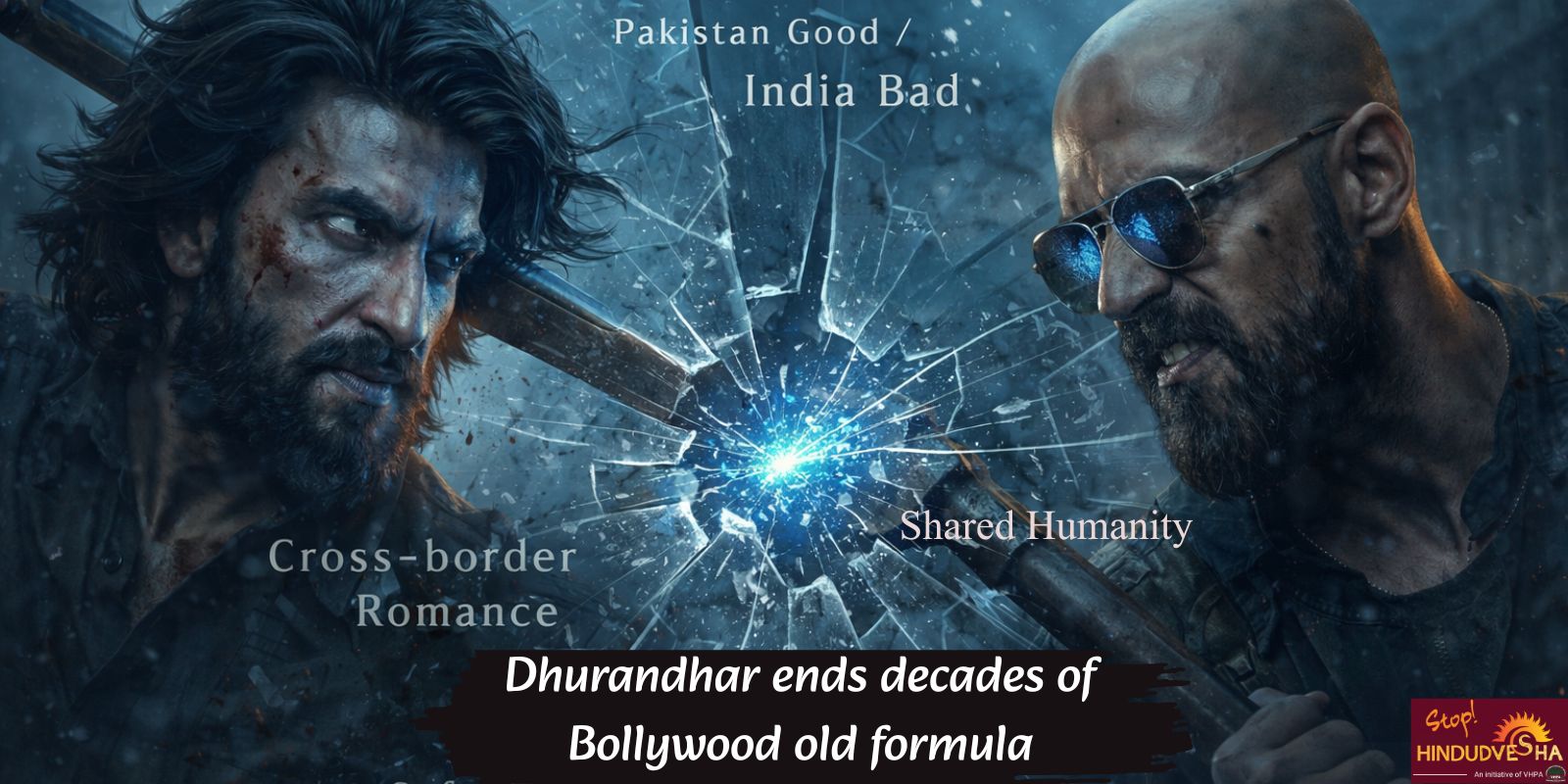
Summary
Dhurandhar and its sequel, Durandar 2 mark a significant shift in Bollywood storytelling, replacing decades of softened narratives with stark realism rooted in conflict and national perspective. Their commercial success demonstrates that Indian audiences are willing to embrace films that move beyond familiar tropes such as sympathetic cross-border portrayals and formula-driven storytelling. However, this creative disruption has not fundamentally altered the industry’s structural dynamics. Major studios remain heavily influenced by overseas markets, particularly in the MENA region, where established formulas continue to drive revenue. As a result, while Dhurandhar has expanded the boundaries of what is commercially viable, Bollywood’s financial incentives still favor continuity over transformation. The outcome is a partial shift—driven by audience demand but constrained by entrenched economic dependencies.
In the winter of 2025 and again in the spring of 2026, two Bollywood action films achieved what decades of diplomacy, cricket matches, and back-channel talks have rarely managed: they left Pakistan visibly rattled. Dhurandhar, released in December 2025, and its sequel Dhurandhar 2: The Revenge, which hit screens in March 2026, together crossed well over ₹2,400 crore (and counting) at the domestic box office—and did so without a single qawwali set in Lahore or a sympathetic Pakistani character.
Directed by Aditya Dhar and starring Ranveer Singh as the steely RAW operative Hamza Ali Mazari, the films traded the usual Bollywood song-and-dance gloss and genial Pakistani characters with grim realism—long tracking shots through Karachi’s back alleys, terse interrogations in dimly lit safehouses, and the relentless grind of infiltration.
Across Pakistan, the reaction to Dhurandhar was immediate and visceral following both releases. Social media is filled with images of burning posters, impractical boycott calls, and a kind of helpless fury that reveals more about the audience than the films themselves. [1] Television anchors railed against “cultural aggression,” while online forums churned out memes of Indian helicopters strafing militants. The outrage was not just about cinema—it was about narratives that refused to follow the familiar script of “Pakistan Good/India Bad.”
Pakistan’s Founding Fantasy: From Hijrah to Reconquest
To understand the intensity of this response, one must revisit Pakistan’s founding premise. The state was not imagined by its early proponents as a conventional, permanent homeland. For Muhammad Ali Jinnah and his Muslim League cohorts, it functioned as a strategic redoubt—an opening move rather than an endpoint. Partition in 1947 was framed by some as a modern hijrah, echoing the Islamic prophet Muhammad’s migration from Mecca to Medina in 622 CE. In this telling, just as early Muslims returned to conquer Mecca eight years later in 630 CE, migrants to Pakistan would one day return triumphantly to India and plant the flag of Islam on Delhi’s Red Fort. [2]
This vision, often linked to the idea of Ghazwa-e-Hind, cast Pakistan as a base rather than a destination—an ideological launchpad for a future reconquest, al-Qaeda in the literal Arabic sense, from which that reconquest would begin. While many Islamic scholars have disputed the authenticity or relevance of such interpretations, the narrative seeped into strands of nationalist imagination, lending theological weight to the two-nation theory and recasting Partition as a prelude rather than a conclusion. [3]
Over time, this idea echoed—sometimes subtly, sometimes explicitly—across public discourse: through cricketers like Shoaib Akhtar, pop singers, and senior army officers such as Asim Munir. [4] Early accounts from the post-independence period suggest that some supporters viewed the new state as temporary—a staging ground for unfinished historical business. Whether literal or metaphorical, this mindset shaped elements of school education, rhetoric, and strategic thinking for decades. [5]
Story That Reversed the Direction
Dhurandhar 2: The Revenge disrupts that imagined trajectory with calculated precision. Its story follows RAW operatives deeply embedded within Pakistan’s institutions. At its center is Ranveer Singh’s Hamza, living undercover in Karachi, cut off from his past and sustained only by mission and memory. The film’s most striking reveal—a quiet montage rather than a dramatic twist—suggests that even senior civic leadership, such as the mayor of Karachi, is compromised, sustained by unseen handlers across the border.
The portrayal is deliberate: institutions like the ISI and the Pakistan Army, long framed as resolute, are depicted as porous, vulnerable, and outmaneuvered. For audiences accustomed to narratives of resilience or eventual victory, this inversion lands as more than fiction—it feels like an affront. The film denies even the dignity of heroic defeat. Instead, it presents a bleaker image: a state exposed from within, lashing out rhetorically while losing control on the ground. [6]
From Romantic Filters to Stark Realism
The first Dhurandhar (2025) laid this foundation, tracing Hamza’s infiltration of Karachi’s criminal networks to disrupt terror financing. The sequel expands outward—to political systems, intelligence hierarchies, and the gradual erosion of institutional confidence. Director Aditya Dhar adopts a restrained, almost documentary style. There are no romanticized montages or symbolic gestures of shared culture—only the routines of dysfunction: idle checkpoints, corrupt officials, and militants reduced to logistical squabbles.
This marks a sharp break from earlier Bollywood conventions. For decades, Indian cinema often softened its portrayal of Pakistan, emphasizing shared humanity even amid conflict. Films like Veer-Zaara [7] and Gadar: Ek Prem Katha framed cross-border tensions through romance or personal tragedy, frequently sidestepping deeper ideological divides. Even in the shadow of wars and terror attacks, Pakistani characters were often depicted as conflicted or sympathetic.
Dhurandhar abandons that lens entirely. Its world is stripped of sentimentality. Historical trauma is neither softened nor stylized, and the dialogue reflects the harsh rhetoric drawn from real conflicts. The result is not subtle, but it is intentional: a counter-narrative to decades of mutual mythmaking.
One recurring figure is Major Iqbal, a mid-level ISI officer whose father—a 1971 veteran—boasts that he raped a thousand Bengali women during the East Pakistan conflict, claiming a thousand offspring “running around in the paddy fields.” The line lands with force because it is not invented. The Pakistan Army’s campaign in what became Bangladesh ranks among the largest organized sexual-violence operations since the Second World War, with historians estimating over 400,000 rapes; many women were held in military camps for systematic abuse aimed at “diluting” Bengali bloodlines. [8]
The refusal to euphemize extends elsewhere. Viewers hear Pakistani militants fantasize about turning Delhi streets into open-air barbecue pits for cow kebabs and about the sexual enslavement of Hindu women—echoing real slogans from the 1990s Kashmir insurgency. In Srinagar and beyond, crowds chanted “raliv, galiv ya chaliv” (convert, leave, or die) as militants drove Kashmiri Hindus from their homes through murder, rape, and expulsion. [9]
The film’s aesthetic reinforces its message. Combat is depicted without grandeur—no swelling music, no slow-motion heroics. Encounters are abrupt, chaotic, and indifferent. The tone recalls the raw immediacy of films like Saving Private Ryan or Black Hawk Down, where violence is stripped of narrative comfort.
This approach extends to its broader themes. Rather than constructing villains or heroes in conventional terms, the film emphasizes systems—how they decay, how they are penetrated, and how individuals are subsumed within them. It is less a story of triumph than of exposure.
Equally significant is the film’s commercial success. The original Dhurandhar demonstrated that Indian audiences would support stories unburdened by the need to appease external markets. Its sequel has reinforced that shift, breaking records and drawing strong viewership across both metropolitan and smaller centers.
This success challenges a long-held industry assumption—that international sensitivities, particularly in Gulf markets, must shape storytelling. Instead, Dhurandhar points to a recalibration: narratives grounded in domestic confidence can achieve both critical and commercial momentum.
Bollywood’s Focus: MENA, China, and the Art of the Overseas Formula
Yet this paradigm shift collides with marketplace realities. For all their cultural impact, the Dhurandhar films are unlikely to dramatically reshape the output—or the anti-Hindu/anti-India content—of major studios like Yash Raj Films. Their business model operates largely beyond India’s domestic audience, rooted in overseas territories where older formulas still yield reliable returns. Nationalistic films may create a marginal dent in domestic collections, but structural incentives favor continuity.
Here is how this nexus operates. Unlike Hollywood, which primarily produces films for American audiences, leading Bollywood studios often target markets beyond India and its majority population. The MENA region (Middle East and North Africa, roughly 20 countries), alongside Pakistan and other Muslim-majority audiences, forms a critical pillar—historically accounting for 20–35 percent of overseas Hindi film collections, with the broader MENA theatrical market approaching $1 billion annually. [10]
Productions are frequently calibrated to these preferences: a light-skinned male lead (often Muslim or bearing an ambiguous name like “Kabir,” allowing dual interpretations), a glamorous Hindu heroine with overt visual appeal, exotic Swiss locations designed to impress aspirational audiences, and narratives that portray Pakistani or ISI figures as noble while depicting Indian agents or soldiers as rogue. Over time, this has become a proven formula for overseas success.
China supplies another dimension, long associated with inflated collections. Dangal, Bollywood’s highest-grossing film, reportedly earned around ₹1,305 crore in China—roughly half its worldwide ₹2,070 crore total—with minimal ripple in Chinese media despite its “mega-hit” status. [11]
In India, vigilant media, social platforms, and agencies like the Enforcement Directorate often scrutinize films that claim massive earnings amid sparse theater occupancy. Overseas markets, by contrast, offer both revenue buffers and a degree of plausible deniability. A Bollywood insider noted that diplomatic warmth with Gulf nations remains largely superficial; on the ground, Islamic Ummah solidarity often prevails. Despite the Dhurandhar films containing no anti-Islamic content, as many as 13 Muslim-majority countries banned them—costing an estimated ₹500 crore in potential earnings from the first film alone. Although objections were largely limited to Pakistan, Bangladesh, and segments of Indian Muslims, Gulf authorities were quick to impose bans on both films.
Mainstream Bollywood no longer relies on India as its primary audience. Tired “Pakistan Good/India Bad” storylines often underperform domestically, yet studios such as YRF remain relatively indifferent to the Indian market; any domestic profits are treated as a bonus. What producers continue to seek from India is publicity—the vast entertainment media ecosystem that generates buzz, which is then amplified in overseas markets and converted into ticket sales across the MENA region.
Where Dhurandhar Actually Matters
Dhurandhar showed Indian audiences how easily the wall of mythmaking built by Bollywood could be dismantled. It demonstrated that tropes such as the “noble Indian Muslim” and the “good Pakistani spy” are not essential to the narrative of an Indian film. Above all, it proved that a film can become a box office blockbuster without running a single show in MENA markets. A slate of nationalist-leaning films is already lined up through 2026 and beyond, riding this wave. Dhurandhar itself was conceived around 2016 after the Uri surgical strikes and took nearly a decade to materialize—highlighting the long gestation of such projects. Director Aditya Dhar adapted to shifting currents rather than acting as an ideologue; notably, his initial choice for the role of India’s National Security Adviser was Aamir Khan.
The films’ most enduring impact lies in mindset and genre expansion. They showed that depicting terrorism in its raw, unvarnished form can achieve major commercial success without being branded anti-Muslim. This opens space for future projects—much as Rambo helped revive American war cinema after the Vietnam era.
Bollywood screenwriter Nitin Sawant, who wrote the screenplay for the 2026 film Shatak (chronicling a century of the RSS), describes his producers’ initial hesitation despite rigorous fact-checking. They pushed for multiple edits, toning down key elements, which ultimately gave the film a more documentary-like tone. Ironically, it was the RSS, rather than the Censor Board—often seen as liberal-leaning—that raised objections. However, in the wake of Dhurandhar, Sawant anticipates greater creative latitude in future installments.
According to Sawant, the film’s scale, budget, and long runtime (229 minutes) may also have shifted audience expectations for Hindi cinema. He anticipates a move toward large-scale, “shock and awe” productions in the mold of ensemble blockbusters, pushing smaller producers toward OTT platforms.
In the end, the Dhurandhar films have opened the door to more unfiltered storytelling and validated a strong domestic appetite for nationalist themes. Indian audiences have signaled a preference for grim realism over polished fiction—films that do not underestimate their intelligence.
The path toward a fully nationalist film industry, however, remains long and gradual. For now, the revenue engines of Bollywood’s largest players—anchored in MENA preferences, Gulf financing sensitivities, and opportunities for overseas revenue manipulation—remain largely intact. Anti-India or equivocal narratives may decline only marginally as studios continue to hedge their bets, often treating the Indian market as secondary. The paradigm may have shifted for creators and audiences, but Bollywood’s financial architecture remains largely unchanged. The overseas tail continues to wag the dog.
Practical Steps to Realign Bollywood with India’s Ethos
Hindi cinema has come a long way from the 1980s and 1990s, when sections of the industry were widely believed to be influenced by underworld figures such as Dawood Ibrahim. At the time, storylines, music, casting, and even production decisions were often said to be shaped by gangsters operating from hubs like Dubai. In that environment, films frequently became platforms for mocking Hindu traditions, normalizing conversion narratives, or presenting Pakistan in a favorable light. Dhurandhar marks a sharp departure from that trajectory. Much more can be achieved—and more quickly—if the government and aligned civil-society groups engage more actively. The following five interlocking steps outline a possible path to reduce Bollywood’s overseas dependence and encourage greater cultural rootedness and national alignment.
- Link Fiscal Incentives to National Interest: The government already provides tax rebates, production subsidies, and infrastructure support through bodies such as the National Film Development Corporation and various state schemes. These incentives could be made conditional. Films deriving at least 60 percent of theatrical revenue from India, passing a transparent national-interest content audit focused on factual integrity (rather than ideology), and avoiding gratuitous glorification of adversarial states could qualify for enhanced rebates—potentially up to 40 percent on GST and income tax. Overseas earnings above a threshold could be subject to higher taxation unless verified through blockchain-based ticketing data.
- Curb Inflated Overseas Collections: China and parts of MENA have long enabled opaque accounting practices due to limited transparency. Agencies such as the Enforcement Directorate and the Income Tax Department could treat unusually high foreign box-office claims as red flags, triggering forensic audits similar to domestic scrutiny. Studios would be required to submit third-party verification—via blockchain systems or recognized international auditors—for any market contributing more than 20 percent of total revenue. Films with unverified overseas collections could face retrospective tax demands and exclusion from government support schemes. A single high-profile enforcement action could deter inflated reporting.
- Use Diplomacy for Reciprocal Market Access and Diversification: India’s growing economic and strategic influence in the Gulf provides leverage. The Ministries of External Affairs and Information & Broadcasting could negotiate cultural reciprocity clauses within trade agreements: if a country bans an Indian film on ideological grounds, India could impose equivalent scrutiny or tariffs on content from that market. At the same time, a “Brand India Cinema” initiative could support expansion into Southeast Asia, East Africa, Latin America, and diaspora markets in the West through subsidized promotion. The goal would be to reduce MENA’s current 20–35 percent share of overseas collections, making those markets less decisive in shaping content.
- Create Parallel Indic Financing and Exhibition Ecosystems: Nationalist industrialists, NRIs, and temple institutions represent significant pools of capital. A dedicated Indic Film Fund—potentially at a scale of ₹5,000 crore—could be established, modeled on infrastructure funds and overseen by a board including veterans, historians, and cultural experts. The fund could support scripts, productions, and exhibition networks centered on civilizational themes, including epics, border narratives, and historical subjects. State governments could complement this by offering land and tax incentives for “Bharat Cinemas”—affordable multiplex chains in Tier-2 and Tier-3 cities that prioritize Indic content. This would create an alternative ecosystem less dependent on overseas financing.
- Mobilize Sustained Cultural and Consumer Pressure from Civil Society: Policy alone cannot reshape audience preferences; sustained cultural engagement is essential. Civil-society groups, critics, and digital influencers could coordinate “Swadeshi Screen” campaigns—discouraging formulaic content while promoting culturally grounded alternatives. Campaigns similar to Shefali Vaidya’s “No Bindi, No Business” initiative demonstrate how consumer pressure can influence industry behavior. [12] Annual “Indic Film Awards,” driven by public participation and cultural leadership, could recognize commercially successful films aligned with civilizational themes. Over time, this could normalize expectations that mainstream Hindi cinema reflect the same confidence audiences have shown in embracing films like Dhurandhar.
Citations
[1] “Pakistan Reacts to Dhurandhar: Indian Superhit Draws Fire in Real Lyari over Reel Depiction.” The Economic Times. https://economictimes.indiatimes.com/news/india/pakistan-reacts-to-dhurandhar-indian-superhit-draws-fire-in-real-lyari-over-reel-depiction/videoshow/126417270.cms?from=mdr
[2] “New Medina.” Dharmapedia. https://en.dharmapedia.net/wiki/New_Medina
[3] Khan, Ayesha. “Complex Narratives: Ghazwa-e-Hind.” Observer Research Foundation. https://www.orfonline.org/research/complex-narratives-ghazwa-e-hind-56257
[4] “Shoaib Akhtar on Ghazwa-e-Hind: ‘Muslims Will Capture Kashmir and Invade India from All Sides.’” DNA India. https://www.dnaindia.com/cricket/report-shoaib-akhtar-ghazwa-e-hind-holy-war-against-india-muslims-will-capture-kashmir-and-invade-india-from-all-sides-pakistan-cricket-team-2863934
[5] “Undercover: History Books in Pakistan Schools Brimming with Hate for India and Hindus, Finds News18.” News18. https://www.news18.com/india/under-cover-history-books-in-pak-schools-brimming-with-hate-for-india-and-hindus-finds-news18-7247779.html
[6] “Why India Targeted Muridke Markaz: Lashkar Bastion Where 26/11 Terrorist Ajmal Kasab Was Trained.” News18. https://www.news18.com/india/why-india-targeted-muridke-markaz-lashkar-bastion-where-26-11-terrorist-ajmal-kasab-was-trained-ws-kl-9326733.html
[7] “Movies like Veer-Zaara Whitewash Pakistan’s Crimes.” Reddit. https://www.reddit.com/r/IndianModerate/comments/1fbmbt2/movies_like_veerzaara_whitewash_pakistans_crimes/
[8] “52 Years On, Bangladesh’s ‘Birangona’ Women Still Seek Justice for Wartime Rapes.” The Guardian. https://www.theguardian.com/global-development/2023/apr/03/52-years-bangladesh-birangona-women-mass-rape-surviviors
[9] “Kashmir Hindus Genocide, Growth of Islamism, and Role of Congress.” OpIndia. https://www.opindia.com/2022/03/kashmir-hindus-pandits-genocide-growth-islamism-role-congress/
[10] “Gulf Region Emerging as Top Overseas Market for Bollywood Films.” Digital Studio Middle East. https://www.digitalstudiome.com/broadcast/broadcast-business/31596-gulf-region-emerging-as-top-overseas-market-for-bollywood-films
[11] “How Is Dangal Faking China’s Collections to ‘Keep Limelight’ against a Southern Invasion?” Quora. https://www.quora.com/How-is-Dangal-faking-China%E2%80%99s-collections-to-%E2%80%9Ckeep-limelight%E2%80%9D-against-a-southern-invasion
[12] “Bindi or Tilak Was the Last Significant Hindu Symbol to Disappear from Deepawali Ads.” Organiser. https://organiser.org/2024/10/26/262400/bharat/bindi-or-tilak-was-the-last-significant-hindu-symbol-to-disappear-from-deepawali-ads/

Donate to HINDUDVESHA
Our Mission is to explore and expose Hindudvesha through research analysis, education and response.
SUPPORT US