

An Eight-Point Institutional Framework for Hindu Continuity in America
 Dr. Jai G. Bansal · 03/31/2026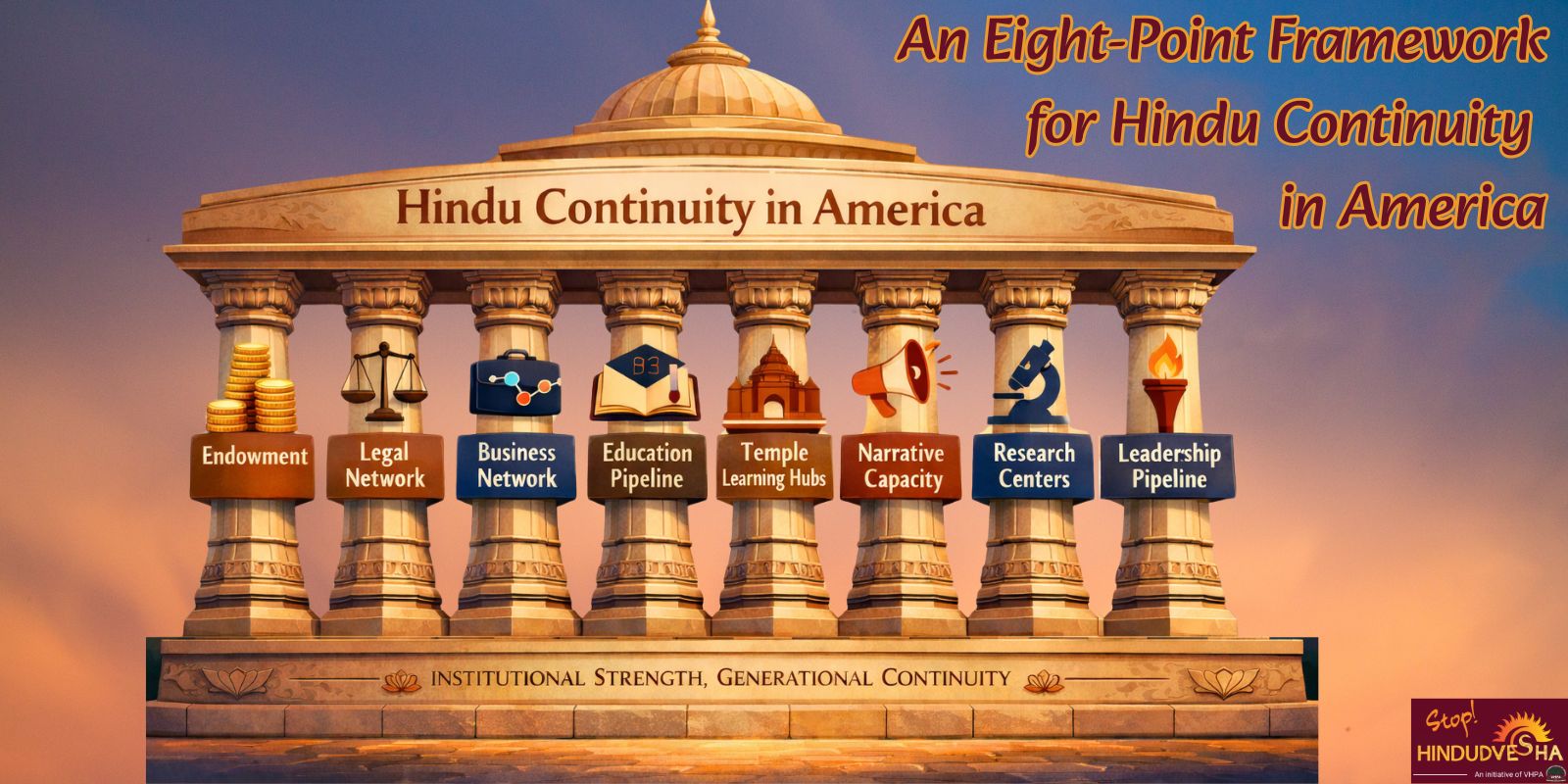
The Hindu diaspora in the United States has achieved exceptional success across education, professions, and public life. For decades, this success fostered a quiet assumption: that continuity of identity would follow naturally from prosperity, visibility, and temple growth. That assumption is now proving fragile. Beneath outward achievement, a slower but consequential shift is underway—Hindu identity is thinning across generations.
The root cause is not loss of belief or overt hostility, but delayed institution-building. Informal systems that once sustained continuity—family transmission, temple participation, and cultural sentiment—are no longer sufficient in a minority environment shaped by scrutiny, competing narratives, and institutional pressures. Individual success cannot substitute for collective capacity, and visibility without structure does not ensure transmission.
The effects are increasingly visible. Many young Hindus lack the depth and confidence to engage critically with how their tradition is portrayed. Professionals often navigate subtle pressures that encourage silence over expression. Community institutions remain active but fragmented, limiting their ability to respond coherently. These are not isolated concerns, but indicators of an underlying structural gap.
To address this gap, the attached report, An Eight-Point Institutional Framework for Hindu Continuity in America, proposes a comprehensive framework to build a durable civilizational infrastructure.
The framework includes: (1) a centralized endowment to provide stable, long-term funding; (2) a coordinated legal network for early intervention in cases of discrimination or misrepresentation; (3) a business and employment network to support economic resilience during periods of pressure; (4) an integrated education ecosystem spanning childhood through adulthood; (5) the transformation of temples into community learning hubs combining worship with structured education; (6) a professional public narrative capacity to engage media and shape representation; (7) research and policy centers to translate Hindu knowledge into contemporary intellectual discourse; and (8) structured leadership pipelines to cultivate future institutional stewards. Together, these pillars shift the focus from reactive, fragmented efforts to coordinated, long-term capacity. The aim is not constant mobilization, but the creation of institutions that quietly sustain continuity across generations.
This framework is not a blueprint, but a starting point for collective refinement. Its central premise is straightforward: continuity in a minority setting does not happen automatically. It must be built—deliberately, professionally, and with urgency—while the window to do so remains open.

Donate to HINDUDVESHA
Our Mission is to explore and expose Hindudvesha through research analysis, education and response.
SUPPORT US