

Annihilation of Caste—or Annihilation of Hinduism? Revisiting Ambedkar’s Legacy
 Rakesh Krishnan Simha · 04/12/2026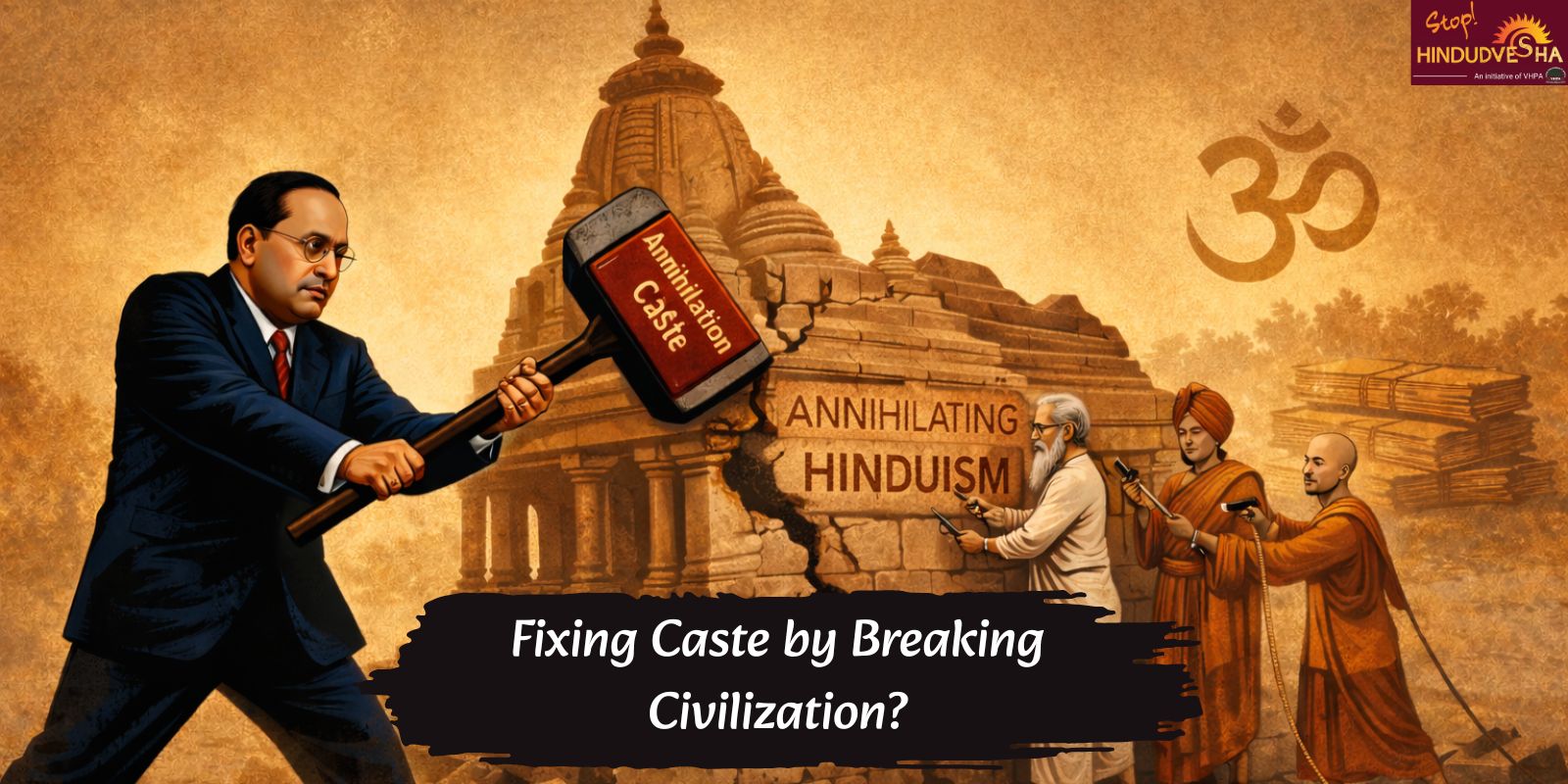
Summary
This article revisits B.R. Ambedkar’s famous 1936 text Annihilation of Caste, examining the radical critique of Hinduism it advanced. While Ambedkar condemned caste discrimination and urged oppressed communities to abandon Hinduism, the article argues that he conflated social injustices with the essence of the religion itself. It highlights responses from contemporaries like Mahatma Gandhi, the reformist intentions of groups such as the Jat-Pat Todak Mandal, and alternative models of social uplift within Hindu society, notably the path shown by Sri Narayana Guru in Kerala. The essay questions whether Ambedkar’s approach fostered social reform or deepened civilizational divisions that continue to shape debates on caste and identity.
On December 12, 1935, the Jat-Pat Todak Mandal, a society dedicated to breaking the caste system in Hinduism, extended an invitation to Bhimrao Ramji Ambedkar. The Lahore-based organization requested the social reformer to deliver a speech on the caste system in India at their annual conference scheduled for 1936. In response, Ambedkar composed the speech in the form of an essay titled ‘Annihilation of Caste’ in which he called for the destruction of Hinduism. [1]
Ambedkar, who would go on to become India’s first Law Minister and one of the key architects of the country’s constitution, wrote: “What the Hindus call Religion is really Law, or at best legalized class-ethics. Frankly, I refuse to call this code of ordinances “Religion.” The first evil of such a code of ordinances, misrepresented to the people as Religion, is that it tends to deprive moral life of freedom and spontaneity, and to reduce it (for the conscientious, at any rate) to a more or less anxious and servile conformity to externally imposed rules. Under it, there is no loyalty to ideals; there is only conformity to commands….. I have, therefore, no hesitation in saying that such a religion must be destroyed, and I say there is nothing irreligious in working for the destruction of such a religion.”
The famous jurist offered a radical recommendation for reforming Hinduism: “There should be one and only one standard book of Hindu Religion, acceptable to all Hindus and recognized by all Hindus. This, of course, means that all other books of the Hindu religion – Vedas, Shastras, and Puranas – which are treated as sacred and authoritative, must by law cease to be so, and the preaching of any doctrine, religious or social, contained in these books should be penalized.”
Claiming Hindu intransigence and the failure of a decade of nonviolent protests to gain basic human rights for the ‘untouchables,’ Ambedkar began asking his followers to quit Hinduism. On October 13, 1935, at a provincial conference of the depressed classes held in Yeola, Nashik, he declared: “I was born in Hinduism, but I will not die as a Hindu.” [2]
The following year, he addressed the Bombay Presidency Mahar Conference and asked his followers to abandon the religion of their forefathers: [3]
- “If you want to gain self-respect, change your religion.
- If you want to create a cooperating society, change your religion.
- If you want power, change your religion.
- If you want equality, change your religion.
- If you want independence, change your religion.
- If you want to make the world in which you live happy, change your religion.”
Twenty-one years later, on October 14, 1956, just three months before his death, Ambedkar embraced Buddhism in a public ceremony in Nagpur along with 380,000 ‘untouchables.’ A repetition of the ceremony the next day for 100,000 latecomers brought the number of people who had embraced the Buddhist faith in 36 hours to nearly half a million.
Overstating his case
Considering the hostility that Ambedkar received from orthodox Hindus (who practiced untouchability, wouldn’t allow the lower castes to draw water from the village tank, and barred them from entering temples), it was natural for him to be bitter. But the fault lay not in the religion but in its most intransigent followers. As Mohandas Gandhi, the freedom movement leader, commented: “The profound mistake that Dr. Ambedkar has made in his address is to pick out the texts of doubtful authenticity and value…. Judged by the standard applied by Dr. Ambedkar, every known living faith will probably fail.” [4]
According to Gandhi, “Can a religion that was professed by Chaitanya, Jnyandeo, Tukaram, Tiruvalluvar, Ramakrishna Paramahansa, Raja Ram Mohan Roy, Maharshi Devendranath Tagore, Vivekanand, and a host of others who might be easily mentioned, be so utterly devoid of merit as is made out in Dr Ambedkar’s address? A religion has to be judged not by its worst specimens but by the best it might have produced. For that and that alone can be used as the standard to aspire to, if not to improve upon.”
Gandhi remarked, “Religion is not like a house or a cloak, which can be changed at will. It is a more integral part of one’s self than one’s body.” [5]
Despite all his learning, Ambedkar conflated the humiliations he and the depressed classes suffered with Hinduism, ignoring the fact that his education was entirely financed by his Brahmin teacher and Sayajirao Gaekwad, the progressive king of Baroda, who was keen to establish a state intelligentsia comprising members from the depressed classes. [6]
The Maratha king not only funded his education in Bombay, the London School of Economics, and Columbia University, but also gave him a job upon completing his studies. [7] The last name ‘Ambedkar’ was conferred on him by his Brahmin teacher, Mahadev Ambedkar. [8] His wife, Dr. Sharada Kabir, also belonged to a middle-class Saraswat Brahmin family. [9] Clearly, the upper castes weren’t as bad as Ambedkar considered them to be.
Similarly, the Jat-Pat Todak Mandal, founded by Punjabi Hindus, was also on the same page as Ambedkar on caste. They said the jurist was free to deliver the entirety of his speech, except the part where he wrote he would be leaving Hinduism.
The Mandal’s founder, Sant Ramji, an ‘untouchable’ from Hoshiarpur district and a member of the Arya Samaj, wrote about their views on Ambedkar’s ‘Annihilation of Caste,’ “We did not invite Dr. Ambedkar to preside over our conference because he belonged to the Depressed Classes, for we do not distinguish between a touchable and an untouchable Hindu. On the contrary, our choice fell on him simply because his diagnosis of the fatal disease of the Hindu community was the same as ours; i.e., he, too, was of the opinion that the caste system was the root cause of the disruption and downfall of the Hindus. The subject of the Doctor’s thesis for his Doctorate being the caste system, he has studied the subject thoroughly. Now, the object of our conference was to persuade the Hindus to annihilate castes, but the advice of a non-Hindu in social and religious matters can have no effect on them. The Doctor, in the supplementary portion of his address, insisted on saying that that was his last speech as a Hindu, which was irrelevant as well as pernicious to the interests of the conference. So we requested him to expunge that sentence, for he could easily say the same thing on any other occasion. But he refused, and we saw no utility in making merely a show of our function. In spite of all this, I cannot help praising his address, which is, as far as I know, the most learned thesis on the subject and worth translating into every vernacular of India.” [10]
In his book ‘Pakistan, or, The Partition of India,’ Ambedkar wrote: If Hindu Raj does become a fact, it will, no doubt, be the greatest calamity for this country. No matter what the Hindus say, Hinduism is a menace to liberty, equality, and fraternity. On that account, it is incompatible with democracy.” [11]
Returning to the Mandal’s letter, in which universe would it be considered undemocratic? Only a Hindu organization would be so liberal as to allow a fellow Hindu to call for the destruction of Hinduism freely. Would a Muslim, Christian, Jewish, or Sikh organization offer a platform to a member of their faith to say Islam or Sikhism needed to be destroyed? In all probability, that person would be lynched on the spot. So Ambedkar’s statement that Hinduism was undemocratic was manifestly wrong.
Was Ambedkar a representative leader?
The Mahar, numerically the largest Scheduled Caste community in Maharashtra before their conversion to Buddhism in 1956, claim that Ambedkar was the leader of all the depressed classes and was accepted as such by everyone. “However, the Mangs (rope-makers) and the Chambhars (leather workers) do not accept such a claim. They bitterly resent the upward mobility of the Mahars and believe that this was, at least in part, a result of Ambedkar having concentrated his attention upon his own caste fellows. There is a widely-held belief that the Mahars, because of Ambedkar, have got a disproportionate share of benefits that should rightly have gone to all Scheduled Caste groups in just measure. It is now generally accepted that Ambedkar did not receive the support of all the untouchable communities even in Maharashtra.” [12]
Several Dalit leaders, such as HJ Khandekar, were opposed to Ambedkar’s claim to leadership of the Depressed Classes. Khandekar wrote letters to Sardar Vallabhbhai Patel and Gandhi in Delhi, questioning Ambedkar’s authority to speak for the Scheduled Caste community. “Ambedkar is the leader of only a small section of Mahars in Bombay and Nagpur… Therefore, he cannot speak on behalf of the whole Scheduled Caste community.” [13]
PN Rajbhoj, another Chambhar leader, went a step further, saying that Ambedkar was misdirecting his followers. This was also reported in the Bombay Chronicle of February 17, 1933. Said Rajbhoj: “I am not surprised by Dr. Ambedkar’s speech as there is nothing new in it… When the Temple Entry Satyagraha was going on at Nashik, some dozen Mahars converted to Mahomedanism on hearing the speeches of Dr. Ambedkar and his colleagues… These undesirable elements in Nashik Satyagraha made me nervous, and I severed my connection with the Kalaram Temple Satyagraha… Dr. Ambedkar is not only misdirecting his followers but also misdirecting his energy, knowledge, and leadership through wrong channels to a wasteland.” [14]
Caste clashes
On January 1, 2018, clashes broke out between villagers over a celebration of a 200-year-old “victory” of Mahars over Peshwa Bajirao II’s Army on January 1, 1818. However, this minor battle was hardly the Panipat that Dalit organizations are spinning. It was not a battle between the Mahars on one side and the Marathas on the other, as both armies were a mixture of castes, races, religions, and nationalities. Whereas the Marathas formed part of the British army, some Mahars also fought on the Maratha side, as the Mahars had historically been part of the Maratha armies. [15]
Writes Krishna Kumar, an author, and a novelist: “Hence, the ‘Them Vs Us’ narrative at Bhima-Koregaon is nothing but a mischievous spin-off of the Dalit identity movements of the first half of the 20th century, when Dalit leaders, especially Dr Ambedkar, started visiting the Victory Tower of Koregaon from 1927 and propounded the theory in 1941 that the Mahars defeated the Marathas in the battle of Bhima-Koregaon. Thus, he appropriated a pure British legacy as a Mahar symbol and used the Victory Tower to give muscle and credence to his brand of identity politics.”
Kerala model
While each state in India has its peculiar caste dynamics, Ambedkar’s methods were indeed divisive and not in the country’s interests. Today, the groups that left Hinduism due to his conversion are on their own. They have not only weakened the religion of the forefathers but also become defenseless against Islam and Christianity, both of which are making inroads among the Buddhists in Maharashtra.
An alternative – and better – way towards social upliftment was shown by Sri Narayana Guru in Kerala, the spiritual leader of the Kerala Ezhava community. In 1888, Narayana Guru consecrated a piece of rock as the statue of Shiva at Aruvippuram village near Thiruvananthapuram. The act, which later came to be known as Aruvipuram Prathishta, created a social commotion among the Brahmins, who questioned whether he possessed the scriptural authority to do so. The Guru’s reply, “My consecration is not of a Brahmin Shiva but an Ezhava Shiva,” became a famous quote that was used against casteism. [16]
The Aruvipuram Prathishta was a landmark event in Kerala because the Ezhava community (which comprised 16 percent of the population of Travancore) and 22 percent of all Hindus) had been steadily losing members to Christianity. Backed by the British, the soul vultures had converted a substantial chunk of the Ezhavas and had almost entirely converted other ‘untouchable’ castes, such as the Pulayas and Parayas. Hinduism was in imminent danger of being reduced to a minority status in Kerala. However, due to the efforts of Narayana Guru and other community leaders to educate and Sanskritize the community, Ezhavas stayed Hindu.
It needs to be emphasized that the road to emancipation and gentrification wasn’t easy for the Ezhavas, as they faced opposition from the higher castes and even Christians. Efforts to overcome disabilities acquired at birth from the caste system were promoted through socio-religious reform and nonviolent methods, such as petitioning. In 1896, a petition to the maharaja was signed by 13,176 Ezhavas, condemning their exclusion from government jobs. The Ezhavas launched Satyagraha and demanded the right to enter state-owned temples, get government jobs, and walk and drive on public roads. [17]
Today, Ezhavas (also known as Thiyyas in northern Kerala) are among the most progressive castes in Kerala and India. Narayana Guru’s efforts ensured that the possibility of a mass conversion to Buddhism became a dead issue. As early as the first decade of the 20th century, the missionaries complained that “for the last 20 years not a single Ezhava was converted to Christianity.” [18] The Ezhavas, even when drawing inspiration from Buddhist ideology, did not seek to convert to Buddhism and instead chose to remain within the Hindu religious order.
Narayana Guru’s path to emancipation was the right one because it did not create a permanent schism in Kerala society. In contrast, Ambedkar became a trenchant critic of Hinduism and harbored a deep resentment of higher caste Hindus.
Criticism of Ambedkar
Jakob De Roover, a professor at the Department of Comparative Science of Cultures at Ghent University, Belgium, asserts that Ambedkar’s thought was not always in sync with the Hindu view of our society. According to him, Christianity and Islam developed a typical condemnation of Hinduism. In this condemnation, Hinduism “chops up the believers into a hierarchy of castes; this shows that it is a false, divisive religion that denies the equality of believers before God.” [19]
According to Roover, “This condemnation was reproduced in a ‘secular’ form not only by Western scholars but also by colonized Indians like Ambedkar. Stripped of rhetoric, factoids, and anecdotes, his writings on caste say one thing over and over again: Hinduism is not (like) Christianity; it should become (like) Christianity. But this is what the missionaries and colonials had been saying all along. Inevitably, our supposed ‘fighter for Hindu unity’ also peddled the accompanying Western-Christian moral judgments about the Hindus: they are anti-social, inhumane, and indifferent to others’ suffering; they are slaves of their religion and its priesthood; they have ‘fouled the air all over.’ In the name of taking on the so-called ‘Abrahamic religions’, then, Ambedkar and his acolytes are selling out to these religions.”
Roover concludes: “To promote the annihilation of a culture and its traditions without any understanding is one of the worst things one can do to humanity. Our cultures and our roots are all we have to save us from the loss of bearings that is overtaking the contemporary world. For India, the rediscovery of its cultural resources will be essential to its future survival. Yet, instead of taking this seriously, the country is witness to the rising celebration of a ‘thinker’ whose ‘thought’ stands diametrically opposed to this endeavor. If there is one piece of evidence that establishes the intellectual and ethical bankruptcy of India’s ideologues on all sides of the political spectrum, it must be their glorification of Ambedkar’s thought.”
Citations
[1] Government of India, Ministry of External Affairs. Dr. Babasaheb Ambedkar: Writings and Speeches, Vol. 1. New Delhi: Government of India. https://www.mea.gov.in/Images/attach/amb/Volume_01.pdf
[2] Government of India, Press Information Bureau. “Prime Minister Pays Tribute to Dr. B. R. Ambedkar.” https://pib.gov.in/PressReleaseIframePage.aspx?PRID=1916229
[3] Blomfield, Vishvapani. “The Great Conversion.” Tricycle: The Buddhist Review. https://tricycle.org/magazine/great-conversion/
[4] Columbia University, Center for New Media Teaching and Learning. “Appendix I: Jat-Pat Todak Mandal Correspondence with B. R. Ambedkar.” https://ccnmtl.columbia.edu/projects/mmt/ambedkar/web/appendix_1.html
[5] Blomfield, Vishvapani. “The Great Conversion.” Tricycle: The Buddhist Review. https://tricycle.org/magazine/great-conversion/
[6] Keer, Dhananjay. Dr. Ambedkar and Untouchability. New Delhi: Popular Prakashan. https://www.google.co.in/books/edition/Dr_Ambedkar_and_Untouchability/KIIJkaJo4z4C?hl=en&gbpv=1&pg=PA27&printsec=frontcover
[7] The Times of India. “Gaekwad Funded Ambedkar’s Education.” https://timesofindia.indiatimes.com/city/patna/gaekwad-funded-ambedkars-education/articleshow/51343101.cms
[8] BBC Hindi. “भीमा-कोरेगांव: इतिहास, विवाद और राजनीति.” https://www.bbc.com/hindi/india-41891413
[9] The Indian Express. “Babasaheb: English Translation of Savita Ambedkar’s Autobiography to Be Out Later This Year.” https://indianexpress.com/article/books-and-literature/babasaheb-english-translation-of-savita-ambedkars-autobiography-to-be-out-later-this-year-7867736/
[10] Columbia University, Center for New Media Teaching and Learning. “Appendix I: Jat-Pat Todak Mandal Correspondence with B. R. Ambedkar.” https://ccnmtl.columbia.edu/projects/mmt/ambedkar/web/appendix_1.html
[11] Government of India, Ministry of External Affairs. Dr. Babasaheb Ambedkar: Writings and Speeches, Vol. 8. New Delhi: Government of India. https://www.mea.gov.in/Images/attach/amb/Volume_08.pdf
[12] Jaffrelot, Christophe. “Dr. Ambedkar and Untouchability: Analysing and Fighting Caste.” Economic and Political Weekly. https://www.jstor.org/stable/4375426?read-now=1&seq=3#page_scan_tab_contents
[13] Jaffrelot, Christophe. “Dr. Ambedkar and Untouchability: Analysing and Fighting Caste.” Economic and Political Weekly. https://www.jstor.org/stable/4375426?read-now=1&seq=3#page_scan_tab_contents
[14] Jaffrelot, Christophe. “Dr. Ambedkar and Untouchability: Analysing and Fighting Caste.” Economic and Political Weekly. https://www.jstor.org/stable/4375426?read-now=1&seq=3#page_scan_tab_contents
[15] WION. “Opinion: Brahman vs Dalit Narrative Sells Well in the West.” https://www.wionews.com/south-asia/opinion-brahman-vs-dalit-narrative-sells-well-in-the-west-28644
[16] Sree Narayana Guru Mission. “Sree Narayana Guru.” https://sngm.org/sree-narayana-guru/
[17] Rao, M. S. A. “Social Movements in India.” Economic and Political Weekly. https://www.jstor.org/stable/44142035?read-now=1#page_scan_tab_contents
[18] Oommen, T. K. “Protest and Change in Indian Society.” Economic and Political Weekly. https://www.jstor.org/stable/41920032?read-now=1&seq=16#page_scan_tab_contents
[19] De Roover, Jakob. “Counterview: Ambedkar Was Wrong about Hinduism; the Right Can Stop Trying to Appropriate Him.” Swarajya. https://swarajyamag.com/politics/counterview-ambedkar-was-wrong-about-hinduism-the-right-can-stop-trying-to-appropriate-him

Donate to HINDUDVESHA
Our Mission is to explore and expose Hindudvesha through research analysis, education and response.
SUPPORT US