

Selective Outrage in Washington: The Politics of Defending Islamists and Lecturing Indian Judiciary
 Rakesh Krishnan Simha · 03/06/2026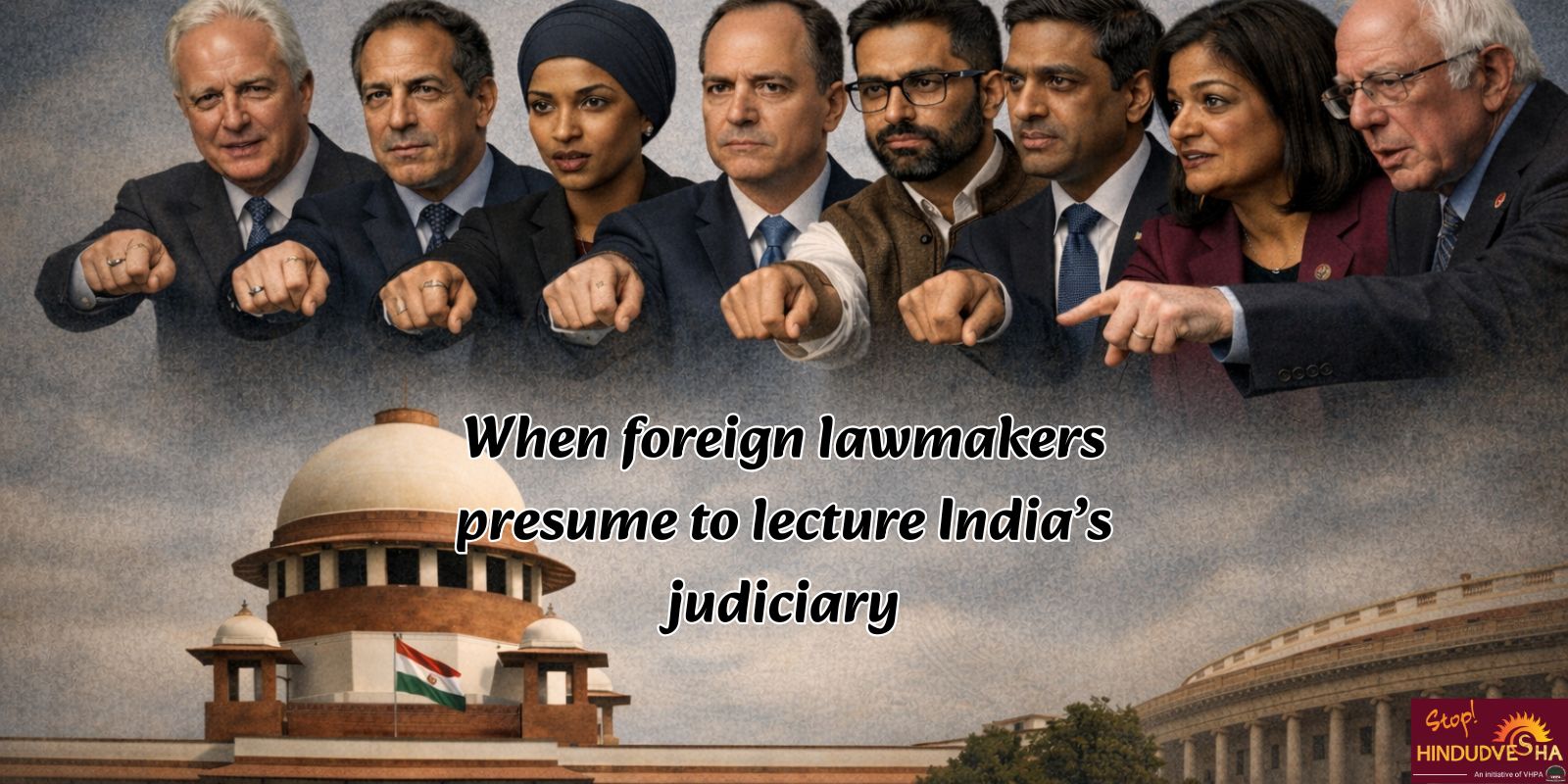
- U.S. lawmakers intervening in India’s terrorism cases reveal a pattern of selective outrage that questions India’s judiciary while overlooking comparable legal and security controversies at home.
- The pressure campaign reflects ideological bias and lingering power asymmetries rather than a neutral commitment to universal human rights standards.
- India’s independent judicial process is treated with suspicion, even as similar or harsher measures in the United States escape comparable scrutiny.
- The lawmakers’ public records show consistent engagement with narratives critical of India, forming a discernible pattern rather than isolated concern.
- Such interventions risk undermining judicial sovereignty, inflaming diplomatic tensions, and weakening democratic partnerships at a moment of shared global challenges.
In November 2008, Lt. Col. Prasad Purohit of the Indian Army was falsely accused of terrorism, arrested while still in uniform, subjected to custodial torture, and spent nearly a decade in prison without a conviction. After 17 long years of legal persecution, a court finally acquitted him of all charges in 2025[1]. There were no candlelight vigils, no anguished statements from European NGOs, and no sermons on human rights from American politicians. An innocent officer’s career was destroyed, his family’s honor dragged through the mud — yet the self-appointed guardians of global conscience remained conspicuously silent.
Contrast this silence with the deafening outrage over Umar Khalid and Sharjeel Imam — figures accused by Indian authorities of instigating violence against Hindus during the 2020 Delhi riots[2]. Both face grave charges linked to the 2020 protests against the Citizenship Amendment Act. Khalid, a former student leader at Jawaharlal Nehru University, is accused of being part of a larger conspiracy, with investigators citing speeches and communications intended to incite violence. The Imam was arrested for inflammatory remarks calling for the severing of India’s Northeast and has been linked by investigators to terror planning. Here, certain American politicians — with no skin in the game — are falling over themselves to demand their release. The hypocrisy is impossible to ignore.
Jurisdictional Overreach
Here’s how it panned out. In early December, in a handwritten note, New York City’s first Muslim mayor, Zohran Mamdani, addressed Khalid, an Indian student activist who has been in custody since 2020 under the Unlawful Activities (Prevention) Act on charges linked to the Delhi riots. The Delhi riots left 53 people — mostly Hindus — dead and more than 700 injured[3].
In the brief message, Mamdani — whose mandate does not extend beyond local governance— wrote: “Dear Umar, I think of your words on bitterness often, and the importance of not letting it consume one’s self. It was a pleasure to meet your parents. We are all thinking of you[4].”
The note was given to Khalid’s parents when they met Mamdani during a visit to the United States in December 2025 and was later shared publicly by Khalid’s partner on social media. For those not in the loop, Khalid’s father, Syed Qasim Rasool Ilyas, is a former member of the banned Islamic terrorist group, the Students Islamic Movement of India or SIMI[5].
Again, in early January 2026, eight US lawmakers — Jim McGovern, Jamie Raskin, Pramila Jayapal, Jan Schakowsky, Lloyd Doggett, Rashida Tlaib, and Senators Chris Van Hollen and Peter Welch — wrote a letter to India’s ambassador in Washington DC, urging Indian authorities to provide bail and a speedy trial for Khalid in “accordance with international law.”
The lawmakers sought clarity on why judicial proceedings in Khalid’s case have yet to commence despite the passage of more than five years since his arrest. They also expressed concern over what they described as the extended use of pretrial detention under India’s anti-terror legislation and the broader implications for civil liberties. McGovern later reiterated the demand publicly after meeting Khalid’s parents in Washington earlier this month. “Earlier this month, I met with the parents of Umar Khalid, who has been jailed in India for over five years without trial,” he wrote in a social media post[6].
Transatlantic Intervention with No Good Outcome
These transatlantic interventions, framed as concern for human rights, amount to an extraordinary intrusion into India’s sovereign judicial process. India, the world’s largest democracy, has an independent judiciary that, while not without shortcomings, operates within a clearly defined constitutional framework. Viewed in this light, such interventions reflect a lingering legacy of Western presumptive moral authority, risk insulting the integrity of India’s judiciary, and inevitably invite comparisons with shortcomings in America’s own criminal justice and incarceration systems, while also raising fundamental questions about sovereignty in an increasingly interconnected world.
The cases of Imam and Khalid stem from the turbulent protests against India’s Citizenship Amendment Act, which fast-tracked citizenship for non-Muslim refugees from neighboring countries, sparking fears of institutionalized discrimination against Muslims. Describing the bill as discriminatory depends on a reading that sets aside both history and context. Here’s why:
In 1947, as the British left, they divided India into three parts — India for Hindus, Muslims, Sikhs, Christians, Buddhists, and everyone else; West Pakistan (now Pakistan) for Muslims; and East Pakistan (now Bangladesh) also for Muslims. Anyone who doesn’t live under a rock can see Hindus (and other non-Muslim minorities) in Pakistan, Bangladesh and Afghanistan face persecution and religious violence from Islamic groups. The Act is, therefore, intended as a homecoming law for non-Muslims from these three Islamic countries. In fact, even some Muslims facing religious persecution in these countries are given asylum in India on a case-by-case basis. So, it is extremely churlish for Islamists like Imam and Khalid to cry discrimination.
The riots that they and their followers instigated in Delhi in February 2020 were a flashpoint of communal violence, with the police finding a broader conspiracy involving student activists. Both men were charged under the Unlawful Activities Prevention Act for offenses including sedition, promoting enmity between groups, and conspiracy to commit terrorist acts, all of which constitute serious charges in any jurisdiction.
India’s Supreme Court — which is often accused of being sympathetic towards Islamists and is certainly not pro-Hindu — has repeatedly reviewed their bail pleas, denying them on grounds of prima facie evidence, though it granted bail to several co-accused in related cases.
Asymmetries in How Democracies Judge One Another
India’s anti-terror laws are not unique. The United States employs similar laws, such as the Patriot Act, which expanded surveillance and detention powers post-9/11[7]. Yet when India invokes such measures in response to threats, it invites foreign scrutiny. Imagine if Indian parliamentarians penned letters to the U.S. ambassador, demanding accountability for the detainees at Guantanamo Bay, where, as of 2025, 15 men remain held indefinitely, many without trial for over two decades.
Established in 2002 as a post-9/11 detention facility, Guantanamo has housed 780 individuals, men and boys, all of them Muslim; 86 percent were sold to the United States during a time when the American military was offering large bounties for capture; commonly, $5,000 was offered per man. 22 or more children were taken to the detention camp. Only a handful have ever been convicted. Nine detainees have died there without charges, far outnumbering the convictions. Such prolonged detentions, often involving torture like waterboarding, have been condemned by the UN as violations of international law[8].
Comparable concerns also arise within the United States. Black Americans, comprising 13 percent of the population, make up 37 percent of the incarcerated, a disparity rooted in systemic racism. In federal prisons, Blacks account for 38.3 percent of inmates. One in three Black men can expect lifetime imprisonment, compared to one in 17 white men. Death row reflects this: Blacks are disproportionately sentenced to death[9]. Were similar disparities elsewhere framed using the language of racial segregation or apartheid, such characterizations would likely be met with strong resistance in Washington.
Then there’s “Driving While Black,” a phenomenon where Black drivers are stopped at rates far exceeding their demographic share[10]. In cities like Minneapolis, Blacks are five times more likely to be pulled over than whites; in Chicago and San Francisco, four times. These stops often escalate fatally, as in the cases of Philando Castile and Daunte Wright, unarmed Black men killed during routine traffic encounters. Since 2017, over 800 people have died in U.S. traffic stops, with Blacks comprising over 25 percent despite being 14 percent of the population.
Mass shootings, another American epidemic, claimed 408 lives in 2025, the lowest in five years but still averaging more than one per day. With 420 killed and 1,898 wounded across 425 incidents, these tragedies highlight persistent challenges in gun regulation and public safety. Were Indian officials to raise similar concerns in human-rights terms, such commentary would likely be viewed in Washington as unwelcome interference. By contrast, when American lawmakers raise parallel critiques of India, they are often presented as expressions of principled concern rather than intrusion.
This asymmetry is rooted in historical power imbalances that continue to shape global discourse, wherein Western democracies often presume the moral authority to scrutinize and instruct the Global South. But India’s democracy, with its vibrant press, opposition parties, and electoral turnouts dwarfing America’s, needs no such tutelage. The interventions by Mamdani and the eight lawmakers risk straining Indo-U.S. ties at a time when strategic partnerships against China are paramount.
The Lawmakers Behind the Pressure Campaign
To understand these interventions, one must profile the actors involved.
Jim McGovern: The Massachusetts Democrat’s public statements and legislative actions have consistently reflected a critical posture toward India’s policy decisions. McGovern has described India’s Citizenship Amendment Act as “fundamentally discriminatory” for excluding Muslims, a characterization that places him among prominent critics of the current Indian government. Taken together, his remarks and initiatives form part of a broader pattern of congressional engagement that challenges India’s domestic legal and political choices[11].
McGovern has also engaged with advocacy organizations such as the Indian American Muslim Council (IAMC), which has been criticized by some observers for its positions on India and alleged links, through individuals associated with it, to the now-banned Students’ Islamic Movement of India (SIMI). IAMC testified before the Tom Lantos Human Rights Commission in 2016 on human rights in India, and McGovern has echoed concerns raised by the group regarding the treatment of religious minorities[12].
Jamie Raskin: The Maryland Democrat and constitutional law scholar is a prominent progressive and serves as vice chair of the Congressional Progressive Caucus. In 2019, Raskin, then co-chair of the so-called Freethought Caucus, led a group of 15 members of Congress in urging then–Secretary of State Mike Pompeo to support a set of Indian civil society activists, including lawyers Indira Jaising and Anand Grover. The intervention followed actions by India’s Central Bureau of Investigation, which had filed a criminal case against the Lawyers Collective over alleged misuse of foreign funds. Raskin and his colleagues expressed concern over what they viewed as the broader implications of these proceedings[13].
In 2020, Raskin also criticized India’s decision to halt Amnesty International’s operations in the country. In a public statement, he characterized the move as detrimental to democratic norms and called on U.S. officials to raise the issue with Indian authorities. His remarks aligned with concerns expressed by a range of international advocacy groups regarding civil liberties and freedom of association in India[14].
Pramila Jayapal: Born in Chennai in 1965, she is an Indian American progressive who served as chair of the Congressional Progressive Caucus until 2025. She has been a persistent critic of the Indian government’s actions in Jammu and Kashmir, particularly following the revocation of the region’s special status in August 2019. In December 2019, she introduced a resolution in the U.S. House of Representatives sharply criticizing India’s efforts to restore administrative normalcy in a region that has endured decades of Islamist militancy and violence.
Notably absent from her critique was any acknowledgment of the subsequent decline in large-scale violence or the Indian government’s reliance on administrative and legal measures rather than military force. For critics, this selective focus suggests that continued instability serves certain activist narratives better than demonstrable on-the-ground improvements.
Her resolution and public criticism prompted an unusually blunt response from India’s External Affairs Minister, S. Jaishankar, during his visit to Washington for the India–U.S. 2+2 dialogue. Jaishankar stated publicly that the resolution misrepresented conditions in Jammu and Kashmir and said he was “not interested” in meeting Jayapal, given her position.
According to U.S. media reports, the Indian side later requested that Jayapal be excluded from a planned meeting with a visiting congressional delegation; when House Foreign Affairs Committee leadership declined, the meeting was cancelled altogether[15].
Jayapal has consistently aligned herself with advocacy positions that critics argue mirror or amplify Islamist narratives, raising concerns about ideological blind spots rather than principled engagement with India’s security challenges[16].
Janice “Jan” Schakowsky: The Illinois Democrat serves as a vice chair of the Congressional Progressive Caucus and has consistently supported initiatives that frame Muslims primarily through the lens of victimhood. In 2021, she co-sponsored the Combating International Islamophobia Act, legislation introduced by Representative Ilhan Omar and promoted as a response to rising Islamophobia worldwide. The bill drew criticism from observers who questioned its framing and viewed its objectives as politically selective rather than even-handed.
In 2023, Schakowsky publicly urged then-President Joe Biden to raise human rights concerns in his engagements with India during Prime Minister Modi’s state visit. In a social media post, she emphasized that respect for human rights was essential to democracy and to maintaining strong U.S.–India relations, reinforcing her broader pattern of public advocacy focused on India’s internal affairs[17].
Lloyd Doggett: The Texas Democrat is a longtime member of the Congressional Caucus on India, though his record on U.S.–India relations has been uneven. In 2008, he voted against recognizing India as a nuclear power. By 2020, in a Republic Day statement, he criticized the Modi government for allegedly using national symbols and religious identity to divide communities. Doggett has also opposed India’s Citizenship Amendment Act, the National Register of Citizens, and the revocation of Jammu and Kashmir’s special status.
He further signaled his alignment with activist narratives by praising then–Jawaharlal Nehru University students’ union president Aishe Ghosh as a “courageous student” resisting what he described as a “violent Hindu nationalist assault,” and by calling for U.S. pressure on India over these issues[18].
Rashida Tlaib: The Michigan Democrat is a Palestinian American lawmaker whose political profile has been closely associated with outspoken opposition to Israel and its policies, positions that have repeatedly generated bipartisan controversy. In 2021, Tlaib participated in a panel discussion on Kashmir organized by Justice for All, an organization affiliated with Sound Vision in Chicago. Watchdog groups have described Sound Vision as part of a broader network connected to the Islamic Circle of North America, which has itself faced scrutiny over ideological and organizational ties to Islamist movements such as the Muslim Brotherhood and Jamaat-e-Islami[19].
In June 2023, ahead of Prime Minister Narendra Modi’s address to the U.S. Congress, Tlaib, along with Ilhan Omar, announced that she would boycott the speech, calling Modi’s visit “shameful[20].” [23]
Tlaib’s rhetoric on Israel has drawn sustained criticism across party lines. She has supported positions widely interpreted as denying Israel’s legitimacy as a Jewish state, and in 2023, she became one of the few members of Congress to be formally censured over her statements on the Israel–Gaza conflict. The censure resolution passed with support from 22 members of her own party, underscoring the extent to which her remarks were viewed as crossing accepted political boundaries[21].
Chris Van Hollen: The Maryland Democratic Senator, born in Karachi to American parents during his father’s Foreign Service posting, co-signed a bipartisan letter with Senators Todd Young, Dick Durbin, and Lindsey Graham addressed to then–Secretary of State Mike Pompeo[22]. The letter asserted that India’s internet shutdown in Kashmir had severely disrupted access to medical care, commerce, and education for millions of residents. Indian authorities and subsequent security developments, however, contested this portrayal, noting that the region soon experienced a marked decline in large-scale terrorist violence.
Ilhan Omar: The Minnesota Democrat, who was born in Somalia, has been a prominent and controversial voice on issues involving Islam, foreign policy, and India. In 2019, Omar drew widespread condemnation across party lines for referring to the September 11 attacks as “some people did something,” a remark she later said was misunderstood but which many critics viewed as minimizing an act of mass terrorism[23]. She has since aligned herself with advocacy positions sympathetic to Islamist causes globally and has been a persistent critic of India, particularly on Kashmir and minority rights.
With support from like-minded progressive networks in both the United States and abroad, Omar has repeatedly pressed the issue of Kashmir in the U.S. House of Representatives, often adopting positions closely aligned with Pakistan’s narrative and calling for U.S. intervention. She has also advanced claims about widespread attacks on minorities and the suppression of human rights in India, assertions that Indian authorities and several independent observers have disputed.
In 2022, Omar intensified controversy by comparing Prime Minister Narendra Modi to Augusto Pinochet, the former Chilean dictator, a comparison widely criticized as inflammatory and historically unsound[24].
Conclusion: The Hubris of Selective Human Rights Advocacy
These profiles suggest a consistent pattern: the positions in question are shaped less by lobbying from anti-India groups than by a particular strain of progressive universalism. While apparently grounded in concern for human rights, this framework too often slides into paternalism when applied to sovereign, pluralistic democracies.
India is not immune to criticism, nor should it be. But it is also not a subordinate polity awaiting external instruction. Its judiciary, despite imperfections, is independent, adversarial, and constitutionally anchored. Attempts to influence it through public letters, symbolic interventions, or moral posturing risk reviving an older habit of lecturing rather than listening. They also overlook an inconvenient truth: the United States itself continues to wrestle with profound and unresolved injustices, from indefinite detention to racialized mass incarceration.
At a moment of shifting global power and shared strategic challenges, particularly the rise of authoritarian China, the India-U.S. relationship calls for maturity, reciprocity, and restraint. Human rights advocacy that is selective, partisan, rests on public hectoring, or is detached from the local context does not strengthen universal values. Instead, it can undermine sovereignty, inflame polarization, and weaken partnerships between democracies.
Citations
[1] The Times of India. “Malegaon Blast Verdict: Who Is Lt Col Prasad Purohit, the Army Officer Who Faced Terror Charges and Walked Free After Court’s Acquittal.” https://timesofindia.indiatimes.com/city/mumbai/malegaon-blast-verdict-who-is-lt-col-prasad-purohit-the-army-officer-who-faced-terror-charges-and-walked-free-after-courts-acquittal/articleshow/123015200.cms
[2] Swarajya. “Every House Became a Fortress: A Survivor’s Account of Tahir Hussain’s Delhi Riots.” https://swarajyamag.com/politics/every-house-became-a-fortress-a-survivors-account-of-tahir-hussains-delhi-riots
[3] Moneycontrol. “Delhi Riots Case: 8 US Lawmakers Write to India’s Envoy Seeking Bail, Timely Trial for Umar Khalid.” https://www.moneycontrol.com/news/india/delhi-riots-case-8-us-lawmakers-write-to-india-s-envoy-seeking-bail-timely-trial-for-umar-khalid-13753269.html
[4] NDTV. “Focus on Your Responsibilities: India Slams Zohran Mamdani’s Note for Umar Khalid.”
https://www.ndtv.com/world-news/focus-on-your-responsibilities-india-slams-zohran-mamdanis-note-for-umar-khalid-10570508
[5] TFI Post. “SQR Ilyas, Father of Umar Khalid, and His SIMI Links.” https://tfipost.com/2019/11/sqr-ilyas-father-of-non-believer-umar-khalid-who-filed-review-petition-against-sc-verdict-on-ram-mandir/
[6] News18. “Umar Khalid Bail: US Lawmakers Seek Fair and Timely Trial.” https://www.news18.com/world/umar-khalid-bail-fair-timely-trial-appeal-us-lawmakers-letter-to-india-ambassador-in-us-2020-delhi-riots-case-9804724.html
[7] American Civil Liberties Union. “Surveillance Under the USA PATRIOT Act.” https://www.aclu.org/documents/surveillance-under-usapatriot-act
[8] Center for Constitutional Rights. “Guantánamo by the Numbers.” https://ccrjustice.org/home/get-involved/tools-resources/fact-sheets-and-faqs/guant-namo-numbers
[9] Prison Policy Initiative. “Racial and Ethnic Disparities in the U.S. Criminal Justice System.” https://www.prisonpolicy.org/research/racial_and_ethnic_disparities/
[10] ABC News. “Driving While Black: Analysis of Traffic Stops Reveals Racial Disparities.” https://abcnews.go.com/US/driving-black-abc-news-analysis-traffic-stops-reveals/story?id=72891419
[11] OpIndia. “Global Anti-India Forces Unite as 8 US Lawmakers Write Letter Seeking Umar Khalid’s Release.” https://www.opindia.com/2026/01/global-anti-india-forces-unite-8-us-lawmakers-write-letter-to-free-umar-khalid/
[12] Indian American Muslim Council. “IAMC Testifies Before Congressional Human Rights Commission on India.” https://iamc.com/iamc-testifies-before-congressional-human-rights-commission-on-challenges-and-opportunities-the-advancement-of-human-rights-in-india-2/
[13] Raskin, Jamie. “Raskin Leads 15 Members Urging Pompeo to Support Human Rights Defenders in India.” U.S. House of Representatives, August 2019. https://raskin.house.gov/2019/8/raskin-leads-15-members-urging-pompeo-support-human-rights-defenders-india
[14] Raskin, Jamie. Post on X (formerly Twitter), October 2020. https://x.com/RepRaskin/status/1321075150603886592
[15] Economic Times. “India Scraps Meeting with US Lawmakers Over Kashmir Criticism.” https://economictimes.indiatimes.com/news/international/world-news/india-scraps-meeting-with-us-lawmakers-over-kashmir-criticism/articleshow/72897242.cms
[16] Guardian. “The July 7 Bombings and the Politics of Terror.” July 19, 2005. https://www.theguardian.com/uk/2005/jul/19/july7.politics
[17] Raskin, Jamie. Post on X (formerly Twitter), October 2020. https://x.com/RepRaskin/status/1321075150603886592
[18] Doggett, Lloyd. “Republic Day Statement: Defend India’s Constitution.” U.S. House of Representatives. https://doggett.house.gov/media/press-releases/republic-day-defend-indias-constitution
[19] NGO Monitor. “NGO Ties to Terror-Linked Conference Featuring Rashida Tlaib.” https://ngo-monitor.org/reports/ngo-ties-to-terror-linked-new-jersey-conference-featuring-rashida-tlaib-and-pflp-member/
[20] Newsweek. “Rashida Tlaib Boycotts Indian PM Modi’s Address to Congress, Calls Visit ‘Shameful.’” June 2023. https://www.newsweek.com/rashida-tlaib-boycott-indian-pm-modis-address-congress-shameful-1807955
[21] BBC News. “Why Rashida Tlaib Was Censured by the U.S. Congress.” https://www.bbc.com/news/world-us-canada-67354706
[22] Van Hollen, Chris. “Van Hollen, Young, Durbin, and Graham Request State Department Assessment on Kashmir.” U.S. Senate.
https://www.vanhollen.senate.gov/news/press-releases/van-hollen-young-durbin-and-graham-request-state-department-assessment-of-situation-in-kashmir-and-of-religious-minorities-in-india
[23] OneIndia. “Ilhan Omar: The Anti-India Ranter and the Muslim Card.” https://www.oneindia.com/india/ilhan-omar-the-anti-india-ranter-is-out-plays-the-muslim-card-and-why-we-aren-t-surprised-3519005.html
[24] The Week. “US Lawmaker Laughs Off Criticism After Comparing Modi to Pinochet.” https://www.theweek.in/news/india/2022/04/08/us-lawmaker-laughs-off-criticism-after-terming-modi-the-new-pinochet.html

Donate to HINDUDVESHA
Our Mission is to explore and expose Hindudvesha through research analysis, education and response.
SUPPORT US