

How Hindu Civilizational Memory Is Slowly Being Erased, One Symbol at a Time
 Aditi Joshi · 03/02/2026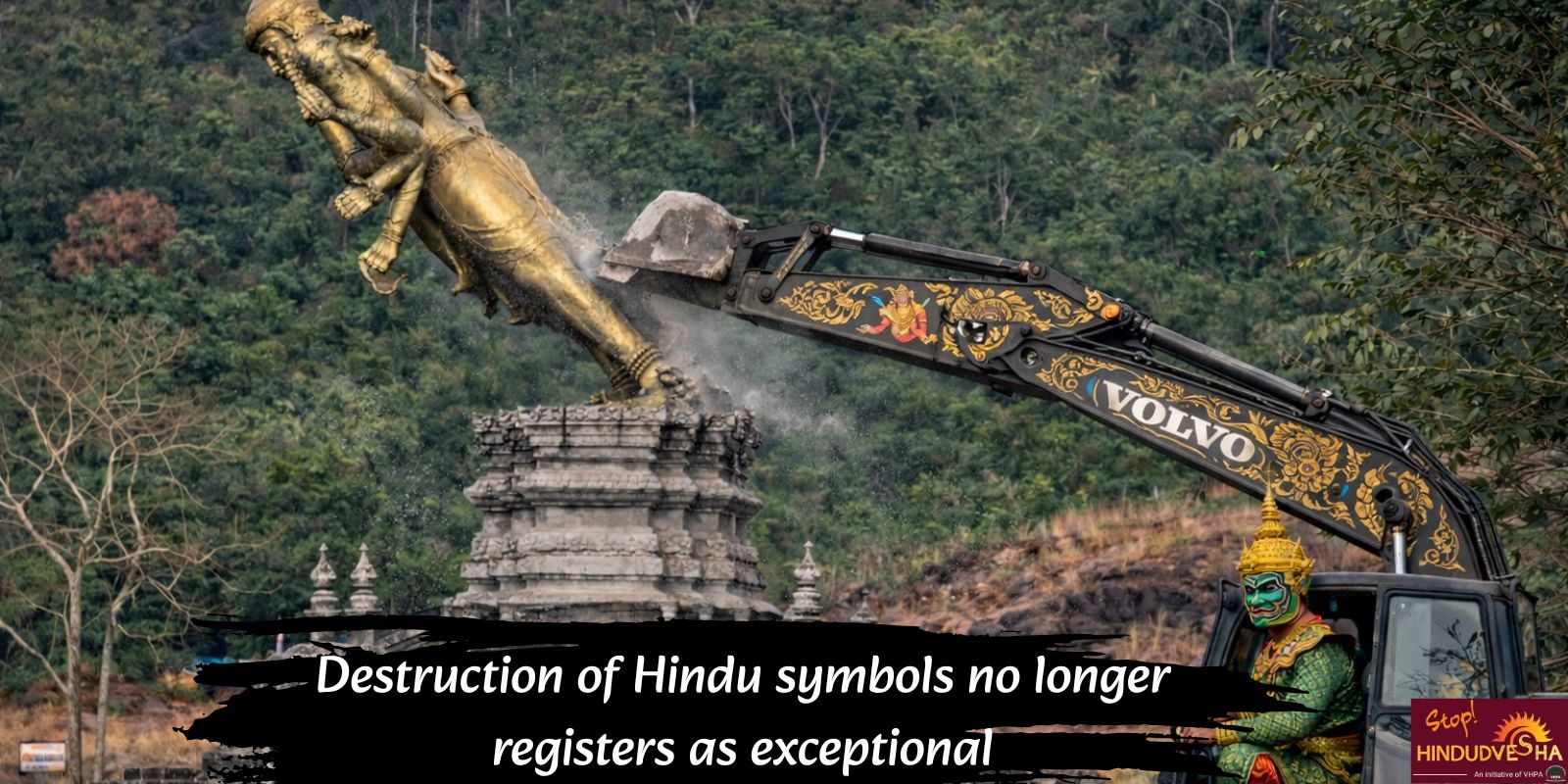
- In regions like Thailand and Cambodia, Hinduism historically functioned as a civilizational grammar shaping kingship, law, aesthetics, and sacred geography.
- Hindu symbology is uniquely exposed because it is omnipresent yet institutionally undefended: lacking centralized authority, rapid-response advocacy, or legal red lines. This allows symbolic attacks to be downgraded as “law-and-order issues,” normalizing injury without civilizational consequence.
- Repeated symbolic injury erodes collective memory. Internal Hindu fragmentation prevents a unified civilizational response, while postcolonial frameworks recast Hindu symbols as folkloric relics rather than living carriers of meaning, facilitating gradual, cumulative erasure.
- Comparative cases (India, Pakistan, Bangladesh, UK diaspora, Bali) reveal the same outcome: Hindus retain presence but lack symbolic sovereignty. Without reclaiming symbols as anchors of historical continuity, Hindu civilization remains vulnerable to slow, normalized loss of meaning rather than overt destruction.
Incidents involving the desecration or damage of Hindu religious symbols are routinely dismissed as isolated acts of vandalism, localized criminality, or incidental by-products of political unrest. Such framings, however, obscure a recurring and transregional pattern: Hindu symbology disproportionately becomes a target during periods of social stress, political transition, and ideological contestation. This pattern persists across majority and minority contexts alike, despite Hinduism’s exceptional civilizational longevity, geographic diffusion, and historical role as a foundational cultural force across Asia.
It is imperative to look at the reported damage to Hindu religious idols in Thailand as a diagnostic case within a broader comparative and civilizational framework. Rather than treating the incident as an aberration, it situates it within a structural condition in which Hindu symbols, icons, temples, and sacred geographies are rendered symbolically visible yet institutionally vulnerable.[1] Even in regions where Hindu cosmology once shaped kingship, law, aesthetics, and political theology, its material and symbolic presence today is increasingly treated as peripheral, negotiable, or politically expendable.
The central argument advanced here is that attacks on Hindu symbology are neither accidental nor merely opportunistic. They reflect a structural vulnerability produced by historical amnesia, postcolonial reconfigurations of identity, and the internal fragmentation of Hindu communities themselves. Together, these forces normalize symbolic injury, fragment collective response, and allow repeated acts of desecration to be absorbed without civilizational consequence. By placing the Thai incident within a comparative analysis spanning South Asia, Southeast Asia and the Hindu diaspora, this study argues that symbolic vulnerability, rather than demographic weakness, constitutes the defining challenge facing Hindu civilizational continuity in the contemporary world.
Hinduism as a Civilizational Framework in Mainland Southeast Asia
Long before the emergence of modern nation-states such as Thailand and Cambodia, Hinduism operated as a civilizational grammar across mainland Southeast Asia, a shared system of symbols, cosmology, political theology, and aesthetic order through which societies articulated authority, space, and meaning.[2] Between the first and thirteenth centuries CE, Indic thought was not simply transmitted as religious doctrine but internalized as a comprehensive cultural framework. Sanskrit functioned as a prestige language of governance and ritual; Hindu cosmology structured conceptions of time and kingship; and dharmic principles informed legal norms and moral legitimacy.
Central to this civilizational order was the concept of devarāja (divine kingship), which positioned the ruler as a sacral figure embedded within the cosmic hierarchy.[3] Drawing on Shaiva and Vaishnava metaphysics, kingship was conceived not as a secular office but as a ritual function that mediates between the human and the divine. Political authority was thus inseparable from ritual sovereignty: the king ruled by embodying cosmic order (ṛta) and the stability of the kingdom was understood as a reflection of metaphysical harmony.[4] This fusion of governance and sacrality shaped court ritual, lawmaking and the spatial organization of capitals and temples alike.
Monumental temple complexes such as Angkor Wat, originally consecrated to Vishnu, exemplify this synthesis of cosmology, politics and architecture. These structures were not merely sites of worship but cosmograms, three-dimensional representations of the Hindu universe. Their axial alignments, tiered towers and surrounding moats symbolically mapped Mount Meru and the cosmic ocean, situating the king and his realm at the center of a divinely ordered universe. Temple urbanism thus transformed geography into theology, embedding power within sacred space.
A parallel process unfolded in the cultural sphere. Thailand’s national epic, the Ramakien, is a localized rendering of the Ramayana, rearticulated through regional idioms yet retaining its core dharmic structure.[5] Far from being a peripheral literary borrowing, the Ramakien functioned as a moral and political text, shaping ideals of kingship, loyalty, justice, and ethical conduct. Through court performances, visual art, and popular retellings, Ramayana-derived narratives became integral to Thai cultural consciousness, reinforcing Hindu ethical cosmology even as religious practice evolved.
Importantly, the subsequent ascendance of Buddhism in the region did not entail a wholesale displacement of Hindu civilizational forms. Instead, Southeast Asia witnessed a process of religious layering rather than civilizational rupture. Hindu deities such as Brahma, Vishnu, Shiva, Ganesha, and Indra retained prominent roles within royal rituals, state symbolism, and popular devotion. Brahmanical priests continued to officiate coronations and court ceremonies; Hindu cosmological motifs structured concepts of sovereignty; and shrines dedicated to Hindu gods proliferated in urban centers, including contemporary Bangkok.
This enduring presence testifies to the depth of Hinduism’s civilizational imprint. Rather than being supplanted, Hindu cosmology was absorbed, adapted and preserved within Buddhist-majority societies as a foundational layer of cultural memory. The resulting religious ecology was plural, stratified and historically continuous. It is within this context of deep integration, rather than marginal coexistence, that contemporary damage to Hindu symbols must be understood. Such acts do not merely affect a religious minority; they disrupt a civilizational inheritance that once structured the region’s political authority, sacred geography, and collective identity.
To treat all symbolic destruction as civilizationally equivalent is, therefore, analytically imprecise. Hindu sacred structures in Southeast Asia are uniquely vulnerable because they arose through accommodation rather than conquest. Their loss represents not resistance to domination, but the erosion of a civilizational substratum that once enabled pluralism, continuity, and shared meaning to endure.
The Global Pattern: Presence Without Preservation
The Thai incident[6] is not an isolated anomaly but a localized manifestation of a broader global pattern observable across South Asia, Southeast Asia, the Hindu diaspora, and even within India itself. Across these varied contexts, a striking paradox recurs: Hinduism, despite being one of the world’s oldest living civilizations and among the most geographically widespread, repeatedly struggles to preserve the integrity of its symbolic ecosystem. Temples are desacralized or bureaucratically neutralized, icons are defaced or vandalized, rituals are mocked or delegitimized, and sacred geographies are repurposed or stripped of their religious significance, often under the ostensibly neutral vocabularies of secularism, modernization, development, or social justice.
This pattern is not reducible to demographic weakness or political marginality. It appears with equal force in contexts where Hindus constitute an overwhelming majority, where they are a vulnerable minority, and where they exist as diasporic communities within liberal-democratic states. What unites these disparate settings is not the external form of power but the absence of symbolic security. Hindu presence is widespread, visible, and historically entrenched, yet its symbols remain negotiable, contestable, and unusually exposed to symbolic aggression.
This condition, global presence without symbolic protection, is significantly exacerbated by internal fragmentation within Hindu society. Linguistic, caste-based, sectarian, regional, and ideological divisions frequently inhibit the articulation of a unified civilizational response. Attacks on Hindu symbols are often interpreted through narrow, localized frames: as regional law-and-order issues, caste-specific grievances, sectarian provocations, or isolated cultural misunderstandings. Rarely are they recognized as cumulative assaults on a shared symbolic order.
The consequence of this fragmentation is not merely disunity, but normalization. Symbolic aggression becomes compartmentalized and rationalized, absorbed into everyday political noise rather than treated as a structural threat. Each incident is mourned or contested in isolation, preventing the formation of a civilizational memory of injury. Over time, repetition without consolidation produces habituation, and habituation erodes the threshold of collective response.
Compounding this internal vulnerability is the enduring influence of postcolonial intellectual frameworks, which have systematically reclassified Hindu symbols as remnants of a “pre-modern” or “traditional” past rather than as living carriers of philosophical, ethica,l and cultural meaning. Within this epistemic order, Hindu symbology is often positioned as incompatible with modern rationality, secular governance, or progressive politics. Its presence is tolerated as heritage or folklore but resisted as a civilizational assertion.
Divisive Tactics and the Politics of Amnesia
The repeated targeting of Hindu symbols must also be understood within the broader politics of manufactured amnesia, a process through which societies are gradually detached from their own civilizational memory. When shared symbolic markers are damaged, desacralized, or delegitimized, the loss is not merely religious or aesthetic; it is epistemic. Societies lose access to integrative narratives that once transcended contemporary divisions of class, caste, region, or ideology. What remains is a fragmented present severed from its historical grammar.
Hindu symbology occupies a uniquely vulnerable position within this process precisely because of its former integrative function. For centuries, Hindu symbols unified political authority, metaphysical meaning, and aesthetic order within a single civilizational framework. Temples were not only sites of worship but centers of learning, economic exchange, artistic production, and political legitimacy. Myths were not folklore but moral cartographies through which societies understood duty, power, and justice. When such symbols are attacked or trivialized, the rupture is therefore strategic: it destabilizes the connective tissue that once linked governance, culture, and worldview.
Divisive tactics thrive in environments where civilizational memory is weakened. The erosion of Hindu symbolic presence creates precisely such conditions. As temples lose sacral authority, rituals are recoded as spectacle and sacred geographies are renamed or repurposed, historical continuity becomes increasingly difficult to perceive. In this vacuum, alternative narratives, often discontinuous, selective, or externally derived, can be inserted with minimal resistance. History is reframed not as an evolving indigenous continuum but as a series of disconnected episodes, borrowings, or interruptions.
Over time, this process produces populations that continue to inhabit Indic civilizational landscapes while remaining largely unaware of their origins. Architectural forms persist without cosmological meaning; festivals survive without philosophical grounding; place-names endure even as their etymological and sacred resonances are forgotten. This condition, inhabitation without recognition, is the most effective form of civilizational erasure, because it eliminates the need for overt suppression. When memory is sufficiently thinned, symbols no longer require active destruction; they decay through neglect, reinterpretation, or administrative neutralization.
The long-term consequence is a reduced capacity for resistance. Societies that do not recognize symbols as carriers of historical continuity are unlikely to defend them as such. Each act of desecration appears isolated; each loss appears negotiable, and each rupture appears reversible. In reality, the cumulative effect is irreversible. Manufactured amnesia ensures that erasure becomes self-sustaining: the less a society remembers, the less it feels compelled to preserve; the less it preserves, the more fragmented its memory becomes.
Comparative Civilizational Vulnerability: India, Pakistan, Bangladesh, the UK Diaspora, and Bali
A comparative lens reveals that targeting Hindu symbolism is neither geographically anomalous nor culturally incidental. Across radically different political regimes, majoritarian, minority, secular, postcolonial, and diaspora contexts, the same structural outcome recurs: Hindu symbols are disproportionately exposed to desecration, delegitimation, or administrative erosion, while Hindu communities respond in fragmented, localized, and ultimately ineffective ways. This pattern suggests a civilizational weakness rather than a situational one.
India offers the clearest internal comparison. Despite the Hindu demographic majority, the vulnerability of Hindu symbology is paradoxically most revealing. Temples are state-controlled, sacred practice is bureaucratically regulated, and acts of desecration are routinely reframed as “law and order issues” rather than civilizational assaults. Hindu symbols are expected to absorb provocation in the name of secular stability, while attempts to establish symbolic red lines are quickly recoded as majoritarian aggression.
This asymmetry produces a condition in which Hindu sacred spaces are accessible but undefended, visible but politically negotiable. The majority status of Hindus thus becomes a liability: numerical strength substitutes for institutional protection, while symbolic injury is normalized as the cost of pluralism. The result is not harmony but habituation to erosion.
In Pakistan, the story advances from vulnerability to near-total absence. Hindu temples, icons and sacred geographies that once formed part of the subcontinent’s civilizational continuum now survive largely as archaeological remnants or contested relics. Desecration here is not episodic but structural, enabled by legal exclusion, demographic intimidation, and theological delegitimation.
Crucially, the near-complete disappearance of Hindu symbology in Pakistan did not begin with mass violence alone; it began with symbolic delegitimation, the quiet normalization of Hindu absence from public space. This trajectory serves as a cautionary precedent: when symbolic loss is tolerated early, physical erasure follows with alarming predictability.
In Bangladesh, attacks on Hindu temples and idols often coincide with political cycles, electoral tensions, or international triggers. Each incident is treated as isolated, reactive, or externally provoked. Yet cumulatively, these episodic assaults generate a climate of chronic insecurity.
Here, Hindu symbology becomes a proxy target, an accessible surface upon which larger political anxieties are discharged. The repeated failure to impose civilizational costs for such acts ensures their recurrence. What emerges is not spontaneous chaos but a predictable rhythm of symbolic attrition.
In the United Kingdom, Hindu temples and icons exist within a liberal-secular framework that promises protection but delivers conditional tolerance. Hindu symbols are welcome as “cultural diversity” but discouraged as civilizational assertion. Desecration, vandalism, or intimidation, when it occurs, is subsumed under generic hate-crime discourse, stripped of its theological and civilizational specificity.
The diaspora condition intensifies Hindu fragmentation: linguistic, regional and sectarian identities supersede collective symbolic defense. Hindu symbology becomes hyper-visible yet politically unspeakable, present in space but absent in discourse. This renders it uniquely susceptible to pressure from more tightly organized ideological or religious blocs.
Bali offers a partial counterexample that paradoxically reinforces the argument. Hinduism survives in Bali not through assertive civilizational memory but through ritual saturation and cultural naturalization. Hindu symbols are protected because they are inseparable from Balinese identity, not because they are defended as Hindu per se.
Yet even here, preservation is contingent, not secure. Hinduism in Bali is tolerated insofar as it remains localized, aestheticized, and politically non-threatening. Its survival does not translate into a broader Hindu civilizational confidence; rather, it confirms that Hindu symbology is safest only when stripped of transregional or philosophical assertiveness.
Shatrubodh Synthesis: Presence Is Not Power
Across these cases, a stark pattern emerges: Hindus possess presence without power, memory without enforcement and symbols without sovereignty. Hindu symbology is attacked not because it is aggressive, but because it is structurally undefended. The aggressor varies, state, mob, ideology, or opportunism, but the vulnerability remains constant.
This is not merely an external failure. Hindu societies have repeatedly internalized a civilizational self-conception that privileges tolerance over continuity, adaptability over preservation, and metaphysical depth over symbolic defense. While these traits enabled historical diffusion, they have become liabilities in a modern world structured around hard identity boundaries, legal asymmetries, and narrative warfare.
Divisive tactics succeed because Hindu responses remain atomized. Each incident is mourned in isolation, litigated locally, and forgotten structurally. Without a civilizational grammar that recognizes symbolic attack as an attack on collective memory, Hinduism remains perpetually reactive, condemned to defend fragments while losing the whole.
From Tolerance to Civilizational Self-Recognition
The comparative evidence dismantles the comforting illusion that Hindu symbolic vulnerability is context-specific. Whether in majority or minority conditions, democratic or theocratic states, homeland or diaspora, Hindu symbology is consistently treated as negotiable terrain. This is the true crisis.
A Shatrubodh lens demands a civilizational recalibration: tolerance without symbolic self-recognition is not virtue but abdication. Until Hindu societies reconceptualize symbols as carriers of historical continuity rather than optional religious artifacts, attacks, whether in Thailand or elsewhere, will continue to fracture memory with impunity.
What is at stake is not sentiment, but the survival of meaning.
Citations
[1] India Condemns Hindu Deity Statue Demolition Amid Thailand–Cambodia Row | Vantage with Palki Sharma; https://www.youtube.com/watch?v=EB84dwujyzA
[2] Why are Thailand and Cambodia fighting at the border?; https://www.bbc.com/news/articles/cdjxje2pje1o#
[3] Axel Michaels, Hinduism: Past And Present; https://archive.org/details/hinduismpastpres0000mich
[4] Devarāja | Hinduism, Khmer Empire, Angkor Wat | Britannica; https://www.britannica.com/topic/devaraja
[5] Ramayana in India, Ramakien in Thailand: The Epic’s Journey to the East; https://www.indiatoday.in/education-today/gk-current-affairs/story/ramayana-in-india-ramakien-in-thailand-the-epics-journey-to-the-east-2703547-2025-04-03
[6] Cambodia-Thailand Border Conflict: Restraint in the Digital Information Battlefield – Modern Diplomacy; https://moderndiplomacy.eu/2026/01/14/cambodia-thailand-border-conflict-restraint-in-the-digital-information-battlefield/

Donate to HINDUDVESHA
Our Mission is to explore and expose Hindudvesha through research analysis, education and response.
SUPPORT US