

The Saffron Tide Moves South: How Hindutva Is Breaking Old Barriers and Gaining Ground Across Southern India
 Rakesh Krishnan Simha · 02/22/2026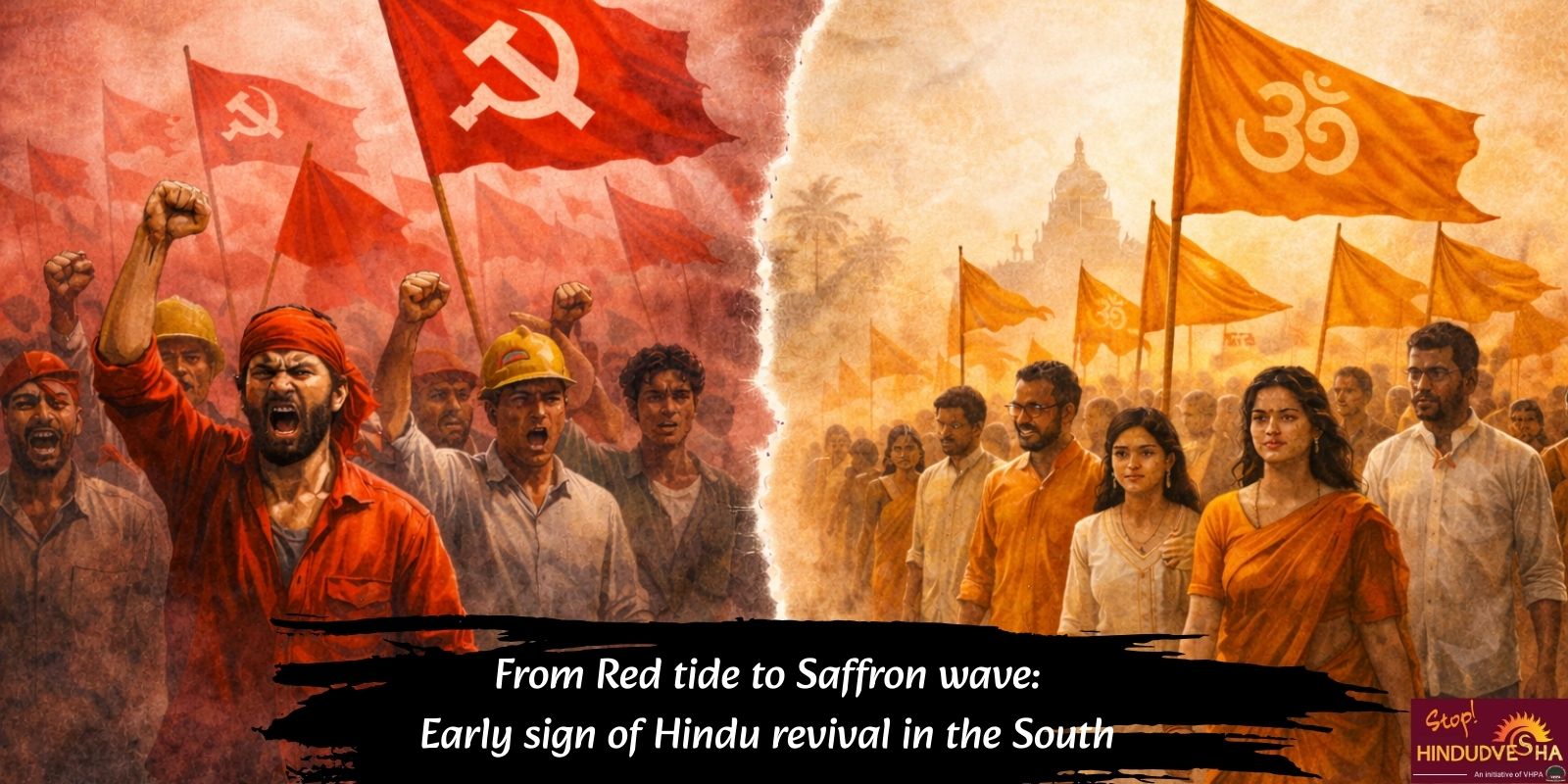
- The BJP’s breakthrough in Kerala’s capital during the 2025 local body elections marked a symbolic rupture in a state long dominated by the Left, signaling a slow but visible rise of Hindu cultural assertion in urban southern India.
- While regional parties in the South have historically blocked the BJP through caste politics, federalism, and minority mobilization, the party has steadily expanded its vote share and organizational presence over the past decade.
- This growth has been driven less by overt religious rhetoric and more by grassroots cultural work, temple-centered identity politics, and dissatisfaction among Hindu communities once aligned with the Left.
- Across southern states, the BJP has adapted its strategy to local conditions, combining development politics, selective cultural revivalism, and alliances with regional parties rather than pursuing a uniform national template.
- Together, these shifts suggest not a sudden saffron surge but a gradual civilizational realignment, with long-term implications for the South’s political and cultural landscape.
Kerala, the slender strip of paradise on India’s southwest coast, is often called God’s Own Country. It’s a deeply ironic sobriquet for a state that has had an enduring relationship with communism, which stems from its pioneering role as the first Indian state to democratically elect a Marxist government in 1957. Almost every Hindu family in Kerala has someone who is or was a card-carrying communist. Known for its plethora of rationalist clubs, it also ranks among the most atheist states in India[1].
However, Kerala’s seven-decade dalliance with communism has led to the state becoming an industrial wasteland. Most young people migrate because the trade unions have driven away all the good jobs; prospects for a good life are slim in Kerala. And yet despite decades of misgovernance, electoral violence, and blatant communal politics, the Marxists keep winning elections.
So, it was with a huge dollop of disbelief that most Indians greeted the news that in the December 2025 local body elections, the Bharatiya Janata Party (BJP), the party of national revival, had ousted the Marxists from the state’s capital, Thiruvananthapuram. In the local body elections, the BJP emerged victorious in 50 of 101 wards in the city’s municipal corporation, enough to shatter the Left Democratic Front’s 45 years of uninterrupted rule. For the first time, the BJP, long dismissed as a northern interloper, would install its own mayor in the state capital.
It was a victory as improbable as it was symbolic, whispered about in the shadows of the famous Padmanabhaswamy Temple, where ancient treasures lie guarded by serpentine deities, and where the party’s rise feels less like politics than a reclamation of forgotten Hindu history[2].
Thiruvananthapuram, the ancient capital of the Kerala kings, has always been a city of layered contradictions. Its streets teem with Hindus who venerate a reclining Vishnu as the city’s eternal patron, Christian fishermen converted by the Portuguese and British colonizers, Muslims whose forebears traded spices with Arab fleets, and the last of the Jews representing the remnants of a 2,000-year-old diaspora known for its unique Judeo-Malayalam culture. For decades, this cosmopolitan weave has been the domain of the Left, whose red flags fluttered defiantly against the verdant landscape, promising land reforms and literacy rates surpassing those of the rest of the Indian subcontinent.
The BJP, on the other hand, served as a convenient punchline in Kerala’s intellectual circles: a Hindi-heartland import peddling cow protection to seafood-loving coastal folk. Yet on December 13, 2025, as counting centers buzzed under watchful eyes, the lotus unfurled. The coalition led by the BJP clinched control of the state’s commercial capital, secured a key suburban municipality in the central region, and retained a major inland district for a third consecutive term. Although the incumbent ruling party prevailed in four of the six corporations, the BJP’s performance in urban centers — particularly fifty seats in the capital — indicated an emerging change in the political landscape, a Hindu revivalism threading through the palm-fringed backwaters of southern India[3].
Back to the Roots
To understand this shift is to trace the slow, subterranean work of ideology in a region long apathetic towards it. Southern India, with its linguistic silos, has been the BJP’s El Dorado — a promised land glimpsed but never grasped. In Tamil Nadu, Andhra Pradesh, and Kerala, entrenched regional elites have contained the saffron surge by invoking federalism, caste arithmetic, socialism, and minority appeasement. In the 2019 general elections, the BJP won zero seats south of the Vindhyas[4].
Kerala, in particular, has long remained one of the toughest states for the BJP. Before the 2024 general elections, the party had never won a parliamentary seat in Kerala[5]. However, its vote share in national polls grew gradually over decades: from around 6.6 percent in 1999 to 10.4 percent in 2004, and then modest increases through 2014 and 2019. By 2024, it had reached about 17 percent, its highest yet in the state, alongside the first Lok Sabha victory in Thrissur[6].
The Tide Turns
The 2025 local body elections, held amid pre-election whispers of anti-incumbency against the Marxist government, marked not a flood but a seep: patches of brilliance in urban enclaves where development usually trumps dogma.
Indian Prime Minister Narendra Modi, ever the cartographer of triumphs, tweeted from Delhi: “Thank you, Thiruvananthapuram! The mandate the BJP-NDA got… is a watershed moment in Kerala’s politics[7].” Even Shashi Tharoor, the incumbent member of Parliament from the city, conceded the “beauty of democracy,” though his smile carried the wry edge of a man watching his backyard bloom in adversary colors[8].
The BJP’s southern foray is no accident but the fruit of a decade-long cultivation by the Rashtriya Swayamsevak Sangh, the ideological soil from which the party springs. Founded in 1925 by Dr. Keshav Baliram Hedgewar in Nagpur amid the ferment of anti-colonial struggle, the RSS emerged as a response to Hindu disunity in the face of Muslim appeasement, British divide-and-rule tactics, and secular drift. In the north, its shakhas — daily gatherings of khaki-wearing volunteers drilling in calisthenics, yoga, and moral lore — birthed Modi’s 2014 mandate.
In the south, the approach has been subtler, patient as the monsoon: school tuck shops sponsoring Bhagavad Gita classes, temple committees enlisting youth for festivals, and WhatsApp chains circulating videos of Modi’s yoga poses against Kerala’s backwaters.
Here, Hindutva marries neoliberal progress (societal advancement via free markets, privatization, deregulation, reduced government spending, and individual responsibility) with cultural assertion. In the south, it manifests as a reclamation of ancient ethos: invoking the greatness of the Vijayanagara empire in Karnataka, or Adi Shankara’s Advaita philosophy in Kerala. The RSS, now a century old, positions itself as the vanguard, emphasizing Hindu unity against divisive forces. “We’ve planted seeds in the soil of every village,” says an RSS member from Bengaluru, India’s Silicon Plateau. “The Left promised equality; we offer dignity rooted in dharma.”
This sense of dignity, in RSS parlance, is expressed through Hindutva — an ethic rooted in civilizational self-respect and pride in Hinduness. The term was first coined by Chandranath Basu in 1892[9] and later systematized by Vinayak Savarkar in his 1923 work as a political and cultural framework. In Savarkar’s formulation, Hindutva articulated a shared Hindu identity grounded in common ancestry, civilizational culture, and India as both homeland and sacred geography. Over time, this formulation evolved into the ideological bedrock of modern Hindu revivalism, shaping the worldview and institutional practices of organizations such as the RSS and, eventually, the BJP[10].
In the north, this manifests as spectacular optics: the 2024 Ram Temple inauguration in Ayodhya, where Modi, clad in saffron, presided over pran pratishtha rituals broadcast to millions, reframing recovery as consecration[11].
Southern Hindus, however, have historically been cold to such overtures. Kerala’s numerically dominant Ezhava community and the socially dominant Nairs, embraced the Left’s class war; Tamil Nadu’s Dravidians, brainwashed by British missionaries, equate Hindi imposition with cultural erasure. A 2021 Pew survey found only 19 percent of southern Hindus voted for the BJP, against 80 percent in the Hindi belt, citing dietary taboos and linguistic pride as barriers[12].
Revivalism surge
Yet revivalism enters through the cracks. In Kerala, it appears in mundane forms: school buses carrying children to RSS summer camps, where they are introduced to a heritage long obscured under successive communist and Congress administrations. Hindu communities that once formed the Left’s social base have grown disillusioned by the government’s suppression of campus protests and its handling of attacks on prominent Hindu temples. Many have since become receptive to the BJP’s message of cultural renewal.
Said businessman KK Rajeev, whose family had donated several acres of land in 1917 to build a massive Shiva temple: “It would be hard to find a Hindu communist or Congress voter in my neighborhood. Barring a few old timers, most members of the Ezhava community in the area have largely switched to the BJP.” The results back up his words: BJP candidates, even those who were expected to lose, surged on voting day.
In 2024, Suresh Gopi, a Malayalam film star turned BJP candidate, captured Thrissur, a culturally prominent temple town known for its syncretic traditions, by invoking its pluralist identity while subtly signaling to Hindu concerns over love jihad cases. Thiruvananthapuram’s win builds on this: voters in middle-class areas cited pothole-free roads and waste management — Modi’s “ease of living” mantra[13]— as reasons, but beneath lurked a quiet affirmation of identity. “The Left forgot our temples while building malls,” said Sunil N, a 42-year-old engineer who flipped his ward from the Left to the BJP. “Modi remembers our Gods; he makes us feel seen.”
This nascent Hindu renaissance is less about a saffron surge than a reclamation of narrative. Across the south, the RSS has tripled its shakhas since 2014, from 1,500 in Tamil Nadu to over 5,000 by 2025[14]. An RSS functionary in Kerala told this writer that the state has approximately 4,800 shakas — a comparatively large number for a small state with 33 million people. For comparison, Uttar Pradesh in the North, with 248 million people, has 8,000 shakas[15].
In the neighboring Andhra Pradesh, since 2024, in alliance with the local regional party, BJP ministers have revived Agnipareeksha festivals honoring Draupadi’s trial by fire, blending myth with cultural soft power[16]. In Telangana, the BJP, buoyed by a 12 percent vote share in the 2023 assembly elections, has pushed for a uniform civil code, presenting it as a question of gender justice while implicitly targeting Muslim personal laws. In Karnataka, the party has twice secured power through Hindu consolidation, leveraging temple administration reforms and anti-conversion legislation.
Modi’s genius lies in packaging this revival as a renaissance. His southern tours — thirteen in 2024 alone — focused on his broad-based development mantra, Sabka Saath, Sabka Vikas (Together with All, Development for All), presenting infrastructure and connectivity as the foundation of national integration. The 2025 Union Budget’s Viksit Kerala allocation — millions of rupees for coastal rail links — dovetailed with local campaigns, positioning the BJP as the antidote to the Left’s fiscal profligacy. In Thiruvananthapuram, the NDA fell one seat short of a majority, until two independents tipped the scales — pragmatic fisherfolk wary of Left unions disrupting trawler subsidies[17]. “It’s not about gods or guns,” says V Muraleedharan, an Uber driver. “It’s about jobs. But jobs in a nation that honors its roots.”
The Left Whines
This renewed rooting, however, also generates unease. Among Kerala’s champagne socialists, the BJP’s gains are read as a creeping homogenization, one that threatens what they regard as the South’s distinctive pluralist mosaic. Anxiety is particularly visible within Kerala’s Christian community, which constitutes roughly 18 percent of the population and includes large numbers of converts from Hindu society aligned with Syrian and Latin Church institutions. In 2021, church leaders decried RSS “ghar wapsi” reconversions as poaching, although they are quick to seek RSS help to rescue Christian girls kidnapped by love jihad gangs.
Tamil Nadu’s 2024 assembly election offered a sharp contrast. Despite securing 11.3 percent of the vote, the BJP failed to win a single seat, while the incumbent DMK used the moment to warn against what he called a looming “North Indian theocracy[18]”. Despite the electoral setback, the BJP’s approach pointed to adaptation rather than withdrawal. Its alliance with AIADMK and the prominence given to leaders such as K. Annamalai underscored a deliberate attempt to embed the party more deeply in Tamil political and cultural life.
Says political analyst Praful Shankar: “A post-2024 focus on the southern states is imminent and very much in sync with the RSS’s philosophy of investing effort in regions with long-term objectives in mind. And this time, chances are that these efforts will be led by a formidable BJP, fresh into its third term at the Center, with an opposition that could very well be struggling for relevance.[19]”
Looking ahead, projections suggest the BJP could govern two southern states by 2031, bridging the north-south chasm. With alliances and cultural osmosis, the party aims for a supermajority, reshaping India into a nation rooted in its Vedic heritage — where epics like the Ramayana unify rather than divide.
Unity and Homecoming
Imagine, then, an India released from its internal fractures. The BJP’s southern advances point to more than electoral math; they suggest a broader civilizational turn. In this vision, the cadences of the Rig Veda resonate even in Chennai’s glass-and-steel software corridors; the pilgrim tide at Sabarimala finds its counterpart in the evening aartis of Kashi; and India’s federal diversity gradually aligns around a shared, unitary ethic of ekta, unity not imposed, but consciously affirmed.
Meanwhile, in Thiruvananthapuram, as the new mayor took oath under Bhagwan Padmanabha’s gaze, the lingering feeling was that of homecoming. At the corporation’s first meeting, the agenda blended affordable housing with spiritual tourism. Voters like Sunil, sipping black tea at a wayside stall, muse on the horizon: “We’ve tried red and blue. Both the Left and the Congress made us diss our own culture. Maybe saffron will remind us who we were.”
Outside, the Arabian Sea laps indifferently at the shore, as ancient as the ethos it cradles. In God’s Own Country, the Gods are stirring.
Citations
[1] Hindustan Times. “The Land of Believers: In India, Just 33,000 People Are Atheists.” Hindustan Times.
https://www.hindustantimes.com/india-news/the-land-of-believers-in-india-just-33-000-people-are-atheists/story-BjwB8QXrWOlvFhd0wJ9nGM.html
[2] Hindustan Times. “Kerala Local Body Election Results 2025: LDF, UDF, NDA Panchayat Results.” Hindustan Times. https://www.hindustantimes.com/india-news/kerala-local-body-election-result-2025-live-ldf-udf-nda-panchayat-results-101765596084056.html
[3]The News Minute. “Kerala LSG Polls: BJP Wins Thiruvananthapuram Corporation and Tripunithara Municipality.”
https://www.thenewsminute.com/kerala/kerala-lsg-polls-bjp-wins-thiruvananthapuram-corporation-and-tripunithara-municipality
[4] DailyO. “Why BJP Can’t Conquer the South: Tamil Nadu, Kerala, Karnataka, Telangana, Andhra Pradesh.”
https://www.dailyo.in/politics/why-bjp-can-t-conquer-the-south-tamil-nadu-kerala-karnataka-telangana-andhra-modi-31088
[5] The Indian Express. “PM Modi Visits South: Karnataka, Andhra Pradesh, Telangana, Kerala.”
https://indianexpress.com/article/political-pulse/pm-modi-visits-south-karnataka-andhra-telangana-kerala-9303877/
[6] News18. “Suresh Gopi Election Result 2024: Live Updates, Highlights, Leading and Trailing.”
https://www.news18.com/elections/suresh-gopi-election-result-2024-live-updates-highlights-leading-trailing-8918446.html
[7] The Statesman. “Thank You Thiruvananthapuram, Says PM Modi on BJP’s Watershed Moment in Kerala.”
https://www.thestatesman.com/india/thank-you-thiruvananthapuram-says-pm-modi-on-bjps-watershed-moment-in-kerala-1503525393.html
[8] The New Indian Express. “Kerala Civic Poll Results: Tharoor Calls BJP’s Win in Thiruvananthapuram the Beauty of Democracy.” December 13, 2025. https://www.newindianexpress.com/states/kerala/2025/Dec/13/kerala-civic-poll-results-tharoor-calls-bjps-win-in-thiruvananthapuram-beauty-of-democracy
[9]Hindu Existence. “The Forgotten Pioneer: Chandranath Basu, the Architect of Hindutva.” March 25, 2025.
https://hinduexistence.org/2025/03/25/the-forgotten-pioneer-chandranath-basu-the-architect-of-hindutva/
[10] Bharatiya Janata Party Library. “Archived Document.” BJP Library Digital Repository. https://library.bjp.org/jspui/handle/123456789/284
[11] Carnegie Endowment for International Peace. “The BJP in Power: Indian Democracy and Religious Nationalism.” April 2019. https://carnegieendowment.org/research/2019/04/the-bjp-in-power-indian-democracy-and-religious-nationalism?lang=en
[12] Pew Research Center. “In India, Hindu Support for Modi’s Party Varies by Region and Is Tied to Beliefs about Diet and Language.” August 5, 2021.https://www.pewresearch.org/short-reads/2021/08/05/in-india-hindu-support-for-modis-party-varies-by-region-and-is-tied-to-beliefs-about-diet-and-language/
[13] Modi, Narendra. “Ease of Living for India’s Middle Class.” NarendraModi.in.
https://www.narendramodi.in/reader/ease-of-living-for-india-s-middle-class
[14] IANS. “Over 10,000 New Shakhas Added in One Year, Sets Tone for RSS Centennial Celebrations.” March 21, 2025. https://ianslive.in/over-10000-new-shakhas-added-in-one-year-sets-tone-for-rss-centennial-celebrations–20250321144204
[15] The New Indian Express. “Kerala Paradox: RSS Shakhas Everywhere, Yet Not a Seat to Show for the BJP.” May 21, 2024. https://www.newindianexpress.com/web-only/2024/May/21/kerala-paradox-rss-shakhas-everywhere-yet-not-a-seat-to-show-for-the-bjp
[16] Indica Today. “Flames of Faith: The Ritual of Theemithi and the Legend of Draupadi Amman.”
https://www.indica.today/long-reads/flames-of-faith-the-ritual-of-theemithi-and-the-legend-of-draupadi-amman/
[17] Onmanorama. “Left Out BJP Delivers Capital Punishment to LDF in Thiruvananthapuram Corporation.” December 13, 2025. https://www.onmanorama.com/news/kerala/2025/12/13/left-out-bjp-delivers-capital-punishment-ldf-thiruvananthapuram-corporation.html
[18] Firstpost. “DMK Chief MK Stalin Blasts BJP, Accuses Centre of Making India a Theocratic State.”
https://www.firstpost.com/politics/dmk-chief-mk-stalin-blasts-bjp-accuses-centre-of-making-india-a-theocratic-state-3515027.html
[19] Swarajya. “Breaking the Myth: BJP’s Southern Surge Challenges North–South Divide Narrative.”
https://swarajyamag.com/politics/breaking-the-myth-bjps-southern-surge-challenges-north-south-divide-narrative

Donate to HINDUDVESHA
Our Mission is to explore and expose Hindudvesha through research analysis, education and response.
SUPPORT US