

Why Hindu Diaspora Failed to Build Institutional Capacity: Insights from Jewish Experience
 Dr. Jai G. Bansal · 01/20/2026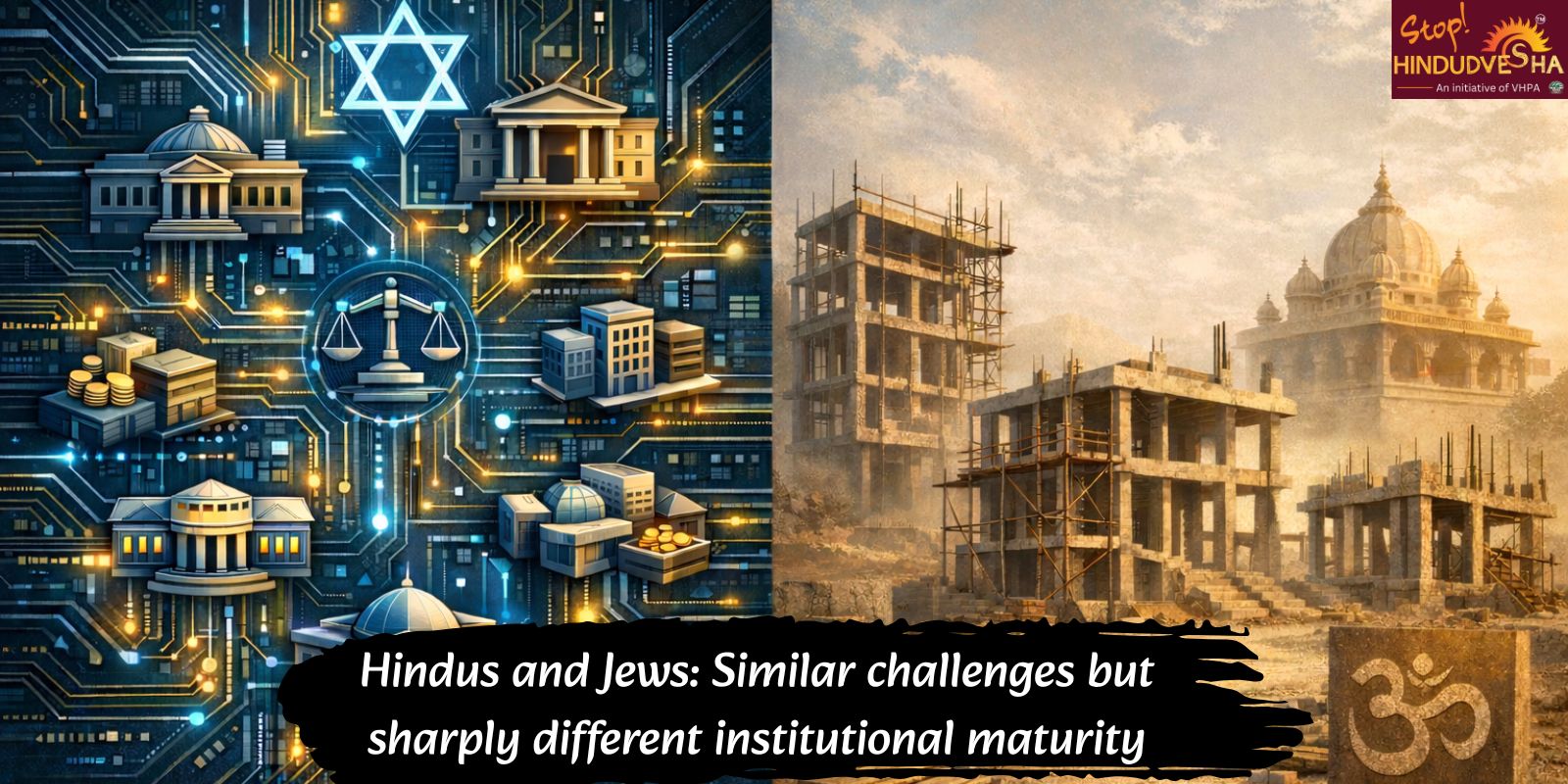
- Hindu and Jewish diasporas share deep civilizational roots and similar minority pressures in the West, but they developed very different institutional responses shaped by when and how they encountered vulnerability.
- Jewish communities entered Western societies under conditions of exclusion and recurring hostility, which made collective risk visible early and led to the deliberate construction of professional, durable institutions across education, advocacy, philanthropy, and leadership.
- Hindu migration coincided with legal inclusion, professional opportunity, and a cultural moment receptive to Eastern practices, delaying the recognition that acceptance is conditional and reducing the urgency to build coordinated, well-funded institutions beyond temples.
- As external scrutiny increases, diaspora Hindus are discovering that individual success does not shield them from collective judgment, exposing gaps in institutional capacity, leadership pipelines, and strategic philanthropy.
- The central question is whether the Hindu diaspora can convert growing discomfort into durable institutions without waiting for a crisis, recognizing that long-term survival in minority settings depends on organized structures rather than goodwill or merit alone.
Social media is increasingly fond of describing Hindus as the new Jews. However, one only wishes that were true, because it would mean Hindus had already learned that success in Western society does not equal protection within it.
Hindu and Jewish diasporas do, in fact, share more than is often recognized. Both are ancient civilizational traditions shaped by long histories of displacement, suppression, and misrepresentation. Both carried ritual, memory, and ethical frameworks across borders long before modern nation-states. And both entered Western societies as visible minorities whose ways of life did not easily blend into dominant cultural norms.
In the modern West, members of both communities faced similar pressures. Education, professional success, and civic participation were pursued as paths to security. Family life, ritual observance, and community networks served as anchors.
Yet the institutional outcomes diverged sharply.
By the early twentieth century, Jewish communities in the United States had built a dense and specialized institutional ecosystem. Organizations addressing public narratives, civil rights, education, fundraising, social services, youth leadership, legal defense, campus life, and research operated with clear mandates. These bodies were professionally staffed, coordinated across cities, and designed for continuity. When pressure emerged, response did not have to be improvised.
The Hindu diasporic landscape developed differently. Temples became the primary durable institutions, ensuring ritual and cultural continuity. Beyond temples, Hindu advocacy and community organizations exist, but they are unevenly coordinated, heavily volunteer-driven, and poorly funded. Many depend on a small number of committed individuals rather than stable institutional structures.
This contrast is visible on campuses, in media engagement, and in policy response. Jewish communities typically act through coordinated institutions with professional depth and institutional memory. Hindu communities more often rely on fragmented efforts, informal coalitions, or individual spokespeople. The difference lies not in commitment or generosity, but in the relative strength, coordination, and durability of institutional structures.
This article begins from that shared civilizational starting point and asks why the paths diverged, and why the conditions that delayed institutional learning for Hindu diasporic communities are now changing.
Entry Conditions Shaped Survival Instincts
Jewish and Hindu migrations into the West occurred under very different conditions, shaping very different instincts.
For Jews, entry into Western societies often came with explicit limits. In much of Europe, Jews faced legal restrictions on residence, education, and employment. In the United States, formal barriers were fewer, but social exclusion remained common. Universities imposed Jewish quotas well into the twentieth century. Elite neighborhoods, clubs, and professional networks were often closed. Jewish success did not erase suspicion; it often intensified it.
These experiences taught an early lesson: fitting in did not guarantee safety. Jewish communities organized accordingly. They created migrant aid societies to help newcomers find work and housing. They built their own schools when admission elsewhere was restricted. They formed mutual aid and legal defense organizations because employers, banks, and courts could not be assumed to be neutral.
Hindus entered the West under different circumstances. Large-scale migration began after civil rights reforms in the mid-1960s, when open religious or racial exclusion had become legally unacceptable. Immigration policies favored education and skills. The resulting professional success brought stability and, in many cases, social acceptance.
The message seemed clear: work hard, follow the rules, and acceptance would follow. For decades, that assumption largely held. Temples were built to meet religious needs. Cultural life continued at home and through festivals. Beyond this, there appeared little urgency to build separate institutions for advocacy, education, or public representation. Universities admitted Hindu students. Employers hired them. Neighborhoods were open.
Because Hindus did not face systematic exclusion upon arrival, the limits of acceptance were slow to register. The lesson Jewish communities absorbed through repeated reversals arrived much later for Hindus, softened by decades of professional success.
The underlying reality, however, has not changed. Western societies still draw boundaries around belonging and still judge minorities collectively when it becomes convenient. Timing explains why one diaspora learned early that institutions were essential, while the other learned later that survival cannot be left entirely to laws, markets, or goodwill.
Divergence in Vulnerability Perception
Jewish and Hindu diasporas perceived societal vulnerability differently because their lived experiences before migration were fundamentally different.
For Jewish communities, vulnerability in the West was concrete and recurring. Exclusion, periodic violence, and later genocide were not distant historical episodes but everyday realities. These experiences could not be postponed or explained away. They returned even after periods of apparent stability. Memory, therefore, served a practical purpose: sustaining alertness rather than grievance. Vulnerability was understood as something that could reappear at any time.
This understanding shaped institutions. Jewish schools, legal defense organizations, advocacy groups, and philanthropic networks were built to reduce dependence on external systems whose neutrality could not be assumed. Education prepared individuals to function in environments that could turn hostile, while advocacy enabled rapid response when collective standing was threatened.
Hindu civilizational trauma was experienced differently. Most Hindu migrants to the United States came of age after 1947, during a period of national sovereignty and social mobility in independent India. Their formative years were shaped more by stability and aspiration than by direct exposure to conquest or colonial rule. Older civilizational wounds remained real, but were encountered through textbooks, family narratives, and political debate rather than daily life.
As a result, vulnerability was harder to perceive in diaspora settings. Early decades in the West reinforced the belief that education, professional success, and adherence to law provided sufficient protection. Historical injury remained cultural rather than operational, and did not translate into institutions designed to manage minority risk or defend collective standing.
That gap is now narrowing. Diaspora Hindus increasingly encounter moments when individual achievement offers little insulation from collective judgment. These experiences signal the limits of informal security.
The risk is not that Hindus lack historical memory, but that memory is arriving too late to shape institutions before pressure intensifies. The window for learning without crisis remains open, but it is closing fast.
Ritual without Reinforcement
Hinduism and Judaism are often described as belief systems, but both have survived largely as lived traditions. Their continuity in diaspora has depended less on theology than on everyday practices: ritual calendars, food rules, home observance, and life-cycle rites. These habits carried identity across borders long before modern institutions existed. Where the two traditions differ is in how they turned religious continuity into durable public infrastructure.
In Jewish communities, religious practice was early tied to formal learning. Children not only attended synagogue; they went to Hebrew schools, studied texts, and prepared systematically for bar or bat mitzvah. Even families that were not deeply observant treated basic religious literacy as necessary. This was not simply about faith. In societies where Jews were often questioned, stereotyped, or excluded, knowing one’s own tradition was a form of protection. It allowed Jews to explain themselves, defend their practices, and pass knowledge on with confidence.
Hindu religious life developed differently. In India, meaning was reinforced by the surrounding culture. Festivals like Diwali or Navratri structured public life. Language, art, food, and social customs carried religious reference points without needing constant explanation. When Hindus migrated to the West, many assumed this ambient model would continue. Religious continuity was maintained through family practice, temples, and major festivals. Formal instruction beyond occasional language or scripture classes often remained secondary.
This worked for the first generation, who carried their cultural memory with them. It weakened for the next. Without a civilizational environment to reinforce meaning, rituals increasingly became events rather than foundations. Children learned how to perform a puja or attend a festival, but not always how to explain what they were doing or why it mattered. Identity remained cultural but grew thinner in knowledge.
Jewish communities planned for this problem. They assumed erosion and built institutions to counter it. Schools, youth groups, summer camps, and leadership programs were treated as necessities, not extras. Religious life required infrastructure.
Hindu communities largely did not. Temples flourished as places of worship and culture, but parallel institutions for education, leadership training, and public engagement lagged behind. Ritual continuity was strong; institutional continuity was not.
The difference is not theological. It reflects context. Jewish practice evolved in environments where loss was expected. Hindu practice evolved where continuity could be assumed. In diaspora settings, that assumption no longer holds. Ritual alone sustains belonging, but without structured learning and transmission, it does not produce institutional resilience.
Learning to Expect Collective Judgment
Life as a minority in the West is shaped not only by how a community sees itself, but by how it is seen by others. That external perception influences how groups organize, how they defend themselves, and whether they build institutions early or wait. Jewish and Hindu diasporas encountered this scrutiny under different conditions and learned different lessons.
Jewish communities faced group-based judgment early. Jews were often treated as a single collective, regardless of diversity in belief or behavior. Success in business, law, or media was sometimes portrayed as excessive influence. Cultural differences were questioned. Loyalty was doubted. Jewish communities learned that personal success did not shield them from suspicion. In many cases, visibility increased it. Even when individuals were praised, the group as a whole remained under scrutiny.
This reality shaped how Jewish communities organized. They built permanent organizations to monitor public narratives, respond to defamation, and defend civil rights. These institutions were not created for isolated crises. They existed because scrutiny itself was ongoing. The external gaze was treated as a structural feature of minority life, not as a misunderstanding that would disappear with good behavior.
Hindus encountered a different environment when they arrived in the West. Large-scale migration coincided with the aftermath of the 1960s civil rights and counterculture movements, a period when yoga, meditation, and Eastern philosophy were already being embraced by segments of Western society. Hindu traditions were often framed as benign, therapeutic, or even fashionable rather than threatening. Early migrants were largely seen through their professional roles, and religious identity attracted curiosity more than concern. Many Hindus, therefore, assumed that individual conduct would determine individual standing, and that collective identity would remain secondary.
That assumption is now being tested. Diaspora Hindus are increasingly seeing how quickly individual actions can be generalized to the entire community. For instance, the growing academic and media focus on “Hindutva” has led to Hindu temples, student groups, and families being viewed through a lens of suspicion, even when they have no connection to political activism. Political disagreements are reframed as cultural or religious problems, and practices that once went unnoticed can suddenly be questioned.
The key difference lies in readiness. Jewish communities expected collective judgment and built institutions to respond to it. Hindu communities, shaped by years of relative acceptance, often respond only after reputational damage has occurred. Advocacy tends to be reactive rather than sustained.
Recognizing the external gaze marks a turning point for any diaspora. It signals the shift from assuming fairness to understanding how group identity operates in public life. Jewish communities crossed that threshold long ago. Hindu communities are crossing it now, under conditions that feel new but follow a familiar pattern for minorities.
Professionalized Versus Improvised Institutions
Jewish diasporic institutions in the West developed early and with clear purpose. Communities built separate organizations for specific needs: helping new immigrants settle, running schools, providing legal defense, funding community programs, monitoring public narratives, and engaging politics. These were treated as essential infrastructure, not optional projects. Even during calm periods, they were maintained because safety was never assumed to be permanent.
These institutions were professionalized. Leadership was treated as a long-term responsibility rather than a rotating volunteer task. Funding emphasized continuity through endowments and stable donor networks. Disagreements were managed within institutions rather than allowed to fragment them. As a result, many Jewish organizations outlasted individual leaders, ideological shifts, and generational change.
Hindu institutional development followed a different path. Temples became the primary centers of community life, serving religious, cultural, and social functions at once. This consolidation made sense when preserving religious practice was the main concern, and external pressure appeared low. Outside temples, institutions were fewer and often formed in response to specific events or controversies rather than as permanent structures.
Leadership in Hindu organizations has largely remained volunteer-driven. Funding is often tied to personalities or one-time causes. Many groups depend on a small number of dedicated individuals, which makes them vulnerable to burnout. When disagreements arise, organizations can slow or dissolve before they mature.
These differences reflect how risk was understood. Jewish communities assumed vulnerability was ongoing and built institutions to match that reality. Hindu communities assumed vulnerability was limited and could be managed through personal success and social integration. For a long time, that assumption seemed to hold.
It is now being tested. As Hindus face greater scrutiny and collective judgment, the absence of durable, specialized institutions becomes more visible.
Strategic Versus Ad Hoc Philanthropy
Both diasporas give generously, but their giving reflects different judgments about what must be protected internally and what can be entrusted to the wider society.
Jewish philanthropy developed with few illusions about the reliability of external institutions. Funding Jewish schools, legal defense organizations, research institutes, and advocacy groups was treated as non-negotiable because these institutions were understood to be irreplaceable. No university, court system, or civic body could be relied upon to consistently protect Jewish interests or ensure continuity across generations. Giving inward was not seen as defensive or narrow. It was seen as responsible.
At the same time, Jewish donors have long supported universities, hospitals, museums, and public charities. This outward generosity followed a clear sequence: internal institutions came first. External giving complemented, rather than substituted for, internal investment.
Hindu philanthropy in the diaspora follows a different pattern. Hindus give generously to temples, disaster relief, and mainstream institutions such as elite universities, hospitals, and large nonprofits. Much of this giving is sincere and civic-minded. A significant portion, however, is also status-driven. Donations to prestigious institutions offer recognition, access, and social validation. By contrast, giving to Hindu educational, research, or advocacy institutions often brings little visibility and therefore attracts less sustained support.
As a result, funding for Hindu institutions beyond temples is often episodic. Resources flow toward festivals, construction projects, or moments of crisis, but not toward long-term capacity in education, leadership development, research, or legal advocacy. Many organizations depend on a small number of donors or personalities, which makes them fragile.
As diaspora Hindus face increasing misrepresentation and collective scrutiny, the limits of status-driven philanthropy become harder to ignore. Without sustained investment in their own institutions, Hindu communities remain exposed.
Youth Engagement
The strength of a diaspora depends less on its founders than on how well the next generation is prepared to lead. Youth education and leadership training are where this difference becomes visible. Jewish and Hindu communities both value their youth, but they have invested in them in different ways.
Jewish communities treated youth education as a core need, not a cultural add-on. Schools, after-school programs, camps, study groups, and leadership fellowships were built to give young Jews a clear understanding of their history and identity. These programs were not limited to religious instruction. They prepared young people to speak confidently in public, engage institutions, and represent their community in professional and political settings.
This approach assumed that identity weakens without structure. Young people were expected to learn how institutions function and how to sustain them. Leadership was cultivated early. As a result, Jewish institutions did not rely solely on the founding generation’s energy or memory.
Hindu youth engagement in the diaspora has followed a different path. Cultural exposure, language classes, festivals, and temple activities have helped maintain connection and pride. These efforts matter. But they have often remained separate from pathways into leadership, policy engagement, or public advocacy.
The effects of this gap are becoming visible. Many second- and third-generation Hindus feel culturally connected but struggle to explain or defend their tradition in public settings. When controversy arises, they are often left to respond individually, without the support of established organizations or trained mentors.
Jewish communities anticipated this challenge early. They assumed minority life would require public explanation and defense, not just quiet participation. Hindu communities, shaped by years of relative acceptance, assumed those skills would rarely be needed. That assumption is weakening. As scrutiny grows, the lack of trained leadership places heavy pressure on individuals. The task now is to integrate them into durable institutions capable of carrying responsibility across generations.
Sense of Shared Priorities
What allows a community to act together is not shared heritage, but shared stakes. When a group agrees on what cannot be allowed to fail, disagreement becomes manageable.
Jewish diaspora communities developed a strong sense of shared stakes early, shaped by repeated experience of collective vulnerability and the understanding that failure in one domain could have consequences far beyond it. Despite deep political, religious, and ideological disagreements, there is broad agreement on certain core priorities that must be protected collectively. One visible example is concern for Israel’s security, but the underlying dynamic extends beyond geography. Disagreement exists and can be intense, but it operates within clear limits. Certain interests are understood to be non-negotiable. Institutions absorb disagreement because the stakes are widely recognized as high.
This shared urgency strengthens internal coherence. It makes cooperation possible even when consensus is absent. Education, advocacy, and communal defense are treated as essential because they are directly or indirectly tied to collective survival. Unity does not require uniformity, but it does require agreement on what cannot be allowed to fail.
The Hindu diaspora operates under different assumptions. Despite visible signposts, there is no common sense that Hindu civilizational survival is at risk in the homeland. As a result, there is little shared urgency binding the diaspora together. Engagement with India tends to be familial, cultural, or emotional, but rarely existential.
In the absence of urgency, internal diversity becomes easier to exploit. Hindu communities abroad are diverse across language, region, sect, and social background, yet in everyday diaspora life, these differences rarely produce conflict. External actors hostile to India and Hindu civilizational identity routinely amplify fault lines such as caste or Dalit identity, even though these play little role in most diaspora social experience. What functions as pluralism in lived experience is recast as moral division, leaving the community reactive rather than organized.
Without a shared survival concern to override these pressures, collective action becomes fragile. Attempts to build common institutions or speak with a unified voice are quickly challenged, and energy is spent on managing internal suspicion rather than sustaining durable structures.
Until Hindu diaspora communities develop a clearer sense of what must be preserved and protected despite differences, fragmentation will continue to weaken institution-building efforts.
Closing Remarks
The comparison between Hindu and Jewish diasporic experience is not about imitation or moral judgment. It is about learning how pressure shapes institutional behavior. Jewish institutions did not emerge from exceptional foresight or discipline. They emerged because repeated experience showed that acceptance had limits and that delay carried real risk. Institutions became the practical means of managing vulnerability.
Hindu diasporic life developed under different conditions. Migration to the West coincided with legal inclusion, professional opportunity, and formal protection. These conditions mattered. They allowed families to succeed and communities to settle. But they also delayed an important realization: that minority security cannot rest on law, merit, or goodwill alone. When vulnerability feels distant, institution-building feels less urgent.
Diaspora Hindus are now encountering patterns Jewish communities learned to recognize earlier: collective judgment, conditional belonging, shifting narratives, and reputational risk that individual success cannot resolve.
The central question is whether discomfort is translated into durable structures before pressure intensifies. Jewish history suggests that institutions built early reduce future costs. Institutions built late must be assembled under stress.
There is still room to act. Hindu diaspora possesses resources, skills, and generational depth that earlier minorities did not. The obstacle is not capacity, but mindset. Institution-building requires a shift from assuming continuity to actively maintaining it.
Whether and when such a shift occurs will shape the future of Hindu life in the West for decades to come.

Donate to HINDUDVESHA
Our Mission is to explore and expose Hindudvesha through research analysis, education and response.
SUPPORT US