

The Karthigai Deepam Issue: The Shrinking Space for Hindu Rituals in Their Own Civilizational Home
 K. Sindhu · 01/12/2026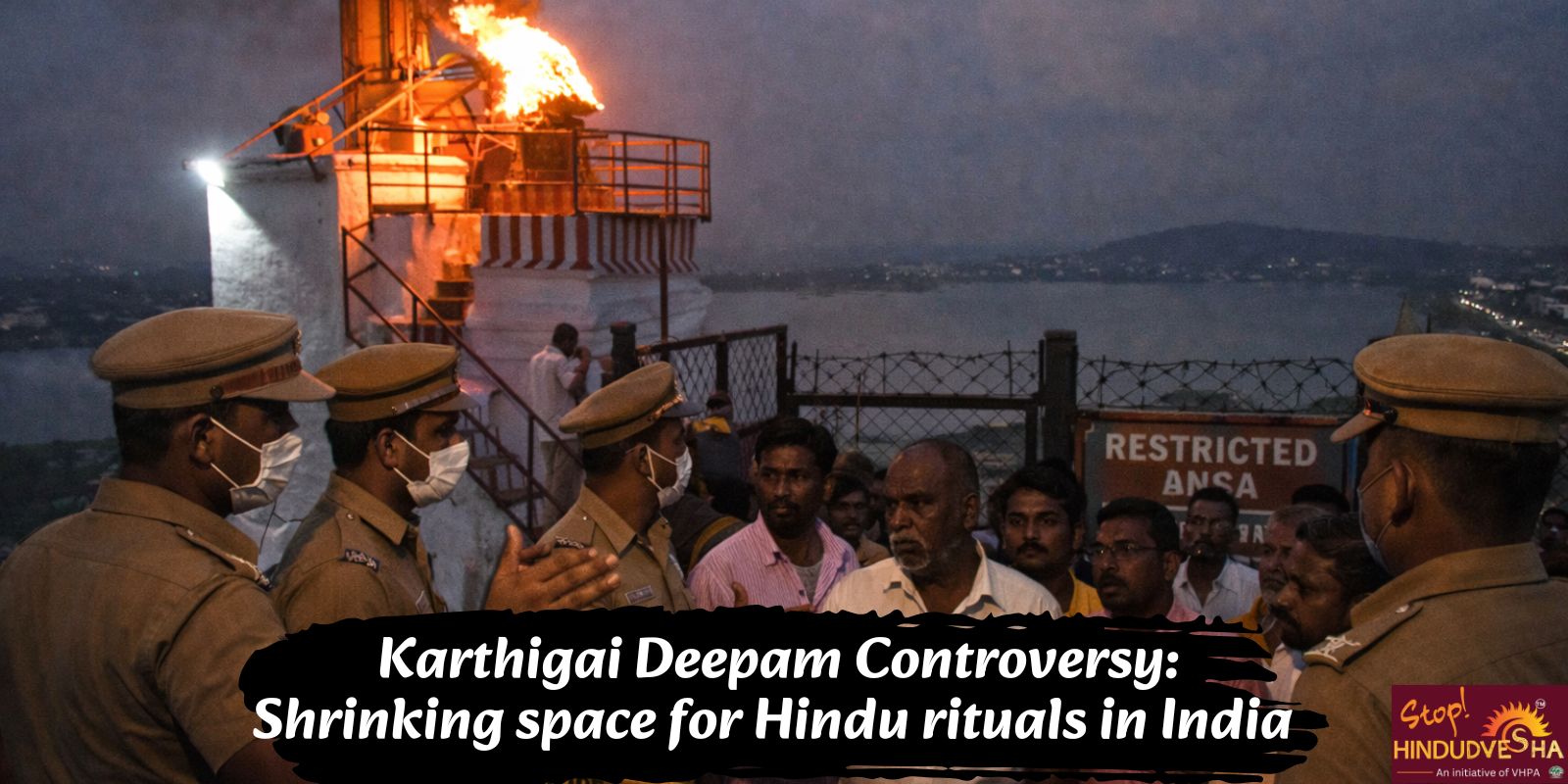
- The Thiruparankundram controversy exposes how a centuries-old Hindu ritual was obstructed despite clear judicial recognition of devotees’ rights.
- Executive defiance of court orders turned a religious matter into a constitutional confrontation over Article 25 protections.
- Political targeting of the judge highlighted growing pressures on judicial independence when Hindu rights are upheld.
- Shifting historical narratives and administrative tactics were used to dilute Hindu claims over sacred space.
- The episode illustrates a broader pattern in which Hindu religious rights in India are treated as conditional rather than firmly protected.
The controversy surrounding the lighting of the Karthigai Deepam at Thiruparankundram Hill in Tamil Nadu is not merely about a ritual or a festival. It is a constitutional moment that lays bare the manner in which Hindu rights are subordinated to administrative convenience, political calculation, and speculative fears.
Despite a clear judicial finding affirming devotees’ right to light the Deepam within the temple precincts—a right rooted in antiquity and recognized even during the colonial period—the Tamil Nadu government chose obstruction over compliance. The episode exposes a deeper pattern in which Hindu practices are treated as negotiable concessions, and constitutional guarantees yield to selective secularism and appeasement-driven governance.
By examining the civilizational background of Thiruparankundram, the religious significance of the Karthigai Deepam at Deepathoon, the High Court’s rulings, and the political escalation that followed, this article shows how selective secularism, administrative obstruction, and historical erasure together constrict Hindu sacred space in contemporary Bharat.
Sacred Geography and the Karthigai Deepam Ceremony
Thiruparankundram Hill occupies a distinctive place in the religious and cultural landscape of Tamil Nadu. At its foothills stands the Arulmigu Subramaniya Swamy Temple, one of the six abodes of Lord Murugan and among the most revered sites in Tamil Hindu tradition. For centuries, the hill has functioned not merely as a physical landmark but as a living sacred geography shaped by ritual practice, pilgrimage, and collective memory. Alongside the Murugan temple, the hill also contains ancient Jain caves and the Sikandar Badusha Dargah, a structure dating to the fourteenth-century Madurai Sultanate [1].
At the summit of Thiruparankundram stands the Deepathoon, an ancient stone lamp pillar historically associated with the lighting of the Karthigai Deepam. Within Tamil Hindu tradition, the lighting of the Karthigai Deepam at elevated points symbolizes spiritual illumination, the ascent of consciousness, and continuity with an ancient civilizational inheritance. Literary sources, temple records, and enduring collective memory consistently identify the Deepathoon as a focal site of this ritual for centuries.
The Karthigai Deepam ritual itself has roots extending back to the Sangam age. Observed on the full moon day of the Tamil month of Karthigai, it signifies the victory of light over darkness, knowledge over ignorance, and dharma over adharma. Across Tamil Nadu, lamps are lit in homes, temples, and public spaces, creating a shared spiritual and cultural moment that binds households and communities into a common rhythm of observance [2]. At Thiruparankundram, this ritual assumed a distinctive and elevated form through the lighting of the Deepam at the hilltop Deepathoon. Devotees recount that the flame once burned there across generations, serving as a visible beacon of faith and continuity.
Over time, however, this practice was disrupted. Devotees attribute the discontinuation of hilltop lighting to periods of foreign invasion, political instability, communal tension, and later administrative reluctance [3]. Colonial-era disruptions, followed by post-independence caution, gradually confined the Deepam to lower-hill structures near the Uchipillaiyar Mandapam. However, disruption does not extinguish rights. The temporary suspension of a ritual under coercion or unrest does not negate the right to its restoration. Hindu ritual practice has never been a rigid, text-bound system frozen in time. It adapts, retreats under pressure, and re-emerges when space permits. Top of Form
Judicial Recognition of a Centuries-Old Ritual
The immediate controversy surrounding Thiruparankundram Hill arose when a devotee, Rama Ravi Kumar, approached the Madurai Bench of the Madras High Court, seeking restoration of the traditional practice of lighting the Karthigai Deepam at the Deepathoon [4]. He contended that the ritual had been observed for centuries and that its discontinuation was a relatively recent deviation from established practice. For several decades, the lighting had been restricted to a mandapam near the Uchipillaiyar shrine midway up the hill, a compromise that departed from long-standing tradition.
The temple administration, governed by the Hindu Religious and Charitable Endowments Department, along with the ruling government of Tamil Nadu, opposed the petitioner on multiple grounds. Their objections included the proximity of the Deepathoon to the dargah and concerns relating to public order and law enforcement.
On December 1, 2025, G. R. Swaminathan delivered a detailed judgment permitting the lighting of the Karthigai Deepam at the Deepathoon [5]. The Court restored the devotees’ right to perform the ritual at its traditional location, characterizing it as a well-established customary practice supported by substantial literary, historical, and judicial evidence [6]. In doing so, it relied on historical materials and prior rulings, including a 1923 civil decree affirming the temple’s title over the hill, which had been upheld by the Privy Council.
The Court held that the Deepathoon stands on unoccupied temple land and lies outside the precincts of the dargah. It further noted that the Sikandar Dargah had issued a no-objection at a peace meeting in 2005, subject to the lighting being carried out at a distance of more than fifteen meters. Significantly, the judgment affirmed that disruption of ritual practice due to external or coercive factors does not extinguish religious rights. It directed that the Deepam be lit at the Deepathoon and ordered police protection to ensure compliance, emphasizing that a symbolic act such as lighting a lamp could not reasonably be said to offend the sensibilities of any community [7].
Executive Defiance and Contempt
The events that followed were deeply concerning. In disregard of clear judicial directions, temple authorities restricted the ritual to the lower-hill mandapam, prompting devotees to approach the court with a contempt petition [8]. In response, G. R. Swaminathan issued a further order permitting the petitioner and ten others to proceed to the Deepathoon for the lighting of the Deepam under Central Industrial Security Force protection, emphasizing the importance of symbolism in matters of faith [9].
Even this order was not implemented. Local police invoked prohibitory provisions, blocked access to the hill, and prevented the ritual. Protests followed, detentions were made, and several people were injured. Amid this escalation, one devotee, Thiru Poorna Chandran, self-immolated [10]. A court order, operative in real time, was thus effectively neutralized by executive defiance.
Meanwhile, the state approached the Supreme Court of India [11]. What should have been routine enforcement of Article 25 protections devolved into a confrontation between the executive and the judiciary. The issue, therefore, ceased to be merely religious. It became unmistakably constitutional.
Political Escalation and Targeting of the Judge
As the issue attracted national attention, political rhetoric escalated sharply. Allegations were levelled against G. R. Swaminathan, culminating in a letter signed by over a hundred opposition Members of Parliament seeking his removal [12]. The charges accused him of bias and of deciding cases contrary to secular principles. However, they remained broad and imprecise, offering no specific facts, evidence, or reasoned substantiation to support so grave a demand [13].
This development provoked a rare and forceful institutional response. Fifty-six former judges of the Supreme Court and various High Courts issued a joint statement condemning the impeachment move as “a brazen effort to browbeat judges who do not fall in line with the ideological and political expectations of a particular section of society [14].” They warned that permitting such actions would strike at the foundations of democracy and judicial independence [15]. The episode must therefore be understood for what it represents: a warning signal. When judges who uphold Hindu religious rights are targeted rather than respected, the message conveyed is unmistakably chilling. Judicial independence cannot operate selectively. A judiciary applauded for decisions favoring certain faiths but attacked for protecting legitimate Hindu practices risks erosion of its independence, not merely in perception, but in substance.
The attempt must also be assessed against the constitutional standard governing the removal of judges. Proven misbehavior or incapacity constitutes the sole grounds for removal of a judge of a High Court or the Supreme Court of India [16]. In Krishna Swami v. Union of India [(1992) 4 SCC 605], the Court made it clear that errors of judgment or unpopular decisions do not amount to misbehavior. Only willful abuse of office, corruption, or moral turpitude meet this threshold. Measured against this settled standard, the allegations against Justice Swaminathan conspicuously failed to qualify [17].
Selective Secularism at Play
The Thiruparankundram episode raises uncomfortable questions about how secularism operates in practice. Secular governance does not require the suppression of religious expression; it requires equal respect for all faiths. In this case, however, the state government appeared willing to accommodate certain groups while displaying marked reluctance to comply with judicial orders affirming a centuries-old Hindu ritual. Secularism demands equal treatment or equal distance, not selective deference. When court orders benefiting other religious groups are implemented without hesitation, but those restoring Hindu practices are resisted, delayed, or recast as threats to public order or communal harmony, secularism ceases to be neutral. It becomes selective. This is not principled governance; it is governance through asymmetry [18].
Shifting Labels, a Familiar Strategy
Throughout the controversy, the identity of the Deepathoon itself became a site of contestation. At different times, it was described as a British survey marker, a neutral secular object, and, later, as a Jain pillar [19]. These shifting characterizations appeared less the result of genuine historical inquiry and more a set of tactical moves aimed at deferring or diluting Hindu ritual claims. They did not arise from new archaeological discoveries but followed a familiar strategy: multiply alternative narratives until the Hindu claim appears provisional and negotiable. Similar patterns have surfaced in other disputes over sacred space, where competing narratives are invoked not to deepen understanding, but to avoid direct acknowledgment of Hindu continuity [20]. The parallel with Ram Janmabhoomi Mandir is difficult to overlook. Denial first, dilution later: remains beneath the Babri mosque were identified as anything but a temple. At Thiruparankundram, the same logic recurs, with the Deepathoon pillar repeatedly framed as anything but Hindu [21].
HR&CE and the Crisis of Representation
Perhaps the most unsettling aspect of the episode is the role played by the Hindu Religious and Charitable Endowments Department. Rather than defending Hindu devotees, the department opposed them and went so far as to appeal against the judgment of Justice Swaminathan [22]. This inversion, where a state-controlled body established to safeguard Hindu institutions acts against Hindu ritual rights, exposes a fundamental structural flaw in government control of temples. A genuinely autonomous religious institution would have defended its traditions, mobilized its resources, and stood with its devotees. Instead, the department positioned itself against those it was meant to represent. Autonomy gave way to bureaucratic caution, and faith was subordinated to administrative convenience.
This episode reinforces a long-standing critique of state control over Hindu temples. When religious institutions are administered by the government, they are vulnerable to being shaped by prevailing political ideologies rather than guided by their own traditions and responsibilities. The call to free temples from government control thus emerges not as ideological rhetoric, but as an institutional necessity rooted in experience.
Broader Implications
The implications of the Thiruparankundram episode extend well beyond a single ritual or location. At its core, the controversy raises a deeper institutional concern: whether lawful religious practices can be stalled or effectively nullified on the basis of anticipated resistance rather than demonstrable illegality. While Article 25 of the Constitution is subject to public order, that limitation cannot be reduced to speculative or pre-emptive fears. If the mere possibility of unrest, real or presumed, is treated as sufficient ground to interrupt constitutionally recognized practices, it confers an informal veto on those most willing to threaten disorder. Such an approach risks rewarding intolerance rather than upholding the rule of law, encouraging pressure politics, and gradually hollowing out the assurance that constitutional guarantees are meant to provide.
Equally troubling is the targeting of a judge for upholding these rights. The impeachment motion against Justice Swaminathan, despite lacking any realistic prospect of success, has rightly drawn criticism from former judges and the wider public. When a government defies a court order and simultaneously vilifies the judge as biased for protecting a legitimate Hindu practice, it sends a chilling message. Judges may begin to hesitate, weighing not only the law but the political consequences of their decisions [23]. Disagreement with judicial outcomes has established and dignified remedies through appeals, review, and constitutional procedure. Personal attacks on a judge who recognized lawful rights while discharging his duty have no place in a constitutional democracy.
It is also significant that Hindu devotees consistently pursued peaceful and institutional avenues in this matter. They relied on historical decrees, administrative representations, peace committee resolutions, and finally the courts. Their conduct reflects restraint and sustained faith in constitutional processes. To characterize such a lawful assertion as provocative raises an unsettling question: if the lighting of a single lamp, once a year, at its traditional site is deemed disruptive, what does this suggest about the space available for Hindu religious continuity in public life? A society that perceives even a peaceful, lawful ritual as a threat to communal harmony reveals a deeper discomfort with Hindu religious expression itself. Public order cannot be preserved by curtailing or ignoring lawful practices; it can only be sustained by consistently and fairly enforcing legality.
Closing Remarks
The Thiruparankundram episode leaves behind a sobering truth about contemporary India. In the land where Hindu civilization was born and sustained itself for millennia, Hindu religious rights no longer enjoy assured protection, even from the judiciary entrusted to uphold the Constitution. When clear judicial findings are met with executive defiance, when enforcement is withheld in real time, and when judges who affirm Hindu rights are isolated or targeted, the promise of constitutional remedy itself begins to fray.
Civilizations do not disappear through sudden collapse. They recede when their rituals are obstructed, their sacred spaces contested, and their rights rendered conditional on political comfort. Today, Hindu worship increasingly survives not by right, but by negotiation, delay, and compromise. The extinguishing of a lamp is never merely symbolic. It reflects a deeper erosion, where legality bends, institutions hesitate, and the oldest living faith in the subcontinent is left to defend itself without the complete protection of the state or the courts.
Citations
[1] Why DMK Admin Blocking Thiruparankundram Deepam Wounds Both The Constitution And Civilisation; https://swarajyamag.com/tamil-nadu/thiruparankundram-why-the-dmk-admins-blocking-of-karthigai-deepam-wounds-both-constitution-and-civilisation
[2] Judgement Analysis of the Karthigai Deepam order passed by Justice GR Swaminathan; https://hindupost.in/law-policy/judgement-analysis-of-the-karthigai-deepam-order-passed-by-justice-gr-swaminathan/#
[3] Karthigai Deepam Row | ‘Vague Fears’ Can’t Justify Denying Right to Worship: Hindu Site Tells Madras HC; https://lawchakra.in/high-court/karthigai-deepam-vague-fears/
[4] ‘Lighting lamp atop hill is a Tamil tradition, can’t offend anybody’s sensibilities’; Madras HC directs Karthigai Deepam to be lit at Deepathoon; https://www.scconline.com/blog/post/2025/12/04/madras-hc-lighting-lamp-atop-hill-tamil-tradition-devasthanam-karthigai-deepam-scc-times/
[5] Rama Ravikumar v. District Collector, Madurai, 2025 SCC OnLine Mad 11477, Decided on 01-12-2025] ; or ‘Lighting lamp atop hill is a Tamil tradition, can’t offend anybody’s sensibilities’; Madras HC directs Karthigai Deepam to be lit at Deepathoon; https://www.scconline.com/blog/post/2025/12/04/madras-hc-lighting-lamp-atop-hill-tamil-tradition-devasthanam-karthigai-deepam-scc-times/
[6] Inhuman deal for harmonious Hindus; https://organiser.org/2025/12/08/329324/bharat/inhuman-deal-for-harmonious-hindus/
[7] ‘Lighting lamp atop hill is a Tamil tradition, can’t offend anybody’s sensibilities’; Madras HC directs Karthigai Deepam to be lit at Deepathoon; https://www.scconline.com/blog/post/2025/12/04/madras-hc-lighting-lamp-atop-hill-tamil-tradition-devasthanam-karthigai-deepam-scc-times/
[8] Rama Ravikumar v. KJ Praveenkumar IAS; CONT(MD) No. 3594 of 2025 https://www.verdictum.in/pdf_upload/rama-ravikumar-v-kj-praveenkumar-others-1757971.pdf
[9] Ibid
[10] Madurai: Hindu devotee dies by self-immolation over DMK government’s refusal to allow lighting of sacred lamp at Thiruparankundram Deepathoon; https://www.opindia.com/news-updates/madurai-man-dies-by-self-immolation-anguished-over-thiruparankundram-deepathoon-row/
[11] Tamil Nadu Officers Move Supreme Court Against Madras HC Order To Allow Temple Devotees To Light Lamp Near Thiruparankundram Hill Dargah; https://www.livelaw.in/top-stories/tamil-nadu-moves-supreme-court-against-madras-hc-order-allowing-lamp-lighting-near-thiruparakundram-hill-dargah-312247
[12] ‘Serious questions over impartiality’: Over 100 opposition MPs submit motion for Madras HC judge Justice G.S. Swaminathan’s removal; https://theleaflet.in/leaflet-reports/serious-questions-over-impartiality-over-100-opposition-mps-submit-motion-for-madras-hc-judge-justice-gs-swaminathans-removal
[13] Karthigai Deepam Row: Impeachment is intimidation; https://organiser.org/2025/12/21/331335/bharat/karthigai-deepam-row-impeachment-is-intimidation/
[14] 56 Former Judges Condemn Impeachment Move Against Justice GR Swaminathan, Call It Attempt To Browbeat Judiciary; https://www.livelaw.in/top-stories/56-former-judges-condemn-impeachment-move-against-justice-gr-swaminathan-call-it-attempt-to-browbeat-judiciary-313157
[15] Ibid
[16] Articles 218 and 124 of the Constitution of India; https://www.indiacode.nic.in/bitstream/123456789/19151/1/constitution_of_india.pdf
[17] Karthigai Deepam Row: Impeachment is intimidation; https://organiser.org/2025/12/21/331335/bharat/karthigai-deepam-row-impeachment-is-intimidation/
[18] Thiruparankundram: Of Shifting Pillars And Sacrifices; https://swarajyamag.com/culture/thiruparankundram-of-shifting-pillars-and-sacrifices
[19] Ibid
[20] Ibid
[21] Ibid
[22] BJP vs DMK: Why a Temple Deepam Lit a Political Fire in Tamil Nadu; https://www.newkerala.com/news/o/systematic-assault-hindu-rights-tn-bjp-attacks-dmk-govt-218
[23] From Lamp Dispute to Constitutional Crisis: Tamil Nadu Government’s War on the Judiciary; https://swarajyamag.com/states/from-lamp-dispute-to-constitutional-crisis-tamil-nadu-governments-war-on-the-judiciary

Donate to HINDUDVESHA
Our Mission is to explore and expose Hindudvesha through research analysis, education and response.
SUPPORT US