

What the Pew Survey Reveals About Hindu Continuity in the Diaspora
 Dr. Jai G. Bansal · 12/27/2025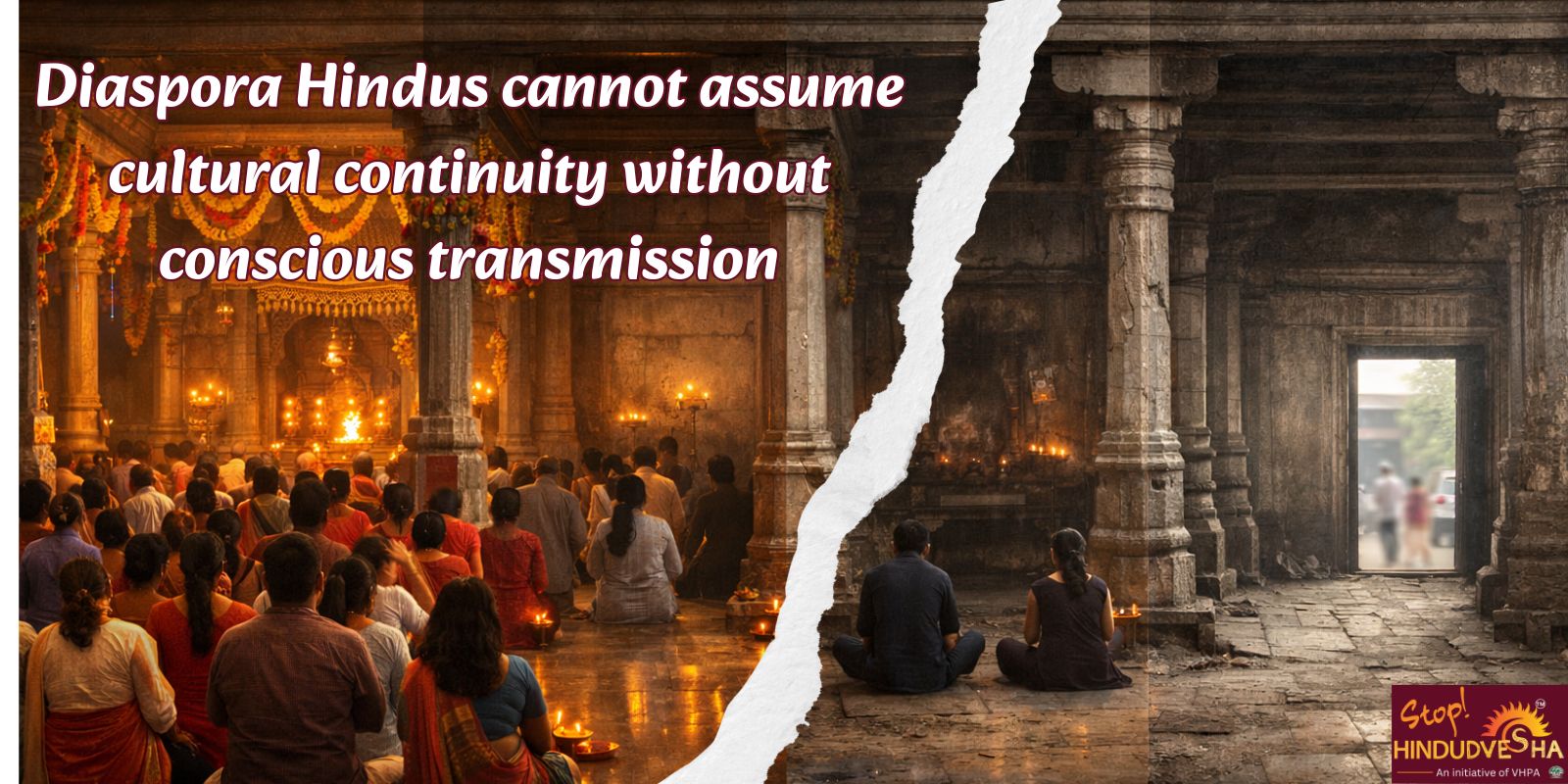
- Continuity of Hindu identity cannot be assumed: Cultural memory and ancestral identity do not reproduce themselves in pluralistic societies.
- The household is the decisive arena of transmission: Temples and community institutions can support continuity but cannot substitute for daily and weekly practice within the family.
- Delayed exposure accelerates cultural erosion: Children who are not immersed early seldom adopt civilizational practices later.
- Spirituality without structure does not endure: Individualized spirituality may offer personal meaning, but it does not transmit across generations.
- Leadership must prioritize formation over visibility: Festivals, public representation, and symbolic pride matter, but long-term survival depends on education, routine practice, and parent-centered transmission strategies.
The February 2025 release of the Pew Religious Landscape Survey[1] provides one of the clearest and most methodologically rigorous windows into how religion is actually lived, transmitted, and lost in the United States, grounded in a nationally representative sample of tens of thousands of respondents. Conducted periodically over the past two decades, the survey examines patterns of religious affiliation, belief, and practice, as well as intergenerational change, allowing researchers to track how religious identities are formed, retained, or abandoned over time. Rather than focusing on theological differences, the survey maps the social mechanics of religion in a pluralistic society, offering rare insight into how family life, education, and routine practice shape long-term religious continuity.
Why Hindus Cannot Ignore This Survey
At first glance, the Pew Survey appears to concern Christianity and the shifting religious profile of the United States. For many Hindus in the diaspora, it may seem peripheral: a study shaped by Western historical experience and institutional forms that differ sharply from dharmic traditions. That impression, however, overlooks the survey’s deeper relevance.
The Pew study is not, at its core, an inquiry into doctrine or denominational fortunes. It is an examination of civilizational and cultural continuity in a modern, pluralistic society. Its focus lies on how inherited ways of life—systems of meaning, practice, and moral orientation—are sustained or diluted across generations. On this question, the findings are consistent and sobering. Cultural identities rooted in belief and practice do not reproduce themselves automatically. They persist only when they are cultivated early, reinforced through repeated and embodied routines, and woven into everyday family and community life. When these traditions are reduced to symbols, occasional observances, or delegated entirely to institutions, erosion follows with striking regularity.
For Hindus in the diaspora, this insight carries particular weight. Hindu civilization in the West exists without demographic dominance, without state reinforcement, and without an extensive parallel system of civilizational schooling. Its continuity depends disproportionately on what takes place within households and small community settings. The Pew data shows that even majority cultures with deep institutional infrastructure struggle to reproduce themselves once family-based transmission weakens. Minority civilizational traditions have far less margin for error.
This article, therefore, approaches the Pew survey as a diagnostic lens rather than a sociological curiosity or a commentary on Christian decline. The question it poses is direct: what does this data reveal about the conditions under which civilizational traditions endure in the diaspora, and what does that imply for the future of Hindu continuity if current patterns persist?
Religion Is Transmitted, Not Inherited
Across the survey, one governing pattern emerges with clarity. Adult religious identity is shaped most powerfully by the intensity of religious formation in childhood. Neither ancestry nor self-described belief is sufficient. What matters is whether religion was practiced regularly, taught deliberately, and treated as integral rather than optional during formative years.
This challenges a widespread assumption within the Hindu diaspora. Hindu identity is often understood as something passed down through birth and culture, sustained through festivals, food, and periodic communal gatherings. While these elements create familiarity, the Pew data indicates they are not enough to transmit a worldview. Culture without discipline produces recognition, not continuity.
The survey also exposes the limits of belief detached from practice. Adults raised in households that identified as religious but did not engage in regular prayer, instruction, or communal observance were far less likely to retain that identity later in life. Religious continuity does not rest on ideas alone. It rests on routines that make those ideas lived and normal.
For Hindus, this finding aligns closely with the tradition’s own civilizational logic. Dharma has never been primarily propositional. It is learned through repetition, imitation, and embodied practice. When that rhythm weakens, identity thins rapidly. In a social environment saturated with competing narratives and value systems, passive inheritance is not inheritance at all.
“74% of adults raised in highly religious homes retain their childhood religion; fewer than half of those raised in low-intensity religious environments do so” – Pew survey report
The Myth of “They Will Return Later”
A persistent consolation offered to disengaged families is the belief that religious distance is temporary. Adolescence and early adulthood are framed as exploratory phases, after which marriage, parenthood, or personal crisis will naturally draw individuals back to religion. The Pew survey offers little evidence for this assumption.
Across multiple birth cohorts, the data show no consistent pattern of people becoming more religious over time in ways that reverse early disengagement. Younger adults raised in highly religious households are less likely to retain that intensity than older generations were at the same age. At the same time, those raised in nonreligious homes show striking stability in remaining nonreligious. Early absence of traditions and rituals tends to persist, while early disengagement rarely corrects itself.
For Hindu families, this finding is particularly consequential. Religious formation is often postponed in the name of autonomy or openness. Exposure is delayed, instruction softened, and practice made optional in the hope that maturity will bring voluntary return. The Pew data suggests such delays rarely succeed. What is not normalized early seldom becomes central later.
The language of “choice” is frequently misunderstood in this context. Choice presupposes familiarity. Children cannot meaningfully choose a tradition they have never inhabited. By the time independent decision-making is possible, competing identities and worldviews have already shaped their defaults. Without early formation, Hindu Dharma often becomes peripheral, not rejected but simply irrelevant.
“Spiritual but Not Religious” is a Dead-End Street
Another common reassurance within the diaspora is the belief that formal religion may be unnecessary so long as children remain “spiritual.” Interest in meditation, ethical sensitivity, or a sense of wonder is taken as evidence that something essential has been preserved. The Pew survey complicates this assumption.
While many Americans report becoming more spiritual over their lifetimes, this increase does not correlate with religious continuity or intergenerational transmission. Spirituality detached from shared practice and institutional form becomes highly individualized. It may offer personal meaning, but it does not generate stable communities, inherited memory, or durable identity across generations.
For Hindus, this distinction is critical. In Western contexts, Hindu Dharma is often presented as a collection of spiritual techniques or philosophical insights rather than as a comprehensive dharmic order. Yoga is separated from ethical discipline, meditation from ritual obligation, and philosophy from daily practice. What remains is accessible and appealing, but thin. It offers experience without inheritance.
Dharma, however, has never been merely inward. It is sustained through festivals, vows, narratives, symbols, and shared obligations that bind individuals to family and community. When Hindu Dharma is reduced to generalized spirituality, it becomes interchangeable with countless alternatives. The Pew findings suggest that such interchangeability undermines long-term survival.
“43% of Americans say they have become more spiritual…[yet] religious affiliation and regular religious practice continue to decline” – Pew survey report
Where Continuity Is Actually Built: Home, Practice, and Education
If the Pew survey dismantles comforting myths, it also clarifies what does work. Religious continuity is strongest where belief is reinforced by structure: regular practice, formal instruction, and predictable routines. Sentiment alone, however sincere, does not sustain identity.
The data highlights a steep decline in formal religious education, particularly among younger generations. This matters because traditions are not absorbed through occasional exposure. They are learned through repetition. Families that treated religious practice as part of ordinary life, rather than as an exception, produced adults far more likely to retain their identity.
For Hindu communities, this exposes a persistent imbalance. Temples often function as vibrant centers of celebration but weak centers of formation. Large festivals draw crowds, yet sustained educational programs remain under-resourced. Children may visit temples frequently, but without structured learning, those visits remain experiential rather than formative.
Public identity is also frequently overestimated. Symbols, pride, and cultural visibility may reinforce adult self-perception, but they do little to transmit dharma to the next generation. What matters far more is what children repeat weekly, what they learn systematically, and what adults model as non-negotiable in daily life.
“Only 19% of young adults received extensive religious education… 42% received no formal religious education at all” – Pew survey report
Learning From Christianity’s Decline: Infrastructure Is Not Enough
The Pew survey makes it difficult to dismiss Christianity’s decline as an isolated case. The relevant lesson is not theological but structural. Christianity in the United States benefited from demographic dominance, cultural legitimacy, and extensive institutional infrastructure. Yet once family-based transmission weakened, these advantages proved insufficient.
Large numbers of children raised in Christian homes drifted away, and few returned. Schools, congregations, and public presence slowed decline but could not reverse it. Infrastructure could not compensate for the erosion of routine practice and parental formation.
For Hindus in the diaspora, the implication is clear. Hindu communities operate without majority status, without parallel educational systems, and often without a shared theological vocabulary accessible to younger generations. Interfaith marriage, assimilation pressures, and competing ideological frameworks further complicate transmission. If a majority religion could not rely on infrastructure alone, a minority tradition cannot afford complacency.
Strategic Implications for Hindu Leadership
Taken together, the Pew findings point not to a crisis of belief but to a failure of prioritization. Too much energy has been devoted to visibility, celebration, and episodic engagement, and too little to formation and transmission.
Attendance figures, festival crowds, and social media reach are misleading metrics. High turnout does not translate into continuity. What matters is whether children receive sustained instruction, whether parents are equipped as transmitters, and whether practice is normalized rather than exceptional.
Leadership priorities must therefore shift. Early childhood formation should take precedence over adult programming that primarily serves those already committed. Parent education, curriculum development, teacher training, and long-term mentoring deserve greater investment than symbolic initiatives. Identity loss follows structural patterns. Treating it as a purely personal matter ignores the evidence.
Conclusion: Survival Is a Choice, Not an Accident
The Pew Religious Landscape Survey offers clarity rather than alarm. Religions that assume continuity lose it. Religions that transmit intentionally give themselves a future.
For Hindus in the diaspora, survival depends on whether dharma is treated as a way of life rather than a symbolic identity. Festivals, temples, and public pride matter, but they cannot substitute for daily and weekly formation. Early formation matters because delayed formation rarely arrives.
Survival is a choice made quietly, in households and classrooms, long before it appears in surveys. A tradition that teaches its children how to live gives itself a future. A tradition that assumes it will be remembered risks being forgotten.
Citation
[1] Smith, Gregory A., Alan Cooperman, Becka A. Alper, Besheer Mohamed, Chip Rotolo, Patricia Tevington, Justin Nortey, Asta Kallo, Jeff Diamant, and Dalia Fahmy. 2025. “Decline of Christianity in the U.S. Has Slowed, May Have Leveled Off.” Pew Research Center, February 26, 2025. https://www.pewresearch.org/religion/2025/02/26/decline-of-christianity-in-the-us-has-slowed-may-have-leveled-off/

Donate to HINDUDVESHA
Our Mission is to explore and expose Hindudvesha through research analysis, education and response.
SUPPORT US