

Empire of Hypocrisy: Sati was Rare in India but Mass Female Burning Was Common in Europe
 Rakesh Krishnan Simha · 12/15/2025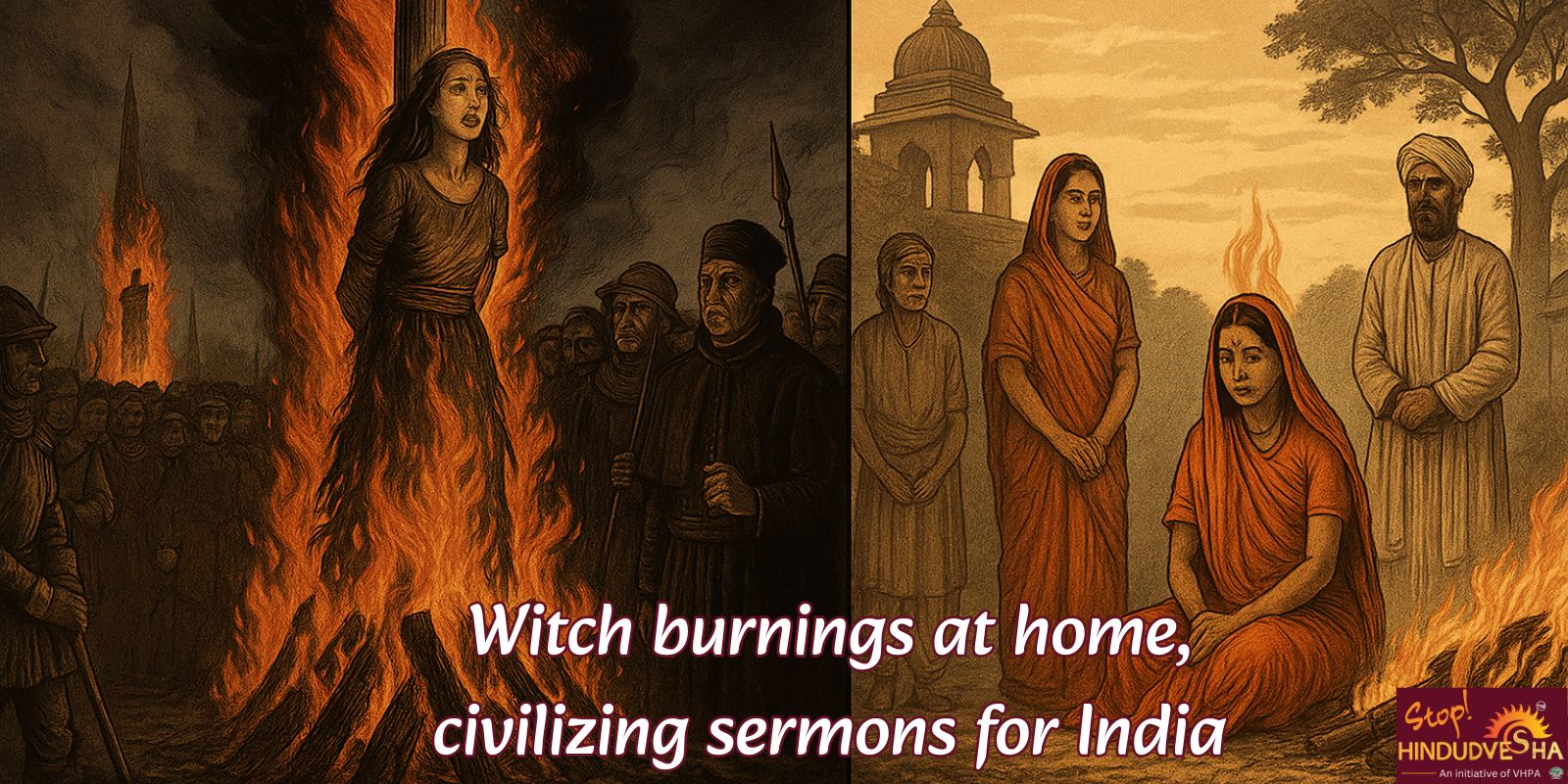
- Sati was an extremely rare, often voluntary practice confined to small elite groups, yet British colonial discourse portrayed it as widespread to justify intervention.
- Europe’s witch hunts, by contrast, executed up to 60,000 people — mostly women — many of them burned at the stake in systematic, state-driven campaigns.
- Missionaries and administrators inflated sati statistics to secure moral authority and distract from the economic exploitation and social devastation of colonial rule.
- Evidence from travelers, inscriptions, and early Company officials shows sati was optional, declining over time, and unsupported as an obligation in core Hindu texts.
- The colonial focus on sati served as propaganda, allowing Britain to claim civilizing superiority while overlooking its own far more brutal history of burning women alive.
While Europe burned tens of thousands of its own women at the stake for “witchcraft,” British imperial moralists pointed across the ocean at a handful of Hindu widows stepping voluntarily onto funeral pyres and thundered: “Behold the savage!” History’s most breathtaking act of projection had found its stage.
Sati, the act of a widow self-immolating on her husband’s funeral pyre, was an exceedingly rare phenomenon in pre-colonial and colonial India, documented in only a few hundred cases across vast populations and centuries. Historians like Anant Sadashiv Altekar have estimated that, even at its peak in medieval times, “only an infinitesimal number of widows in the general population were immolating themselves,” adding that in the Deccan and Central India, “not more than one widow in a thousand used to mount the funeral pyre [1].” British records — which were highly exaggerated to further their colonizing and missionary agendas — from 1815 to 1828 tallied 8,134 widow immolations in Bengal, an average of 581 per year amid an estimated 1 million widows — a figure so minuscule it borders on statistical insignificance [2].
In stark opposition, Europe’s witch hunts between the 15th and 18th centuries unleashed a torrent of institutionalized violence, executing up to 60,000 individuals — predominantly women — under the guise of purging demonic influences [3]. [3These persecutions, fueled by religious fervor and social paranoia, ravaged communities across Germany, France, Scotland, and beyond, with Germany alone accounting for up to 25,000 deaths. While colonial powers decried sati as a symbol of Eastern barbarism to justify their “civilizing” mission, their own societies were still extinguishing the embers of similar atrocities, revealing a profound hypocrisy in the moral narratives of empire.
This disparity is not merely numerical but emblematic of how history is wielded as a tool of power. Sati, often voluntary and generally confined to elite strata, was exaggerated by British missionaries and administrators into a pervasive horror to legitimize colonial rule. In contrast, the witch hunts represented a systematic, state-sanctioned campaign against women, often targeting healers, midwives, and the marginalized amid economic upheavals following the Black Death and the Reformation.
Colonial Construction of Sati: Myth and Manipulation
The portrayal of sati as a rampant scourge in Hindu society was not an organic revelation but a deliberate construct of British colonial ideology. Following the Battle of Plassey in 1757, which marked the ascendancy of the East India Company, administrators sought moral pretexts to cloak their economic exploitation. Christian missionaries, restricted from proselytizing until the Charter Act of 1813, bombarded the British Parliament with sensationalized accounts of Hindu “atrocities” to gain entry into India. Sati emerged as their quintessential emblem of oriental depravity, inflated from isolated incidents into an epidemic that demanded Western intervention [4].
Historian Lata Mani, in her seminal work Contentious Traditions: The Debate on Sati in Colonial India, argues that the discourse surrounding sati was less about the welfare of Indian women and more about redefining Hindu tradition to suit colonial agendas [5]. Missionaries like William Carey propagated wildly inflated figures — claiming 10,000 to 100,000 annual cases — to galvanize support for evangelical efforts. Yet, these claims crumbled under scrutiny. Comprehensive analyses of epigraphic and historical records from 1900 BCE to 1900 CE reveal fewer than 500 documented instances of sati in South India, roughly one every 8 years over the millennia [6]. Even in Bengal, where sati was relatively more common due to socio-economic factors like land inheritance laws under the Permanent Settlement of 1793, the practice affected a negligible portion of widows.
This exaggeration served multifaceted purposes. Economically, it diverted attention from colonial policies that precipitated famines, such as the Bengal Famine of 1770, which claimed up to 10 million lives [7]. Culturally, it positioned Britain as the enlightened arbiter, echoing Rudyard Kipling’s “White Man’s Burden [8]” while erasing indigenous identity. This narrative persists in modern discourse, equating colonialism with progress and overshadowing the economic drain — estimated at $45 trillion by economist Utsa Patnaik — that impoverished India [9]. The irony is palpable: while Britain lamented a phantom epidemic of sati, its own history was marred by the very real pyres of witch persecutions, which claimed lives on a scale sati never approached.
Historical Evidence and Regional Variations
To demystify the prevalence of sati, one must delve into its historical footprint, which reveals a practice far from ubiquitous. Ancient accounts, such as those by the Greek traveler Megasthenes in the 4th century BCE, mention only isolated cases among Indian elites.
Dutch observer Francisco Pelsaert, writing during the reign of Mughal Emperor Jahangir, remarked that “there are hundreds, or even thousands, who do not do it…[10]” Italian nobleman Pietro Della Valle, who travelled through India in the 1630s, likewise noted that the burning of widows upon their husbands’ deaths was optional and that “indeed few practice it [11].” Francois Martin of the French East India Company, who lived in India from 1669 until his death in 1706, similarly observed that the custom was “not very widely practiced now [12].”
Author Meenakshi Jain points out that even officials of the East India Company maintained, well into the late eighteenth century, that sati was not a common practice. In 1770, Alexander Dow asserted that it had almost disappeared and was not “reckoned a religious duty, as has been very erroneously supposed in the West.” George Forster wrote in 1782 that many Hindu widows — particularly in the Maratha regions — held significant power and influence through their abilities, wealth, connections, or political involvement [13].
Eliza Fay, the wife of a judge of the Supreme Court in Calcutta, wrote in September 1781 that she had “never had an opportunity of witnessing the various incidental ceremonies, nor have I ever seen any European who had been present at them.”
John Malcolm, who administered Central India including Malwa, observed that the practice had been most widespread when the Rajputs held power and prestige, but that the Marathas had “rendered this practice very rare.”
Jain adds that the Eran inscription of 510 CE indicated sati’s emergence during socio-political upheavals rather than as a Vedic or religious mandate. Mughal emperors like Akbar and Jahangir attempted to regulate it, viewing it as a curious Hindu custom rather than a widespread crisis.
In vast swaths of South India, sati was virtually absent, while in North India, it was largely confined to martial communities like the Rajputs, where it sometimes merged with jauhar—collective self-immolation during sieges to evade capture by invaders. Historian Roshen Dalal attributes its sporadic rise after 500 CE to feudal dynamics, with a decline by the 17th century, until colonial sensationalism revived its notoriety [14].
Colonial records, despite their biases, affirm this. The surge in documented cases in Bengal post-Company rule often stemmed from zamindars’ coercion to circumvent inheritance rights, rather than from religious fervor. Even assuming underreporting, sati affected perhaps one in 50,000 widows, a rarity comparable to modern anomalies like honor killings in other societies. In empires like Vijayanagara or the Marathas, it wasn’t very important, underscoring their elite, regional character [15].
Scriptural Underpinnings
The foundational texts of Hindu Dharma — the Vedas, Upanishads, and epics — do not enshrine sati as a compulsory rite but, when it is mentioned, frame it as a voluntary expression of devotion. The Rig Veda (10.18.7–8), frequently misinterpreted, explicitly urges widows to rise from the pyre and embrace life for their progeny: “Rise up, woman, come to the world of living beings; come, he lies lifeless; you have fulfilled the wifehood of this husband.” No Vedic hymn commands immolation; instead, longevity and familial duties are emphasized [16].
Later Smritis vary in tone. The Manusmriti (5.157–158) extols chaste widowhood but prioritizes child-rearing over death. The Yajnavalkya Smriti advocates asceticism, not fire. Puranas like the Garuda Purana praise voluntary sahagamana for spiritual merit — promising heavenly reunion — but only if uncoerced. Commentators like Medhatithi condemn force, deeming it antithetical to dharma. The Parashara Smriti (4.28–30), often cited as an endorsement, reflects later interpolations amid invasions, not the core Vedic ethos [17].
Swami Vivekananda, one of India’s greatest reformers and spiritual leaders, dismissed sati as a “social custom gone wrong,” not an intrinsic Hindu institution. The Arthashastra’s silence on penalties for coercion further underscores its voluntary nature. In essence, scriptures portray sati as the apex of pativrata — devotional purity — but subordinate to grihastha responsibilities, with coercion rendering it void [18].
Madri’s Immolation: Grief, Agency, and Epic Archetype
The Mahabharata provides one of sati’s earliest literary depictions in the tale of Queen Madri, offering a window into its voluntary, emotion-driven essence. In the Adi Parva (Section 117), Madri, second wife to King Pandu and mother to twins Nakula and Sahadeva (conceived via divine boon), ascends the pyre after Pandu’s death from a curse prohibiting intimacy.
Pandu, exiled to the forest due to a hunting mishap, succumbs when Madri’s allure overcomes his restraint. Overwhelmed by guilt, Madri declares, “I am the cause of the king’s death; how can I live without him?” Despite pleas from Kunti and sages to prioritize motherhood, Madri’s resolve prevails: “My heart follows him; let me share his pyre.”
Madri’s story humanizes sati: no external pressure, only personal sorrow and love. Kunti, rejecting immolation, raises all five Pandavas, embodying maternal dharma. Later additions, such as the acts of Krishna’s wives, are post-500 CE interpolations, but the core epic features thriving widows like Satyavati [19].
Raja Rammohun Roy: Reformer or Colonial Stooge?
Raja Rammohun Roy’s crusade against sati culminated in the Bengal Sati Regulation of 1829, which criminalized abetment and marked a pivotal reform. Witnessing his sister-in-law’s immolation in 1811, Roy leveraged Vedic arguments in his newspaper Sambad Kaumudi, asserting sati’s lack of scriptural sanction. Collaborating with Governor-General Lord William Bentinck, he framed his petitions as an aberration, leading to their ban.
Yet, Roy’s legacy is ambivalent. Critics like Rajiv Malhotra view him as a “brown sahib,” whose employment with the East India Company and Brahmo Samaj’s monotheistic leanings echoed missionary rhetoric. By aligning with Evangelicals, Roy inadvertently bolstered the “dark India” trope, ignoring Europe’s witch hunts. Post-abolition, Bentinck celebrated it as a “civilizing triumph,” diminishing Indian initiative. Roy’s rationalism sought Hindu revival, but his Western influences made him a conduit for anglicization, as later reformers like Ishwar Chandra Vidyasagar built upon. This alliance, noble in intent, entrenched colonial moral superiority, where indigenous voices validated foreign intervention [20].
Europe’s Infernos: The Scale and Savagery of Witch Hunts
While the British colonial authorities in India condemned and eventually banned the practice of sati (the immolation of widows on their husbands’ funeral pyres), much of Christian Europe was engulfed in its own frenzy of lethal persecution against supposed witches during the same broad era — a period historians sometimes call the “Burning Times” (roughly 1450–1750) [21].
Across the continent, an estimated 60,000 people were executed on charges of witchcraft, with women making up roughly 80 percent of the victims. The infamous Malleus Maleficarum (“Hammer of Witches”), published in 1486, gave theological and legal sanction to rampant misogyny, declaring women inherently more vulnerable to demonic temptation and Satanic pacts because of their supposed moral weakness and carnal nature [22].
The worst outbreaks occurred in the German-speaking lands of the Holy Roman Empire (25,000 executions), Switzerland, and parts of France and the Low Countries, with a particularly intense wave between 1580 and 1662. In mainland Europe and Scotland, convicted “witches” were typically burned alive — a punishment intended to mirror the eternal flames of hell and prevent their bodies from rising again. England and its North American colonies, by contrast, generally preferred hanging.
This was an age steeped in fear of the supernatural: crop failures, diseased livestock, infant deaths, and personal misfortunes were routinely blamed on the Devil and his human agents. At the same time, post-Reformation Europe was obsessed with religious uniformity; entering a pact with Satan was therefore framed not only as heresy but as treason against both God and the state. Secular and ecclesiastical courts, armed with anti-witchcraft statutes, used torture to extract confessions, creating a self-reinforcing cycle of accusation and terror.
Far from the stereotypical cackling, warty crone of later folklore, most of those accused were ordinary villagers — healers, midwives, poor widows, or simply people who had quarrelled with neighbours, refused charity, or stood out in any way that made them convenient scapegoats for a community’s anxieties. A single denunciation could spiral into mass trials and executions, tearing apart entire regions in waves of paranoia and violence that dwarfed, in both scale and brutality, the colonial critique Britain later levelled at sati.
England’s witch pyres endured into the 18th century. The last burning for petty treason was Catherine Murphy’s in 1789 at Newgate, strangled, then tormented for coining [23]. This prompted the Treason Act 1790, replacing burning with hanging. Precedents included Joan of Arc (1431) and Elizabeth Gaunt (1685).
This institutionalized brutality, persisting amid Enlightenment stirrings, exposes the hypocrisy: colonizers who “saved” Indian women overlooked their own gendered genocides.
Lingering Shadows: Executions in America
The Salem Witch Trials of 1692 in Massachusetts Bay Colony stand as one of the most notorious episodes of the broader European witch-hunting panic. Beginning in early 1692, over 200 people — mostly women — were accused of witchcraft, sparked by the bizarre behavior of a group of young girls who claimed to be tormented by spectral visions. These “afflicted children,” some as young as nine, became the primary accusers, “crying out” against neighbors, relatives, and even strangers [24].
Nineteen of the accused (fourteen women and five men) were ultimately convicted and hanged on Gallows Hill; one man, Giles Corey, was pressed to death for refusing to enter a plea. No one was burned at the stake — burning remained rare in English tradition — but the trials were lethal enough.
Crucially, children’s testimony carried extraordinary weight. In the 17th-century worldview, the young were often regarded as spiritually pure and therefore especially sensitive to demonic influence; paradoxically, this made them ideal “witch-finders.” As English folklorist Christina Hole notes in her study A Mirror of Witchcraft, the practice of using children to detect witches was commonplace in English villages throughout the century. Certain children gained local or even regional fame for their supposed ability to identify malefic neighbors simply by falling into fits or pointing fingers in court. Salem was not an aberration; it was a particularly explosive outbreak of a Trans-Atlantic pattern in which the voices of the young, amplified by adult fear and theology, could send ordinary people to the gallows.
These late echoes coincided with Britain’s anti-sati campaigns, underscoring the irony of colonial “civilizing” claims.
Closure
Sati’s abolition, though a progressive measure, ultimately served to conceal the deeper machinery of colonial exploitation. Bentinck’s 1829 Act, shaped partly by Ram Mohan Roy’s arguments, unfolded against the backdrop of famines that claimed millions—calamities rooted in British policies yet conveniently omitted from the moral narrative. Missionaries like William Carey denounced Hindu “evils” with fervor, even as Europe’s own history bore the scars of sixty thousand witch executions. This selective outrage became the foundation of an imperial storyline in which sati symbolized Eastern barbarism while Western atrocities were quietly set aside. The pattern is unmistakable: empire thrived not on altruism, but on myths deployed to legitimize domination.
The sharp contrast between Europe’s vast centuries-long landscapes of flame and its pointed indignation toward a statistically rare, often voluntary practice exposes a deeper truth. The moral discourse of empire was never about protecting women; it was about asserting authority. British officials seized upon sati as a ready-made moral alibi—a rhetorical shield that justified conquest, diverted attention from economic plunder, and reframed India as a civilization in need of rescue, even as Europe’s own explicitly misogynistic witch persecutions still smoldered in living memory.
By elevating sati into the defining emblem of India’s supposed savagery, colonial authorities engineered a narrative that sanctified their rule while erasing the violence embedded within their own societies. To revisit this constructed contrast is not to defend sati, but to dismantle the imperial mythmaking that continues to shape global perceptions of history, morality, and power.
Citations
[1] Altekar, A.S. “The position of women in Hindu civilization,” p.168. Internet Archive. https://archive.org/details/in.ernet.dli.2015.100033.
[2] Women’s History Network. “Empire on Fire: The Institutionalisation of Widow Immolation by the British Colonial State in India.” https://womenshistorynetwork.org/empire-on-fire-the-institutionalisation-of-widow-immolation-by-the-british-colonial-state-in-india/
[3] Gendercide Watch. “Case Study: Witch Hunts.” https://www.gendercide.org/case_witchhunts.html.
[4] IndiaFacts. “Sati: Historical Evidence.” https://indiafacts.org/sati-historical-evidence/.
[5] Mukherjee, Lata. “Sati: A Historical Anthology.” Journal of Women’s History (summary page). Project MUSE. https://muse.jhu.edu/article/18416/summary.
[6] Indica Today. “Revisiting Sati, Part III: Missionaries Debate Sati.” https://www.indica.today/long-reads/revisiting-sati-part-iii-missionaries-debate-sati/.
[7] Stop Hindu Dvesha. “Britain’s Biological Warfare: How Colonial Famines Made India the World’s Diabetes Capital.” https://stophindudvesha.org/britains-biological-warfare-how-colonial-famines-made-india-the-worlds-diabetes-capital/.
[8] History Matters (George Mason University). “Sati.” https://historymatters.gmu.edu/d/5478/.
[9] Committee for the Abolition of Illegitimate Debt (CADTM). “The Great Famine and Colonial Exploitation.” https://www.cadtm.org/spip.php?page=imprimer&id_article=16972.
[10] Eraly, Abraham. The Mughal World: Life in India’s Last Golden Age. Text version via Internet Archive.
https://archive.org/stream/AbrahamEralyTheMughalWorldLifeInIndiasBookZZ.org/%5BAbraham_Eraly%5D_The_Mughal_World_Life_in_India%27s_%28BookZZ.org%29_djvu.txt.
[11] Scribd. “Untitled Document (5-6271466930146640791).” https://www.scribd.com/document/520708212/5-6271466930146640791.
[12] Dube, Saurabh. Sati: Evangelicals, Baptist Missionaries and the Changing Colonial Discourse. Dokumen.pub edition. https://dokumen.pub/sati-evangelicals-baptist-missionaries-and-the-changing-colonial-discourse-9788173055522.html.
[13] Indica Today. “Revisiting Sati, Part III: Missionaries Debate Sati.” Duplicate of item 6. https://www.indica.today/long-reads/revisiting-sati-part-iii-missionaries-debate-sati/.
[14] Mani, Lata. Contentious Traditions: The Debate on Sati in Colonial India. Google Books excerpt. https://books.google.co.in/books?id=DH0vmD8ghdMC&pg=PA363.#v=onepage&q&f=false
[15] IndiaFacts. “Missionaries, Sati, and Colonial India.” https://www.indiafacts.org.in/missionaries-sati-colonial-india/.
[16] Indica Today. “Sati: Understanding the Practice from a Dharmic Perspective.” https://www.indica.today/research/sati-understanding-practice-dharmic-perspective/.
[17] IndiaFacts. “Sati: A Dharmic Perspective.” https://indiafacts.org/sati-dharmic-perspective/.
[18] Sanatan Wisdom of Vedas. “Sati Pratha and Hinduism.” https://sanatanwisdomofvedas.wordpress.com/2020/06/28/sati-pratha-and-hinduism/.
[19] Swarajya. “The Sati Strategy: How Missionaries Used an Extinct Practice to Christianise India.” https://swarajyamag.com/reviews/the-sati-strategy-how-missionaries-used-an-extinct-practice-as-a-rallying-point-to-christianise-india.
[20] OpIndia. “The Great Cultural Revolution: The Debate Surrounding Raja Ram Mohan Roy’s Legacy.” https://www.opindia.com/2019/05/the-great-cultural-revolution-the-debate-surrounding-raja-ram-mohan-roys-legacy-is-symbolic-of-it/.
[21] BBC News. “Catherine Murphy, the Last Burning at the Stake.” http://news.bbc.co.uk/2/hi/uk_news/magazine/8334055.stm.
[22] Malleus Maleficarum. Sacred-Texts.com. https://sacred-texts.com/pag/mm/index.htm.
[23] ExecutedToday.com. “1789: Catherine Murphy, Last Burning at the Stake.” https://www.executedtoday.com/2009/03/18/1789-catherine-murphy-last-burning-at-the-stake/.
[24] Bill of Rights Institute. “The Salem Witch Trials.” https://billofrightsinstitute.org/essays/the-salem-witch-trials.

Donate to HINDUDVESHA
Our Mission is to explore and expose Hindudvesha through research analysis, education and response.
SUPPORT US