

The Gen Z Experiment: How Western Media Manufactures Revolt in India and Nepal
 Rati Agnihotri · 11/17/2025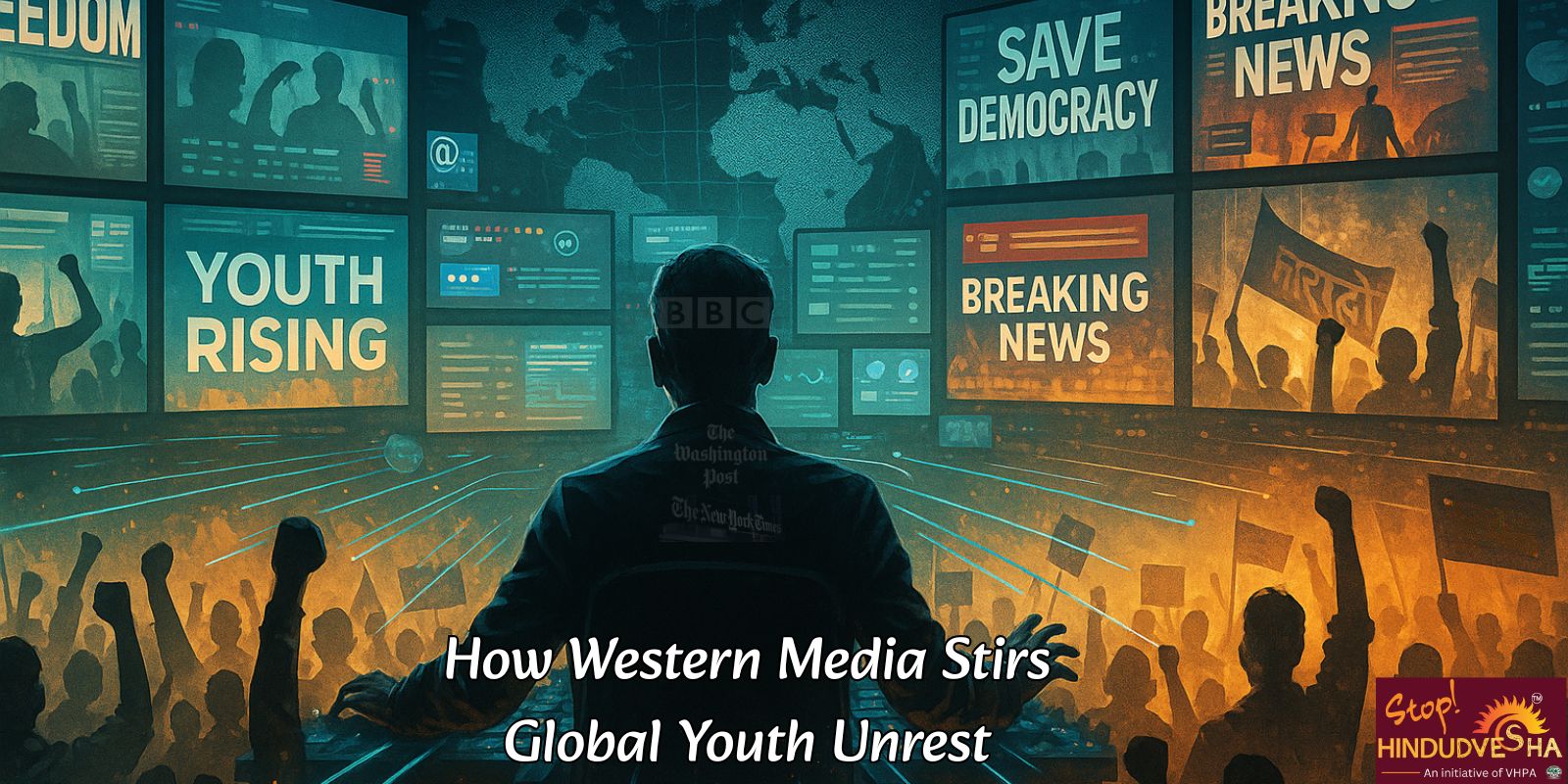
- Western media has increasingly abandoned objectivity, using biased narratives to glorify unrest in non-Western nations.
- BBC’s “Gen Z” article on India exemplifies an attempt to romanticize protests and incite youth-led dissent.
- Similar media patterns emerged in Bangladesh and Nepal, where violent movements were framed as democratic “Gen Z revolutions.”
- These narratives reveal deep double standards—Western protests are portrayed as disruptive, while non-Western ones are celebrated as heroic.
- The trend reflects a modern form of narrative colonialism aimed at destabilizing sovereign nations like India and Nepal.
The media is often called the fourth pillar of democracy. Yet in today’s globalized world, dominated by a few hegemonic power centers, much of the elite Western media has become more of a disruptor than a pillar.
Under the guise of defending democracy and human rights, sections of the mainstream Western press have assumed the role of a globalist monarchy—dismissing governments and stirring unrest with opinionated rhetoric and distorted truths presented as journalism.
In the age of “woke,” media and journalism have been reduced to instruments of ideological warfare. The Western press has been largely weaponized against the Global South, where disorder and violence are glorified as social movements and portrayed as moral crusades to “save democracy.”
It is the same old geopolitical playbook, only with more aggressive tactics and familiar players.
A recent BBC article lamenting the supposed apathy of India’s Gen Z toward street protests takes this to a new extreme. By sensationalizing protest movements in India and other developing nations, the Western media has abandoned even the pretense of objectivity. It now openly circulates propaganda that seems to anticipate, even welcome, violence and chaos in countries like India.
BBC Incites Gen Z Unrest in India
The BBC has long been at the forefront of promoting deeply anti-India and anti-Hindu narratives.
StopHinduDvesha has published numerous reports exposing the BBC’s consistent pro-Islamic and anti-Hindu, anti-India bias. [1] [2] This pattern of Hinduphobia in its coverage has also been repeatedly called out by Hindu advocacy organizations across the West. INSIGHT UK, in particular, has conducted extensive research on the BBC’s reporting and coverage patterns, bringing these inherent biases to light.[3]
However, with its recent piece targeting India’s Gen Z, the elite media organization seems to have outdone itself. The article, titled “Gen Z rising? Why young Indians aren’t taking to the streets,” [4] insinuates that young Indians refrain from protesting out of fear of being labelled “anti-national.” One might reasonably ask why the writers are so eager to see India’s youth on the streets. According to them, it is to save the country from “crony corruption” and unemployment, among other issues. Apparently, those of us who believed democracy meant engaging through parliamentary and non-violent means must be delusional.
Taking on the archetypal “white man’s burden”—though the piece is authored by journalists with Indian-sounding names—the writers, and by extension the BBC, appear firmly convinced of the need for Gen Z uprisings in India. They contrast what they describe as the “passivity” of India’s youth with that of other countries in Asia and Africa, where, as they put it, “a lot of action” is taking place on the ground. “Elsewhere in Asia and Africa, the same cohort, Generation Z, those born roughly between 1997 and 2012, has been anything but quiet recently,” the article laments. [5]
The entire write-up reads like a desperate attempt to romanticize violent protests—its intent seemingly to incite India’s Gen Z into unrest, disrupt democratic institutions, and pave the way for regime change, ultimately reducing India to a banana republic. Citing a few scattered voices, the article alleges that the Indian government is “cracking down” on protests and that this has intimidated the youth. Yet it offers no credible evidence to substantiate these claims. The piece, in effect, appears to anticipate, if not outright wish for, large-scale violence on Indian streets.
Now imagine the scenario reversed—an Indian media outlet publishing a similarly incendiary piece lamenting the lack of Gen Z protests in the UK. Such a situation is almost unthinkable. Unfortunately, many elite, English-speaking Indians, who form the main audience of Western media, tend to accept whatever the Western press says about India as the unquestionable truth. The same readers seldom consider that Indian media, too, could claim the right to examine and criticize Western democracies on similar grounds.
Deep State’s Script for Gen Z Unrest in South Asia
South Asia has long remained on the radar of the global deep state. From Pakistan’s terror machinery to the political instability in Nepal and Sri Lanka, the region has been turned into a playground for vested geopolitical interests.
The mainstream left-liberal Western media—including outlets such as the BBC, The Guardian, The Washington Post, The New York Times, and Deutsche Welle—have often acted as sensational catalysts through their biased and distorted coverage of South Asian affairs. From glorifying Pakistan-sponsored cross-border terrorism and weaponizing the Kashmir issue to curb India’s rise, to subtly endorsing radical Islamic extremism in Bangladesh and ignoring the persecution of Hindus under the Yunus regime, the Western media has played a deeply problematic role.
With Gen Z now emerging as the new buzzword and increasingly being used as an instrument for regime change—from Bangladesh to Nepal—the role of Western media in shaping and amplifying such narratives can no longer be ignored or dismissed. StopHinduDvesha has already published extensive analyses exposing this bias, particularly in the coverage of the violent protests that led to regime change in Bangladesh in 2024.[6] Mainstream Western media largely portrayed the 2024 Bangladesh crisis as a Gen Z revolution, presenting violent protests as a progressive youth movement. Its coverage not only romanticized the unrest but also whitewashed the wave of communal anti-Hindu violence that swept across Bangladesh during that period—and likely continues under the Yunus regime.
The Western press likewise glorified the so-called Gen Z protests that swept Nepal in September 2025, resulting in widespread violence and loss of life. Though these demonstrations stemmed from genuine frustration over corruption and unemployment, they were soon hijacked by violent factions. The Western media, instead of acknowledging this descent into chaos, chose to romanticize the unrest—echoing its earlier pattern of glorifying dissent and overlooking disorder, as seen in its coverage of Bangladesh’s anti–Sheikh Hasina movement rooted in radical extremism. Consider, for instance, a few of the provocative headlines that marked the Western coverage of Nepal’s Gen Z protests:
- “Nepal’s uprising was a generation in the making” – The Washington Post, September 12, 2025.[7]
- “Gen Z protests differently. This skull flag is one example” – The Washington Post, September 17, 2025.[8]
- “Gen Z protests: Why are Asia’s youth so angry?” – Deutsche Welle, October 14, 2025.[9]
- “The Gen Z uprising in Asia shows social media is a double-edged sword” – BBC, September 24, 2025. [10]
- “No Country for Young People: Nepal’s Gen Z Sees Little Hope at Home” – The New York Times, October 24, 2025.[11]
- “The Contagious Gen Z Uprisings” – The New York Times, October 19, 2025.[12]
The pattern is eerily familiar. The style of writing can best be described as a blend of moral posturing and exoticized storytelling aimed at Western audiences. Some of these reports lament corruption and unemployment, waxing eloquent about Nepal’s social, economic, and political challenges while glorifying the so-called Gen Z “movement.” Others go a step further, subtly suggesting that Nepal should serve as a model for the rest of Asia, where young people are encouraged to emulate Nepal’s Gen Z activism.
A Deutsche Welle article proclaims, “Young people across South and Southeast Asia have grown up online, frustrated and impatient with their leaders. As jobs dry up and inequality widens, their protests are shaking even the most entrenched political systems.” Meanwhile, The New York Times appears almost breathless in its enthusiasm for the role of social media in fueling protest movements across the world—from the Philippines and Indonesia to Peru and Kenya.
Sensational Coverage of Protests in Non-Western Countries
The Western media has a long history of covertly glorifying protests in non-Western countries. Its coverage often relies on biased, selective, and distorted reporting, presenting only one side of the story and framing these movements in moral and ethical terms, depicting protesters as defenders of democracy and human rights.
In India, this pattern has been evident in the portrayal of the anti-CAA protests, which were framed through the lens of “Islamophobia.” A law designed to offer citizenship to persecuted minorities from Pakistan, Afghanistan, and Bangladesh was instead painted as a “Hindu majoritarian” conspiracy engineered by the Modi government. Likewise, the Western media’s disproportionate focus on the 2020–2021 farmers’ protests was far from neutral. A movement in which the authorities showed remarkable restraint was exaggeratedly cast as an episode of state repression and human rights violations, relying on half-truths and ideologically slanted narratives that resembled activism more than journalism.
In Madagascar, the Western media recently cheered a “Gen Z “movement that led to a military takeover of the nation. [13]
A recent piece by The Japan Times aptly captures the propensity of the Western media to fuel anarchic protests in non-Western countries: “Western media have perfected a seductive but dangerous narrative: the romanticized tale of youth-led “revolutions” toppling supposedly repressive, graft-ridden governments abroad. In just the past month, coverage of political unrest in Madagascar, Nepal, Indonesia, and the Philippines has followed the same script. The ouster of Sheikh Hasina in Bangladesh in 2024 was packaged as a heroic liberation, only for Islamist repression and chaos to follow”.[14]
Strong Reactions to BBC’s Gen Z Narrative
The BBC article—effectively a clarion call urging India’s Gen Z to draw inspiration from recent events in neighboring Nepal and take to the streets—has sparked sharp criticism across Indian media and civil society. Writer and economist Sanjeev Sanyal strongly condemned the publication’s “oversight.” In an unambiguous response, he criticized the BBC’s barely concealed attempt to incite civil unrest and sow anarchy in India: “Britain’s state-owned media wonders why there are not enough political protests by the youth in India. What exactly do they want to see?”[15]
Leading Indian news channels, including CNN-News18 and national broadcaster DD India, have run panel discussions and news analyses on the BBC’s Gen Z article, questioning its intent in wishing for social and political anarchy in a sovereign nation. CNN News-18 panel discussion titled “Gen Z rising or BBC Itching for riots? Disconnect or Anti Bharat Agenda”[16] raises the issue of the BBC outrightly abandoning media and journalism ethics and indulging in anti-India politics.
An opinion piece published by Firstpost aptly argues how the BBC write-up penned down by Soutik Biswas and Antriksha Pathania[17] distorts India’s Gen Z’s sentiments and mindsets to create a vicious anti-India narrative: “The BBC piece strings together selective anecdotes, protests, online polarisation, farmer movements, caste unrest, and implies that these add up to an approaching revolution. Yet in every thriving democracy, public contestation is not collapse; it’s participation”. [18]
What stands out most from the BBC’s Gen Z piece is that Western media coverage of India has grown increasingly desperate. Having moved beyond sensationalism, it now veers into the murky terrain of anticipating, even normalizing, violence and unrest. From glorifying protests to whitewashing anarchy, the Western press appears intent on framing India as a nation perpetually on the brink.
The recent coverage of the violent protests in Ladakh in September—culminating in the detention of Magsaysay Award–winning climate activist Sonam Wangchuk under the National Security Act (NSA)—offers a telling example. The “Ladakh protest toolkit” is being subtly promoted as the ideal template for Gen Z uprisings across India.
“India Detains Popular Leader of Protest Movement,” declares The New York Times headline. The article insinuates that Wangchuk’s detention reflects a broader pattern in the Modi government’s “reaction to those it perceives as challenging its authority,” a list that, according to the report, includes academics, media organizations, religious minorities, and “activists who advocate causes unpopular with the government.” [19]
“In India, there have been faint sparks of discontent. In September, the disputed Himalayan region of Ladakh saw violent clashes between police and protesters demanding statehood for the territory, prompting activist Sonam Wangchuk to describe the unrest as a sign of “Gen Z’s frenzy” and long-suppressed anger”, according to the BBC piece on India’s Gen Z.[20]
The Western media has long abandoned even the pretense of journalistic objectivity or neutrality in its coverage of India. Now, it appears to have crossed a red line. The BBC’s recent article, seemingly designed to incite India’s Gen Z into street protests, amounts to direct interference in the country’s internal affairs and can justifiably be viewed as a covert attempt to influence regime change.
Selective Outrage: The Western Media’s Hypocrisy Exposed
The Western media’s coverage of protests within the West stands in sharp contrast to its reporting on protest movements elsewhere.
When demonstrations erupt in Western countries, the media tends to adopt a measured and nuanced tone, avoiding any glorification of the protesters. Depending on the context, outlets often lean toward a pro-government stance, portraying protesters as rioters or disruptors. Police crackdowns are justified as necessary for maintaining law and order. Yet, when similar situations arise in non-Western nations, these same outlets eagerly highlight even the smallest instance of police action, distorting it into a narrative of “state repression.”
In January 2024, many European nations—including France, Poland, Germany, and Romania—witnessed large-scale farmers’ protests. Most Western media coverage of these demonstrations was either pro-government or strictly objective. This approach stands in stark contrast to their reporting on India’s 2020–2021 farmers’ protests, where the Indian government was depicted as draconian and authoritarian, and routine law-and-order measures taken in the interest of public convenience and national security were branded as acts of repression. [21]
Similarly, when UK police arrested more than fifty protesters during King Charles’ coronation in March 2023, there was no outpouring of “moral outrage” or denunciation of “state repression” in the Western media. The arrests were reported in a matter-of-fact manner, with a subtle undertone suggesting that preventing disruption outweighed the right to protest. [22]
In contrast, violent and anarchic protest movements in non-Western countries—whether in India, Bangladesh, Sri Lanka, or Nepal—are sensationally portrayed as “people’s revolutions” undertaken to “save democracy.” Yet similar protests in Western nations are depicted as disruptive and dangerous.
These blatant double standards in Western media coverage reflect the persistence of colonial-era attitudes of dominance and control. Only the methods have changed: in the twenty-first century, narratives have become the new instruments of colonial influence.
Wrapping Up
The West-centric left-liberal ecosystem will continue producing atrocity literature against much of the non-Western world until its readership stops idolizing such publications and begins openly challenging their biases.
The “brown sepoy” syndrome—where sections of the English-speaking elite from former colonies, including India, actively participate in spreading anti-India and anti-Hindu narratives—further deepens this problem.
For the Western media to eventually abandon these distorted portrayals, the demand for such narratives must decline. That will only happen when the Global South undertakes a serious and sustained effort to decolonize its collective psyche and reclaim control over its own stories.
Citations
[1] BBC’s bias against India//Hindus, pro-Islam stance known (StopHinduDvesha, February 2023); https://stophindudvesha.org/bbcs-anti-india-anti-hindu-and-pro-islamic-bias-is-an-established-fact/
[2] BBC Documentary: A Hit-job on India and its Prime Minister (StopHInduDvesha, February 2023); https://stophindudvesha.org/bbc-documentary-a-hit-job-on-india-and-its-prime-minister/
[3] Spotlight on the BBC – INSIGHT UK; https://insightuk.org/spotlight-on-the-bbc/
[4] Why India’s Gen Z is not taking to the streets (BBC, October 2025); https://www.bbc.com/news/articles/cq6zg9ele22o
[5] Ibid.
[6] Western Media’s Whitewashing of Hindu Genocide in Bangladesh (StopHInduDvesha, August 2024); https://stophindudvesha.org/western-medias-whitewashing-of-hindu-genocide-in-bangladesh/
[7] Nepal’s uprising was a generation in the making (The Washington Post, September 2025); https://www.washingtonpost.com/world/2025/09/12/nepal-uprising-government/
[8] Gen Z protest differently – The skull flag is one example (The Washington Post, September 2025); https://www.washingtonpost.com/opinions/2025/09/17/gen-z-nepal-indonesia-kenya-serbia-protests/
[9] Gen Z protests: Why are Asia’s youth so angry? (Deutsche Welle, October 2025); https://www.dw.com/en/gen-z-protests-why-are-asias-youth-so-angry/a-74349495
[10] Gen Z uprising in Asia shows social media is a double-edged sword (BBC, September 2025); https://www.bbc.com/news/articles/cn4ljv39em7o
[11] Nepal’s Gen Z Sees Little Hope at Home (The New York Times, October 2025); https://www.nytimes.com/2025/10/23/world/asia/nepal-protests-migrants-gen-z.html
[12] The Contagious Gen Z Uprisings (The New York Times, October 2025); https://www.nytimes.com/2025/10/19/world/gen-z-revolutions-protests-louvre-heist-gaza.html
[13] Madagascar military leader Colonel Michael Randiranirina sworn in as president and thanks protesters (BBC, October 2025); https://www.bbc.com/news/articles/cr7mn1n53jno
[14] What Western media calls insurrection at home, they call revolution abroad (The Japan Times, October 2025); https://www.japantimes.co.jp/commentary/2025/10/03/world/media-hypocrisy-on-insurrections-and-revolutions/
[15] Sanjeev Sanyal on X; https://x.com/sanjeevsanyal/status/1981356451835854989
[16] Gen Z rising or BBC Itching For Riots? Disconnect Or Anti-Bharat Agenda? (News18-YouTube); https://www.youtube.com/watch?v=tHa5XZ8C0xY&t=114s
[17] Why India’s Gen Z is not taking to the streets (BBC, October 2025); https://www.bbc.com/news/articles/cq6zg9ele22o
[18] India isn’t heading for revolution, it’s redefining democracy (FirstPost, October 2025); https://www.firstpost.com/opinion/india-redefining-democracy-not-heading-for-revolution-13944739.html
[19] India Detains Popular Leader of Protest Movement (The New York Times, September 2025); https://www.nytimes.com/2025/09/27/world/asia/india-ladakh-protests-sonam-wangchuk.html
[20] Why India’s Gen Z is not taking to the streets (BBC, October 2025); https://www.bbc.com/news/articles/cq6zg9ele22o
[21] Exposing Western media double standards on coverage of protests in the West vs protests in Bharat (Hindu Post, January 2024); https://hindupost.in/world/exposing-western-media-double-standards-on-coverage-of-protests-in-the-west-vs-protests-in-bharat/#
[22] Police arrest 52, including republican,s during King Charles’ coronation (Reuters, May 2023); https://www.reuters.com/world/uk/police-arrest-anti-monarchy-protesters-ahead-king-charles-coronation-2023-05-06/

Donate to HINDUDVESHA
Our Mission is to explore and expose Hindudvesha through research analysis, education and response.
SUPPORT US