

Manufacturing Truth: How FactShala Shapes India’s Media Mindscape
 Aditi Joshi · 11/01/2025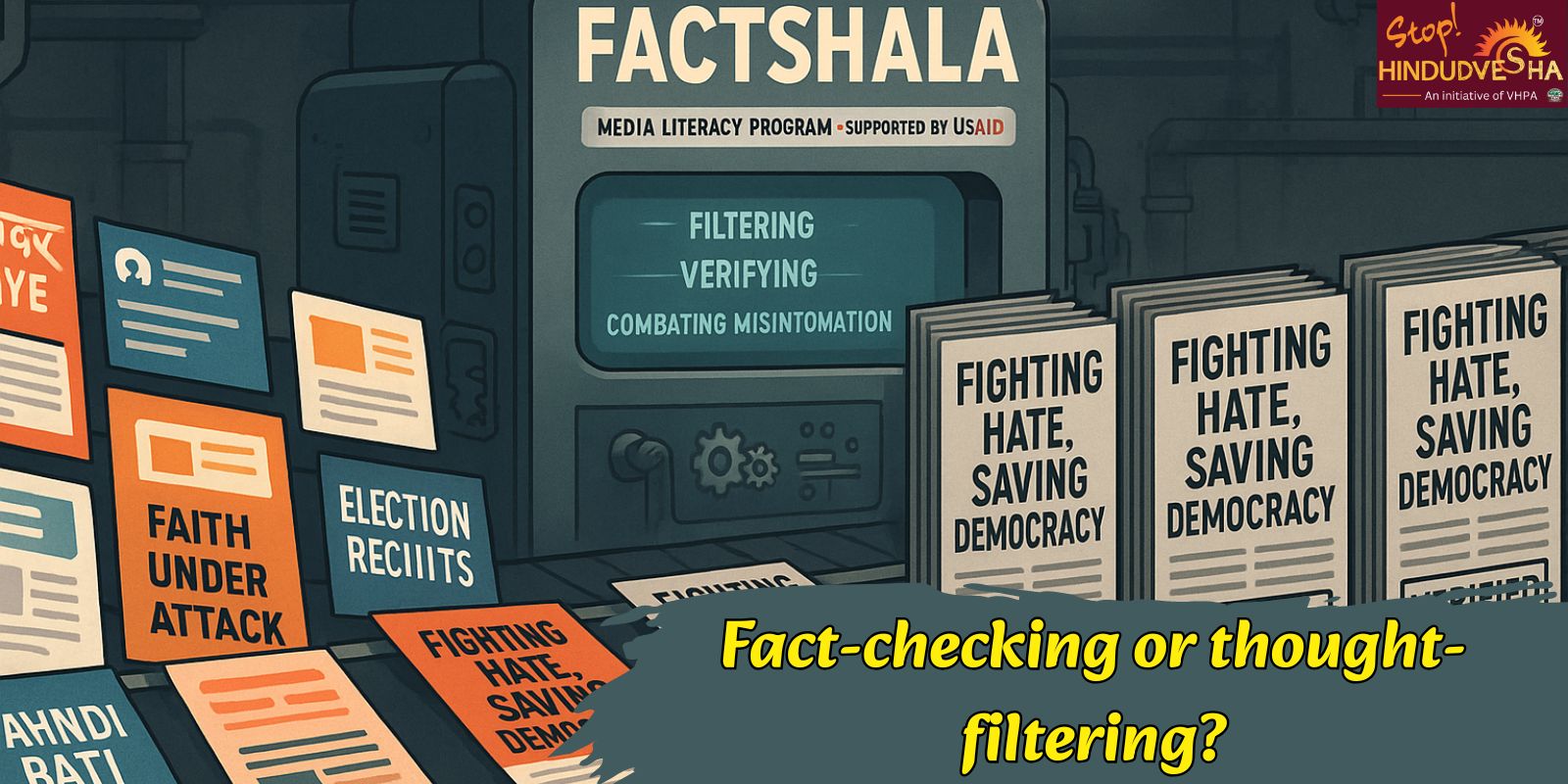
- Organizations such as DataLeads, Alt News, and the Sambhaavnaa Institute work together in a close network that turns certain ideological ideas into everyday journalistic practice.
- Civilizational or nationalist viewpoints that differ from this framework are often dismissed as “fake news,” creating a new kind of intellectual dependency.
- The Indian diaspora, especially in North America and Europe, takes in these filtered narratives through Western media and think tanks, often repeating criticisms of India focused on communalism, majoritarianism, and democratic decline.
- The debate around misinformation is therefore less about checking facts and more about who gets to decide what truth means. For India, restoring the ability to define truth and knowledge through its own traditions is not only a political task but also a civilizational one.
In recent years, India has seen a surge in “fact-checking” and “media literacy” programs that claim to fight misinformation and strengthen journalistic standards. These initiatives are often promoted as neutral and civic-minded efforts to build public awareness and critical thinking. Among them, FactShala stands out for its scale and international connections. Supported by the United States Agency for International Development (USAID) and implemented through Indian partners such as DataLeads, Alt News, and the Sambhaavnaa Institute, FactShala claims to have trained more than seventy-five thousand media professionals across the country. Its leadership and mentors include some of India’s most recognized media figures—Ritu Kapoor of The Quint, Shekhar Gupta of The Print, JM Mathew of Malayala Manorama, and Faye D’Souza of Beatroot News—placing the initiative firmly within the country’s mainstream media establishment.[1]
On the surface, FactShala appears to be a forward-looking program dedicated to improving media literacy and encouraging responsible reporting. Yet beneath this educational mission lies a deeper tension. Its design, funding, and institutional partnerships suggest that it also serves as a channel for importing Western ideas about truth, objectivity, and democracy. While the program may help participants sharpen journalistic skills, its underlying outlook reflects a particular ideological stance—one that aligns with global liberal-left assumptions often presented as universal. This creates an uneven field where certain worldviews are elevated as “neutral,” while others, especially those rooted in indigenous or dharmic traditions, are marginalized as biased or regressive.
Such efforts form part of a larger global pattern where development aid and “capacity-building” initiatives double as instruments of soft power. Through programs like FactShala, external actors shape not only how facts are verified but also how truth itself is defined. In a diverse and civilizationally complex country like India, this dynamic risks narrowing the space for homegrown perspectives, traditional reasoning, and culturally grounded ideas of knowledge and ethics.
This essay examines FactShala as more than a media training project. It explores how foreign funding, institutional networks, and ideological influence intersect to shape India’s media and information ecosystem. By tracing these links, it argues that the battle over misinformation is not only about verifying facts—it is also about who holds the authority to define truth, and whose voices set the boundaries of India’s public discourse.
The Ecosystem of Influence
FactShala’s structure offers a clear example of how media education can evolve from a tool of professional training into an instrument of ideological influence. Rather than simply teaching journalists to verify facts, it subtly shapes the very frameworks through which truth, bias, and legitimacy are defined in India’s media space. This influence becomes clearer when one looks at the program’s scale and reach.
FactShala’s claim of training more than 75,000 Indian media professionals is important not just for its size, but also because it represents the spread of a particular way of thinking about news, truth, and objectivity. The number reflects the scale at which certain ideological ideas are being absorbed within India’s media space. Although described in the language of “media literacy” and “fighting misinformation,” FactShala’s teaching model closely mirrors Western liberal-left frameworks. These frameworks are often presented as universal principles of fairness and rational inquiry, but in practice, they tend to standardize journalism according to Euro-American assumptions while downplaying India’s own intellectual and civilizational perspectives. As a result, journalists trained through such programs may unconsciously adopt biases that weaken traditional ways of reasoning, diminish cultural memory, and overlook ethical ideas rooted in dharmic thought.[2]
At the institutional level, DataLeads serves as the principal implementing body of FactShala, organizing workshops that operationalize these epistemic premises through modules on verification, source evaluation, and information credibility.[3] On the surface, these topics seem neutral and professional. However, the examples, case studies, and materials used in these sessions often reflect left-liberal interpretations of what constitutes reliable information or credible journalism. This framing is reinforced by the involvement of Alt News, a prominent fact-checking outlet that has frequently been criticized for targeting right-leaning or Hindu nationalist narratives more aggressively than others. By serving both as a partner in the project and as an authority on what qualifies as “truth,” Alt News influences the overall orientation of the program and embeds its ideological preferences within the structure of media training itself.
Complementing this ecosystem is the Sambhaavnaa Institute,[4]—an overtly activist organization that frames media literacy within the larger contexts of social justice, identity politics, and civic activism. Its role helps transform theoretical ideas into organized social action, giving the initiative a wider cultural and political reach.
Taken together, these institutions constitute a symbiotic ecosystem wherein “media literacy” becomes less a pedagogical exercise in critical reasoning and more a project of ideological calibration. Through workshops, collaborations, and media outreach, they cultivate a discursive environment that presents the global left-liberal consensus as journalistic common sense.[5] When this imported consensus is applied to India’s social and political realities, it influences how newsrooms operate, how stories are framed, and even how India itself is perceived abroad. What appears to be a well-meaning effort to build media responsibility may therefore also serve as a tool of influence. Instead of encouraging independent thinking, it risks deepening intellectual dependence—where Indian journalism increasingly reflects Western worldviews at the cost of its own cultural and philosophical autonomy.
The Deep State Dimension
The funding trail leading to the USAID warrants careful investigation.[6] Since its establishment in 1961, USAID has operated not merely as an instrument of humanitarian assistance or economic development but as a key arm of American soft power, a conduit through which political values, governance models, and normative frameworks are exported under the banner of development aid. Scholars of international relations and postcolonial studies have long observed that USAID’s interventions in Latin America, Africa, and Asia have frequently transcended the material realm of economic support, extending instead into the ideological architecture of governance and civic life. Concepts such as democracy, human rights, and civil liberties, though ostensibly universal, are often defined and operationalized through a distinctly American ideological grammar, thereby embedding Western liberal-democratic assumptions into the institutional DNA of partner nations.
In this context, FactShala emerges not as a neutral media literacy initiative but as part of a longer historical trajectory wherein “capacity-building” becomes a euphemism for ideological standardization. Through its funding and design ties to USAID, FactShala serves as part of a larger effort to embed global liberal-left narratives within India’s media and information space. The program’s focus on tackling “fake news” and “hate speech,” though presented as neutral, operates within a framework that favors certain worldviews over others. Such framing has profound implications in a country like India, where civilizational pluralism and contestation are intrinsic to the public sphere, and where the definition of “truth” or “hate” is inseparable from political, cultural, and religious context.
The issue, therefore, extends beyond journalism training to questions of sovereignty and intellectual autonomy. When foreign-funded initiatives shape domestic discourses on credibility and verification, they also influence what counts as legitimate knowledge. The seemingly technical terms “fake news” and “misinformation” acquire political meaning when filtered through Western frameworks. As a result, viewpoints challenging global liberal orthodoxy—especially those rooted in Hindu civilizational or nationalist thought—are often dismissed as propaganda or extremism. This raises urgent questions central to India’s democratic and epistemological independence:
- Who retains the authority to define “truth” in India’s media environment?
- Are journalists and citizens trained to think critically, or to think within ideologically approved boundaries?
- To what extent do such interventions subtly reframe India’s internal discourses on democracy, communal harmony, and freedom of expression in ways that serve external geopolitical and ideological interests?
Viewed within the broader history of foreign-funded programs in the Global South, FactShala exemplifies a power shift. The struggle for sovereignty now extends beyond borders and economies to the cognitive and cultural domains. Media workshops and literacy campaigns become new instruments through which national identity and knowledge are negotiated. What appears as a benign educational effort can thus operate as a tool of influence, gradually narrowing India’s ability to define truth and tell its own story on its own terms.
Impact on India’s Image Abroad
The Indian diaspora, particularly across North America and Europe, increasingly engages with India not through direct experience but through global media narratives, academic analysis, and advocacy networks. This mediated relationship means that many overseas Indians understand their homeland through the filters of Western newsrooms, think tanks, and NGOs rather than through lived familiarity. Their perceptions are therefore shaped by frameworks and assumptions that often differ from India’s civilizational and socio-political realities.
When domestic fact-checking initiatives such as FactShala are influenced by Western funding and ideological models, they begin to echo left-liberal critiques of India’s politics, religion, and society. This alignment significantly shapes how the diaspora interprets India.
The resultant image often privileges themes of communal polarization, democratic regression, and majoritarianism, creating a simplified and negative portrait that fails to capture India’s pluralism and diversity.
This phenomenon generates a self-reinforcing perceptional cycle. Western media outlets, many of which maintain close links to liberal think tanks and human rights organizations, frequently cite Indian “fact-checkers” as authoritative and ideologically neutral arbiters of truth. Such references grant these organizations international credibility, even though their objectivity is hotly debated within India. The diaspora, encountering these portrayals through mainstream media or academic platforms, tends to internalize and re-circulate them across social, professional, and digital ecosystems, from campus dialogues and diaspora associations to policy advocacy networks. Over time, the discursive echo chamber between Western institutions and the diaspora solidifies a narrative in which India is understood less through the dynamism of its civilizational ethos and more through a globalized template of liberal critique.
The consequences of this narrative circulation are neither abstract nor benign; they manifest across multiple strata of transnational engagement:
- Policy Advocacy: Diasporic lobbying in Western legislatures, particularly in the United States, the United Kingdom, and Canada, has increasingly come to mirror the ideological undertones of fact-checking discourse. Parliamentary discussions, human rights reports, and policy deliberations often reproduce these framings, thereby influencing immigration policies, trade negotiations, and foreign aid discourses. India’s domestic developments are thus filtered through moral and political frameworks shaped outside its borders, allowing foreign governments to use internal issues as leverage in diplomacy and trade.
- Campus Politics: Within universities, especially in the humanities and social sciences, student organizations and academic forums frequently appropriate the “fact-checker” framing of India’s democracy. This has generated new forms of polarization among Indian-origin students, dividing them along ideological lines reminiscent of India’s own political cleavages. Consequently, Western campuses have become proxy arenas for India’s ideological contestations, where discourses on secularism, caste, and nationalism are often mediated through Western academic lenses rather than indigenous intellectual traditions.
- Community Identity: Hindu and Indian cultural organizations in the diaspora increasingly find themselves reacting to these narratives. Some take defensive positions, while others conform to the dominant moral tone of Western liberalism to avoid controversy. This shift weakens collective confidence and transforms a once-civilizational identity into a fragmented and reactive one. Pride in heritage is replaced by the urge for ideological conformity.
In this complex web, diaspora Indians often become unwitting amplifiers of narratives that originate from foreign-funded domestic initiatives and are legitimized by Western institutions. What begins as a local project on media literacy evolves into a global mechanism shaping how India is discussed, critiqued, and understood worldwide. This process reproduces deep imbalances in narrative power. India’s image is increasingly defined not by Indians themselves but by external frameworks disguised as universal truths. Epistemic sovereignty—the right to define one’s own story—is not lost through force but through the quiet, repetitive circulation of ideas that reshape global understanding. In this way, India’s identity in the international imagination becomes less an expression of its civilizational voice and more a reflection of imported ideological expectations.
These global narratives do not remain confined to Western media or diaspora spaces. They eventually circle back into India’s own discourse, shaping how journalists, policymakers, and citizens perceive their society. When Indian media practitioners encounter these externalized critiques—often legitimized by the same “fact-checking” networks—they tend to internalize them as benchmarks of professional integrity or democratic health. Thus, the feedback loop between global perception and domestic understanding blurs the boundary between external evaluation and internal self-definition, preparing the ground for deeper shifts within India’s informational and intellectual landscape.
Closing Remarks
The contest over information in India today is not merely a question of factual precision; it reflects a deeper struggle over meaning, authority, and self-definition. Programs like FactShala, shaped by foreign funding and ideological influence, extend beyond civic education to become part of a wider system that molds how societies understand legitimacy and truth. In doing so, they highlight a paradox at the heart of India’s modern public life: even as the nation reclaims political confidence and cultural identity, it remains vulnerable to subtle forms of intellectual dependence.
Safeguarding India’s democratic and civilizational integrity, therefore, requires more than resisting misinformation—it demands the revival of independent thinking rooted in the country’s own philosophical and ethical traditions. Media education must evolve beyond borrowed frameworks to reflect India’s plural ways of knowing and reasoning. The challenge ahead is not only to produce accurate journalism but to cultivate a mindset that recognizes India’s right to interpret its own reality. In that sense, the future of truth in India will depend less on who checks the facts and more on who shapes the frameworks through which facts themselves are understood.
Citations
[1] WikiLeaks exposé reveals ties between USAID-funded Internews and ‘Factshala’, which has Shekhar Gupta and Faye D’Souza as ‘Ambassadors’; https://www.opindia.com/2025/02/wikileaks-usaid-internews-factshala-expose-shekhar-gupta-faye-dsouza/
[2] How USAID Trained 75,000 Indian Media Personnel: An Expose; https://tfipost.com/2025/02/how-usaid-trained-75000-indian-media-personnel-an-expose/
[3] DataLEADS; https://dataleads.co.in/
[4] Ravish Kumar, Pratik Sinha, and more: Know leftwing propagandists associated with Prashant Bhushan’s Sambhaavnaa Institute and its link with USAID-funded Internews; https://www.opindia.com/2025/02/ravish-kumar-pratik-sinha-prashant-bhushan-internews-usaid-expose-wikileaks-anti-india-propaganda/
[5] The hidden story behind the viral “Azadi” slogans ft. Prashant Bhushan; https://thepamphlet.in/the-hidden-story-behind-the-viral-azadi-slogans-ft-prashant-bhushan/
[6] USAID spent millions of dollars to promote media control through Internews, which is linked to India-based Factshala; https://organiser.org/2025/02/10/277413/bharat/usaid-spent-millions-of-dollars-to-promote-media-control-through-internews-which-is-linked-to-india-based-factshala/

Donate to HINDUDVESHA
Our Mission is to explore and expose Hindudvesha through research analysis, education and response.
SUPPORT US