

Illegal Immigration and India’s Challenge: Balancing Humanity with Sovereignty
 Aditi Joshi · 10/22/2025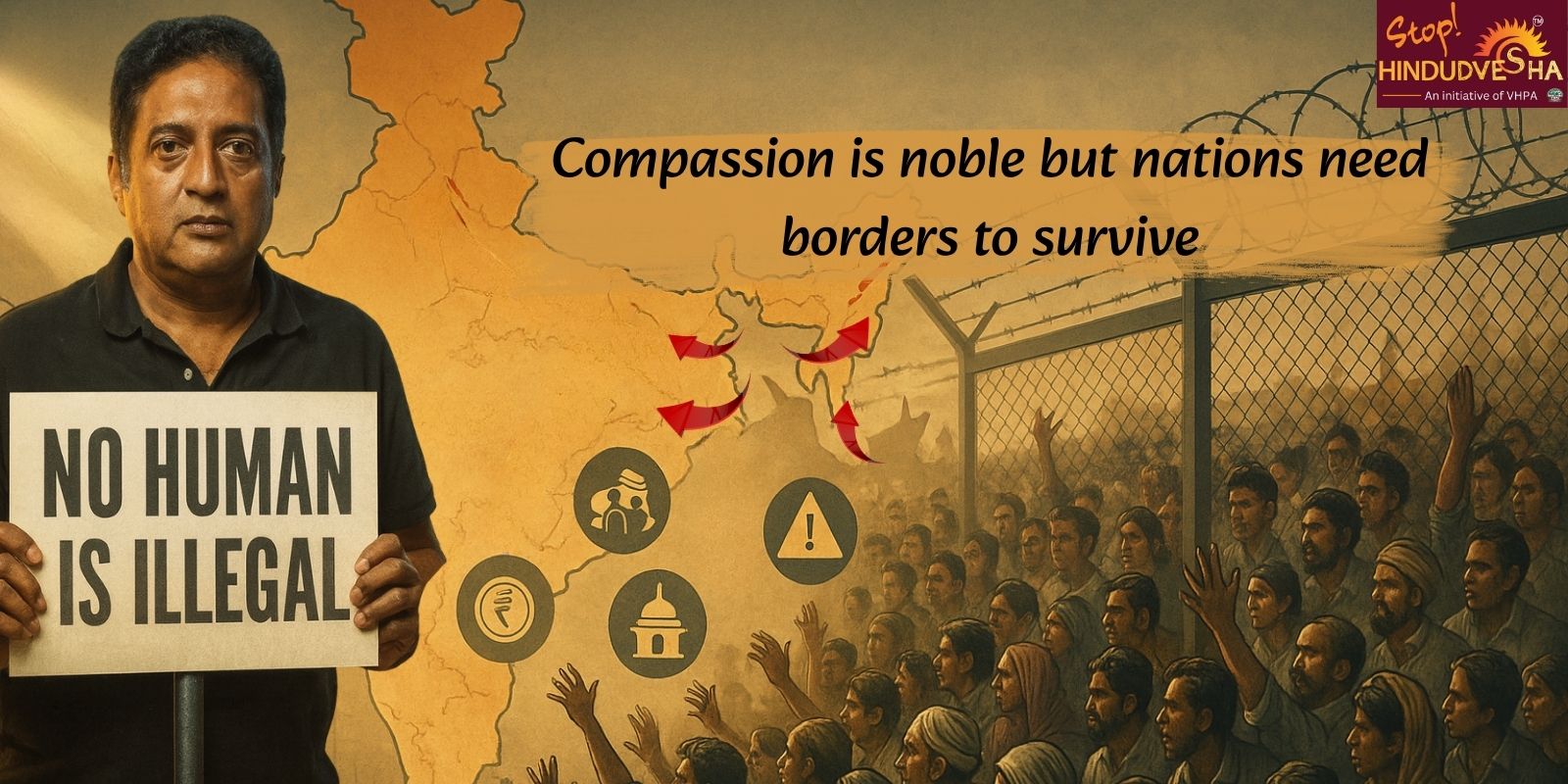
- India’s open and difficult-to-control borders, its Partition legacy, and past conflicts linked to population changes make it especially exposed to illegal immigration.
- Unchecked migration brings many risks for India: shifts in population balance, pressure on cultural identity, economic strain, political vote-bank tactics, threats to national security, and repeated outbreaks of communal violence.
- When celebrities say, “no human is illegal,” they often overlook serious legal, demographic, and geopolitical issues. Such slogans weaken constitutional responsibilities and can serve as cover for movements that destabilize society.
- India needs a practical migration policy that combines compassion with clear laws, sensitivity to demographics, and protection of state sovereignty.
The phrase “no human is illegal” has gained traction as a moral slogan in global debates on migration and refugee protection. Human rights groups, artists, and progressive politicians frequently utilize it to emphasize the dignity and equality of all people. Recently, Indian actor Prakash Raj echoed this idea, saying that “moving anywhere isn’t wrong” and that “no human is illegal on this earth.” These words sound inspiring, but when placed in the real-world framework of modern nations and their laws, the idea raises difficult questions.[1]
This article examines both the moral appeal and the practical limitations of the slogan, with a special focus on India’s complex history with illegal immigration. It suggests that while the phrase points to a noble humanitarian goal, it does not hold up against the hard realities of law, demographics, and geopolitics—especially in a country like India, where borders are porous, identities are contested, and population balance is politically sensitive.
Moral Universalism and Human Dignity
The slogan “no one is illegal” derives its strength from the belief that every person’s dignity transcends legal categories. At its core, the phrase challenges the idea that human beings can be reduced to a legal status of “illegality.” It urges compassion for people displaced by war, persecution, poverty, or climate crises, and it criticizes the dehumanization that follows when people are labeled “illegal” instead of being seen as holders of rights. This way of thinking has strong roots in moral and political philosophy. Hannah Arendt, writing about statelessness, warned of the dangers of losing citizenship, which she described as the loss of “the right to have rights.”[2] The slogan, therefore, links closely with human rights arguments that insist on dignity for all people, regardless of nationality.
However, turning moral principles into practical politics is not straightforward. Modern states are organized around the principles of sovereignty, territorial integrity, and the boundaries of citizenship. Even international law—such as the 1951 Refugee Convention[3] and its 1967 Protocol[4]—creates careful distinctions between asylum seekers, recognized refugees, legal migrants, and those who cross borders without authorization. If all of these are collapsed under the phrase “no one is illegal,” it weakens the very legal systems that make rights real and enforceable. Legal theorists note that rights do not exist in isolation; they depend on institutions that can guarantee and protect them. Without clear legal categories, rights risk becoming empty statements with no mechanism for protection.
If accepted as a universal truth, the slogan suggests a world without borders, where migration is seen as an unrestricted human right. But the reality of open borders is not neutral. States have limited resources—such as schools, hospitals, housing, labor markets, and welfare systems—that can be overwhelmed by large numbers of newcomers. When migrants compete with existing populations for these resources, it creates conflict and political backlash. Far from protecting dignity, such conditions can increase xenophobia, sharpen social tensions, and lead to widespread violations of rights that affect both migrants and host communities.
This is the fundamental problem with moral absolutism. While “no one is illegal” appeals to compassion and equality, when used without attention to political and legal realities, it may cause more harm than good. Instead of preventing injustice, it can deepen divisions and undermine the very dignity it seeks to defend.
The Neglect of Citizens’ Rights
Any fair approach to migrant rights must also recognize the rights of citizens. Governments are not only expected to uphold humanitarian values but also to protect the welfare, security, cultural identity, and democratic voice of their people. When illegal migration is dismissed as morally irrelevant, the social, economic, and political costs fall directly on host communities. This shift of burdens overlooks the legitimate rights of citizens and prioritizes abstract ideals over the lived reality of political membership. Thinkers such as Hannah Arendt have argued that citizenship is not only about exclusion; it is also the foundation that makes the exercise of rights meaningful.[5]
Celebrity Rhetoric and Political Vacuity
Slogans like “no one is illegal” gain traction because they are repeated by celebrities, activists, and intellectuals who hold influence but no direct policy responsibility. Their words carry symbolic force but often bypass the difficult questions that real governance requires: Who should count as a refugee? On what terms should asylum be granted? How should scarce resources be divided fairly between migrants and citizens? Without engaging with such questions, slogans risk becoming what Jacques Rancière has called “empty signifiers”[6]—gestures that sound moral but fail to produce real solutions. At their worst, these slogans can provide cover for political inaction, allowing leaders to hide behind words of compassion while avoiding the hard choices migration governance demands.
Illegal Immigration in India: Scale, Challenges, and Risks
India’s geography and politics make it especially vulnerable to large-scale undocumented migration. The country has more than 15,000 kilometers of land borders, much of which runs through rivers, marshlands, forests, and densely populated villages. Monitoring such terrain is extraordinarily difficult. The Indo-Bangladesh border is particularly significant. While estimates vary and are often contested, some suggest that millions of undocumented Bangladeshi nationals may be living in India.[7]
The problem is made worse by loopholes in India’s identification systems. Fake Aadhaar cards, voter IDs, ration cards, and even land documents have allowed illegal immigrants to blend into local communities. This blurs the line between citizens and non-citizens, complicates detection, and changes local demographics in ways that fuel political tension. Aware of these risks, the Government of India has set up high-level committees and commissioned demographic studies to better understand the scale and impact of illegal migration. Such steps underscore the seriousness with which the issue is viewed at the policy level.
India’s response has been shaped by its evolving legal framework. The primary law governing illegal entry remains the Foreigners Act of 1946, a colonial-era statute.[8] It gives the government the authority to detect, detain, and deport unauthorized migrants. Yet, enforcement has often been inconsistent. A further complication arose from the Illegal Migrants (Determination by Tribunals) Act of 1983[9], which applied only to Assam. This law made deportation far more difficult by placing the burden of proof on the complainant rather than on the accused migrant. The Act was widely criticized as ineffective, and in 2005 the Supreme Court struck it down in the case of Sarbananda Sonowal v. Union of India,[10] describing illegal immigration as “external aggression” and a threat to national security.
More recently, the Citizenship (Amendment) Act (CAA) of 2019 reignited national debate. The law created a fast-track path to citizenship for non-Muslim minorities—Hindus, Sikhs, Buddhists, Jains, Parsis, and Christians—from Afghanistan, Pakistan, and Bangladesh. [11] Supporters argue that the Act offers necessary humanitarian relief for persecuted minorities, while critics contend it undermines India’s secular Constitution and the principle of equality before the law. When combined with proposals for a nationwide National Register of Citizens (NRC), the CAA has sparked protests, lawsuits, and fierce political battles. Together, these measures underscore the profound impact of law, religion, and national identity on India’s immigration policy.[12]
Enforcement Gaps and Structural Challenges
Even with laws on the books, enforcement continues to face serious hurdles. Monitoring India’s vast and complex borders is extremely difficult. In Assam, rivers cut across boundary lines; in Tripura and Mizoram, dense forests limit visibility; and in many rural areas, villages lie on both sides of the border, making crossings easy. While India has invested in fences, floodlights, drones, and smart sensors along parts of the Indo-Bangladesh frontier, coverage is incomplete and results uneven.[13]
Within the country, the problem is exacerbated by a weak administrative capacity. Local police and border agencies often lack the necessary resources. Corruption and widespread document fraud further undermine enforcement efforts. Many illegal immigrants settle in urban slums or remote rural areas where detection is both hard and politically sensitive. Deportation itself is another challenge. India’s constitutional guarantees under Articles 14 and 21[14] require due process for all, including non-citizens. International human rights commitments also restrict arbitrary action. On top of this, origin states—especially Bangladesh—are often unwilling to recognize or take back undocumented migrants. These factors leave India with limited options, despite strong legal authority on paper.
Risks and Implications
Illegal immigration in India is not just a law-and-order problem. It has wide-ranging social, political, economic, cultural, and security consequences. Its effects are felt across many areas—reshaping population patterns, shifting political balances, straining limited resources, and deepening identity-based anxieties.
- Demographic Shifts: Border states like Assam and West Bengal have carried much of the burden of undocumented migration, especially from Bangladesh. The arrival of large Bengali-speaking Muslim communities has fueled fears among local Hindus and tribal groups of being outnumbered in their own regions. These demographic changes directly affect ethnic balance, cultural survival, and political representation. The 2019 National Register of Citizens (NRC) process in Assam reflected these long-standing concerns, as the state tried to clearly identify “genuine” citizens amid mounting anxieties. [15]
- Cultural and Identity Tensions: Illegal immigration also brings challenges of cultural assimilation. Large inflows alter the linguistic, religious, and everyday practices of host communities, creating fears of identity erosion. In Assam, worries about preserving the Assamese language and culture have repeatedly led to mass protests and violent mobilizations. In urban areas, demographic changes—seen in settlement patterns, religious observances, and cultural habits—often spark tensions between migrants and locals who feel their way of life is under threat. [16]
- Economic Pressures: Migrants play a significant role in the informal economy, working in sectors such as construction, agriculture, and domestic labor. This provides industries with cheap workers but also creates competition for scarce jobs, land, and welfare benefits. Fraudulent documents enable many migrants to access subsidized housing, healthcare, and education, thereby further burdening already overstretched public services. The result is a double effect: while migrants contribute to local economies, they also increase pressure on limited resources. For poor citizens, this competition fuels resentment, reinforcing cycles of marginalization and hostility.
- Political and Security Concerns: The political effects of illegal immigration are far-reaching. When undocumented migrants obtain voter IDs and enter electoral rolls, they change the political balance. Critics often accuse parties of deliberately cultivating migrant communities as “vote banks,” undermining fair democratic representation. Security risks also grow. Unchecked migration makes it easier for extremist groups or criminal networks to exploit porous borders. In South Asia’s volatile environment, this raises threats of terrorism, smuggling, and insurgency, giving migration a direct link to national security concerns.
- Social Conflict and Communal Violence: Illegal immigration frequently becomes a flashpoint for violence. Indigenous groups often see migrants as intruders threatening their land, livelihoods, and culture, leading to clashes between communities. The 2012 ethnic violence in Assam, which displaced hundreds of thousands, stands as a stark reminder of how dangerous demographic disputes can become.[17] Similar tensions have emerged in Tripura, Meghalaya, and even Delhi, highlighting the fragility of social harmony when migration remains unchecked.
Why the Slogan Is Irresponsible in India
In India’s context, Prakash Raj’s use of the slogan “no human is illegal” is not just simplistic but deeply problematic. Unlike more uniform or resource-rich societies that may afford broad universalist ideas about migration, India is a fragile federal union marked by immense linguistic, religious, and ethnic diversity. It already struggles with communal tensions, unsettled border disputes, and uneven development. In such a setting, absolute slogans risk ignoring history, weakening state responsibility, and upsetting delicate social balances.
- Historical Amnesia and Demographic Conflicts: India’s modern history is marked by conflicts driven by demographic changes, particularly in border states such as Assam, Tripura, and Jammu & Kashmir. Migration has repeatedly altered ethno-religious balances, fueling insurgencies, separatist demands, and communal violence. Using a slogan that glosses over these scars dismisses the lived experiences of communities that have endured the upheavals of demographic disruption.
- Undermining Constitutional Responsibility: The Indian Constitution entrusts the state with regulating citizenship, securing borders, and protecting national security. Declaring that “no human is illegal” dismisses these duties by erasing the distinctions between citizens, legal migrants, refugees, and illegal entrants. It undermines the state’s sovereignty to decide membership and its ability to protect the rights of citizens, which depend on clear legal definitions.
- Rhetorical Cover for Destabilizing Movements: Universalist slogans often act as shields for political movements that aim to normalize or excuse illegal migration. In states like Assam and West Bengal, such narratives have been used to resist enforcement tools like the NRC, weakening legal efforts to address demographic anxieties. In this way, humanitarian language risks being co-opted as a form of political weaponry.
- From Naïveté to Destabilization: While the phrase carries emotional appeal, applying it blindly in India is irresponsible. Instead of promoting human dignity, it risks destabilizing fragile regions, eroding institutions, and deepening identity divides. In India, where sovereignty, security, and citizenship are closely tied, the slogan is not a harmless moral gesture—it is a potential trigger for disorder.
Towards a Balanced Framework
Instead of relying on sweeping slogans, India needs a practical and context-sensitive framework that balances humanitarian obligations with the demands of sovereignty and security. While the phrase “no human is illegal” may carry emotional weight, policymaking in a diverse and fragile country like India requires nuance, institutional clarity, and demographic awareness.
- Clear Legal Categories: Migration policy must begin with precise, legally defined terms. Refugees escaping persecution, economic migrants seeking better opportunities, and those entering without authorization should not be treated as one group. Current ambiguities blur these categories, weakening enforcement while also diluting protections for genuine refugees. Consistent application of legal categories ensures that compassion is not confused with unchecked permissiveness.
- Strengthened Borders and Surveillance: Given India’s porous borders—especially with Bangladesh and Myanmar—better border management is essential. This means not only building physical infrastructure, such as fencing and floodlights, but also adopting technology, including drones, biometric databases, and AI-enabled monitoring. At the same time, cooperation with neighboring states is necessary to address irregular migration at its source.
- Due Process Safeguards: Even as enforcement improves, constitutional guarantees must be upheld. Deportations and detentions should be conducted in accordance with transparent procedures that prevent arbitrary action and adhere to international human rights standards. Such safeguards protect migrant dignity and shield the state from charges of bias or abuse.
- Conditional Legalization Pathways: For long-term undocumented residents who are integrated into local economies and communities, India could explore conditional regularization under strict rules—such as the length of stay, a clean criminal record, and a willingness to assimilate. This avoids keeping people in a permanent state of limbo while maintaining state control.
- Integration and Community Programs: Migrant settlement should be supported with measures that ease friction with host populations. Programs that encourage language learning, cultural adaptation, and economic participation can help reduce fears of identity loss. Effective integration also lowers the risk of migrants being exploited for political or communal purposes.
- Demographic Sensitivity: Policies must take into account fragile demographic balances, especially in states such as Assam, Tripura, and West Bengal. In such regions, stricter migration controls along with targeted welfare for indigenous groups are vital to prevent unrest.
- International Engagement: Illegal immigration cannot be solved by India alone. Bilateral and regional agreements with countries like Bangladesh and Myanmar on repatriation, refugee management, and border security are crucial. Such diplomacy lessens India’s unilateral burden and strengthens its standing in global migration debates.
Beyond Celebrity Rhetoric
Prakash Raj’s use of the slogan “no human is illegal” shows how easily moral slogans gain attention in debates on migration. While emotionally powerful, such phrases are shallow and risky when applied without context, especially in India, where concerns over demographics, identity, and sovereignty are intense.
India needs more than rhetoric; it requires a serious migration policy that blends humanitarian concern with legal clarity, demographic caution, and constitutional responsibility. Only with such a balanced approach can India protect the dignity of migrants while safeguarding citizens’ rights, ensuring social stability, justice, and legitimacy in the long run.
Citations
[1] Prakash Raj’s Delusion vs The Dark Truth About Illegal Immigration – YouTube; https://www.youtube.com/shorts/7REV4obtds0
[2] What Is a “Right to Have Rights”? Three Images of the Politics of Human Rights; https://www.jstor.org/stable/27644535
[3] The 1951 Refugee Convention | UNHCR; https://www.unhcr.org/about-unhcr/overview/1951-refugee-convention
[4] The 1951 Convention and 1967 Protocol relating to the Status of Refugees; https://www.unhcr.org/sites/default/files/2025-02/1951-refugee-convention-1967-protocol.pdf
[5] The Right to Have Rights: Citizenship, Humanity, and International Law | Oxford Academic; https://academic.oup.com/book/3620/chapter-abstract/144933941?redirectedFrom=fulltext
[6] Passages · Jacques Rancière: Democracy means equality (1997); https://www.radicalphilosophy.com/interview/jacques-ranciere-democracy-means-equality
[7] Detection and Deportation; https://www.mha.gov.in/sites/default/files/72_RTI_NE_AK_280714.PDF
[8] THE FOREIGNERS ACT, 1946; https://www.indiacode.nic.in/bitstream/123456789/2259/3/A1946-31.pdf
[9] THE ILLEGAL MIGRANTS (DETERMINATION BY TRIBUNALS) ACT, 1983 | India Code; https://www.indiacode.nic.in/bitstream/123456789/1766/5/A1983-39.pdf
[10] Sarbananda Sonowal vs Union Of India & Anr on 12 July, 2005; http://www.mcrg.ac.in/RLS_Migration_2019/Readings_MODULE_F/Sarbananda%20Sonowal%20vs%20UoI.PDF
[11] THE CITIZENSHIP (AMENDMENT) ACT, 2019 NO. 47 OF 2019; https://indiancitizenshiponline.nic.in/Documents/UserGuide/E-gazette_2019_20122019.pdf
[12] Timeline: Key Events in the NRC Controversy – Supreme Court Observer; https://www.scobserver.in/journal/timeline-key-events-in-the-nrc-controversy/
[13] addressing illegal migration and border security; https://www.pib.gov.in/PressReleseDetailm.aspx?PRID=2110805#:~:text=To%20increase%20the%20effectiveness%20of,question%20in%20the%20Rajya%20Sabha.
[14] Unmaking Citizens: The Architecture of Rights Violations and Exclusion in India’s Citizenship Trials; https://www.nls.ac.in/wp-content/uploads/2025/07/Unmaking-Citizens_online-report.pdf
[15] Complete NRC Draft | Home & Political | Government Of Assam, India; https://homeandpolitical.assam.gov.in/resource/complete-nrc-draft
[16] CAA contradicts Assam Accord? – Supreme Court Observer; https://www.scobserver.in/journal/caa-contradicts-assam-accord/
[17] Ethnic Violence in Bodoland | Economic and Political Weekly; https://www.epw.in/journal/2012/34/commentary/ethnic-violence-bodoland.html

Donate to HINDUDVESHA
Our Mission is to explore and expose Hindudvesha through research analysis, education and response.
SUPPORT US