

Selective Secularism: The Hindu Quest for Equal Justice in India’s Courts
 Parth Ojas · 10/03/2025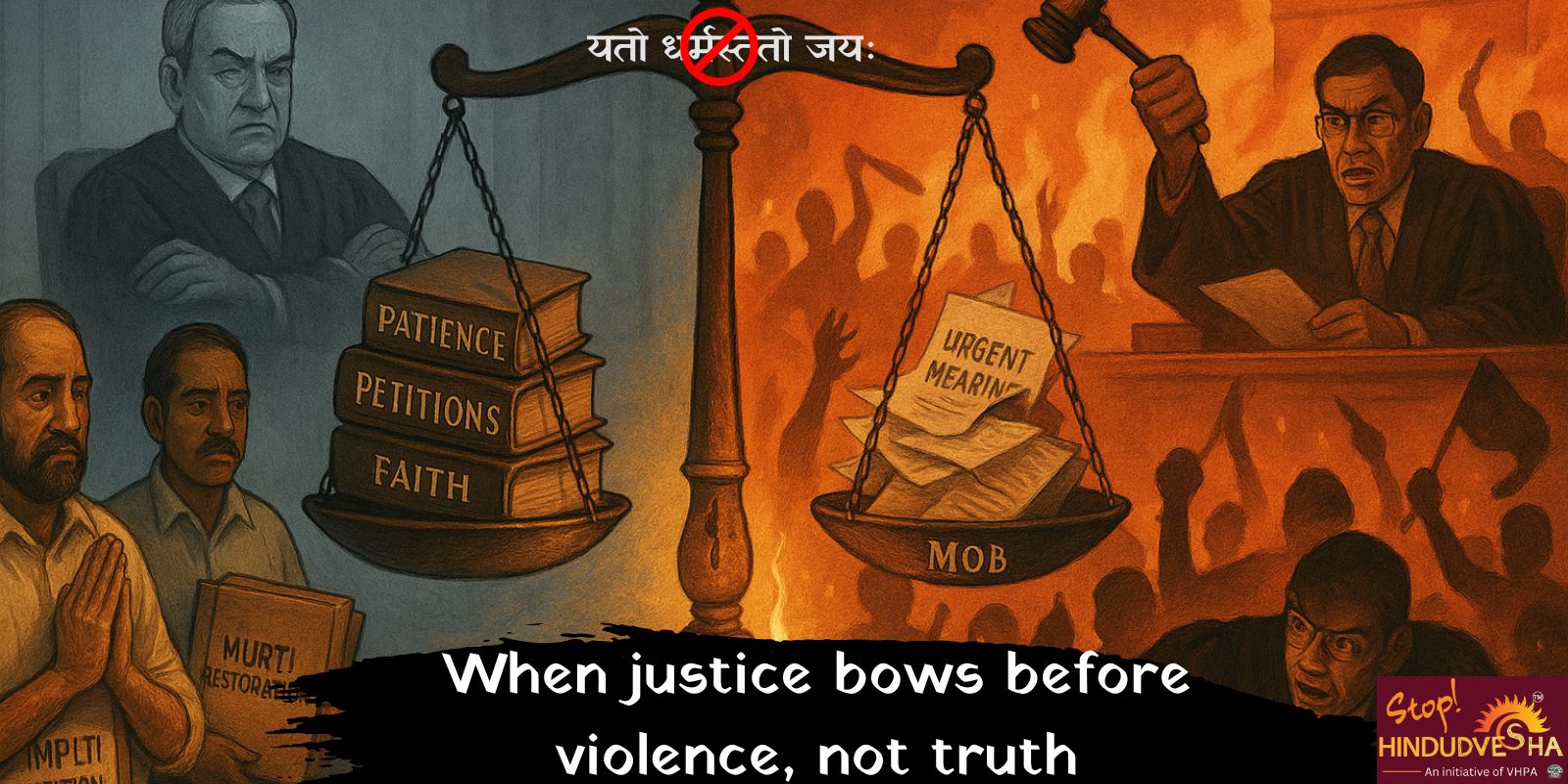
- Recent remarks by the Chief Justice of India, B.R. Gavai, during the Khajuraho Javari Temple plea have sparked public discussion on judicial impartiality and sensitivity – emphasizing the need for courts to consider the perceptions and sentiments of Hindu society while upholding the rule of law and the principle of secularism.
- Even if a small fraction of citizens begins doubting judicial impartiality and fairness, it erodes the judiciary’s greatest asset—public trust and respect—which it is duty-bound to protect and strengthen.
- Ancient jurisprudence emphasized the importance of impartiality, while modern legal challenges show recurring neglect of Hindu concerns, requiring systemic reforms.
- Preaching equality while practicing partiality – selective secularism – undermines India’s constitutional promise; only adherence to Sarv Dharm Sambhav can restore true secularism.
One of the settled principles of law is that justice must not only be done but also seem to have been done,[1], a principle that lies at the heart of judicial credibility. Citizens repose immense trust in the judiciary because they see it as the guardian of their rights, the neutral arbiter in times of conflict, and the ultimate protector of constitutional guarantees. However, recent developments have triggered a wave of disquiet, particularly among Hindus, who increasingly perceive the judiciary as inconsistent and, at times, prejudiced, when it comes to matters affecting their faith. [2] The controversy sparked by Chief Justice B.R. Gavai’s remarks in the Vishnu murti restoration case—where a genuine plea was brushed aside as “publicity interest litigation”—brought these concerns into sharper focus. The remarks were not merely a rejection of a petition; they appeared to many as a casual dismissal of Hindus’ deeply held faith.
In a democracy like India, where faith and law are often intertwined, such perceptions carry real weight. If a section of society comes to believe that the judiciary shows less respect or sensitivity toward their faith compared to others, the very trust and credibility that form the judiciary’s greatest strength begin to weaken. Even if this feeling exists only among a “small” group, it is serious because once doubts arise about judicial impartiality, the very foundation of the justice system is put at risk.
This article examines why some Hindus are increasingly disillusioned with judicial attitudes, why this perception of selective secularism is problematic, and how genuine equality before the law can be achieved by addressing these inconsistencies.
Constitutional Promise vs. Judicial Reality
The Constitution of India enshrines the principle of equality before the law under Article 14. It guarantees freedom of conscience, as well as the right to freely profess, practice, and propagate one’s religion, under Article 25. On paper, these provisions apply uniformly to everyone, regardless of their religion.
Yet, in practice, some judicial pronouncements often give the impression of a dual standard. [3] Hindu institutions are policed more stringently, their practices scrutinized with an activist lens, and their sacred spaces (temples) are controlled mainly by the state. Minority institutions, by contrast, are often treated with greater deference, their claims accommodated with urgency, and their traditions protected from state interference.
The dissonance between constitutional ideals and practical reality has created fertile ground for critics to believe that the ‘secular’ India and its judiciary are not entirely impartial when it comes to Hindu concerns. [4]
Faith Denied at Khajuraho
The Javari Temple in Khajuraho, a UNESCO World Heritage site, houses a seven-foot broken murti of Lord Vishnu. The murti was mutilated during Mughal invasions. Several times, Hindus have pleaded with governments and the Archaeological Survey of India (ASI) to restore it, but to no effect.
The desecrated murti results in a practical denial of Hindus’ Article 25 right to freely worship. As such, their right to restore the sacred murti flows directly from the constitutional guarantee under Article 25. By prioritizing ASI ACT (1958)[5] over the living faith of Hindus, the system is subordinating fundamental rights to technicalities—contradicting Article 13(2), which voids any law inconsistent with fundamental rights. The crucial point here is why a statutory provision should outweigh a constitutional provision – particularly a fundamental right to worship, guaranteed under Article 25(1) of the Constitution?
Since the government and ASI have ignored this issue, Hindus, having no other recourse, turned to the judiciary. However, instead of ordering restoration or suggesting that the government amend the laws, or at least issue a notice to the ASI, the petition was dismissed, being termed as a “publicity interest litigation.” The oral remarks by CJI Gavai—telling petitioners to “go and ask the deity itself to do something. If you claim to be a staunch devotee of Lord Vishnu, then you should pray and engage in meditation”[6]—were seen as belittling. Such remarks deepen the sense of judicial apathy toward Hindu concerns and seem to make a mockery of the petitioner’s faith (Hinduism) by the very institution meant to protect his faith and rights. [7]
For millions of Hindus, a murti is not just a piece of stone but a living embodiment of divinity. In law, it is also considered a juristic personality. Even if the Court believed it lacked jurisdiction, it could have simply declined the PIL (Public Interest Litigation) by citing ASI’s authority, without making any adverse remark on the petitioner’s faith.[8]
Advocate Vineet Jindal wrote to the Chief Justice to withdraw his remarks.[9] The Chief Justice later clarified that his words were misunderstood and that he respects all religions.[10] While the clarification was welcome, it raised a crucial discussion in the public domain – should such remarks have been made at all in Court? In a country where judicial words carry the weight of destiny, even unintended phrases can appear as bias.
This is why, across Indian history, judges were warned against even the appearance of partiality, as it is not enough to do justice – it must also be perceived that justice has been done.
When Hindu Faith Meets Judicial Apathy
The Vishnu murti case is not an isolated episode. Hindus have faced a series of dismissals, often accompanied by remarks that trivialize their devotion, and which would never be tolerated if directed at minorities. For instance: [11]
- Bombay HC (2025): An urgent plea against mocking the Holi festival was dismissed with the admonition, “Don’t be so sensitive.”
- Allahabad HC (2025): A PIL against a book defaming Goddess Gayatri was rejected as repetitive, signalling tolerance for insults to deities.
- Bombay HC (2025): A complaint against a song mocking Lord Shiva was dismissed with the reasoning that “every action disliked by a class is not an outrage of religious sentiments.”
- Supreme Court (2023): Petitions against the Adipurush movie for distorting Hindu epics were rejected with the comment, “everyone is touchy about everything now.”
- Madras HC (2022): Cases against conversions and misuse of loudspeakers were dismissed with the remark that “tolerance is a tenet of every Hindu.”
- Bombay HC (2018): A case against social media ridicule of Hinduism was dismissed with the advice to “get a sense of humour.”
- Supreme Court (2014): In the PK movie case, the Court told petitioners, “If you don’t like it, don’t watch it.”
Each of these rulings normalized disrespect towards Hindu traditions. Chapter XVI of the Bharatiya Nyaya Sanhita (2023) and Chapter XV of the Indian Penal Code (1860)—designed to deal with offences relating to religion—are generally seen as rarely invoked in Hindu cases, but are seen as quickly actionable in other scenarios.[12]
Asymmetric Secularism
Imagine if the same remark (as made in the Lord Vishnu murti case) had been directed at the Muslim community. The reaction would have been immediate and apocalyptic. Bar Councils would issue condemnations, the media would scream “judicial islamophobia”, NGOs would rush petitions to the UN, political parties across the aisle would jump in, and the Chief Justice would be tarred as a bigot.[13]
But if Hindus are mocked, watch the silence set in. No lawyers’ bodies pass resolutions, no protests erupt, no leaders intervene, no judge is asked to step aside. That’s because in Bharat, secularism is a one-way street—minority hurt is headline news, Hindu hurt is trivialized.[14]
The same asymmetry was evident when the Supreme Court recently stayed some provisions of the Waqf Amendment Act (2025), including clauses aimed at preventing encroachment.[15] Yet, petitions on Hindu causes – from Kashi Vishwanath Temple-Gyanwapi Mosque to the challenge against the Places of Worship Act (1991) – have languished for years.[16] Hindu temple cases languish for generations, while minority grievances find instant redress. Call it what you will, but this is bias dressed up as secularism.
Rewarding Riots, Punishing Faith
The asymmetry persists because different communities channel their grievances through different forums. When Muslims feel offended, the response often escalates from street protests to riots to savage killings—like Kanhaiya Lal’s beheading in Udaipur for backing Nupur Sharma. Violence becomes the message. The state and judiciary, fearing bloodshed, tiptoe around, shifting blame onto victims. Instead of punishing the killers, the Court scolded Nupur Sharma for a “loose tongue,” even accusing her of “setting the country on fire.” Justice bows, violence dictates.[17]
Hindus, by contrast, seek justice in courts. They file petitions, argue their cases, and place faith in legal remedies. But instead of timely justice, they receive dismissals and mockery. The message conveyed is dangerous: aggression receives a remedy, while patience invites ridicule.[18] This twisted reward system—appeasing the violent while restraining the law-abiding—if left unchecked, corrodes the pillars of democracy itself.
Unequal Burden of Proof
Another glaring bias is seen in the matter of evidence. The Waqf Amendment Act (2025) abolished the controversial “Waqf by User” clause, which allowed land to be claimed as Waqf merely on the basis of usage, without any documentary proof. The Supreme Court criticized this reform, asking how Muslim institutions could produce 500-year-old land records.[19]
Yet in the Ram Janmabhoomi case, Hindus were asked to produce centuries-old archaeological, textual, and historical evidence to establish Shri Ram’s birthplace. Ancient texts, such as the Skanda Purana, colonial-era maps, and ASI findings, were scrutinized in minute detail before the Court ruled in favor of the temple.[20]
The burden of proof, therefore, appears lopsided – leniency for Muslim claims, but exacting demands from Hindus.
Judicial Inconsistencies
Commentators, such as Dr. Anand Ranganathan, have highlighted patterns of judicial inconsistency. He remarked that episodes such as the Supreme Court’s recent observation on a Bhagwan Vishnu murti are not isolated. According to him[21], there have been several instances where the Court’s approach appeared discriminatory towards Hindus. He pointed out that the Supreme Court refused to reopen the genocide cases of Kashmiri Hindus from 1990, citing “lapse of time,” while simultaneously constituting an SIT for the 1984 anti-Sikh riots that occurred six years earlier than the Kashmiri Hindus’ genocide. He also questioned why the state is allowed to control Hindu temples while similar controls are never extended to mosques or churches. On the issue of free speech, he contrasted the Court’s sharp censure of Nupur Sharma for merely quoting Islamic scripture with its silence when political leaders like Udhayanidhi Stalin made derogatory remarks about Sanatan Dharma.
Dr. Ranganathan also flagged the ban on animal sacrifice for Hindus while halal practices continue for Muslims, the judicial ratification of the Places of Worship Act (1991), in the Ayodhya judgment that freezes historical injustices, and the Sabarimala verdict that singled out Hindu practices while ignoring parallel exclusions in Islam and Christianity. He noted how, during the anti-CAA protests, the Shaheen Bagh blockade was deemed illegal, but the Court sought mediation instead of enforcement – a leniency never extended to Hindu causes.[22]
Advocate Vishnu Shankar Jain has echoed similar concerns. He recalled instances[23] such as the Delhi High Court’s remark that “Lord Shiva does not need protection” while allowing demolition of a temple in Delhi—an observation upheld by the Supreme Court. He highlighted how waqf-related cases are directly entertained by the Supreme Court under Article 32, but Hindu temple cases are deflected to other courts. He gave the example of challenges to Hindu temple endowment laws filed in 2013, which, after 12 years of waiting, were directed by the Supreme Court to be returned to the High Courts. In contrast, petitions challenging amendments to the Waqf Act in 2025 received urgent hearings and interim relief within a matter of months.
Mr. Jain, while criticizing the remarks made in the Jawari temple case, rightly noted that such comments deeply pain the Hindu community. He recalled how Hindu processions, such as the Jagannath Yatra and Kanwar Yatra, were halted during the COVID-19 pandemic, while Bakrid processions in Kerala were allowed to continue by the same bench of Justice Nariman (now retired). He further pointed out how demolitions in Jahangirpuri were directly entertained by the Supreme Court, while Hindus seeking remedies for temple rights under Article 32 were told to approach lower courts.[24]
Dharma of Impartiality
The foremost duty of a judge has always been integrity—not just freedom from corruption, but absolute impartiality, detachment, and fairness. In Bharat’s civilizational ethos, judicial integrity is seen as a sacred duty (Dharma)–equated with the performance of a Yajna. The Smritis and Nitishastras gave this concept an exceptionally wide meaning. Brihaspati says[25]“A judge should decide cases without any consideration of personal gain or any kind of personal bias, and his decision should be in accordance with the procedure prescribed by the texts. A judge who performs his judicial duties in this manner achieves the same spiritual merit as a person performing a Yajna.”
The strictest precautions were prescribed to ensure impartiality. Trials were to be conducted in open Court, and judges were forbidden to converse privately with parties while a suit was pending, recognizing that such dealings may lead to Pakshapat (partiality). Shukra-Nitisara enumerates five causes that destroy impartiality[26]: attachment, greed, fear, enmity, and private hearings. It further insists: “The judges appointed by the king should be well versed in procedure, wise, of good character and temperament, soft in speech, impartial to friend or foe, truthful, learned in law, active (not lazy), free from anger, greed, or desire for personal gain.”[27]
Indeed, Bharat has the oldest judicial system in the world, and no other civilization has upheld such an exalted vision of integrity in public office.
The Path Forward
It must be said that in a number of landmark judgments, Bharat’s judiciary has acted to shield Hindu Dharma from dilution. In Sastri v. Muldas (1966)[28], the Supreme Court rejected the attempt to classify Swaminarayan followers as non-Hindus, affirming that Hinduism is a broad, living, and inclusive tradition rooted in the Vedas, the Smritis, the Puranas, and the Upanishads. This was not merely a verdict—it was a civilizational safeguard against fragmentation of Dharma. Similarly, in Aruna Roy v. Union of India (2002)[29], the Court upheld the inclusion of Vedic wisdom in school teachings, making it clear that exposing students to scriptures of all faiths, including Hindu texts, did not violate the principle of secularism.
It is also important to note that Hindus deeply respect the judiciary and acknowledge its invaluable contributions to sustaining democracy and justice. However, it is also abundantly clear that certain reforms are necessary to preserve that respect:
- Equal Protection for All Religions – Any attack on Hindu Dharma must be treated with the same seriousness as an attack on any other religion. Selective outrage, where only particular religious sentiments invite immediate judicial or political response, undermines both secularism and justice. Penal provisions under the Bharatiya Nyay Sanhita (2023) related to offending religious sentiments must be applied equally, regardless of whether the accused is Hindu, Muslim, Christian, or from any other religion.
- End Selective Secularism– The core of the problem lies in the distorted meaning of secularism, where “sarva dharma samabhava” (equal respect for all faiths) has been replaced by “appeasement of some, neglect of others.” There must be a complete bar on selective secularism. Secularism should not be interpreted as the erasure of Hindu practices while defending minority rights.
- Public Responsibility– There is an urgent need to define what secularism truly means in India. The Supreme Court must clearly state this in its judgments. Until then, judges should use public and academic forums to explain it. If they openly highlight the dangers of selective secularism, political parties will be less likely to exploit it for electoral gain, and citizens will resist divisive politics. Likewise, if parties challenge bias, judges too will act with greater care. Such a balance between the judiciary, politics, and society is vital to ending selective secularism and upholding both individual dignity and national integrity, as promised in the Preamble.
- Temple Autonomy and Religious Parity– The state’s control over Hindu temples, while other religious institutions enjoy autonomy, must end. Judicial intervention should mandate parity—either all religious institutions are regulated equally, or all are left free. Anything less is discriminatory.
- Timely and Equal Hearing of Petitions– One of the strongest grievances among Hindus is the uneven pace of hearings. Petitions concerning Hindu Dharma often languish in Courts for years, while petitions involving other religions are heard with remarkable speed—sometimes even at midnight. For example, the Waqf Amendment Act (2025) was challenged and granted interim relief within months. Yet, petitions on crucial Hindu causes, such as the constitutionality of the Places of Worship Act, the Gyanvapi Masjid, or the Harihar Temple (Sambhal case), remain pending for years. Worse still, Hindu matters are often directed to the High Courts, whereas similar issues of other religions are entertained directly by the Supreme Court.[30]
To restore balance, the Court must adopt a uniform standard – similar cases must receive similar attention. If the Supreme Court decides to hear a matter directly, it must also do so for Hindu petitions of a similar nature. And if it transfers a case to another Court, it must record reasons distinguishing them from earlier cases of other religions that it entertained directly. Equality before the law demands nothing less, and at the same time, transparency will dissolve suspicion and reaffirm faith.
- Live-streaming of Court Proceedings – All court proceedings must be live-streamed, in line with Justice D.Y. Chandrachud’s own observation in the Swapnil Tripathi case (2018) [31] [32] that “sunlight is the best disinfectant.” Live telecasts will ensure transparency, discourage ideological biases, and reinforce that judgments are based on law and research rather than personal predilections.
- Hearing on Merits – Cases must be heard and decided strictly on their merits (i.e., on the substantial points/core issues involved in the case). Courts must evaluate legal arguments, remedies, and precedents rather than the ideological leanings of a particular judge.[33] The judiciary must recognize that rejecting petitions related to Hindu Dharma without reasoned analysis is not merely dismissing arguments—it is dismissing core legal and civilizational issues, emotions, and constitutional rights under Articles 25 and 26.[34]
- Codifying Judicial Integrity Norms and Accountability– Drawing from the Dharma injunctions of Brihaspati, Shukra-Nitisara, and other related texts, modern India must strengthen its judicial code of ethics. Integrity, impartiality, and freedom from attachment or fear should not remain abstract ideals but be concretely codified, monitored, and enforced. Judicial accountability must be strengthened, and judges engaging in improper practices, such as corruption, should be held accountable and dealt with strictly.
By implementing these reforms, the judiciary can rebuild faith among all Hindus, not by granting them special privilege, but by ensuring equal dignity. Hindu Dharma has always embraced pluralism, but it must not be the only faith asked to continuously compromise and be extra tolerant in the name of secularism.
Conclusion
The Indian Constitution envisions equal respect and protection for all religions. Yet, selective secularism—where minority grievances are amplified while Hindu concerns are brushed aside—betrays that vision. [35]
For Hindus, the faith that has sustained this land for millennia, justice cannot mean being told to “be tolerant,” “pray for relief,” or wait decades while others receive swift remedies. If secularism is to mean anything, it must mean equal dignity for all.
Hindus are not asking for privilege; they are asking for parity. When temples are demolished, when murtis, festivals, and rituals are mocked, when petitions linger without resolution, it is not only Hindu Dharma that suffers—it is India’s constitutional promise of equality that is undermined.
The judiciary must now introspect. The trust of Hindus, the very majority whose ancestors preserved this civilization, cannot be taken for granted. True secularism will exist only when Hindu concerns receive the same seriousness, dignity, and urgency as those of every other faith.
Citations
[1] Detailed Notes on the Principles of Natural Justice; https://lawctopus.com/clatalogue/clat-pg/notes-on-the-principles-of-natural-justice/
[2] CJI Gavai makes a sarcastic jibe while denying restoration of Lord Vishnu’s idol in Khajuraho: Read five stark instances that expose judiciary’s entrenched anti-Hindu bias; https://www.opindia.com/2025/09/cji-gavai-makes-a-sarcastic-jibe-while-denying-restoration-of-lord-vishnus-idol-in-khajuraho-read-5-stark-instances-that-exposes-judiciarys-entrenched-anti-hindu-bias/
[3] Apathy in Robes: Systematic Judicial Disregard for Hindu Sentiments; https://hindupost.in/society-culture/apathy-in-robes-systematic-judicial-disregard-for-hindu-sentiments/#
[4] ibid
[5] The Ancient Monuments and Archaeological Sites and Remains Act 1958; https://www.indiacode.nic.in/bitstream/123456789/15477/1/the_ancient_monuments_and_archaeological_sites.pdf
[6] ‘Publicity Interest Litigation’: Supreme Court Dismisses Plea Seeking Repair Of Dilapidated Lord Vishnu Idol At Khajuraho Temple; https://www.livelaw.in/top-stories/publicity-interest-litigation-supreme-court-dismisses-plea-seeking-repair-of-dilapidated-lord-vishnu-idol-at-khajuraho-temple-304107
[7] Mainstreaming of Hinduphobia: Dear CJI BR Gavai, If ‘go pray’ is the response to a plea for the restoration of a desecrated idol, why have courts at all? https://www.opindia.com/2025/09/cji-br-gavai-petition-dismissed-restore-lord-vishnu-idol-khajurao-go-pray-hinduphobia/
[8] ibid
[9] Advocate Seeks Withdrawal of Remarks on Hindu Faith from CJI in Khajuraho Idol Case; https://lawbeat.in/top-stories/advocate-seeks-withdrawal-of-remarks-on-hindu-faith-from-cji-in-khajuraho-idol-case-1518745
[10] “I Respect All Religions”: CJI Gavai Reacts To Social Media Row Over His Comments In Vishnu Idol Case; https://www.livelaw.in/top-stories/i-respect-all-religions-cji-gavai-reacts-to-social-media-row-over-his-comments-in-vishnu-idol-case-304332
[11] 8 Cases When Judiciary Rejected Pleas Over Hurting Hindu Sentiments, Advising Hindus Not To Be “So Sensitive” (2014 to 2025); https://d3ksk6inf0f90y-medias.s3.ap-south-1.amazonaws.com/uploads/focus/8-cases-when-judiciary-rejected-pleas-over-hurting-hindu-sentiments-advising-hindus-not-to-be-so-sensitive-2014-to-2025.pdf
[12] Apathy in Robes: Systematic Judicial Disregard for Hindu Sentiments; https://hindupost.in/society-culture/apathy-in-robes-systematic-judicial-disregard-for-hindu-sentiments/#
[13] Mainstreaming of Hinduphobia: Dear CJI BR Gavai, If ‘go pray’ is the response to a plea for the restoration of a desecrated idol, why have courts at all?; https://www.opindia.com/2025/09/cji-br-gavai-petition-dismissed-restore-lord-vishnu-idol-khajurao-go-pray-hinduphobia/
[14] ibid
[15] Supreme Court stays key provisions of the Waqf Amendment Act 2025; https://www.scobserver.in/reports/constitutionality-of-waqf-amendment-act-interim-stay-judgement-pronouncement/
[16] Chief Justice BR Gavai’s ‘Deity Remark’ Controversy, Lawyer Vishnu Jain Exclusive| #plainspeak; https://www.youtube.com/watch?v=NHxw4J3ib24
[17] CJI Gavai makes a sarcastic jibe while denying restoration of Lord Vishnu’s idol in Khajuraho: Read 5 stark instances that expose judiciary’s entrenched anti-Hindu bias; https://www.opindia.com/2025/09/cji-gavai-makes-a-sarcastic-jibe-while-denying-restoration-of-lord-vishnus-idol-in-khajuraho-read-5-stark-instances-that-exposes-judiciarys-entrenched-anti-hindu-bias/
[18] ibid
[19] The Silent Discrimination: Is India’s judiciary systematically ignoring rights of Hindus?; https://organiser.org/2025/04/22/288470/bharat/the-silent-discrimination-is-indias-judiciary-systematically-ignoring-rights-of-hindus/
[20] ibid
[21] SC Rejects Petition Against Invite to Banu Mushtaq for Mysuru Dasara | Karnataka News | News18; https://www.youtube.com/watch?v=FqVGgiyK1wE
[22] ibid
[23] Chief Justice BR Gavai’s ‘Deity Remark’ Controversy, Lawyer Vishnu Jain Exclusive| #plainspeak; https://www.youtube.com/watch?v=NHxw4J3ib24
[24] ibid
[25] The Indian Judicial System: A Historical Survey (Page No. 3) – By Mr. Justice S.S. Dhavan, High Court, Allahabad; https://www.allahabadhighcourt.in/event/TheIndianJudicialSystem_SSDhavan.pdf
[26] ibid
[27] ibid
[28] 1966 AIR 1119; https://indiankanoon.org/doc/145565/
[29] Air 2002 Supreme Court 3176; https://indiankanoon.org/doc/509065/
[30] Chief Justice BR Gavai’s ‘Deity Remark’ Controversy, Lawyer Vishnu Jain Exclusive| #plainspeak; https://www.youtube.com/watch?v=NHxw4J3ib24
[31] AIR 2018 SUPREME COURT 4806; https://indiankanoon.org/doc/43629806/
[32] Live-streaming debate: Supreme Court must prevent sensationalism; https://www.barandbench.com/columns/live-streaming-debate-court-must-prevent-sensationalism
[33] Chief Justice BR Gavai’s ‘Deity Remark’ Controversy, Lawyer Vishnu Jain Exclusive| #plainspeak; https://www.youtube.com/watch?v=NHxw4J3ib24
[34] ibid
[35] Apathy in Robes: Systematic Judicial Disregard for Hindu Sentiments; https://hindupost.in/society-culture/apathy-in-robes-systematic-judicial-disregard-for-hindu-sentiments/#

Donate to HINDUDVESHA
Our Mission is to explore and expose Hindudvesha through research analysis, education and response.
SUPPORT US