

From Brain Drain to Brain Gain: How the HIRE Act Could Spark India’s Tech Renaissance
 Rakesh Krishnan Simha · 10/24/2025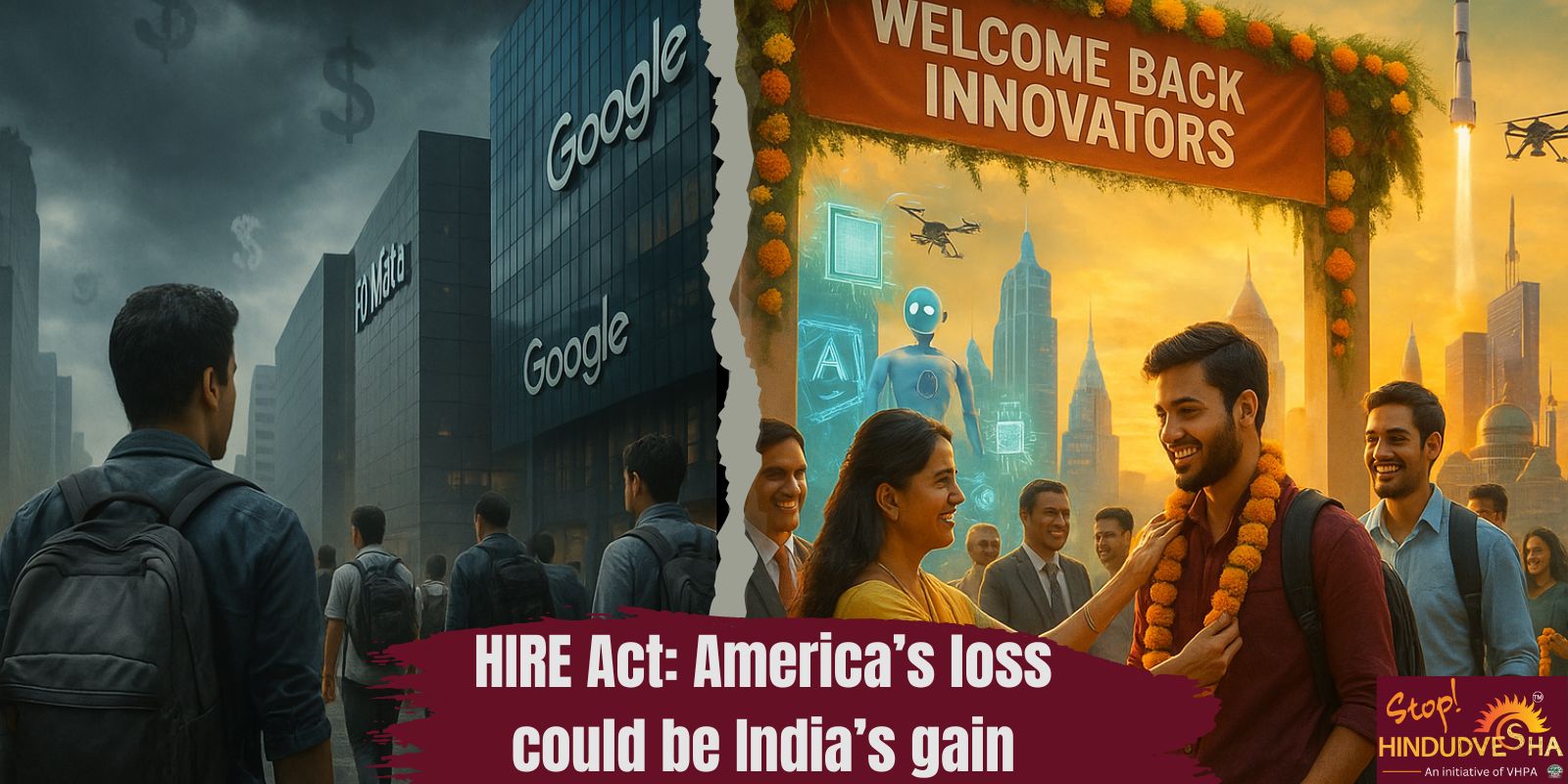
- The HIRE Act proposes a 25% outsourcing tax, making U.S. contracts with Indian IT firms significantly more expensive and non-deductible for tax purposes.
- Indian IT, which earns over 60% of revenues from U.S. clients, faces pricing pressure, renegotiations, and potential nearshoring shifts to Mexico or Canada.
- Engineers in India, already hit by stagnant salaries and currency depreciation, could see further stress as clients push for onshoring and cost cuts.
- While the Bill signals rising U.S. economic nationalism, many expect it to be watered down due to corporate pushback and global interdependence.
- The disruption may catalyze India’s IT sector to move beyond wage arbitrage into higher-value innovation, AI, and startup ecosystems, fueling a reverse brain drain.
On a breezy monsoon afternoon in early September, Rajesh Patel (name changed) was hunched over his laptop in the gleaming glass tower of a sprawling corporate campus on the outskirts of Bengaluru. At 32, Patel’s was the epitome of India’s IT dream — an IIT Bombay graduate who had traded the allure of Silicon Valley startups for a steady gig, coding cloud migrations for a Fortune 500 bank in New York. His days blurred into nights of debugging algorithms, fueled by endless cups of coffee and the promise of a six-figure USD bonus.
But on September 5, 2025, as lightning cracked the sky, a notification pinged his screen: “US Senator Bernie Moreno Introduces HIRE Act — 25 Percent Tax on Outsourcing.“[1] Patel’s jaw dropped. It wasn’t just a bill; it felt like a guillotine poised over the neck of the industry that had transformed millions of Indians into millionaires. Now India’s $254 billion IT behemoth had to confront its own reinvention — or risk obsolescence.
The Bill That Bit Back — A Protectionist’s Gambit
Picture the marbled halls of the U.S. Senate, where Senator Moreno, a Republican firebrand from Ohio with a background in auto parts manufacturing, stood at a podium flanked by union leaders and displaced factory workers. On that day, he unveiled the Halting International Relocation of Employment (HIRE) Act of 2025, a one-page legislative torpedo aimed squarely at the global outsourcing model.
Moreno lashed out in his floor speech, “American companies have shipped jobs overseas, hollowing out our heartland while padding executive bonuses. While college grads in America struggle to find work, globalist politicians and C-suite executives have spent decades shipping good-paying jobs overseas in pursuit of slave wages and immense profits – those days are over. It’s time to fight for working-class Americans and ensure they can work and retire with dignity and respect. If companies want to hire foreign workers instead of Americans, my Bill will hit them where it hurts: their pocketbooks.“[2]
Moreno explained HIRE’s implications: “If you outsource American jobs to a foreign country, you will pay a 25 percent fee for the value of that contract. And here’s the best part, we take that 25 percent fee that we collect, and we use it to fund trade schools to upskill workers to be able to step up into a better, higher-paying job.“[3]
At its core, the HIRE Act is deceptively simple yet brutally effective. U.S. firms paying Indian entities — like TCS for software maintenance or Wipro for data analytics — would face an immediate 25 percent levy if those services “benefit American consumers or businesses.” Worse, these payments couldn’t be deducted from federal taxes, potentially ballooning effective costs by up to 46 percent when combined with corporate rates hovering around 21 percent.
The Bill’s architects framed it as economic patriotism, echoing Biden’s “Buy American” mandate[4] and Donald Trump’s H-1B visa crackdown, which followed just days later.[5] However, for India, which exports up to 60 percent of its IT services to the U.S., the initial reaction was one of panic.
Shockwaves in the Indian IT Sector
To see how this works in practice, let’s consider a standard outsourcing arrangement: JPMorgan pays TCS $10 million annually for software maintenance and customer support. Before the HIRE Act, TCS retained the full amount, benefiting from India’s wage advantage — where a senior engineer such as Patel might earn $20,000 annually compared to $120,000 in the U.S. With the HIRE Act in place, JPMorgan would owe an additional $2.5 million in taxes. Because this expense is no longer deductible, their taxable income also rises, pushing the effective cost of the deal to roughly $14.6 million, depending on the applicable tax rate.
Faced with this increase, JPMorgan could:
- Push for lower contract rates,
- Explore nearshoring alternatives like Mexico or Canada, or
- Require TCS to expand its U.S.-based workforce.
Back to Patel in Bengaluru. In mid-September, the New York bank’s CIO fired off an email: “HIRE’s got us rethinking. Can you onshore 40 percent of this by Q1? Or we eat the tax — and pass it to you.” Patel’s response? A frantic pivot to “nearshoring” simulations, but the math didn’t add up. India’s edge — wages 70 percent lower — was under the tax hammer.
For Indian engineers, the Act isn’t just an economic issue; it is personal. Abid Hassan, CEO of options platform Sensibull, vented on X: “Average Indian IT fresher salary: 2011 – 3L ($6,800); 2025 – 4L ($4,500). A 33 percent drop, thanks to the INR depreciation… It’s like feudalism became IT labour arbitrage.”[6]
If the Bill passes, U.S. clients, who account for over 60 percent of India’s IT outsourcing revenues, may further tighten their spending. “If passed, the HIRE Act would sharply reduce the cost advantage that drives outsourcing to India,” said Rohit Jain, managing partner at law firm Singhania & Co. “It could slow down fresh contracts, squeeze margins, and make Indian IT firms more dependent on non-US markets for growth.”
According to Jain, most U.S. clients are likely to pause large-scale deals, renegotiate existing ones, or even shift part of the work closer to home to hedge against policy risks. “Others could continue working with Indian firms but push harder for better terms, knowing suppliers are under pressure. Pricing pressure could intensify, particularly in commoditized IT services like application development and maintenance, though high-end digital transformation and AI-driven projects may be relatively shielded.”[7]
Overblown Threat?
At its heart, the HIRE Act of 2025 reflects a broader shift toward economic nationalism in American politics — an agenda that increasingly emphasizes self-reliance, protectionist trade policies, and tighter immigration controls. This inward turn is most strongly championed by the conservative base aligned with Trump’s MAGA support base in the Republican Party, where skepticism of globalization runs deep.
Support for such policies has gained renewed momentum, particularly with the resurgence of uber-right advisors, such as Peter Navarro.[8] Once again a vocal figure in trade policy circles, Navarro recently amplified a call from a far-right activist advocating for tariffs not just on imported goods, but also on services — signaling a potential expansion of protectionist measures into new sectors of the economy. His rhetoric has been especially pointed toward countries like India, which is now contending with tariffs as high as 50 percent on key exports to the U.S. These moves underline a combative trade posture that prioritizes domestic political gain over multilateral cooperation.
However, not everyone is buying the doom and gloom scenario. According to a spokesperson for the Bangalore Chamber of Industry and Commerce, a watered-down version of the Bill is more likely to feature a reduced tax rate of 10-15 percent, sectoral carve-outs, or phased implementation rather than the proposed 25 percent outsourcing tax. The legislation also faces opposition from U.S. corporations that benefit from cost-effective Indian services, making passage in its current aggressive form politically challenging.[9]
Blueprints for Survival
As September waned, resilience flickered. The Indian government fast-tracked incentives for AI and semiconductors, aiming to retain tech talent. Engineers like Patel are planning to upskill via Coursera, transitioning from Python to PyTorch and from legacy code to GenAI models. Patel summed it up: “HIRE is a catalyst. We’ve survived Y2K busts and dot-coms — now we lead in transformation, not just maintenance.”
After the hype and hoopla, there is now a growing concern that the HIRE Act may be watered down because it would cause damage on a global scale, not just in India.[10] That it could damage not only the business models of U.S. tech giants but also global innovation networks. While the combined impact of HIRE and the H-1B visa fee hike may be felt most acutely by Indian IT firms in the immediate term, economists warn that the longer-term ripple effects could significantly disrupt the U.S. tech and business services ecosystem itself.
According to a BBC report citing IT industry body NASSCOM, the increased cost of visa sponsorship could “disrupt business continuity for certain onshore projects” in the U.S. With the rising cost of bringing in skilled foreign talent, clients may respond by pushing for project repricing, delaying start dates, or reevaluating their outsourcing strategies altogether until the legal and financial uncertainties are resolved.
In response, many Indian IT services firms appear to be bracing for this scenario. Over the past few years, they’ve invested in building stronger local workforces in the U.S. while simultaneously shifting more delivery capabilities offshore. This dual-track strategy allows them to adapt quickly to changing immigration rules without severely impacting service delivery.
Aditya Narayan Mishra, CEO of staffing firm CIEL HR, notes that Indian providers are also likely to pass the higher visa-related costs on to U.S. clients.[11]
Navroop Singh, an IPR attorney, says the HIRE Act is unlikely to alter the deep economic interdependence between India and the U.S., as U.S. Big Tech’s influence in Washington is immense.[12] “Most industry observers view the HIRE Act largely as political theater – an election-era posturing unlikely to meaningfully change the deep economic interdependence between US tech firms and the Indian IT sector.”
“U.S. Big Tech holds tremendous influence in Washington, and both the economic disruption and the feasibility of implementing such a disruptive tax are doubted. In a more realistic scenario, the U.S. may instead follow the European model of targeted digital service taxes, along with moderate onshoring nudges; however, the core demand for Indian IT, covering SaaS, cloud solutions, engineering, and sophisticated digital services, remains fundamentally resilient. For now, there is little reason to believe the Indian IT sector faces existential risk from these legislative proposals.”
Past as Prologue: Bans That Fizzled
Washington’s resistance to outsourcing is not a new phenomenon. The HIRE Act of 2025 may be the most aggressive attempt yet, but it builds on a long history of political efforts — often symbolic or only partially effective — to curb the offshoring of American jobs.
- 2004: State-Level Offshoring Ban Attempts: In the early 2000s, the first wave of anxiety about outsourcing IT jobs to countries like India led several U.S. states to propose legislation that would block government contracts from being fulfilled overseas. These efforts, while headline-grabbing, had minimal practical impact. Most of the proposed bills either failed to pass or were later watered down under pressure from industry groups and legal concerns over trade rules.[13]
- 2009-2012: Outsourcing as Political Rhetoric in the Obama Era: President Barack Obama frequently criticized the outsourcing of U.S. jobs, especially during the aftermath of the 2008 financial crisis. He championed initiatives like the Bring Jobs Home Act, which aimed to incentivize companies to relocate overseas operations back to the United States through tax breaks and penalties. However, despite strong rhetorical backing, the legislation never gained enough bipartisan support to pass both chambers of Congress. Outsourcing remained largely unaffected.[14]
- 2017: Trump Administration’s Hire American Directive: Rather than directly taxing or banning outsourcing, the Trump administration took a different approach. Through the 2017 Buy American, Hire American executive order, it targeted the H-1B visa system, which has long been relied upon by Indian IT service providers to send skilled workers onsite to U.S. client locations. The tightening of eligibility and increased scrutiny under this policy have created bottlenecks and delays in visa approvals, resulting in higher operational costs for major firms such as Infosys, TCS, and Wipro.[15]
While these changes disrupted the traditional “offshore + onsite” outsourcing delivery model, they did not reverse the broader trend. Companies adapted by hiring more local staff or expanding nearshore operations, and the global outsourcing industry continued to evolve rather than retreat.
From Threat to Opportunity
While the HIRE Act may or may not pass in its current form, its introduction in Congress and the accompanying $100,000 increase in H-1B visa fees will prompt many talented Indian professionals — especially recent graduates from U.S. universities and top Indian institutes — to reconsider long-term relocation to America. Instead, a growing number are choosing to remain in India, where the startup ecosystem is rapidly evolving. With access to global knowledge, capital, and a large domestic market, these returnees and stay-back professionals are founding startups, joining high-tech ventures, and contributing to innovation in areas like AI, fintech, SaaS, and biotechnology.[16]
This phenomenon echoes the experience of Chinese graduates who returned to China from the U.S. in the early 2000s, bringing with them world-class expertise and entrepreneurial energy. Their return played a crucial role in transforming China into a global manufacturing and technology powerhouse.
Similarly, the “reverse brain drain” driven by restrictive U.S. immigration policies may unintentionally catalyze a tech renaissance in India. By retaining top talent and channeling it into domestic innovation, India could significantly accelerate its transformation into a leading high-tech industrial nation.[17]
Epilogue — Start of a New Era
By September 19, as Patel watched the sun set over Bengaluru’s lush canopy, hope began to edge in. The Bill languished in committee — lobbied by vested parties who warned of mutually assured destruction. Yet the signals were clear: the golden age of outsourcing had waned. For India’s IT sector, HIRE was no apocalypse, but a warning — to move quickly from low-cost code to high-stakes innovation. Patel closed his laptop, envisioning his next project: an AI startup, born in India, for the world.
Clearly, the best outcome of the HIRE-H-1B double whammy is that India’s top software engineers will finally stop chasing the greenback, stay home, and help Make India Great Again.
Citations
[1] What is the US Hire Act Bill? Understand Easily Here (Jagran Josh, 2025); https://www.jagranjosh.com/general-knowledge/us-hire-act-bill-plan-1820002393-1
[2] New Moreno Bill Would Crack Down on Outsourcing, Fund American Workers (United States Senate, 2025); https://www.moreno.senate.gov/press-releases/new-moreno-bill-would-crack-down-on-outsourcing-fund-american-workers/
[3] Democrat Senator Objects to Senator Moreno’s HIRE Act (YouTube); https://www.youtube.com/watch?v=F8GOtTwuIjY
[4] President Biden signs “Buy American” Executive Order (Norton Rose Fulbright, 2021); https://www.nortonrosefulbright.com/de-de/wissen/publications/068c9ab4/president-biden-signs-buy-american-executive-order
[5] President Biden signs “Buy American” Executive Order (News 18, 2025); https://www.news18.com/videos/us-h1b-visa-restriction-what-are-the-exemptions-us-visa-row-h1b-visa-explained-plainspeak-9592001.html
[6] Indian IT companies increased USD billing rates. But the IT worker pay dropped. And no R&D spend. It’s like feudalism became IT labour arbitrage (Abid Hassan, X); https://x.com/abidsensibull/status/1965262268972892514?referrer=grok-com
[7] Microdrama opens new doors for actors and writers amid streaming slowdown (LiveMint, 2025); https://www.livemint.com/industry/media/microdramas-rewrite-the-script-for-india-s-entertainment-workforce-11758609532661.html
[8] “India’s Keyboard Minions”: Trump Aide After Tariff Claim Fact-Checked On X (NDTV World, 2025); https://www.ndtv.com/world-news/us-tariff-news-donald-trump-aide-peter-navarro-after-tariff-claim-fact-checked-on-x-indias-keyboard-minions-9249236
[9] HIRE Act or H-1b visa shock: Time for Indian IT industry to look within for reforms (The Indian Express, 2025); https://www.newindianexpress.com/business/2025/Sep/22/hire-act-or-h-1b-visa-shock-time-for-indian-it-industry-to-look-within-for-reforms
[10] ibid
[11] How Trump’s $100,000 H-1B Visa Fee Could Impact US Economy More Than India (NDTV, 2025); https://www.ndtv.com/world-news/how-trumps-100-000-h-1b-visa-fee-could-impact-us-economy-more-than-india-9327489
[12] The HIRE Act 2025: Impact of the Proposed Bill on Outsourcing Tax on US-India Tech Dynamics (Navroop Singh, X); https://x.com/TheNavroopSingh/status/1964613925875691558?referrer=grok-com
[13] 25% Outsourcing Tax? Could this new US Bill destroy India’s outsourcing industry? (The Finance Story, 2025); https://thefinancestory.com/new-us-bill-could-destroy-indias-outsourcing-industry
[14] Senate advances bill to end tax breaks for outsourcing (The Hill, 2014); https://thehill.com/blogs/floor-action/senate/213093-senate-bill-to-end-tax-breaks-for-outsourcing-stalls/
[15] President Biden Revokes ‘Buy American and Hire American’ Executive Order (Ogletree Deakens, 2021); https://ogletree.com/insights-resources/blog-posts/president-biden-revokes-buy-american-and-hire-american-executive-order/
[16] Indians leaving big tech to launch startups back home (Business Insider, 2024); https://www.businessinsider.com/indians-leaving-big-tech-to-launch-startups-back-home-2024-9
[17] The Business of Startups: How India Plans to Lead Globally | Peak XV & BCG | India For The World (YouTube); https://www.youtube.com/watch?v=OIPqP9rOoUM

Donate to HINDUDVESHA
Our Mission is to explore and expose Hindudvesha through research analysis, education and response.
SUPPORT US