

Hinduphobia as Playbook: Turning Anti-Hindu Rhetoric into Political Capital
 Rati Agnihotri · 09/20/2025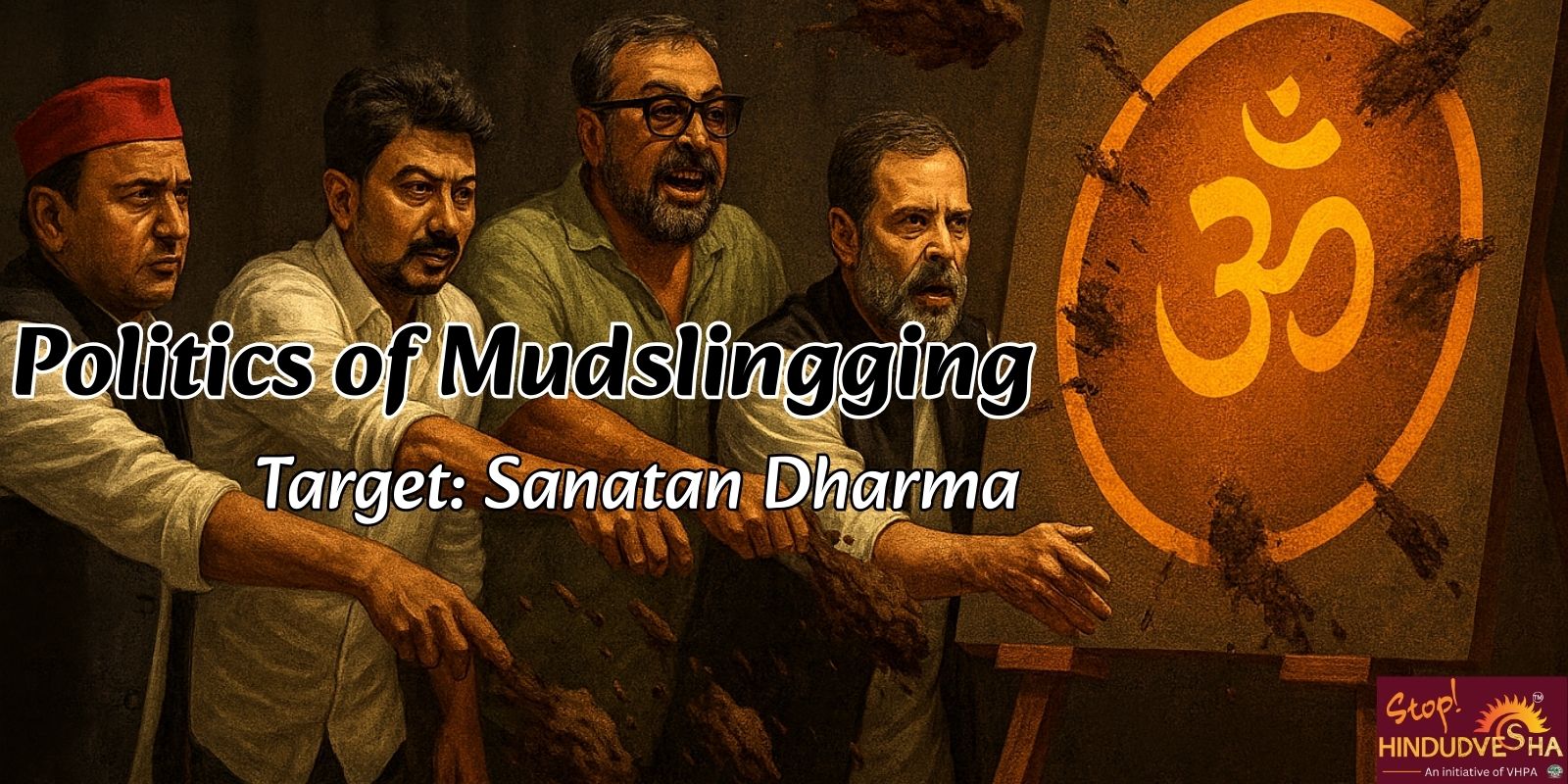
- Casual abuse of Hindu Dharma and its practitioners has become a trend in Indian politics. For many politicians, abusing Hindu Dharma becomes the fastest ticket to being noticed by their “secular electorate”
- Much of today’s opposition politics is centered on countering the Modi government’s alleged “Hindu majoritarianism,” which in practice often takes the form of Hinduphobia.
- This political targeting of Hindu Dharma is closely tied to minority appeasement, where minority identities are defined in opposition to Hindu culture, fueling unnecessary hostility between communities.
- The tolerant and secular nature of Hindus makes them an easy scapegoat for political Hinduphobia.
- Tamil Nadu Deputy Chief Minister Udhayanidhi Stalin’s call to “eradicate” Sanatan Dharma reflects the broader anti-Hindu tilt in South Indian politics, shaped heavily by Dravidian ideology.
Indian actor-politician Kamal Haasan recently courted controversy by making derogatory remarks about Sanatan Dharma only days after assuming office as a Rajya Sabha MP from Tamil Nadu. Speaking at an educational event in Chennai, he claimed that education is “the only weapon that can break the chains of autocracy and Sanatana (Dharma).” [1]
His comments triggered strong reactions from the BJP and from Hindus across India, who condemned them as Hinduphobic. This was not the first instance of Haasan targeting Hindu traditions, but the timing—immediately after his induction into Parliament—underscored the extent to which casual abuse of Hindu Dharma has become normalized in Indian politics.
For many politicians, attacking Hindu beliefs is the easiest shortcut to win favor with the so-called secular electorate. The formula is simple: mock Sanatan Dharma, grab headlines, and posture as the opposite of a “Hindutva-driven” BJP. In this cynical game, Hindu Dharma has been reduced to a political punching bag. Leaders casually equate it with diseases like Dengue or Malaria, or hurl other degrading epithets—demeaning not just a faith, but an entire civilization and its people.
Despite occasional protests from the ruling party, Hindu organizations, and outraged netizens, such incidents rarely spark sustained mass outrage. This muted response only emboldens politicians to repeat their attacks, confident that the fallout will remain limited. Consequently, Hindus are repeatedly pushed on the defensive while their traditions are openly denigrated.
Since the rise of the Modi government in 2014, this trend has intensified. Opposition parties have increasingly equated Hindu Dharma with authoritarianism, while simultaneously presenting themselves as champions of secularism. In doing so, they cultivate a political climate that encourages Hindus to distance themselves from their own traditions under the guise of progressivism, even as Hinduphobia becomes mainstream.
When Secularism Becomes a Cover for Anti-Hindu Rhetoric
Much of opposition politics in India is focused on countering the current ruling party’s supposed “Hindu majoritarian” ideology. Since the perception is such that the ruling party’s vote bank casts its vote on Hindu issues, the opposition parties have turned the opposition to Hindu Dharma and Hindu issues into an electoral strategy. They are increasingly trying to create an alternative narrative that hinges on the demonization of Hindu Dharma.
The Ayodhya Ram Mandir holds immense spiritual significance for Hindus worldwide, yet many opposition leaders declined invites to attend the Ram Mandir Pran Prathishtha ceremony in January 2024, on the pretext that the Ram Temple is the BJP’s political project.[2] The Communist Party of India (Marxist) categorically declined the invitation, arguing that while they respect religious beliefs, the tying of a political agenda with religion is something they are not comfortable with.[3] The Congress party also gave similar reasoning for declining the invites, accusing the ruling party of turning faith into a “religious project”,[4] even as some of its leaders attended the ceremony in their personal capacity.
A similar pattern emerged with the demonization of Maha Kumbh 2025. Speaking at an event, Samajwadi Party MP Afzal Ansari ridiculed the belief that bathing during the Kumbh absolves sins and grants access to Baikunth, sarcastically suggesting that “hell will be empty” if such faith were true. Samajwadi Party chief Akhilesh Yadav also courted controversy during Maha Kumbh 2025 with remarks that many viewed as deeply insensitive. He mocked Sanatan Dharma and dismissed Hindu beliefs, claiming that “there is no such thing as Maha Kumbh,” further alleging that the term was merely “coined” to “mislead” people and “waste” public money.[5]
Congress President Mallikarjun Kharge also made inflammatory comments against the Maha Kumbh, rhetorically claiming that the leaders of the ruling party were competing against one another to take a dip in the Sangam for the cameras, and he wondered if such an act would help eradicate the problem of poverty affecting the country. [6]
Such remarks are not isolated but part of a larger trend where Hindu traditions and beliefs are casually belittled in political discourse. While these comments provoke outrage among devotees, the lack of consistent, widespread condemnation enables Hinduphobia to thrive unchecked.[7]
The more troubling aspect is that, too often, Hindus remain passive observers—or worse, active cheerleaders—when their culture, traditions, and Dharma are mocked. A key reason lies in the politics of the “secular vote bank.” Many opposition parties cultivate a segment of Hindu voters who are encouraged to feel embarrassed about their identity. For them, raising Hindu issues is framed as a form of “fascism,” while appeasement of others is celebrated as progressivism.
StopHinduDvesha has earlier highlighted how academia acts as the fountainhead of Hinduphobia. It creates the ideological frameworks that justify hostility toward Sanatan Dharma, which are then amplified by media, social platforms, entertainment, and organized networks.[8]
The prevalence of Hinduphobic rhetoric in Indian politics reflects this larger trend. Rather than challenging the Modi government by constructively addressing Hindu concerns and expanding the discourse, many opposition parties build their strategy on an anti-Hindu framework. This approach seeks to consolidate a vote bank by demonizing Hindu Dharma and discrediting the public expression of Hindu issues.
Hindu issues haven’t been exclusively raised by the BJP or the Sangh Parivar. The Ram Janmabhoomi movement itself had multiple stakeholders with several politicians across party lines and people from various walks of life supporting the movement.[9] [10] Similarly, many Hindu issues, such as the creation of a Hindu Rashtra and the need for a National Sanatan Board, etc., have been raised by many Hindu spiritual leaders and advocacy organizations, and the current ruling party doesn’t necessarily agree with all their demands.
Then, there are issues where the government and the Hindu community have a clear difference of opinion, for example, the issue of freeing temples from state control. There is considerable scope for the opposition to address such issues and gain the trust of the “Hindu community”. But it instead chooses to peddle anti-Hindu narratives to appease the minority vote bank, something we will discuss in detail in the next section.
Politics of Minority Appeasement in India
The political targeting of Hindu Dharma is also intimately connected with the politics of minority appeasement in India, which defines the identity of the minority communities in contrast to Hindu identity and culture, thus fuelling animosity between Hindus and minority communities. It further portrays Hindu cultural practices and traditions as antithetical to the existence of the minorities, thus portraying Hinduphobia as essential for their survival.
Ironically, the politics of minority appeasement in India has been consistently detrimental to the social and economic well-being of the minorities. In an article published by The New Indian, Arshia Malik describes how the Muslim leadership in post-independent India “largely failed to chart a path of integration and development for the community”. She further opines that Muslim leaders who aligned with the politics of “secular” parties like the Congress ended up exploiting the community as a “vote-bank”, while systematically neglecting their socio-economic and developmental concerns. The writer argues that the politics of minority appeasement was used as a weapon by leaders to keep the Muslim population perennially in their grip. Thus, they revelled in the power of “symbolic gestures” rather than undertaking work to improve the socio-economic well-being of the community, which resulted in the phenomenon of Muslims lagging behind other communities in key indicators such as employment, literacy, and access to healthcare. [11]
The politics of minority appeasement has packaged issues deeply connected with Bharat’s civilizational identity – Ayodhya Ram Mandir, Krishna Janmbhoomi, the Kashi Gyanvapi Mosque issue, etc., into ego-battles for the Muslim community. That’s partly because the Muslim community in India is still stuck in a time-warped Stockholm Syndrome – tracing their civilizational and cultural legacy to that of the Islamic invaders. The lack of an alternative civilizational narrative that defines their identity in the light of India’s ancient civilizational and cultural ethos makes the community even more vulnerable to the politics of minority appeasement.
The Indian Muslim community’s reluctance to let go of the “Mughal legacy” has led to heightened tensions between Hindus and Muslims, as Hindus are decisively reclaiming their civilizational and cultural legacy, argues Arshia Malik: “The rise of political Hinduism can partly be attributed to the vacuum created by Muslim leaders’ failure to adopt inclusive, progressive approaches, or letting go of the rule of the Mughal period. Today, though it is late, the challenges faced by Indian Muslims demand a new generation of leadership that prioritizes socio-economic development and integration over identity politics”. [12]
Hindus, unlike Muslims and Christians, do not function as a consolidated vote bank in India. This vacuum has allowed the politics of minority appeasement to flourish, with almost every political party succumbing to the weight of the “minority vote.”
The Nupur Sharma episode in 2022 stands as a stark reminder of this dynamic. When she made controversial remarks about Islam during a televised debate on the discovery of a Shivling at the Kashi Gyanvapi Mosque complex, her comments were quickly weaponized. According to reports, the debate panelists mocked the findings, which hurt her religious sentiments and provoked her response. Soon after, Alt News co-founder Mohammed Zubair shared a clipped version of her remarks out of context[13], inflaming passions and mobilizing outrage across the Muslim community. What followed was a global uproar framed through the rhetoric of “Islamophobia.” Nupur faced relentless death threats and remains in hiding, forced into a life of fear and near invisibility. Yet, instead of firmly standing up for her safety and freedom, the government bowed to the politics of appeasement. Those issuing threats were not confronted with the same urgency; instead, Nupur herself was quietly removed from public view.
Why Hindu Issues Rarely Spark Nationwide Movements
Most major protest movements in India are framed through the lens of minority rights. A striking example was the anti-CAA protests at Shaheen Bagh (December 2019–March 2020), where images of elderly Muslim women sitting in defiance became the centerpiece of left-liberal propaganda. The protests deliberately obscured the fact that the Act was designed to grant refuge to persecuted minorities from Pakistan, Afghanistan, and Bangladesh.
Even movements unrelated to minority issues are often cast in this narrative. The farmers’ protests of 2020–2021 illustrate this trend. Though primarily about agricultural laws, media narratives linked them with Shaheen Bagh, presenting them as a continuation of resistance against “Hindu nationalism” and “majoritarian ideology.” Romanticized accounts emphasized women protesters and highlighted supposed inspiration drawn from Shaheen Bagh. In both cases, opposition to the government was framed less around the actual issues at hand and more around symbolic resistance to Hindu identity.[14]
Minority communities in India frequently organize protests to highlight their concerns, including those of questionable legitimacy. In contrast, Hindus have never mobilized a large-scale, nationwide movement around Hindu issues. Many “woke” Hindus are instead drawn into left-liberal or Islamist-backed agitations under the banner of “secularism,” unwittingly enabling anti-Hindu agendas. This tendency to equate neutrality with virtue makes Hindus easy targets for Hinduphobia.
Adding to this vulnerability is the community’s forgiving nature. A perfunctory apology for anti-Hindu remarks is often enough to diffuse outrage. Such quick pacification perpetuates a cycle of abuse, as politicians and activists know they can denigrate Hindu beliefs without fearing sustained backlash.
When filmmaker Anurag Kashyap made obscene remarks against the Brahmin community in April, the Hindu response once again exposed a troubling pattern. During an online debate over the “Phule” movie, Kashyap declared that he would “urinate on Brahmins.” The statement sparked outrage and widespread condemnation.[15] Yet, as soon as he issued an apology, the matter quickly dissipated. No protest marches followed, no sustained campaign to boycott his films—nothing beyond a brief outburst of anger.
This lack of collective pushback emboldens politicians, intellectuals, and artists, turning Hinduphobia into a thriving enterprise with little fear of meaningful backlash.
Dravidian Politics and the Targeting of Hindu Dharma
Some of the vilest attacks on Hindu Dharma have come from politicians in South Indian states, particularly Tamil Nadu and Kerala. This is no accident. In these regions, abusing Hindu beliefs has long been a calculated political strategy. Dravidian politics, supported by the missionary conversion ecosystem and the left-liberal establishment, thrives on weakening Hindu identity through the rhetoric of caste divisions and the Aryan-Dravidian theory.
In September 2023, Tamil Nadu leader Udhayanidhi Stalin openly called for the eradication of Sanatan Dharma, likening it to “dengue,” “malaria,” and “corona.”[16] The fact that a senior minister could make such a remark against the majority’s faith and continue unscathed highlights the political culture of Tamil Nadu, where denigrating Hindu Dharma is normalized, rewarded, and even presented as progressive politics.
A write-up by Swarajya traces the historical trajectory of anti-Hindu politics in South India. It says that Udhayanidhi’s statement should not come as a surprise since the DMK ( Tamil Nadu’s ruling party) founder C.N. Annadurai called for the dismantling of “sanatanam” during a speech in 1943. The article further argues that ” the fear of a Hindu consolidation has led to the pitch of the unabated calumny being raised in Tamil Nadu”. [17]
David Frawley has highlighted the growth of anti-Hindu politics in South India, pointing to deep cultural contradictions. On one hand, the region has a rich legacy of Vedic heritage; on the other, its electorate often supports staunchly anti-Hindu parties like the DMK in Tamil Nadu and Communists in Kerala. Frawley attributes this paradox to the absence of Hindu political consolidation. Unlike other communities, he observes, South Indian Hindus seldom vote to safeguard their cultural identity or defend their social and human rights as Hindus, whether in state or national elections—leaving their traditions politically vulnerable.[18]
Wrapping Up
Hindus in India often find themselves at the receiving end of political mudslinging largely because they lack the cohesion of a consolidated vote bank.
This absence of unity, particularly in forging a collective front to raise Hindu issues in the political sphere, leaves the community vulnerable to “Hinduphobia” disguised as secular or progressive politics.
As India experiences a broader civilizational and cultural resurgence, the need for political consolidation around issues impacting Sanatan Dharma becomes especially urgent. A unified Hindu identity—rising above caste-based appeasement and centered on core Hindu concerns—is the most potent antidote to the systematic demonization of Sanatan Dharma in Indian politics.
Citations
[1] Education alone can break ‘chain of Sanatan’, says Kamal Haasan; https://www.newindianexpress.com/nation/2025/Aug/04/education-alone-can-break-chain-of-sanatan-says-kamal-haasan-2
[2] Ram Mandir opening ceremony: Here’s a list of people who declined the invitation; https://timesofindia.indiatimes.com/india/ram-mandir-ayodhya-consecration-ceremony-invitation-declined-congress-cpi-sharad-pawar/photostory/106978279.cms?picid=106979932
[3] Inidian leaders divided over attending Ram Temple event | Latest News India – Hindustan Times; https://www.hindustantimes.com/india-news/india-leaders-divided-over-attending-ram-temple-event-101703618945495.html
[4] Ayodhya boycott move splits Congress leaders | Ayodhya boycott move splits Congress leaders; https://www.deccanchronicle.com/nation/current-affairs/110124/congress-a-divided-house-over-attending-the-ram-temple-consecration-ce.html
[5] ‘No Such Thing Like Maha Kumbh’: Akhilesh Yadav Says Govt Wasting Money; BJP calls it ‘Cheap Politics’ | Politics News – News18; https://www.news18.com/politics/no-such-thing-like-maha-kumbh-akhilesh-yadav-echoes-lalus-remark-bjp-calls-it-cheap-politics-9230597.html
[6] Kharge insulted the sentiments of Hindus with remarks on Maha Kumbh: BJP | Politics News – Business Standard; https://www.business-standard.com/politics/kharge-insulted-sentiments-of-hindus-with-remarks-on-maha-kumbh-bjp-125012800430_1.html
[7] Samajwadi Party MP Afzal Ansari booked for insulting Maha Kumbh; https://www.opindia.com/2025/02/samajwadi-party-mp-afzal-ansari-booked-for-insulting-maha-kumbh/
[8] Hindudvesha and UN’s Double Standard; https://stophindudvesha.org/hindudvesha-and-uns-double-standard/
[9] Explained | Congress’s Catch 22 dilemma with Ram Janmabhoomi dispute; https://www.deccanherald.com/india/explained-congress-catch-22-dilemma-with-ram-janmbhoomi-dispute-2858009#google_vignette
[10] Unsung Heroes of Sri Ram Janmabhoomi Movement; https://organiser.org/2024/08/05/217413/bharat/unsung-heroes-of-sri-ram-janmabhoomi-movement/
[11] Detrimental legacy of Indian Muslim leadership THE NEW INDIAN – detrimental legacy of Indian muslim leadership – New Indian; https://www.newindian.in/detrimental-legacy-of-indian-muslim-leadership/
[12] Ibid.
[13] From death threats to bounties, Islamists descend on BJP leader Nupur Sharma for countering abuse of Hindu deities; https://hindupost.in/news/from-death-threats-to-bounties-islamists-descend-on-bjp-leader-nupur-sharma-for-countering-abuse-of-hindu-deities/#
[14] How farmers’ agitation is similar to Shaheen Bagh protests | India News – Times of India; https://timesofindia.indiatimes.com/india/how-farmers-agitation-is-similar-to-shaheen-bagh-protests/articleshow/79610710.cms
[15] Phule Controversy: Anurag Kashyap apologises for remarks against Brahmin community – The Economic Times; https://economictimes.indiatimes.com/news/entertainment/phule-controversy-anurag-kashyap-apologises-for-remarks-against-brahmin-community/articleshow/120512487.cms?from=mdr
[16] Supreme Court Issues Notice To Udhayanidhi Stalin For ‘Eradicate Sanatana Dharma’ Remarks; https://swarajyamag.com/tamil-nadu/supreme-court-issues-notice-to-udhayanidhi-stalin-for-eradicate-sanatana-dharma-remarks
[17] Tamil Nadu Politics Has Always Been A Breeding Ground For Anti-Hindu Forces; https://swarajyamag.com/politics/tamil-nadu-politics-has-always-been-a-breeding-ground-for-anti-hindu-forces
[18] Hindus in South India must unite for their collective past and shared future – Sanatan Prabhat; https://sanatanprabhat.org/english/147602.html

Donate to HINDUDVESHA
Our Mission is to explore and expose Hindudvesha through research analysis, education and response.
SUPPORT US