

Desecrating Memory: How Revisionists Whitewash the Bengal Pogroms of 1946
 Dr. Jai G. Bansal · 08/20/2025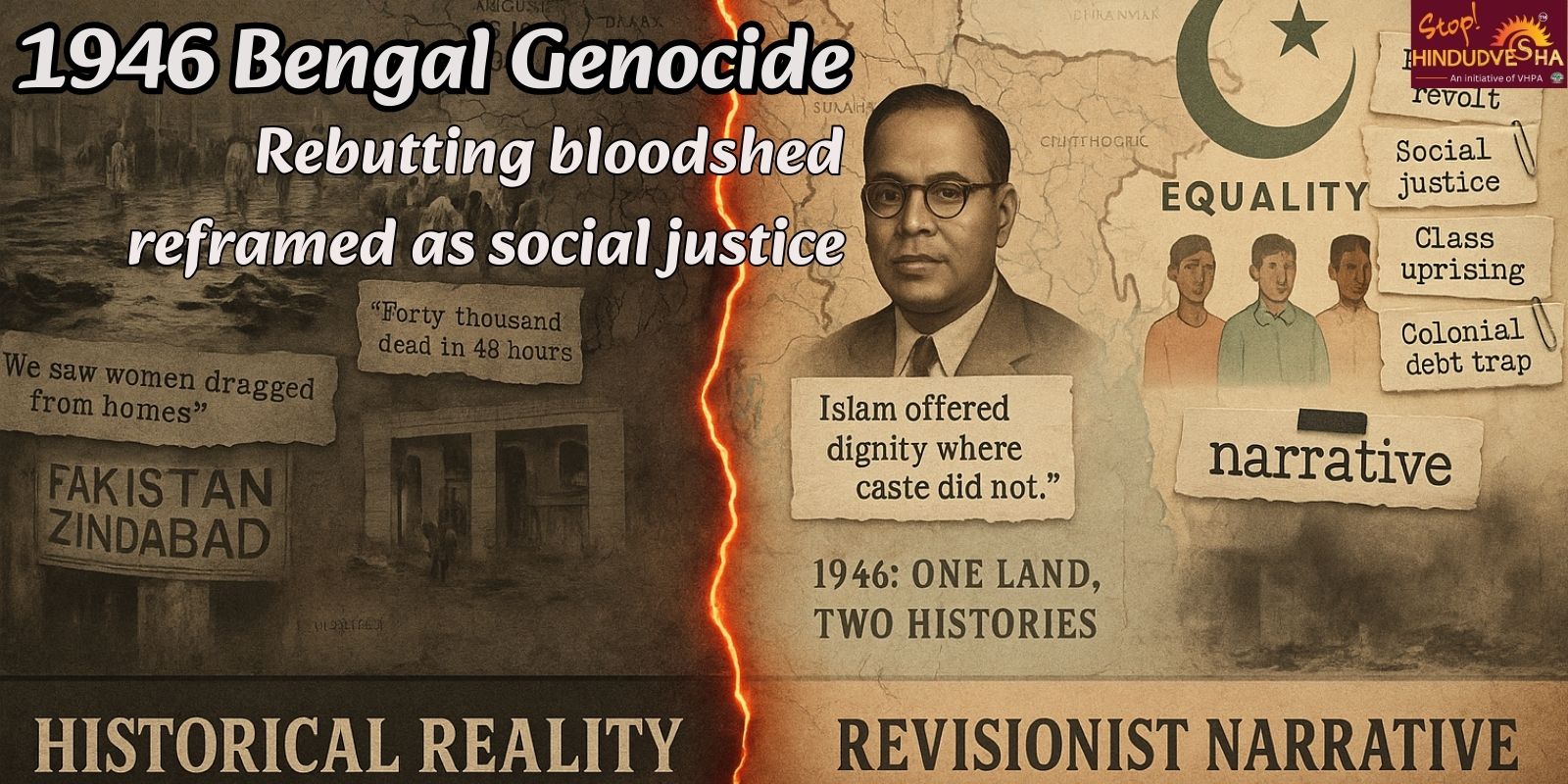
- Ahemede Hussain’s Wire article distorts the 1946 Bengal massacres by recasting them as peasant revolts for justice, rather than what they were—pre-planned pogroms targeting Hindus under the banner of Pakistan.
- The claim that Islam offered Dalits dignity and escape from Hindu oppression ignores entrenched caste-like hierarchies within Muslim society, both historically and today, as seen in the Pasmanda marginalization.
- Citing Jogendra Nath Mandal as proof of Muslim egalitarianism is misleading—his political career in Pakistan ended in betrayal, disillusionment, and exile after witnessing atrocities against Hindus.
- Equating communal violence with class struggle is an ethical inversion; it obscures the religious motivations behind mass rape, slaughter, and forced conversions, and insults the memory of the Hindu victims.
- By cloaking jihadist violence in progressive language, The Wire article contributes to ideological sanitization, erases historical truth, and numbs public memory to the brutal reality of the Partition-era atrocities.
Seventy-nine years after Direct Action Day, revisionists are still trying to launder the bloodshed of Partition into a story of justice. The Wire’s recent piece by Ahemede Hussain[1] is only the latest: it recasts the violence in Bengal not as communal terror but as a peasant revolt against oppression. His thesis rests on depicting East Bengal’s demand for Pakistan as a struggle of debt-ridden peasants under zamindari bondage, reinforced by colonial policy, and extends to portraying Islam itself as the natural equalizer of the downtrodden.
In truth, this is not history, but rather selective amnesia masquerading as analysis. By framing the Muslim League’s separatist politics as a movement for justice, Hussain conceals the brutal reality: the 1946 massacres in Bengal were not uprisings for dignity but orchestrated pogroms meant to terrorize, cleanse, and subjugate Hindus. To invoke “social justice” in the same breath as Direct Action Day and the Noakhali genocide is not simply dishonest—it desecrates the memory of thousands of Hindu men, women, and children butchered, raped, and forcibly converted. History is not clarified by euphemism; it is betrayed.
This rebuttal exposes Hussain’s central claims for what they are: a distortion that whitewashes communal violence, a hollow portrayal of Islam as a universal equalizer, and a misuse of figures like Jogendra Nath Mandal to legitimize a false narrative. Only by confronting these myths can the truth of 1946—and its grim aftermath—be understood.
What Really Happened
In August 1946, the All-India Muslim League under Muhammad Ali Jinnah, claiming to speak for all of India’s Muslims, announced “Direct Action” to press its demand for Pakistan. What unfolded in Bengal was not a protest but an atrocity. For four days, from August 16 to 19, Calcutta became a city of death. Muslim League cadres, backed by mobs stirred by incendiary slogans for Pakistan, poured into Hindu neighborhoods. Law enforcement, under the premiership of Huseyn Shaheed Suhrawardy, stood aside as the slaughter began. Eyewitnesses spoke of streets running with blood, of families hacked apart in their own courtyards, of women dragged from their homes to be raped in public or forced into sham “marriages.” More than 40,000 Hindus were killed in just forty-eight hours.[2] Homes and shops were looted, set alight, and reduced to ash. American photojournalist Margaret Bourke-White, present in Calcutta, captured the grim aftermath: bones scattered in gutters, vultures circling over unclaimed corpses. Her photographs, published in Time and The New York Times, seared the world’s conscience.[3]
Two months later, the terror moved east to Noakhali and Tipperah.[4] Here, the aim was not only intimidation but wholesale cleansing. Hindu villages were methodically depopulated and set aflame. Survivors fled stripped of property and dignity, their homes seized to ensure they could never return. Families were forced at knifepoint to recite the shahada—the Islamic creed of conversion—as proof they had abandoned their ancestral faith. Temples were desecrated, idols smashed, sacred sites reduced to rubble. Community leaders were singled out, executed in public, and their severed heads paraded through villages as warnings.
This was a campaign of terror, which Hussain now tries to dress up as “social justice”.
How Hussain Reframes it
Hussain frames Direct Action Day and the Noakhali violence through two main claims:
- The “social-justice thesis”: East Bengal’s demand for Pakistan was less about religion or nationalism and more about equality. He roots the movement in peasant bondage under zamindari rule, Dalit subjugation, poverty, and colonial policies that entrenched debt, rent-seeking, and dispossession.
- Islam as equalizer: In a misplaced act of virtue signaling, Islam is cast as a natural equalizer for Dalits trapped in hierarchy. Conversion and Muslim League politics are portrayed as providing solidarity and welfare denied by Hindu society. Jogendra Nath Mandal is invoked as proof—his alliance with the League framed as a pragmatic bid for representation and security. Pakistan is presented not as a theological project, but as a vehicle for social transformation.
These assertions form the core of what the rebuttal must dismantle.
Rebutting the Social-Justice Thesis
The most cynical aspect of Hussain’s article is its exploitation of the language of justice to justify bloodshed. To claim that Bengal’s call for Pakistan was a movement for equality—that poor Muslims rose in righteous rebellion against Hindu landlords—is to grant moral cover to calculated mass violence. It is as grotesque as calling the Rwandan genocide[5] land reform or Kristallnacht[6] a workers’ revolt.
The violence was no uprising of the oppressed. It was organized with precision. Processions marched under banners for Pakistan, not justice or reform. Looting, arson, and mass killings followed a clear choreography, leaving Calcutta scarred beyond recognition.
Hindus were not slaughtered for land or wealth. They were slaughtered for being Hindu. What notion of justice explains the public rape of women in Noakhali? What emancipation is achieved by hacking subsistence farmers in their huts, or torching the modest shops of Hindu cloth merchants whose only crime was their name?
To reduce such targeted atrocities to “class struggle” is an ethical perversion. A movement that rallies by religion, marks its victims by faith, and wields terror as its weapon is not revolution—it is communal violence masquerading as reform.
And if the aim was emancipation, it failed. Hierarchies endured. Power remained in the same hands. Discrimination was not erased but entrenched. Hussain’s framing is not history—it is propaganda repackaged for today.
Rebutting Islam as a Social Equalizer
Hussain’s claim that Islam gave Dalits a dignified escape from Hindu oppression rests on two long-standing falsehoods recycled by Islamist apologists. The first is the myth that Islam is free of hierarchy, a faith of universal brotherhood. The second is the tired refrain that it is a “religion of peace.” Neither withstands scrutiny. History records something very different: conquests, forced conversions, massacres, and scriptural sanction for violence, from the early caliphates to modern jihadist terror. Equally damning is the lived reality in South Asia, where Muslim societies remain deeply stratified and “brotherhood” offers little real mobility for the marginalized.
A. The Betrayal of 1971
The most damning refutation of the “brotherhood” myth lies in Bangladesh’s own blood-soaked history. In 1971, the West Pakistani army—dominated by Punjabi Muslims—unleashed genocide on East Pakistan. Over three million Bengalis were slaughtered. Hindus bore the brunt, but countless Bengali Muslims were butchered too—not for disbelief, but for daring to be Bengali, for speaking their own tongue, for refusing subordination. They were Muslims, yet marked as lesser Muslims—too native, too defiant, too expendable. That betrayal should have buried forever the illusion that shared religion ensures solidarity. In truth, “brotherhood” has always had boundaries—and Bengali Muslims themselves have already paid for discovering where those boundaries lie.[7] [8]
B. Pasmanda: The Betrayal of Islamic Brotherhood
In India, the myth of Islamic egalitarianism collapses under both data and daily experience. Far from being a caste-free utopia, South Asian Islam has hardened into its own hierarchy. Muslims are divided into Ashraf (nobles), Ajlaf (commoners), and Arzal (the “despised”). Together, Ajlaf and Arzal are known as Pasmanda—literally “those left behind.” The term itself is a confession.[9]
Ashraf Muslims, claiming descent from Arab, Persian, or Central Asian lineages, dominate mosques, politics, and business. Pasmanda, whose ancestors were local converts from Hindu and Buddhist communities—often coerced by force or poverty—are kept on the margins. This exclusion is structural, not incidental.
Despite making up nearly 85% of India’s Muslim population, Pasmanda remain locked out of power. Of almost 400 Muslims elected to Parliament since independence, only around 60 have come from Pasmanda backgrounds. Leadership is monopolized by the Ashraf elites.[10] If Islam truly erased hierarchy, would representation remain so skewed?
And politics is only the beginning. Discrimination pervades daily life. In many Muslim areas, Pasmanda are still made to drink from separate utensils, excluded from Ashraf mosques, or pushed to the back rows if admitted.[11] Even in death, barriers persist: Pasmanda are often denied burial in Ashraf graveyards.[12] A 2016 BBC investigation, “Untouchable Muslims,” found 13% of Dalit Muslims served separately in food and water, and 8% of children segregated in schools. These practices are widespread in madrasas and religious institutions, where state oversight is minimal.[13]
Pasmanda advocacy groups, such as the Pasmanda Muslim Mahaz, active since 1998, are branded “un-Islamic” by Ashraf clerics.[14] Amana Begum Ansari, a leading Pasmanda activist, adds that cultural exclusion compounds caste: Pasmanda are mocked not only for their lineage but also for failing to conform to Arabized norms of dress, language, and ritual.[15] This reveals the deeper reality—that Islamic “brotherhood” is less about equality than about enforcing a hierarchy of race, culture, and class.
This is not the embrace Hussain imagines. It is another system of stratification—entrenched, institutionalized, and denied in the name of faith.
C. Myth of Universal Brotherhood
Across the Muslim world, Shia-Sunni massacres, Ahmadiyya persecution, and the erasure of ethnic minorities in Pakistan, Iran, and the Gulf expose Islam’s “universal brotherhood” as little more than a slogan—fragile at best, violently fractured at worst. Pasmanda activist Faize Ahmad Fyzie rightly points out that discrimination against the lower orders is not a South Asian quirk but a reality baked into Islam’s heartlands themselves.[16]
Consider the debates around the Citizenship Amendment Act (CAA). Activists demanded that Muslim refugees from Bangladesh, Pakistan, and Afghanistan be included, countries supposedly founded on Islamic equality. But the obvious question was never asked: why are Muslims fleeing Islamic theocracies at all? The answer is plain for anyone not blinded by ideology. Religious identity provides no immunity from persecution, and Islamic states manufacture their own hierarchies, exclusions, and brutalities.
D. From “Equality” to Betrayal: The Mandal Saga
Hussain cites Jogendra Nath Mandal as proof that Dalits, fearing Hindu oppression, chose Pakistan and found dignity under Muslim-majority rule. The record says otherwise.
Mandal’s rise was brief and hollow. Though named Pakistan’s first Law and Labour Minister, he remained a token in a bureaucracy monopolized by Muslim elites. After Jinnah’s death in 1948, minorities in East Pakistan endured abductions, forced conversions, and police-backed pogroms. Mandal’s protests were ignored. Soon, he was sidelined, threatened with arrest, and forced to flee in 1950. The rest of his life was spent helping Hindu refugees escaping the very “brotherhood” he once trusted.[17]
Mandal’s story is not proof of Islamic egalitarianism but a devastating indictment of its failure.
Why This Distortion Matters Today
Seventy-nine years on, the lesson of Direct Action Day is not buried in archives—it stares at us still. The violence of 1946 was not an uprising for justice but a blueprint for Partition: faith weaponized, neighbors turned executioners, and ideology vanished as liberation. To recast those massacres as “social struggle” is to repeat the very propaganda that made them possible. Hussain’s revisionism does more than distort—it dishonors the dead, and blinds future generations to the dangers of sectarian mythmaking.
True remembrance requires honesty: acknowledging that what unfolded in Bengal was not emancipation but annihilation, not reform but religious cleansing. If history is twisted into a moral alibi, its warnings are lost. The only safeguard against repetition is clarity. To face 1946 as it was—brutal, communal, and deliberate—is not communalism, but responsibility. Truth is the first duty owed to the victims. Anything less is betrayal.
Citations
[1] Ahemed Hussain: ‘Not Just Religion or Nationalism, the Call for Pakistan in East Bengal Was About Social Justice and Equality’ (The Wire, 2025); https://thewire.in/history/not-just-religion-nationalism-call-for-pakistan-bengal-social-justice
[2] Majumdar, R.C. History of the Freedom Movement in India, Vol. 3. Calcutta: Firma K.L. Mukhopadhyay, 1963; https://archive.org/details/historyoffreedom03maju/page/864/mode/2up
[3] “India: Calcutta Killings,” Life Magazine, 2 September 1946
[4] Noakhali riots – Wikipedia; https://en.wikipedia.org/wiki/Noakhali_riots
[5] Rwanda genocide of 1994 | Summary, History, Date, Background, Deaths, & Facts | Britannica; https://www.britannica.com/event/Rwanda-genocide-of-1994
[6] Kristallnacht (Holocaust Encyclopedia); https://encyclopedia.ushmm.org/content/en/article/kristallnacht
[7] 1971 Bangladesh Genocide: Pakistan’s Brutal Legacy (StopHinduDvesha.Org, 2025); https://stophindudvesha.org/remembering-the-1971-bangladesh-genocide-pakistans-brutal-legacy/
[8] The Unfinished Business of the 1971 War and Its Impact on Bangladesh Hindus (StopHindudvesha.Org, 2025); https://stophindudvesha.org/the-unfinished-business-of-the-1971-war-and-its-impact-on-bangladesh-hindus/
[9] Pasmanda: Explained: Who are the Pasmanda Muslims? (The Times of India, 2022); https://timesofindia.indiatimes.com/india/explained-who-are-the-pasmanda-muslims-the-group-that-bjp-is-trying-to-woo/articleshow/92766145.cms
[10] India’s Muslim community under a churn: 85% backward Pasmandas up against 15% Ashrafs (The Print, 2019); https://theprint.in/opinion/indias-muslim-community-under-a-churn-85-backward-pasmandas-up-against-15-ashrafs/234599/
[11] Islamic caste (Britannica); https://www.britannica.com/topic/Islamic-caste
[12] Backward Muslims protest denial of burial (rediff.com, 2003); https://www.rediff.com/news/2003/mar/06bihar.htm
[13] Why are many Indian Muslims seen as untouchable? (BBC News, 2016); https://www.bbc.com/news/world-asia-india-36220329.amp
[14] Pasmanda Muslim Mahaz (Wikipedia); https://en.wikipedia.org/wiki/Pasmanda_Muslim_Mahaz
[15] Understanding the Muslim Lived Experience in India (CoHNA.Org, 2022); https://cohna.org/understanding-the-muslim-lived-experience-in-india/
[16] Pasmanda Muslims missing from positions of power— Waqf Board to Jamaat-e-Islami (ThePrint.in, 2021); https://theprint.in/opinion/pasmanda-muslims-missing-from-positions-of-power-waqf-board-to-jamaat-e-islami/746464/
[17] Jogendra Nath Mandal (Wikipedia); https://en.wikipedia.org/wiki/Jogendra_Nath_Mandal

Donate to HINDUDVESHA
Our Mission is to explore and expose Hindudvesha through research analysis, education and response.
SUPPORT US