

Mandirs as the Soul of Hindu Society: Reclaiming Sacred Institutions from Colonial Erasure
 Aditi Joshi · 08/12/2025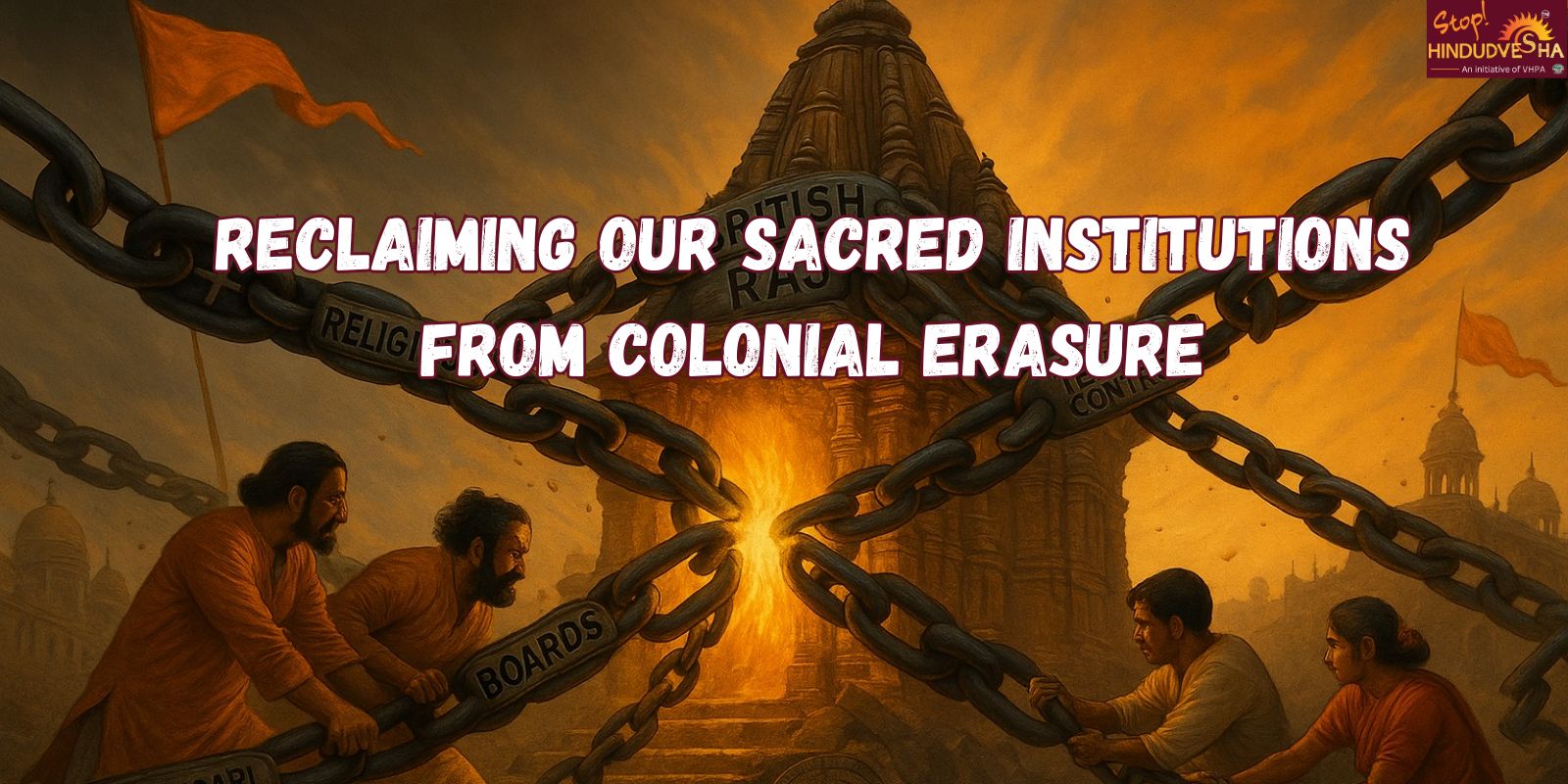
- Hindu temples have historically functioned as dynamic institutions central to India’s socio-cultural and spiritual life.
- Far from being confined to ritualism, they served as nodes of community welfare, education, artistic expression, and local governance.
- However, colonial and postcolonial regimes—particularly through discourses and Marxist historiography—systematically redefined temples as exploitative, regressive, and casteist.
- The original roles of temples are enshrined in scriptural, epigraphic, and historical records.
- The prevailing narratives must be decolonized, and temples restored to their original dharmic functions.
For centuries, Hindu temples were not merely sites of worship; they were the living heart of Indic civilization. Far beyond their spiritual role, they functioned as institutions of collective upliftment, anchoring the socio-economic, educational, artistic, and political life of the community. However, this civilizational ecosystem came under sustained assault during colonial rule. By branding them as strongholds of superstition, caste tyranny, and priestly exploitation, the colonial state sought to break their influence and moral authority.
The damage did not end with the departure of the British. In post-independence India, the ideological project of desacralizing Hindu institutions was carried forward by a new class of state-sponsored intellectuals.[1]
This article examines the original role of temples in pre-colonial India, the deliberate vilification campaigns conducted by colonial actors, the post-independence ideological distortions that redefined Hindu institutions, and the ongoing legal and political challenges faced by temples in contemporary India. In doing so, it seeks to reclaim the narrative surrounding Hindu temples, not merely as relics of a spiritual past, but as dynamic, self-sustaining institutions central to India’s civilizational future.
Role of Temples in Pre-Colonial India
Long before the advent of modern nation-states, Hindu temples served as autonomous centers of civilization, thereby integrating the spiritual, social, educational, economic, and cultural needs of society. Rooted in the Indic principle of lokasangraha (the collective well-being of society), temples were not isolated spaces of ritual, but living institutions that orchestrated a holistic order grounded in Dharma. Far from being passive places of worship, they were purusha-kendras, the centers that nurtured both the individual and the collective spirit of the nation.[2]
Temples as Welfare Institutions
Historically, Indian temples functioned as robust systems of social support and resource redistribution. The practice of annadāna, the free offering of food, was not a sporadic act of charity, but a meticulously organized and sustained institution. Major pilgrimage centers like Jagannath Puri, Tirumala Tirupati, and Meenakshi Madurai maintained nitya annachhatras (perennial kitchens), feeding thousands of devotees, pilgrims, ascetics, and the poor every single day. These kitchens were funded through agricultural land grants (devadāya) and donations from patrons, ensuring self-reliance and sustainability.
Moreover, in times of natural calamity, whether floods, famines, or droughts, temples often served as decentralized relief centers, outperforming state mechanisms in both agility and compassion. Historical accounts from medieval inscriptions and temple records attest to their proactive role in disaster response and economic stabilization. In essence, temples provided a proto-welfare state centuries before the modern state even conceptualized public relief mechanisms.
Temples as Educational Centers
Temples were not only centers of devotion but also of learning. Nearly every significant temple complex had attached pathshalas or gurukuls, where students received instruction in the Vedas, Vedangas, Sanskrit grammar, Nyaya (logic), Vaisheshika (physics), Jyotisha (astronomy/astrology), and Ayurveda. These educational institutions were often free of cost, sustained by temple endowments that supported not only the acharyas (teachers) but also the shishyas (students) and their families.[3]
The pedagogy was immersive, intergenerational, and often interdisciplinary, integrating spiritual instruction with scientific inquiry. The temple itself, often designed according to cosmic geometry and Vastu Shastra, served as a living textbook, with its walls, sculptures, and layout encoding metaphysical knowledge and ecological wisdom.
Temples as Cultural and Artistic Hubs
Indian classical arts found their genesis and flourishing in the temple ecosystem. Dance forms such as Bharatanatyam, Odissi, Mohiniyattam, and Kuchipudi were intimately tied to temple rituals, serving as offerings (seva) to the deity. Far from mere entertainment, these were sacred embodiments of bhakti rasa and symbolic gestures rooted in Natya Shastra traditions.[4]
Musical genres like Carnatic and Hindustani also evolved under the protective and patronizing gaze of temples and kings, many of whom were ardent devotees and connoisseurs. Even temple architecture, based on the Shilpa Shastras, was not arbitrary, but profoundly symbolic. From the towering vimana to the intricately carved mandapa, every element reflected cosmic principles, philosophical ideas, and regional cultural idioms. Wall murals, frescoes, and sculptures often depicted episodes from the Puranas, the Mahabharata, and the Ramayana, serving as visual scriptures for those who could not read.
The Devadasi Tradition: From Sacred Aesthetics to Colonial Erasure
One of the most misunderstood elements of temple culture is the Devadasi tradition.[5] In pre-colonial India, the Devadasi tradition was a highly respected socio-spiritual institution integral to temple culture. Derived from deva (god) and dāsi (female servant), Devadasis were not ordinary performers, but women consecrated to temple deities.[6] Their role was both devotional and cultural, offering music, dance, and ritual service as acts of sacred seva.
Devadasis were trained in classical dance forms such as Bharatanatyam and Odissi, and were deeply versed in temple liturgies, Sanskrit verses, and spiritual aesthetics. They performed during daily pujas, festivals, and utsavas, serving as conduits between the divine and the devotee. Far from being marginalized, Devadasis were often patronized by kings, respected in society, and afforded a degree of autonomy uncommon for women in many other historical contexts.
However, with the advent of colonial rule, this tradition suffered a catastrophic transformation. British administrators, influenced by Victorian moral codes and unable to comprehend Indic sacred aesthetics, reinterpreted Devadasi practices through the lens of European binaries of morality and sexuality. What had been a dignified spiritual vocation was now recast as a form of moral degeneracy.[7]
Colonial policies, often framed as “reform”, targeted Devadasi traditions under the pretense of eradicating exploitation, but in effect dismantled a refined cultural ecosystem. Indigenous narratives of bhakti, aesthetics, and natyashastra were overwritten by bureaucratic morality and legal intervention. The result was the stigmatization and eventual collapse of a tradition once central to temple life.[8]
It is crucial to recognize that this rupture was not merely cultural but epistemic. The colonial project, in seeking to “civilize” Indian institutions, frequently misunderstood or deliberately misrepresented their dharmic foundations. The Devadasi tradition is a prime example of how nuanced, sacred roles were flattened into colonial caricatures, serving both administrative control and cultural alienation.
The Colonial Disruption: Theology, Control, and Revenue
Ideological Vilification
British colonial authorities, driven by an orientalist outlook and a civilizing mission, systematically vilified Hindu temples as dens of “idolatry,” “superstition,” and social degeneracy. The temple system was framed as irrational and morally bankrupt, portrayed as upholding caste hierarchies and obstructing social progress. Such portrayals served dual purposes: they legitimized proselytization efforts and justified administrative intrusion. The Hindu priesthood was demonized as corrupt and intellectually stagnant, reinforcing the perception that native religious institutions were incompatible with modernity and governance.
Legislative Appropriation and Economic Plunder
Colonial policies moved swiftly from ideological assault to legislative control. The Madras Religious Endowments Act of 1833 became a pivotal instrument for asserting British authority over temple wealth and operations.[9] Under the pretense of regulating mismanagement, the East India Company acquired the power to oversee temple finances, appointments, and land use. Endowments, painstakingly accumulated through royal patronage and public contributions, were either seized outright or subjected to crippling taxation. Revenue that had traditionally funded community welfare, festivals, feeding programs, and educational services was diverted to support colonial administrative expenses.
Dismantling Indigenous Education
The colonial disruption extended beyond religious spaces into the domain of education. British administrators, such as Thomas Munro, acknowledged the existence of a widespread indigenous educational system across South India, comprising over 100,000 village schools, many of which were supported by temple endowments.[10] These institutions provided instruction in Sanskrit, Tamil, mathematics, astronomy, law, and philosophy. However, under colonial reforms, this native system was dismantled. Funding was withdrawn, schools were closed, and English-medium institutions were established in their place, not to cultivate thinkers, but to produce a class of loyal clerks for the British bureaucracy. This educational shift not only eroded intellectual traditions but also severed the organic link between temples and local knowledge ecosystems.
Scriptural and Epigraphic Realities
Epigraphic Documentation
Epigraphic records from across the subcontinent provide irrefutable evidence of the civic and institutional character of Hindu temples. Inscriptions from the Brihadeeswarar Temple in Thanjavur, among others, detail a structured payroll system that included not only priests but also dancers, cooks, musicians, temple guards, oil pressers, and even veterinarians for the temple’s elephants.[11] Far from being mere sites of ritual, temples functioned as organized public institutions that employed and sustained large segments of the local population. Chola-era copperplate grants and stone inscriptions also record extensive land endowments dedicated to annadāna (feeding pilgrims), maintenance of water tanks, remuneration of artisans, and the performance of temple festivals, highlighting the temples’ role as community centers rooted in a dharmic economy.
Scriptural Guidelines
The internal frameworks of temple management were not arbitrary but derived from a robust scriptural tradition. The Agamas, which govern temple architecture, ritual, and administration, prescribe detailed codes on how temple wealth is to be used, emphasizing dāna (charity), ritual propriety, and communal service. Similarly, Dharmashastra texts delineate the king’s duty (rajadharma) to uphold temple sanctity, ensure fair distribution of temple revenues, and protect these institutions from misuse. Temples were thus conceptualized not as instruments of domination, but as sacred trusts (sampradāya-dhanam), held for the collective benefit of the community and managed in accordance with dharma. The emphasis on accountability and stewardship stands in stark contrast to later colonial caricatures of temple misgovernance.
The Contemporary Crisis: Media, State, and Narrative Warfare
Media Misinformation and Cultural Derision
In recent decades, mainstream media have played a significant role in perpetuating negative stereotypes about Hindu temples. Temple festivals are frequently portrayed as environmentally harmful, caste-exclusive, or irrational, often without any cultural or theological context. The sacred symbolism behind rituals such as Aarti, the Trishula, and Rudraksha is routinely misrepresented or mocked in popular entertainment, especially on OTT platforms. This pattern of selective derision reflects a broader trend in which Indic religious practices are dismissed as archaic or regressive, even as similar rituals in other faiths are shielded by multicultural sensitivity and academic deference. The cumulative effect is the normalization of a secularized contempt for Hindu religiosity, often under the guise of progressivism or satire.
State Control and Financial Exploitation
Despite India’s constitutional commitment to secularism, Hindu temples in many states remain under direct government control through endowment boards and administrative departments. This control extends not only to temple finances but also to key ritual decisions, appointments, and land usage. Temple lands have frequently been leased, sold, or left encroached, while revenue from devotee donations is often diverted to non-religious state expenditures. In sharp contrast, the religious institutions of other communities—such as churches and mosques—enjoy legal and administrative autonomy under their respective governing boards. This asymmetry violates the principle of equal treatment under secular law and deprives Hindu communities of their right to manage their own religious and cultural institutions.[12] The continuing state interference also disrupts the transmission of traditional practices, arts, and knowledge systems embedded within temple ecosystems.
Reclaiming Civilizational Sovereignty
Hindu temples were never passive sites of ritual; they were, and remain, civilizational lungs of Bharatvarsha. The portrayal of temples as exploitative institutions, initially constructed under colonial rule and later solidified by Marxist scholarship, is a deeply flawed narrative, sustained by selective historical amnesia, ideological hostility, and institutional control.[13] Reclaiming the dignity and autonomy of temples is not merely a cultural project but a civilizational imperative.
Policy and Civilizational Recommendations
- Reintroduce historically accurate, context-rich content on temples and their societal roles in school curricula, textbooks, and teacher training programs.
- Amend state laws and central policies to ensure financial and ritual autonomy for Hindu temples, aligning their governance with constitutional guarantees of religious freedom.
- Support the restoration of temple infrastructure, the revival of temple arts, and the preservation of temple inscriptions and archives through community-driven initiatives.
- Establish robust counter-narratives in media, academia, and policymaking that challenge Hinduphobic portrayals and reaffirm the living vitality of temple traditions.
Temples are not relics of the past; they are dynamic institutions that continue to embody and protect the dharmic soul of India. Their revival is not only a matter of religious freedom but an act of civilizational justice and spiritual continuity.
Citations
[1] Irfan Habib (1995), Essays in Indian History: Towards a Marxist Perception, Tulika Books.
[2] Sita Ram Goel (1990), Hindu Temples: What Happened to Them? (Vols. 1–2), Voice of India; https://archive.org/details/hindu_temples_-_what_happened_to_them-1_sita_ram_goel
[3] Dharampal (1983), The Beautiful Tree, Bharatiya Vidya Bhavan; https://archive.org/details/TheBeautifulTree-Dharampal
[4] Vasudeva Sharan Agrawala, (1970), The Heritage of Indian Art. Publications Division, Government of India; https://archive.org/details/heritageofindian00agra
[5] Saskia C. Kersenboom (1987), Nityasumangali: Devadasi Tradition in South India, Motilal Banarsidass; https://archive.org/details/nityasumangalide0000kers/page/n7/mode/2up
[6] Tradition of Devadasi: A Conceptual Framework in India and Abroad; https://magazines.odisha.gov.in/Orissareview/2014/Jun/engpdf/33-36.pdf
[7] Exploitation of Women as Devadasis and its Associated Evils: https://ncwapps.nic.in/pdfReports/Exploitation_of_Women_as_Devadasis_and_its_Associated_Evils_Report.pdf
[8] Devadasi System in India; https://www.iilsindia.com/blogs/devadasi-system-india/
[9] Thomas Munro (1826), Minutes on the State of Education in the Madras Presidency; https://www.jstor.org/stable/44148176
[10] ibid
[11] Archaeological Survey of India; https://asi.nic.in/epigraphy/
[12] V. R. Krishna Iyer (1991), Religion, Law and Secularism, Deep & Deep Publications.
[13] Romila Thapar (2003), Cultural Pasts: Essays in Early Indian History, Oxford University Press.

Donate to HINDUDVESHA
Our Mission is to explore and expose Hindudvesha through research analysis, education and response.
SUPPORT US