

Colonial Hangover Hindering Bharat’s Cultural Revival: How Woke Consumerism Fuels Self-Alienation
 Rati Agnihotri · 08/03/2025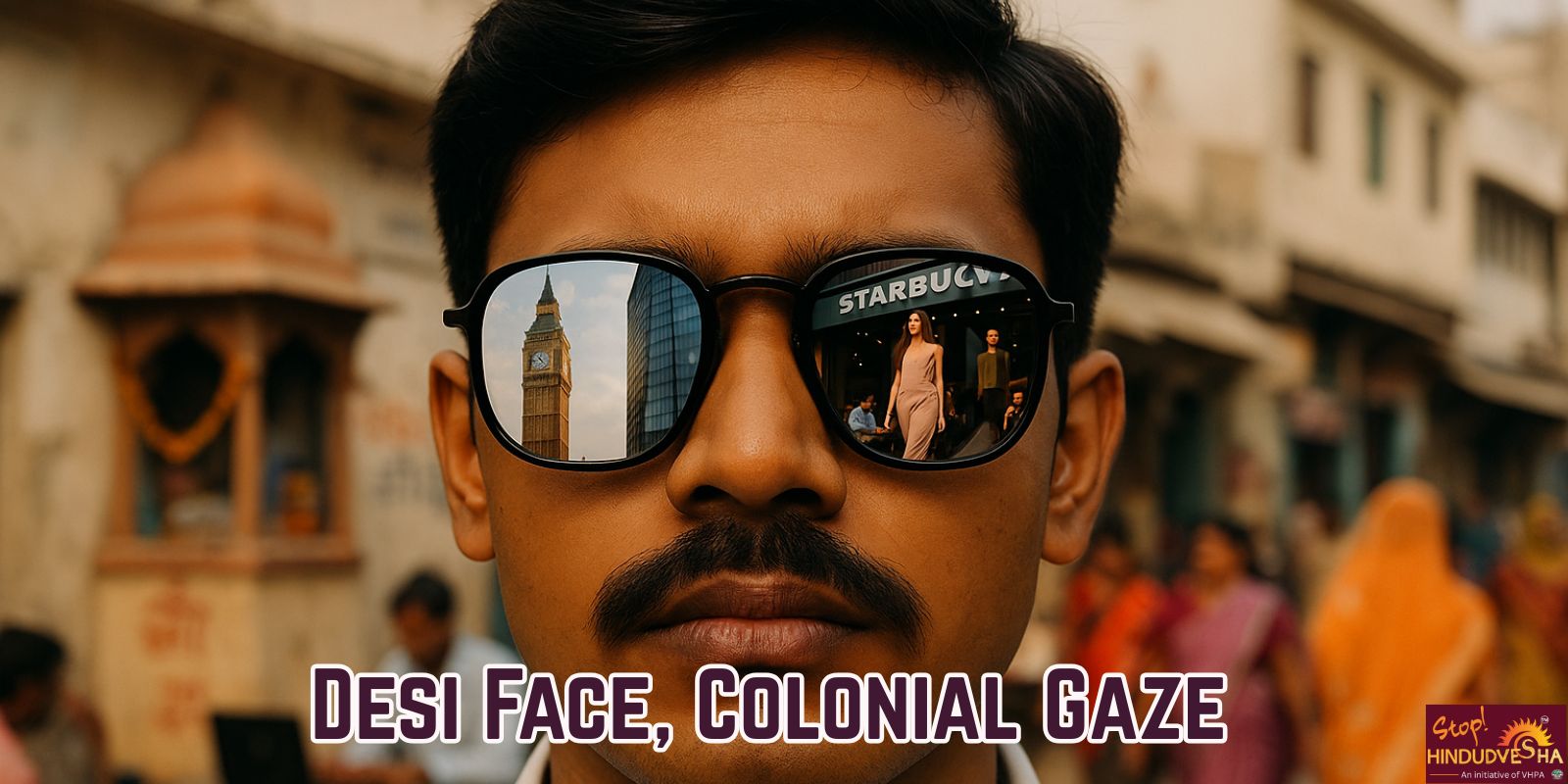
- Centuries of invasions and colonial rule have led to the internalization of a colonial Stockholm syndrome among Indians.
- India’s consumer culture often parodies Western aesthetics, capitalizing on the deep-seated psychological vulnerabilities and colonial complexes within society.
- The toxic combination of neocolonialism and wokeism has made Indians ideal targets for woke marketing gimmicks and ideological experiments.
- One of the ugliest paradoxes of modern India is that many of us value our indigenous art and craft only after it’s appropriated by the West, repackaged, and sold back as something “chic” or “contemporary.”
- This persistent colonial complex remains the greatest obstacle to India fully realizing the potential of its civilizational and cultural resurgence.
Upamanyu Chatterjee’s English August portrays rural and small-town India through the eyes of Agastya Sen, a young civil servant from the English-speaking urban elite who displays open disdain for anything authentically “Indian.”
Sen, the hyper-westernized protagonist of English August, embodies the internalized colonial gaze that continues to afflict modern Indian society. He views his own country and culture with loathing, contempt, and quiet disgust. His outlook reflects a broader mindset shared by many Indians who, shaped by deep-seated colonial inferiority complexes, have consciously distanced themselves from—and at times actively dismantled—their own civilizational roots. What’s more troubling is that they remain largely unaware of the consequences of their actions.
A drive through small-town India today reveals some quietly telling patterns. Many bylanes are dotted with shops and establishments bearing “anglicized names,” many of which are borderline funny. You’ll also come across coaching centers ‘specializing’ in English speaking courses’—a booming industry in itself. With such coaching centers mushrooming in every corner of India, the quality of teaching remains suspect. Still, that doesn’t stop Indians from gambling their hard-earned money in the hope that improving their English language skills would help them fix their life, or better still, make them a part of the ‘elite’ crowd.
While the inherent absurdity of the scenario often elicits goofy responses, the deeper layers of pathos and dark irony are rarely recognized, let alone seriously discussed. Centuries of invasions and colonial rule have given rise to a troubling psychological effect: many Indians have come to internalize what can be described as a colonial form of Stockholm syndrome.
Even as India has witnessed a significant civilizational and cultural revival over the past decade, the deeper psychological traces of colonialism remain difficult for many Indians to fully shed. This has created a striking contradiction. On the one hand, there is a growing pride in Dharmic identity, a rise in temple tourism, a renewed interest in civilizational roots, and an increasing global recognition of Indian culture. Yet on the other hand, in everyday life, many Indians continue to quietly aspire to Western lifestyles and value systems.
This is a classic example of what V.S. Naipaul describes in India: A Wounded Civilization—a poignant reflection of the psychological and cultural damage inflicted on Indian society by centuries of foreign domination. The resulting inner conflict reveals a civilizational identity torn between revival and colonial hangover—between rediscovery and inherited mimicry.
In response to this chaotic duality, the consumer culture industry has developed a “kitsch” aesthetic that turns Indians into imposters in their own land. From the hospitality sector to advertising, people are constantly bombarded with messages that subtly encourage them to abandon their own value system and imitate Western ideals. At the same time, it is the deeply ingrained colonial complex within Indians that makes such messaging effective in the first place.
However, the consumer culture infected with the colonial bug is merely a reflection of the deeper rot within our collective consciousness.
Indian Consumer Culture Still Smitten with the Colonial Bug – The ‘Elitist’ Syndrome
India’s elite hospitality culture often ends up as a comical parody of Western aesthetics—whether it’s the ambience, interior design, overall vibe, service style, or even dress codes. In upscale cafes and restaurants, it’s routine for staff to address customers as “Sir” or “Ma’am,” mimicking a colonial-era formality. In many establishments, employees are explicitly instructed to speak only in English with guests, even when the majority of the clientele are local and perfectly comfortable with Indian languages.
To an outsider, the absurdity of such a scenario is immediately apparent—and it’s not limited to the hospitality industry. In many Indian cities, it’s common to see locals conversing with each other in English, even when they share a native language. For a foreign visitor to India, this behavior often signals a deeper issue—a perceived lack of cultural confidence or self-esteem. I was personally caught off guard when a Spanish friend once asked me casually during my student days at the University of Leeds, UK: “Why do Indians always talk to each other in English?” Like most Indians, I didn’t quite know how to answer that question.
While outsiders can easily recognize the absurdity of such a situation, we as Indians have internalized colonial complexes to such an extent that it no longer strikes us as unusual or out of place.
The urge to sever ties with one’s colloquial roots and cling to the English language is a defining feature of middle-class anxiety in India. But it’s not just about language. There’s a deeper, often unspoken aspiration to adopt everything perceived as Western, particularly in lifestyle and cultural preferences. Terms like “cosmopolitan” or “global” have become euphemisms for a diluted, copycat version of Western sensibilities. Ironically, “Indianness”—which should naturally form the core of India’s hospitality identity—is instead reduced to a curated novelty. It becomes a carefully packaged “theme,” treated more like a museum exhibit than a living cultural expression.
As a result of these trends, Indians with more traditional values are treated as aliens in their own land. An upmarket restaurant in Delhi became the center of controversy in 2021 after a video surfaced, showing an employee telling a customer that a saree was not allowed in the restaurant because it was not considered a “smart casual” dress. This led to immense social media outrage as netizens slammed the restaurant for allegedly denying entry to people donning the most popular Indian garment.[1]
In yet another such incident in Delhi in 2020, a woman was allegedly denied entry into a restaurant in Delhi because she was wearing traditional Indian attire. The woman reportedly shared a video in which the staff could be seen denying entry to her and another person by saying, “ethnic is something we don’t allow.” [2]
In another shocking incident, a man wearing Tamil Nadu’s traditional attire—a white shirt and veshti—was denied entry into a Mumbai restaurant owned by Virat Kohli. He later posted a video on X, calling it an insult to all Tamils and their culture. [3]
Discrimination against traditional Indian attire in the hospitality industry has become a serious concern, prompting even local politicians to take notice. In September 2021, a councillor from a Delhi locality submitted a proposal to the South Delhi Municipal Corporation (SDMC), urging the imposition of heavy fines on establishments that deny entry to individuals wearing traditional Indian clothing.[4]
The hospitality industry, on its part, attempts to justify the discrimination on the pretext that every restaurant or club has the right to establish its own criteria regarding the kind of “vibe” it wants to create for the establishment.[5]
It’s a common practice among certain restaurants and clubs worldwide to impose dress code restrictions, creating a certain halo around their brand and cultivating an image of posh exclusivity. However, in India, the problematic aspect is not so much the imposition of the dress code itself, but the fact that this exclusive culture is based on a snobbish rejection of India’s indigenous culture and lifestyle. When restaurants in the West cultivate an image of exclusivity, they brand certain elements of their own culture as “exclusive” rather than mocking it. In India, it’s the exact opposite.
The pressure to look and behave a certain way in public spaces and entertainment venues—driven by a hyper-Westernized consumer culture—only worsens the cultural amnesia that many Indians already face. The result is a deep identity crisis that continues to haunt us, making it difficult to break free from the grip of a cultural Stockholm syndrome, even as our broader cultural narrative undergoes meaningful change.
A write-up by Brhat[6] aptly argues that India’s cultural amnesia stems from the colonial education system introduced by the British, designed to reshape the “collective psyche of Indians” and serve as an “ideological apparatus” to dominate them across all spheres. Post-independence, the failure to dismantle these “colonial legacies” led to the internalization of colonial complexes among Indians.
Woke Consumer Culture – Neocolonialism Meets Wokeism
A previous piece by StopHindudvesha[7]analyzed the influence of wokeism on Indian youth. It discussed how wokeism has infiltrated the culture and social sphere of young people, especially those living in metropolitan cities like Delhi, Mumbai, and Bangalore. It noted how woke ideology has steadily infiltrated the cultural and social spaces of urban youth. While consumer trends two decades ago could largely be explained by crony capitalism, today these trends are increasingly shaped by wokeism—a strange alliance between capitalism and left-wing politics.
The toxic blend of neocolonialism and wokeism has turned Indians into ideal targets for woke marketing gimmicks and ideological experiments. When deep-seated colonial complexes—marked by an irrational admiration for all things Western and a corresponding disdain for Bhartiya culture—intersect with the desire to appear “progressive” and “socially aware,” the result is a troubling cultural phenomenon. Indian traditions are increasingly vilified, while the language of social justice is exploited as a convenient façade to advance divisive and often harmful narratives.
Woke advertising has made significant inroads into India in recent years. In May 2023, Starbucks India released an advertisement as part of a campaign promoting “transgenderism.” The ad, however, sparked widespread backlash for going beyond the message of respect and inclusivity for the transgender community. Instead, it was seen as implicitly endorsing sex change operations through a carefully crafted and emotionally manipulative storyline.
The advertisement features a young woman named Arpita entering a café to meet her parents. As she sits down, her father asks the barista to write the name “Arpita” on the cup, revealing that she was formerly known as Arpit, their son. While the ad attempted to showcase acceptance and reconciliation, it subtly framed gender transition as a normalized and even encouraged process, without addressing the complex issues surrounding transgender healthcare, safety, or psychological well-being. As a result, it was criticized for importing the American-style woke narrative around gender identity into the Indian context, where such issues require far more cultural sensitivity and nuance.[8]
The ad faced widespread criticism from netizens who viewed it as an attempt to frivolously soft-sell the woke version of “transgenderism” in India and ruin middle-class families. Independent writer and columnist Shefali Vaidya pointed out the implicit anti-Hindu agenda of the ad, posing a rhetorical question to Starbucks if they would have dared to show an advertisement “where Asif becomes Asifa or John turning into a Jane”.[9]
In 2020, the renowned jewelry brand Tanishq ran an advertisement featuring an interfaith couple, where a Muslim family had organized a baby shower for their Hindu daughter-in-law. The ad drew intense criticism from netizens, many of whom accused it of subtly promoting a ‘love jihad’ narrative. The company was ultimately forced to withdraw the advertisement.[10]
India’s deep-rooted colonial complex, combined with the rise of wokeism, has fueled a desire among many Indians to appear “progressive,” leading to a growing trend of rejecting Indian culture in favor of a kitschy, woke aesthetic. Traditional Indian weddings are increasingly giving way to Westernized versions, with designer gowns and Christian-style ceremonies[11] —popularized by Bollywood—setting the tone for the elite and gradually influencing the wider public.
India’s wedding planning industry is capitalizing on cultural insecurities by promoting trends like pre-wedding shoots—borrowed from the woke playbook—that have little to no relevance in traditional Indian culture. Wokeism has, in many ways, reduced the sacred Hindu wedding ceremony to a spectacle, where aesthetics is curated more for social media than for spiritual or familial meaning.
A recent Times of India piece[12] highlighted India’s growing “fake shaadi boom”—a trend where traditional Indian weddings are staged in club-like settings to offer Gen Z a modern, party-style experience of marriage, stripped of the perceived ‘baggage’ associated with authentic rituals and customs.
Trends like these slowly reduce Bhartiya Sanskriti to a museum artifact—something exotic to be displayed or fetishized—while a superficial, kitsch version of Western aesthetics is being imposed on Indian sensibilities.
In March 2023, Bride Today, the bridal platform of India Today, stirred controversy by featuring Indian-origin trans activist Alok Vaid-Menon on its cover, dressed in traditional Indian jewelry and attire. The platform also published an interview transcript in which Menon claimed that India discriminates against the LGBTQ+ community by “not normalizing same-sex marriages.”[13]
Indian Culture Becomes “Cool” when the “firangs” embrace it
It’s one of the most embarrassing paradoxes of modern India that many of them appreciate the richness of our own indigenous art and craft only when the West steals it, repackages it, and sells it back to them as something “chic” and “contemporary”.
Yoga is a prime example. The practice of yoga is an integral part of India’s cultural and civilizational heritage, with roots firmly grounded in Hindu Dharma. It is not merely a system of physical workouts, but a spiritual darshan (philosophy) in its own right. Yet, urban Indians largely prefer working out in Western-style gyms, often dismissing yoga as “stretching exercises” meant for the elderly. Fancy jargon like “Pilates” and “bodyweight training” now defines the fitness routine of Gen Z—most of whom remain unaware that many of these trendy, modern workouts are fundamentally rooted in classical yogic asanas.
According to Patanjali’s Yoga Sutras, Yoga is an eight-limbed path (ashtanga) combining meditation, ethics, and devotion. Yoga has its roots in Vedic Agni (fire) rituals and Upanishadic contemplation (1500-500BCE), later refined by Hindu rishis who viewed the body as a vehicle for transcendent union. However, the West has appropriated Yoga in a way that reduces it to “mindfulness” and “breathwork”, while dissociating the practice from its “spiritual core”. [14]
The metaphysical and spiritual aspects of Yoga have been diluted into trends like Goat Yoga, Power Yoga, Christian Yoga, and even Yoga Barbie dolls. A 2023 article published by Firstpost reveals the startling extent of yoga’s commercial appropriation in the West: “The US Patent and Trademark Office has issued 150 yoga-related copyrights, 134 trademarks on yoga accessories, and 2,315 yoga trademarks.”[15]
It’s a telling symptom of colonized minds. The inability of Bhartiyas to recognize the greatness and depth of their own cultural practices paves the way for Western appropriation of Hindu spiritual systems like yoga. Ironically, once yoga is rebranded as “mindfulness” or “Pilates,” elite Indians are often the first to queue up and pay for these repackaged “services.”
The ancient Indian science of Ayurveda, routinely snubbed by elite Indians for supposedly lacking in “scientific method,” has also been appropriated by the West in numerous ways. Many Indians dismiss Ayurvedic practitioners as quacks, mocking age-old Ayurvedic remedies that use spices readily available in Indian kitchens. Yet, they swoon the moment a Western brand repackages an Ayurvedic staple and markets it as a groundbreaking scientific discovery.
The humble haldi or turmeric — a common ingredient in Indian households — stands out as a prime example. For generations, Indian families have relied on turmeric milk to treat a wide range of ailments, from the common cold to wound healing. However, many urban Indians wrinkle their noses at the mention of indigenous remedies, yet go gaga over turmeric lattes or health booster drinks with a “dash of turmeric” promoted by international brands.
Another good example of this phenomenon is the recent controversy surrounding international luxury brand Prada’s presentation of a slipper that resembles India’s traditional Kolhapuri chappals. Prada chose to copy the design of Kolhapuri chappals but did not credit the craft or acknowledge the roots of its design. This led to enormous criticism from various stakeholders, including Indian artisans, trade bodies, and politicians. A red-faced Prada was eventually forced to “acknowledge” the inspiration behind its design.[16]
It’s not the first time that a well-known global luxury brand has stolen or appropriated Indian art and craft traditions without giving due acknowledgment. However, the irony is that many of these luxury creations, which blatantly plagiarize Indian arts and crafts, end up in the wardrobes or homes of elite Indians who would relentlessly heckle and bargain with a local craftsperson but wouldn’t think twice before shelling out ₹1 lakh for a pair of Prada Kolhapuri chappals.
However, nothing exposes the deep-seated inferiority complex of Indians more brutally than social media trends. When foreigners—more precisely, white foreigners—praise Indian culture or make reels showcasing local traditions, they are showered with overwhelming admiration, which, incidentally, might explains why so many Westerners have suddenly reinvented themselves as influencers on Indian culture. But if a brown-skinned person creates similar content, the response is far more muted. It’s a telling sign that we still need a foreign stamp to value what’s ours.
Wrapping Up
The lingering colonial mindset among Indians remains one of the greatest obstacles to fully realizing the potential of India’s ongoing civilizational and cultural resurgence.
Globally, the rise of wokeism has further amplified anti-Hindu narratives. Its entry into India—under the guise of promoting “social justice” and “progressive values”—has made Indians increasingly susceptible to a toxic blend of woke ideology and colonial baggage.
There is no quick solution to these deeply rooted distortions in our collective consciousness; they can only be corrected from within. Yet, there is hope that the current civilizational awakening will help steer this transformation in a meaningful and lasting way.
Citations
[1] Barred from Delhi eatery for wearing saree, says woman; staff denies | Delhi News – Times of India; https://timesofindia.indiatimes.com/city/delhi/barred-from-eatery-for-wearing-saree-says-woman-staff-denies/articleshow/86439063.cms
[2] Woman refused entry into Delhi restaurant for wearing Indian ethnic dress – The Week; https://www.theweek.in/news/india/2020/03/13/woman-refused-entry-into-delhi-restaurant-for-wearing-indian-ethnic-dress.html
[3] Virat Kohli’s Restaurant Denies Entry to Tamil Nadu Man Wearing Veshti – WATCH; https://www.india.com/sports/virat-kohlis-restaurant-denies-entry-to-tamil-nadu-man-wearing-veshti-watch-6557878/
[4] Proposal in SDMC seeks action against restaurants denying entry to those wearing traditional attire | Today News; https://www.livemint.com/news/india/sdmc-councillor-seeks-rs-5-lakh-fine-against-restaurants-denying-entry-over-indian-attire-11632665308076.html
[5] Rights to admission reserved at restaurants: Colonial hangover or a vibe thing? – Hindustan Times; https://www.hindustantimes.com/more-lifestyle/rights-to-admission-reserved-at-restaurants-colonial-hangover-or-a-vibe-thing/story-3bkdeN7eVAeaiplAuZEutN.html
[6] Colonial Education, Cultural Amnesia and Pathologies of the Raj; https://www.brhat.in/dhiti/colonialeducationculturalamnesia
[7] Indian Youth, Identity Politics, and the Rise of Wokesim – Hindu Dvesha; https://stophindudvesha.org/indian-youth-identity-politics-and-the-rise-of-wokeism/
[8] Starbucks India’s woke agenda leads to boycott calls against the coffee giant in the USA; https://www.opindia.com/2023/05/starbucks-india-woke-agenda-boycott-calls-usa/
[9] ‘Boycott Starbucks’: Coffee Giant Receives Backlash Over Viral Ad on Transgender Inclusion | Viral News – News18; https://www.news18.com/viral/boycott-starbucks-coffee-giant-receives-backlash-over-viral-ad-on-transgender-inclusion-7797721.html
[10] Those asking what if Tanishq ad had religions reversed, answer is – bomb blast, Read why; https://www.opindia.com/2020/10/tanishq-ad-interfaith-couple-hindu-muslim-reverse-mani-ratnam-bombay/
[11] Unravelling the subtle secularization and wokeization of the Hindu Vivaah Sanskar; https://hindupost.in/dharma-religion/unraveling-the-subtle-secularization-and-wokeization-of-the-hindu-vivaah-sanskar/
[12] No pheras but the party’s real: Inside India’s fake shadi boom – The Times of India; https://timesofindia.indiatimes.com/toi-plus/society-culture/no-pheras-but-the-partys-real-inside-indias-fake-shaadi-boom/articleshow/122405900.cms
[13] India Today puts controversial trans activist on the cover of its bridal magazine; https://www.opindia.com/2023/04/india-today-controversial-trans-activist-cover-brides/#google_vignette
[14] The sacred theft: How Yoga’s Christianization is erasing its Hindu heritage; https://www.opindia.com/2025/06/yogas-hindu-roots-being-erased-christian-appropriation-and-spiritual-theft-rampant-it-is-about-time-sanatan-dharma-reclaims-its-spiritual-core/
[15] Western appropriation of Indic culture and why it matters – Firstpost; https://www.firstpost.com/opinion/western-appropriation-of-indic-culture-and-why-it-matters-12924352.html
[16] Prada ‘Kolhapuri’ ‘scandal’: How the controversy sparked a big surge in sales of this Indian sandal; centuries-old craft sees boost – Times of India; https://timesofindia.indiatimes.com/business/india-business/prada-kolhapuri-scandal-how-the-controversy-sparked-a-big-surge-sales-of-this-indian-sandal-centuries-old-craft-sees-boost/articleshow/122210637.cms

Donate to HINDUDVESHA
Our Mission is to explore and expose Hindudvesha through research analysis, education and response.
SUPPORT US