

Empuraan: The Rise of Hinduphobia in Malayalam Cinema
 Rakesh Krishnan Simha · 04/18/2025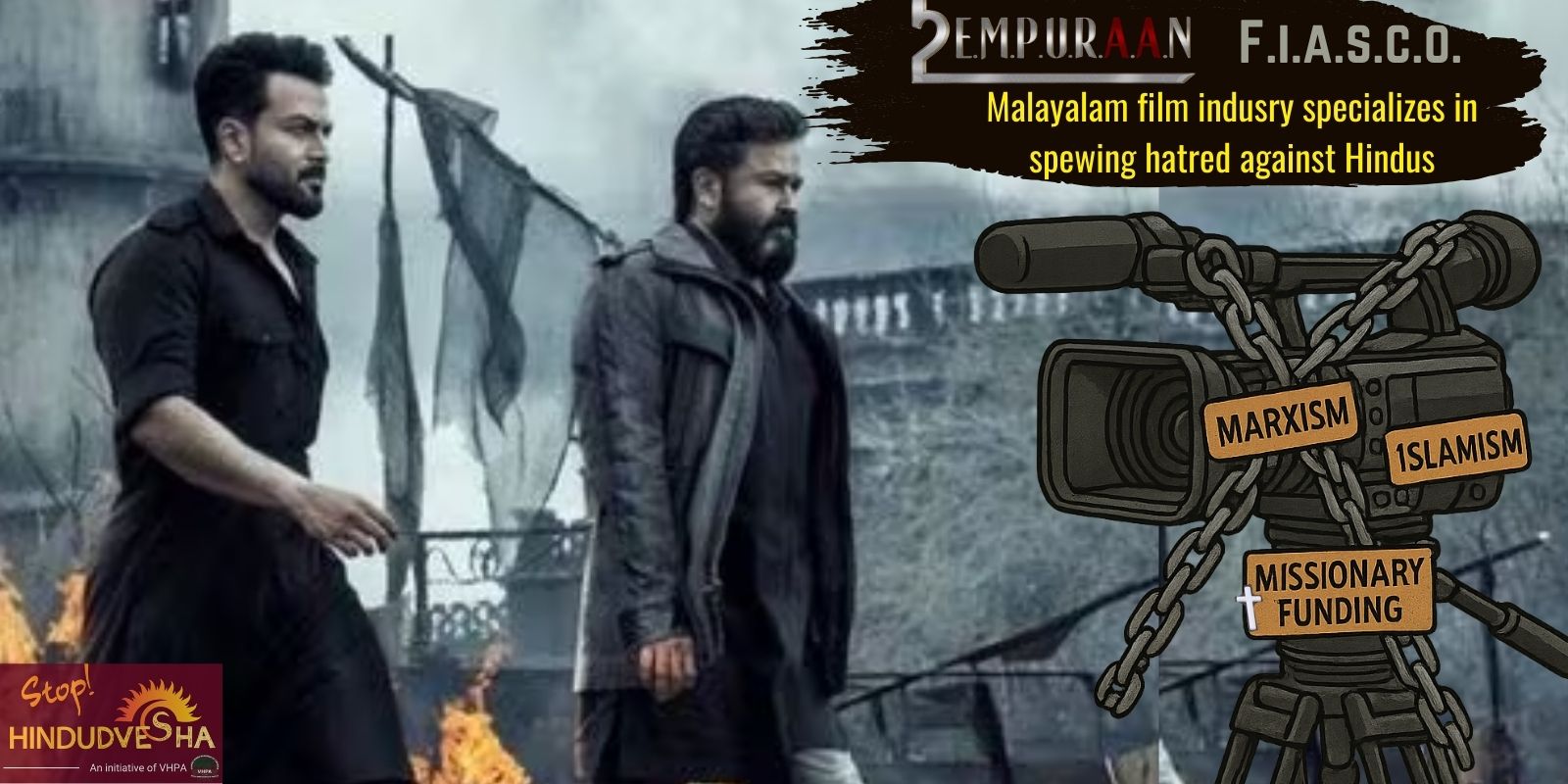
- Empuraan has sparked backlash for peddling leftist and anti-Hindu propaganda, using exaggerated and debunked portrayals of the 2002 Gujarat riots and vilifying Hindu characters and institutions.
- The film reflects a broader pattern in Malayalam cinema, where Hindu identity is repeatedly mocked, distorted, or sidelined, while Christian and Muslim characters are shown in heroic or noble light.
- Superstar Mohanlal, despite his influence, has repeatedly chosen to support films with implicit or overt Hinduphobia, raising questions about his complicity in normalizing such narratives.
- Caste-based ridicule and Hinduphobia have become entrenched in Malayalam films, as seen in past works like 1971: Beyond Borders and Pattarude Mutton Curry, often escaping scrutiny due to Kerala’s ideological climate.
- As the Hindu population in Kerala declines and the industry becomes dominated by non-Hindu financiers, Hindu voices and representations are being erased or demonized, pushing the need for ideological balance and cultural introspection.
The Malayalam language movie Empuraan has been hammered by critics and audiences for being a propaganda vehicle for the Left and Muslims. It opens with a chilling portrayal of the 2002 Gujarat riots, including scenes of a Muslim village set on fire, Hindu men ruthlessly attacking a Muslim child, and a pregnant Muslim woman being violently assaulted. As the plot unfolds, it shows Hindu politicians exploiting the police and central investigative agencies during the chaos.[1] The movie is simply regurgitating the lies spun by leftist activists, published by the mainstream media, and amplified by the liberal commentariat.[2] The film’s deceitful agenda seems evident when you consider that in 2022, the Supreme Court of India dismissed these fake charges[3] and slammed the activists, saying they were pursuing the case to keep the “pot boiling.”[4] Since anti-Hindu motifs are a frequent recurrence in director Prithviraj Sukumaran’s films,[5] it leaves no doubt that Empuraan was conceived as a platform for an anti-Hindu agenda on a grand scale.
For those not familiar with India’s movie industry, the Malayalam film industry is based in the southern state of Kerala. Compared with the more famous Mumbai-based Bollywood, which makes Hindi language films, it is much smaller but punches above its weight due to the large Kerala diaspora scattered globally. Perhaps due to the fact that the storylines in Malayalam films tend to peddle communist propaganda and often an anti-Hindu agenda, the film industry in Kerala has never been able to produce a pan-India hit to rival Bollywood. Empuraan was touted as the breakthrough movie that would change that and establish the Malayalam film industry as a serious player.
Erosion of Hindu Identity
Malayalam cinema, like much of Indian cinema, reflects the state and nation’s cultural, social, and political zeitgeist. However, a troubling trend in recent decades has been the portrayal of caste and religion in ways that are inherently Hinduphobic. At the heart of this issue is the portrayal of Hindu characters and religious practices in a manner that is often negative or dismissive. This portrayal, especially when tied to the film industry’s power structures, has sparked debates about the representation of Hindus and their cultural identity in Malayalam cinema. One could argue that the undercurrents of casteism and Hinduphobia are deeply entwined in the industry’s narratives, impacting both the stories told and how certain communities are depicted on screen.
Mohanlal – Hero or Villain?
After copping criticism for his role in giving Empuraan traction through his star power, the lead actor Mohanlal Vishwanathan has tried to distance himself from the movie. But is the Malayalam superstar as innocent as he claims? Why did he agree to act in a movie in which Hindus are portrayed negatively? He may not write the scripts, but with his net worth of Rs 476 crore (roughly $55 million)[6], his standing in the industry gives him the clout to make changes or tweaks. He could have put his foot down and asked his close friend Prthiviraj to tone down the Hinduphobia, but he didn’t.
Again, in the megahit Drishyam (2013), the hero is a Christian named Georgekutty who does everything to protect his family, and the villains are a Hindu family. If you scan the credits, you’ll know why this is so — the producer is Antony Perumbavoor, and the director-writer is Jeethu Joseph.[7] And yet, Mohanlal had no issues with the subtle Hinduphobia of the script. You could call it the Broken Window Theory – when you are not stopped from committing a small crime, you go on to commit a more serious offense.[8]
Weaponizing Caste
Mohanlal is a key member of the Malayalam film industry that has, for decades, normalized caste-based stereotypes. From caste phobia (mocking certain castes) to Hinduphobia (showing Hindus in a negative light), Malayalam movies have acted in step with the agenda of the Left-Muslim-Christian nexus. Empuraan is thus the inevitable consequence of the Malayalam film industry’s ulterior agenda. Let’s explore further.
The 2021 film Pattarude Mutton Curry (Brahmin’s Mutton Curry) has an extended scene showing a Brahmin cooking mutton curry. Would they make a movie titled “Syed’s Pork Curry?”
The film outraged the Kerala Brahmins Association, who wrote a letter to the Censor Board in Trivandrum, saying ‘Pattar’ is a colloquial — and mocking term — used to refer to Brahmins in Malayalam. In the letter, the Association argued that the title mentioning ‘mutton curry’ was a deliberate attempt to insult the community. “The fact that Brahmins are vegetarians is also known to all. Thus, the words ‘Pattars’ and ‘Mutton Curry’ are intended to insult the Brahmins,” read the letter signed by Karimpuzha Raman, State President of the Kerala Brahmana Sabha.[9]
Another blatant insertion of caste and religion was in the 2017 movie 1971: Beyond Borders. Mohanlal’s character, Sahadevan, is attending a temple festival when he invites a character named Sulaiman to come and watch the temple festival. A temple administrator observes this and says, “Sahadeva, there is no need to bring Muslims into the temple. We don’t have the time to do shudhikaran (purification). Sulaiman, you leave.” At this, Mohanlal steps in and sneers at the temple administrator: “It has been only a short while since you were allowed to wear dhoti, apply tilak, and enter temples.”[10]
The scene achieves two things. One, it establishes for the audience that Mohanlal’s character is a member of a formerly dominant caste. This is a constant theme in Mohanlal movies. Two, it shows the former lower caste person his place. He may be a temple administrator, but he has to step back and allow the Muslim man to enter the temple when confronted by the former dominant caste hero. This is laughable because, in real life, such an interaction can never happen in Kerala. Thanks to the numerous social welfare movements over the past century and a half, referring to another person’s caste is considered taboo, and anyone who pulls such a stunt will be rightly branded a bigot.[11]
Interestingly, the producers edited out the scene in the Hindi-dubbed version, thereby proving that the scene was intended only for Kerala viewers. This proves that blatantly casteist and Hinduphobic content, which the brainwashed leftists of Kerala tolerate, won’t get traction outside the state. The scene is missing at the 22-minute mark here[12]: https://www.youtube.com/watch?v=rmFcQ7DFbNM
As opposed to Sulaiman’s character, Muslims in real life are in no tearing hurry to enter a Hindu temple. They are not seeking invites from seculars like Sahadevan to step into the kafir’s place of worship. A practicing Muslim would consider entering a temple as shirk – the greatest sin a Muslim can commit. That’s why Muslims in India don’t accept prasad (consecrated offerings) from Hindu temples.[13]
Implicit Bias
In Beyond Borders, the temple administrator’s dialogue about the need for purification if a Muslim enters the temple implies that Muslims and Christians are treated as second-class citizens and that there is a blanket ban on the entry of Muslims (and Christians) into Hindu temples in Kerala. This is classic atrocity literature that the Leftist cabal excels in.[14]
The truth is that only a very few Hindu temples, such as Guruvayur, have banned non-Hindus. The reason for this is that both groups of foreign invaders have destroyed, vandalized, and stolen Hindu temples. The ban is primarily a reaction to the iconoclasm of Muslims and Christians.[15] In 99% of temples in Kerala, there is no ban on non-Hindus.
Now, have a look at Bollywood war movies from yesteryears. Most Indians have grown up on Hindi war classics such as Hindustan Ki Kasam, Lalkar, Haqeeqat, and Border. Despite Bollywood’s underlying Hinduphobia, these movies did not push an anti-Hindu agenda. If Sunny Deol, who plays a Sikh soldier in Border, had spewed caste rhetoric or given a speech on peace, the viewers would have panned the movie, and the producer would have become the laughingstock of Mumbai. But in Kerala, Mohanlal is eulogized because snubbing people based on caste on the big screen has been normalized. Decades of caste-bashing have created what could be described as implicit casteism, where people tend to laugh at the jokes directed at their caste.
Toxic Lobby
Cancel culture. Sexploitation. Crime rings. Midnight raids. Cyberbullying. Horrendous treatment of workers. This may sound like the plot of a B-grade thriller, but according to the Justice K Hema Committee report, this is real life in Malayalam movies. When the committee’s report was released in 2024, the reactions ranged from disbelief to “we knew it all along.”[16]
But years before the report was made public, one of the biggest exposures to the toxic nature of the Malayalam film industry was done by veteran actor Thilakan. In 2010, he pointed out the presence of a movie mafia in Kerala’s film fraternity, which he said imposed unofficial bans.[17] His accusations against AMMA, the Association of Malayalam Movie Artists, were met with dire consequences, as he was denied many opportunities later in his life.[18] The 75-year-old actor from the Ezhava community was banned for a year. When the Hema Committee Report finally confirmed Thilakan’s assertions, it was 12 years too late for the thespian.
Othering the Hindu
What has happened in Kerala movies is the slippery slope syndrome. For decades, the film industry in the state used caste in an attempt to divide Hindus. Malayalam movies have now graduated to outright Hinduphobic content. As the Hindu population of Kerala continues to plummet (estimated at under 50 percent currently), the space for Hindu characters has declined too. Today, it is normal to have Christian and Muslim lead characters while Hindus play second fiddle. Hindus are now portrayed as villainous, lecherous, greedy, and other negative stereotypes. With neither the public nor the media opposing the Malayalam film industry’s casteism and Hinduphobia, it is now largely under the control of anti-Hindu and anti-national forces.
Kerala-based conservative columnist Rajeev Srinivasan says Malayalam mainstream film is where he first encountered what has now become endemic enough to outrage a lot of viewers: the casual or deliberate attack on Hindus and Hinduism.[19]
In Nirmalyam (1973), which won national awards, the climactic scene has a velichapad, or temple oracle, spitting on the deity at the small, poor Hindu temple that he had served all his life, in despair that his life was ruined, and he falls dead. Notably, the actor was a Christian named Joseph.
“What staggered me was that you would never see such a scene about any other religion in even the most ‘progressive’ Malayalam films, as it would be blasphemous, and there would be consequences.” But in the lexicon of leftist ‘intellectuals,’ such a narrative demeaning Hindus is acceptable, and the director/writer went on to win a top literary prize.
In Malayalam films, Srinivasan noticed that Hindu swamis are inevitably portrayed as crooks, rogues, or cheats. In contrast, Christian padres are uniformly holy and kind, and Muslim mullahs are always stern but with a heart of gold. “That is a standard leftist narrative. Over time, the narrative became rigid, and even in fictional retellings of real incidents where an Abrahamic hurt a Hindu, the roles are reversed, so that the villain is always a Hindu.”
Over time, as wealthy Christians began to fund the films, their stories began to take center stage, but the motif of Hindu hatred continued. Now, the majority of films are financed by wealthy Muslims, but the Hindu hatred is unabated. This mirrors the Hindi film industry, or Bollywood, where it is par for the course to mock Hindus, Hindu religious rituals, and deities.
Srinivasan concludes that the demonization of Hindus in Malayalam is so extreme that the film Meppadiyan (2022) was attacked simply because it had a staunch and religious Hindu protagonist and featured an ambulance funded by the Hindu charitable organization Sewa Bharati. “This is reaching absurd levels of ‘cancel culture,’ in effect denying Hindus the very right to exist. It is normalizing the idea of ethnic cleansing and genocide.”
Malayalam Cinema Shaping Kerala’s Islamization
In 2021, on the centenary of the Moplah Riots[20], Prithviraj had planned to produce a movie titled ‘Vaariyamkunnan’ based on the life of a violent Islamist named Variyam Kunnathu Kunjahammed Haji, who spearheaded the Hindu genocide of 1921 which led to the massacre of more than 10,000 Hindus, forcible conversions, rape of Hindu women and children, and destruction of Hindu properties and places of worship.
The biopic, in which Prithviraj was to play the title role, projected Kunjahammed as a valiant freedom fighter and Hindus as villains who sided with the British. Over successive decades, the Muslims of Kerala and the communist governments have tried to turn Kunjahammed into a braveheart who evicted the British and established an independent Malayala Nadu (land of Malayalis) for a few months, though in reality, what he established was Al-Daula (Islamic State), where he imposed jizya (religious tax) on the Hindus of his territory.
And the plot thickens. Most of the key jobs in the film, right from production to execution, were to be handled by individuals who leaned towards radical Islamist outfits, including the banned Popular Front of India and the Islamic State. “One of the scriptwriters had posted a message on social media as to how cinema can be an effective tool for furthering the cause of Islamisation of Kerala. Another key person of the project reportedly made a failed attempt to join the Islamic State in Syria to wage jihad against infidels.”[21] The movie was shelved after the filmmakers received massive backlash against their attempts to whitewash crimes committed by Muslims against innocent Hindus in Kerala.[22]
Prithviraj wasn’t the first director to cash in on anti-Hindu sentiments. In 1988, the Malayalam film industry produced a hagiography on the Moplah Riots titled ‘1921.’ Produced by the famous Hindu director IV Sasi, it glorified Kunjahammed and whitewashed the genocide of Hindus.[23] Predictably, the film was praised by liberals as an example of Hindus and Muslims coming together to fight the British when, in reality, it was nothing of that sort.
Now, fast forward to 2022. Kerala-based filmmaker Ali Akbar (who prefers to be called Ramasimhan) decided to make a movie on the same topic but which tells the true story of the genocide, the brutalities committed by the Muslims, the force-feeding of beef to Brahmin families, the filling of wells with the corpses of Hindus slaughtered by the Muslims, and the mass conversion of Hindus to Islam.[24]
From the beginning, Ramasimhan had to face numerous roadblocks. Firstly, several investors, including Prithviraj, walked out of the venture, and the director had to resort to crowdsourcing to finance the film. Then, during filming, the state police and the intelligence officers advised him that he was under serious threat from Islamic radicals. “The central agencies came to my house and told me to install eight cameras for security purposes,” he said.[25]
After filming was completed, the Censor Board, packed with liberals, communists, and Muslims, called for massive cuts, which would have made the film unwatchable. Finally, Ramasimhan approached the Kerala High Court, which approved the film ‘1921: Puzha Muthal Puzha Vare’ but with seven key scenes removed. Such is the extent to which the system can gang up on anyone who makes a movie that is sympathetic to Hindus.[26]
Conclusion
The Hindus of Kerala, who are addicted to Marxist and secular ideologies, may continue to support Mohanlal, Prithviraj, and their cohorts. They may not care that the Malayalam film industry is run by a Marxist-Mullah-Missionary nexus whose real aim is to erase Hindu identity from Kerala. They may shrug off the fact that Prithviraj endorses India’s first Sharia-compliant apartments with flats facing Mecca, where residents share the same religion, food habits, and attire. Non-Muslims will not be allowed in the building, so it’s basically housing apartheid.[27]
With Muslims currently constituting 30 percent of Kerala’s population, the Malayalam film industry may be tempted to promote pro-Islamic and anti-Hindu rhetoric in their movies. But as Empuraan has shown, Hindus are pushing back hard on such false and biased narratives.
Against this backdrop, the Malayalam film industry must begin confronting its own biases on-screen and behind the camera. The industry needs more diverse voices, more filmmakers willing to step outside the confines of narrow narratives, and more stories that genuinely reflect Kerala society, whose underlay is undeniably Hinduism. Until then, the Hinduphobia embedded in the industry’s caste dynamics will continue to perpetuate stereotypes and reinforce an exclusionary social structure, hindering true progress and eventually promoting conflict. Plus, it will never gain a pan-India audience.
Citations
[1] Malayalam star Mohanlal expresses regret after his film ‘Empuraan’ shows Hindus in bad light, regrets distress to fans, assures removal of such references (OpIndia, 2025); https://www.opindia.com/2025/03/malayalam-star-mohanlal-issues-apology-after-outrage-over-his-film-empuraan-showing-hindus-in-bad-light/
[2] Sanjiv Bhatt, Teesta Setalvad, Congress, leaked emails and BlackBerry: How the ‘ecosystem’ was united to play politics over the dead (OpIndia, 2022); https://www.opindia.com/2022/06/how-teesta-setalvad-sanjiv-bhatt-congress-spread-lies-against-pm-modi-on-gujarat-riots/#google_vignette
[3] ‘Narendra Modi fought for 19 years, braved pain’: Amit Shah defends PM after ruling on Gujarat riots (The Economic Times, 2022);
[4] Gujarat Riots Verdict: Will Those Who Created An ‘Industry Of Lies’ Finally Be Made To Pay? (Swarajya, 2022); https://swarajyamag.com/politics/gujarat-riots-verdict-will-those-who-created-an-industry-of-lies-finally-be-made-to-pay
[5] Unmasking the anti-Hindu and anti-Bharat narrative in Malayalam film ‘Empuraan’ (Organiser, 2025); https://organiser.org/2025/03/30/285110/bharat/unmasking-the-anti-hindu-and-anti-bharat-narrative-in-malayalam-film-empuraan/
[6] Mohanlal Net Worth, Salary, House (MoneyMint, 2024); https://moneymint.com/mohanlal-net-worth-salary-house/
[7] https://www.imdb.com/title/tt3417422/fullcredits/?ref_=tt_cst_sm
[8] Broken Windows Theory (Psychology Today); https://www.psychologytoday.com/nz/basics/broken-windows-theory#:~:text=The%20broken%20windows%20theory%20states,to%20work%20and%20educational%20environments
[9] Kerala Brahmins Association takes offence to ‘Pattarude Mutton Curry’ short film title (The News Minute, 2021); https://www.thenewsminute.com/kerala/kerala-brahmins-association-takes-offence-pattarude-mutton-curry-short-film-title-145335
[10] 1971 Beyond Borders Malayalam Superhit Movie Scene 1971 (YouTube); https://www.youtube.com/watch?v=A9PMI8epX60
[11] Life of Sree Narayana Guru: What impact did he have on our society? (Organiser, 2021); https://organiser.org/2021/08/20/21408/analysis/life-of-shree-narayana-guru-his-reforms-and-philosophies/
[12] 1971: Beyond Borders | Hindi Dubbed Full Movie | | Mohanlal | Arunoday Singh | Allu Sirish (YouTube); https://www.youtube.com/watch?v=rmFcQ7DFbNM
[13] Are Muslims allowed to eat Prasad from Hindu temple and can they eat food cooked by Hindus? Here is what Darul Uloom Deoband says (OpIndia, 2022); https://www.opindia.com/2022/09/are-muslims-allowed-to-eat-prasad-from-hindu-temple-what-darul-uloom-deoband-says/
[14] Breast Tax: A False Story to Attack Hindus (Hindupost, 2016); https://hindupost.in/society-culture/breast-tax-a-false-story-to-attack-hindus/
[15] https://www.prekshaa.in/tipu-sultan-temple-destroyer-par-excellence
[16] Hema committee reveals 17 forms of exploitation in Malayalam film industry in Kerala including sexual harassment, assault (The Economic Times, 2024); https://economictimes.indiatimes.com/news/india/hema-committee-reveals-17-forms-of-exploitation-in-malayalam-film-industry-in-kerala/articleshow/112643493.cms?from=mdr
[17] Thilakan (Malayalam actor) speaks out against Mammootty, AMMA and FEFKA (YouTube); https://www.youtube.com/watch?v=UvNkxH7-yiU&t=325s
[18] Thilakan In Nerechowe – Old Episode | Manorama News (YouTube); https://www.youtube.com/watch?app=desktop&v=uDT8EhMXsYs
[19] Cinema As Metaphor: Enough With Trashing Hindu Sentiment, Especially As Streaming Largesse Fades (Swarajya, 2022); https://swarajyamag.com/culture/cinema-as-metaphor-enough-with-trashing-hindu-sentiment-especially-as-streaming-largesse-fades
[20] What MK Gandhi said while Moplah Muslims massacred thousands of Hindus in 1921: Support to Khilafat and asking Hindus to die without a fight (OpIndia, 2021); https://www.opindia.com/2021/09/what-mk-gandhi-said-moplah-genocide-of-hindus-1921-support-khilafat/
[21] Moplah riots were a pogrom against Hindus (Sunday Guardian, 2020); https://sundayguardianlive.com/opinion/moplah-riots-pogrom-hindus#google_vignette
[22] Malayalam movie ‘Vaariyamkunnan’ glorifying the Jihadis behind Moplah Hindu genocide in Kerala shelved after outrage (OpIndia, 2021); https://www.opindia.com/2021/09/malayalam-movie-vaariyamkunnan-hailing-jihadis-shelved-after-protests/
[23] Nineteen Twenty One (IMDB, 1988); https://www.imdb.com/title/tt0271675/
[24] Here’s how Kerala censor board killed Ramasimhan’s film based on Malabar Hindu Genocide (Organiser, 2022); https://organiser.org/2022/09/06/93270/bharat/heres-how-kerala-censor-board-killed-ramasimhans-film-based-on-malabar-hindu-genocide/
[25] The exclusive story on how Ramasimhan’s movie on 1921 Malabar Genocide of Hindus is being stonewalled: Cuts by CBFC, threats by Islamists and more (OpIndia, 2022); https://www.opindia.com/2022/09/exclusive-how-ramasimhan-ali-akbar-movie-1921-moplah-genocide-hindus-stonewalled-cbfc/
[26] 1921 Puzha Muthal Puzhavare Official Trailer (YouTube); https://www.youtube.com/watch?v=eM3JCLwNhWA
[27] In a first, Sharia compliant apartments come up in Kerala (Times of India, 2018); https://timesofindia.indiatimes.com/city/kochi/shariah-model-flats-facing-mecca-clocks-in-sync-with-azan/articleshow/64151619.cms#:~:text=The%20high%2Dend%20apartments%20coming,be%20heard%20clearly%20in%20all

Donate to HINDUDVESHA
Our Mission is to explore and expose Hindudvesha through research analysis, education and response.
SUPPORT US