

Avoiding Deep Freeze: How India Can Insulate Itself From Western Financial Sanctions
 Rakesh Krishnan Simha · 03/17/2025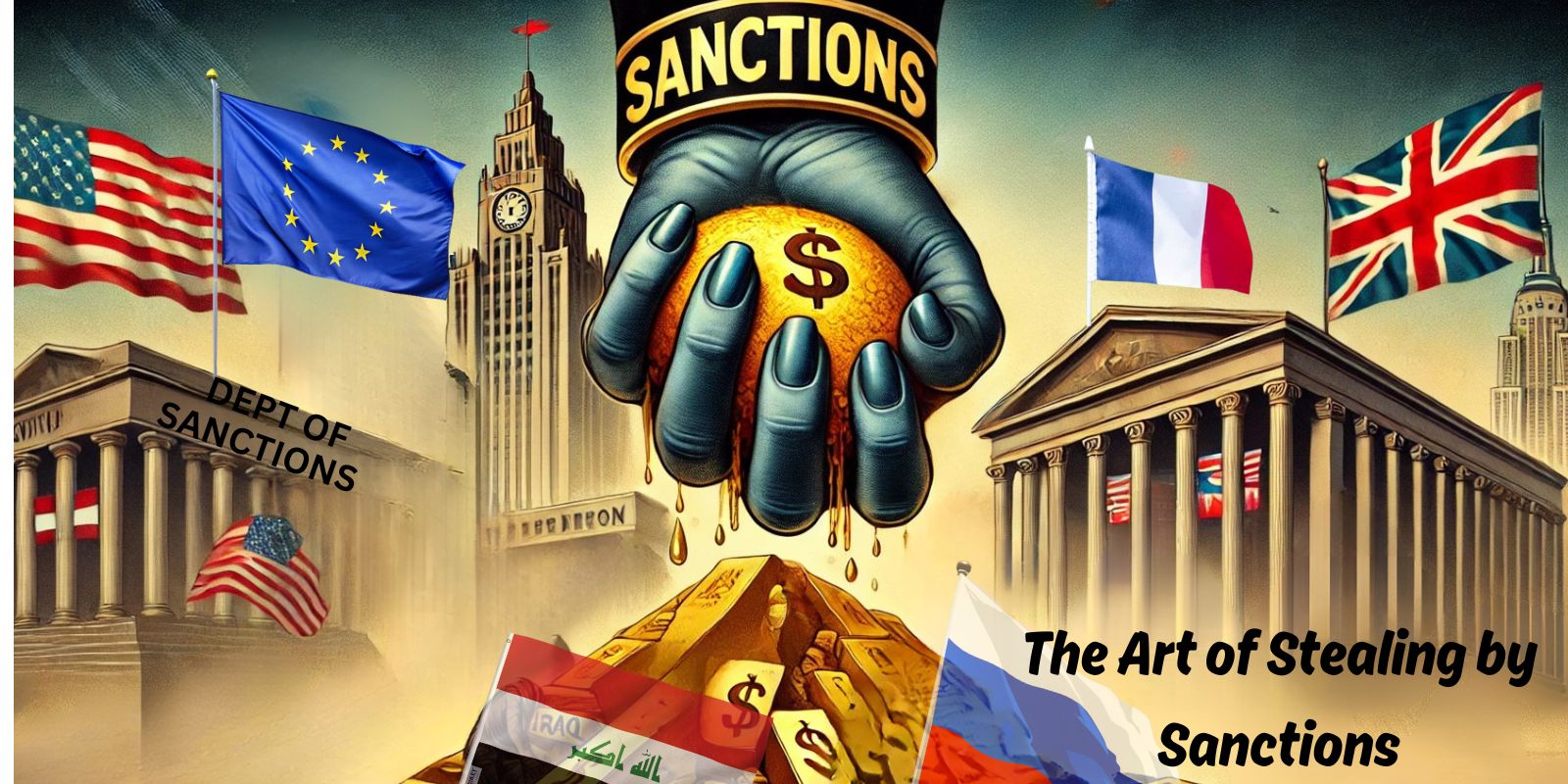
- Western nations froze $322 billion in Russian assets after the 2022 Ukraine invasion, including government bonds and oligarch wealth, following a pattern seen with Iraq, Libya, and Iran.
- The UK advocates moving from freezing to seizing Russian assets to rebuild Ukraine, echoing historical colonial plundering practices.
- Asset freezes serve as a legal pretext for wealth appropriation, often becoming permanent, with Iraq, Libya, and Iran losing billions under similar schemes.
- India and other nations at risk of future sanctions should safeguard their reserves by diversifying investments, avoiding Western-dominated financial systems, and strengthening diplomatic ties.
- India must develop alternative financial systems, trade in local currencies, engage with non-Western institutions, and bolster economic self-reliance to protect sovereign wealth.
Call it daylight robbery. In response to Russia’s 2022 invasion of Ukraine, which was in response to the US deep-state-sponsored attack on Russian majority provinces in Ukraine, Western countries have frozen a gargantuan $322 billion in Russian financial assets.[1] Many of these frozen assets are held in government bonds that Russia’s central bank had stored as reserves. Plus, there are assets belonging to high-profile Russian oligarchs and elites. Their assets, including luxury properties, yachts, and other financial holdings in Western nations, were seized or frozen. This was part of the broader strategy to penalize individuals benefiting from the Russian regime.
Freezing assets is a gateway to outright theft. Britain – which has approximately 200 years of experience in colonial looting – has restated its long-standing position that Europe should move from just freezing Russian assets to seizing them.[2] According to London, the seized Russian funds would be used to rebuild Ukraine. That’s ironically coming from a country that has refused to pay a single pound in reparations after looting $45 trillion from India.[3]
Among the tools the West uses to apply sanctions is the little-understood “assets freeze.” It is a term used so often in recent years that it qualifies to enter the dictionary as a synonym for greed.[4]
This is how the scheme works. Let’s say a Western nation wants to seize a foreign country’s banking accounts, term deposits, or other properties on its soil. To do this, the leader of that nation signs a piece of paper known as an executive order, “freezing” the known assets of the targeted country. From that moment onwards those assets become the property of that Western nation.
The chances that the assets will be unfrozen depend entirely on the targeted country’s relationship with the West thawing. Since that rarely happens, Western governments can manage and enjoy stolen wealth virtually forever.
Loot of Iraq
Iraq – like other oil-rich countries – had deposited billions of petrodollars in Western banks, and these assets were frozen after Iraq’s 1991 invasion of Kuwait. The amount stolen is still being debated by the bean counters. The total amount seized was $40 billion.[5]
Here’s a simple illustration to comprehend the quantity of cash stolen: The height of a stack of 40 billion $1 bills would measure 4,360 km. A column of bills this high would be more than 12 times higher than the orbiting International Space Station.
The Coalition Provisional Authority showed inexplicable zeal in ensuring the money was distributed as quickly as possible. The billions splurged under its watch were supposed to rebuild Iraqi infrastructure – destroyed in the first place by the Western war coalition – but even today, Iraqi utilities and its once excellent hospitals are in shambles.[6]
Another $18.7 billion remains unaccounted for. According to an Al Jazeera report, “Piles and piles of shrink-wrapped US dollars came here, but the cash coming in is not the important part – it is what happened to it after it got here. There are no documents to indicate who got it, where it was spent, and what was ever built from it.“[7] An easy guess is Western contractors, lawyers, soldiers, crooked military officers, banks, corrupt diplomats, and Iraqi politicians working for the West.
An even bigger stash looted was Libya’s. The North African country’s nearly $32 billion deposit and $19 billion worth of assets in the UK form the biggest sovereign wealth portfolio ever blocked.[8] In an article dated March 23, 2011, the Washington Post practically salivates over how it took just 72 hours to locate and block Libyan assets. The propaganda mouthpiece shamelessly boasts: “Instead of being a secondary measure, as in the past, economic sanctions have become a centerpiece of national security policy.”[9]
No less sordid is the illegal transfer by the US of $8 billion in frozen Iranian assets to the Bank of England and another $3.6 billion to the Federal Reserve.[10] In 1981 Iran and the US signed an agreement known as the Algeria Declaration, which obliged Washington to remove the block on Iran’s assets.[11] But not only did Washington not pay back a single cent, it in fact rented out part of Iran’s properties to Romania and Turkey, and built a parking lot after demolishing some Iranian-owned properties.
In the Iran case, we can cut America some slack because the Iranians were clearly the aggressors and had held 52 American embassy staff as hostages for 444 days. Thousands of Iranian students stormed the embassy and attacked diplomats and other employees.[12] It was a clear and naked violation of international law. Over 45 years later, the Islamic Republic of Iran remains a rogue state and refuses to become a normal, law-abiding country. In this context, punishing the Islamist regime wasn’t a bad thing at all.
Don’t Be A Target
One must shake one’s head in disbelief at how easy it is for the West to seize the wealth of sovereign countries. How could Muammar Gaddafi and Saddam Hussein, who ran two of the leading Arab republics for several decades, lack the basic common sense to keep their national wealth in safer places? Why did they keep their money in the countries they knew were out to get them? And how did the Russians not have the sense to liquidate at least some of their treasury bonds before launching the invasion?
This is not a matter of academic interest but of pressing concern for countries that might be targeted in the future. India, for instance, has a massive $639 billion foreign exchange reserves.[13] While India currently enjoys strong ties with the West, one can never be sure which direction the relationship will go in the coming decades. In the event of a war or a punitive military action by India, the West could freeze these reserves. As the ancient Hindu strategist Chanakya said over 2,300 years ago, “One whose knowledge is confined to books and whose wealth is in possession of others can use neither knowledge nor wealth when the need for them arises.”[14]
Securing India’s Sovereign Wealth
Back-of-the-envelope calculations suggest that if Saddam Hussein had invested his oil income in bonds and deposits in, say, Indian banks, the $20 billion would have been worth approximately $80 billion today. Instead, the money is lining the pockets of Americans and Europeans, while Iraqi citizens have given up hope that they will ever see a fraction of it.
In the context of Western nations freezing the assets of countries like Russia, Libya, Iraq, and Iran, India and wealthy Indians may face increasing pressure to protect their finances, given the country’s growing economic importance and geopolitical significance.
Perhaps you are a high net worth individual (HNWI) and believe that keeping your money in tax havens or secrecy jurisdictions may be the solution. In fact, that could be a terrible idea. For, there is no guarantee that Western intelligence agencies won’t sniff out your holdings.
Plus, there’s the very real possibility that Western governments could collaborate during crises and conflicts. For instance, the CIA could share information about private wealth kept in the Cayman Islands with the UK; similarly, British intelligence will pass on information about funds invested in the Isle of Man to the CIA.
India could adopt strategies to safeguard its financial interests now and in the future. These include measures ranging from diplomacy to finance.
Diplomatic Engagement
India has been increasing its engagement with Western countries, particularly the United States. In recent years, the country has become a regular attendee at G-7 summits, participating as a special guest. This engagement allows India to align more closely with Western powers while maintaining its strategic autonomy.
Expanding trade partnerships with Western countries is critical as the West is already India’s most important trading partner and a dominant source of capital and technology. Participating in new networks of global supply chains with trusted partners, as proposed by the United States. Leveraging its position as a growing economy to attract more Western investments and technological collaborations. If the West is heavily invested in India, the chances of economic and military sanctions are low to negligible.
Strategic Alignment
India can position itself as a “south-western power,” bridging the gap between the Global South and the West. This approach allows India to maintain close ties with the United States and the West while emphasizing its Global South identity. India can act as a mediator between different global forces, amplifying the voice of the Global South in international forums.
India can coordinate with the United States and the West on behalf of the Global South, leveraging its unique position as both a developing country and the “world’s largest democracy.”
Balancing Power
To avoid potential sanctions and maintain good relations with both the West and other global powers, India should continue its policy of strategic autonomy while prioritizing closer ties with the United States. It could also emphasize its role as a democratic counterweight to China in the Indo-Pacific region, aligning with Western interests in regional stability.
Diversifying Foreign Reserves
First, stop investing trade surpluses in Western treasury bonds. These bonds are often considered the safest of all investments. But in fact, they are neither safe nor lucrative. They seem so because few investors know what really happens to their money.
By holding more assets in gold, other stable currencies such as the Swiss Franc or the Chinese Yuan, or even in cryptocurrencies with robust security, India could reduce its reliance on Western-dominated financial systems.
Perhaps the New Development Bank, a multilateral development bank established by the BRICS (Brazil, Russia, India, China, and South Africa), could offer long and short-term bonds where smaller countries can park some of their wealth.[15]
Strengthening Multilateral Relations
India can strengthen financial and trade relationships with countries outside Western sanctions regimes, such as Russia, China, and other nations in Africa, Asia, and Latin America. This would help create alternative payment and trade systems that are less reliant on Western banking institutions.
Building a Strong Economic and Political Diplomacy Framework
India must maintain strong diplomatic ties with Western and non-Western powers, ensuring it remains an important global player. By acting as a bridge between different power blocs, India can leverage its geopolitical position to protect its financial interests while reducing the likelihood of being caught in sanctions regimes.
Promoting the Use of Local Currencies
India has already begun discussions with various countries, including Russia and Iran, to settle trade in local currencies rather than relying on the US dollar. This shift would help shield India from sanctions and asset freezes, as transactions would not pass through Western financial institutions.
Strengthening Financial Infrastructure
Invest in alternative financial systems and institutions. For example, India’s RuPay payment system and the National Payments Corporation of India (NPCI) could be expanded and made interoperable with countries outside the Western-dominated financial networks. Developing independent systems for SWIFT-like messaging services could also reduce vulnerability.
Improving Domestic Financial Resilience
Ensuring strong financial institutions and a robust domestic economy can mitigate external shocks. India must maintain a healthy foreign exchange reserve buffer, manage its fiscal deficit prudently, and diversify its investments into less volatile assets.
Engaging with Non-Western Institutions
India could engage more actively with institutions like the Asian Infrastructure Investment Bank or even the Shanghai Cooperation Organization, which are less likely to be influenced by Western sanctions. These institutions can offer alternative project financing, reducing dependency on Western-dominated financial systems.
Enhanced Use of Digital Assets
With the rise of blockchain technology and cryptocurrencies, India could explore the potential for digital currencies or blockchain-based systems for international transactions. Digital currency initiatives like the Digital Rupee could offer an alternative route for financial exchanges outside the traditional global financial network.
Adopting Strategic Resilience in Key Sectors
Focus on strategic self-sufficiency in critical sectors such as energy, defense, and technology. For example, increasing investments in renewable energy can reduce dependence on oil and gas imports, thus buffering the impact of potential sanctions or supply disruptions. After the Ukraine War started in 2022, the strategic oil purchase from Russia at discounted rates has been a huge windfall for the Indian economy. At the same time, India’s decision to increase oil purchases from Russia was encouraged by the US because it had the effect of lowering oil prices globally.[16]
Expanding Alternative Payment Systems
Integrate further into alternative payment systems like China’s CIPS (Cross-Border Interbank Payment System), which provides an alternative to the Western SWIFT system. As India and China grow closer economically, this integration could reduce India’s reliance on the US-led financial infrastructure.
Conclusion
After four centuries of colonialism, the philosophy of loot-and-scoot seems to be ingrained among some Western elites, especially the British and French. With very little of the mechanism of this loot – the word comes very appropriately from India, which the British plundered for over two centuries – known to the Western public, there is not much pressure on these countries to mend their ways.
Against this backdrop, India’s strategy should focus on reducing exposure to the Western financial system, building alliances with non-Western nations, diversifying its economic base, and strengthening its internal financial infrastructure. By doing so, New Delhi can better protect its finances against the unpredictability of geopolitical tensions and sanctions.
Citations
[1] How Europe could seize frozen Russian assets to fund Ukraine (Money Report); https://www.nbcphiladelphia.com/news/business/money-report/how-europe-could-seize-frozen-russian-assets-to-fund-ukraine/4126320/
[2] Explainer: How the West uses Russia’s frozen reserves to help Ukraine (Reuters); https://www.reuters.com/world/europe/how-west-uses-russias-frozen-reserves-help-ukraine-2025-03-05/
[3] Independence Day: How the British pulled off a $45 trillion heist in India (The Economic Times); https://economictimes.indiatimes.com/news/india/independence-day-how-the-british-pulled-off-a-45-trillion-heist-in-india/articleshow/102746097.cms?from=mdr
[4] Financial embargoes and assets freezing: Comments and recommendations by the NBB (National Bank of Belgium); https://www.nbb.be/en/financial-oversight/combating-money-laundering-and-financing-terrorism/information-and-14
[5] NY Fed’s $40 Billion Iraqi Money Trail (CNBC); https://www.cnbc.com/2011/10/25/ny-feds-40-billion-iraqi-money-trail.html
[6] So, Mr Bremer, where did all the money go? (The Guardian); https://www.theguardian.com/world/2005/jul/07/iraq.features11
[7] Iraq to chase missing billions (AlJazeera); https://www.aljazeera.com/economy/2011/6/20/iraq-to-chase-missing-billions
[8] Libya has billions in US banks: WikiLeaks (ABC); https://www.abc.net.au/news/2011-02-25/libya-has-billions-in-us-banks-wikileaks/1956754
[9] Sanctions in 72 hours: How the U.S. pulled off a major freeze of Libyan assets (The Washington Post); https://www.washingtonpost.com/investigations/sanctions-in-72-hours-how-the-us-pulled-off-a-major-freeze-of-libyan-assets/2011/03/11/ABBckxJB_story.html
[10] Unfrozen Assets Received so far by Iranianss come to $2.9 Billion (The New York Times); https://www.nytimes.com/1981/01/21/business/unfrozen-assets-recieved-so-far-by-iranians-come-to-2.9-billion.html
[11] 40 Years Later: The Role of Algerian Diplomacy During the Iran Hostage Crisis (Near East South Asia Center for Strategic Studies); https://nesa-center.org/40-years-later-the-role-of-algerian-diplomacy-during-the-iran-hostage-crisis/
[12] Economic Sanctions and the Iran Experience; https://www.cia.gov/readingroom/docs/CIA-RDP83M00914R002800040051-6.pdf
[13] India’s forex reserves down by $1.7 billion at $638.69 billion as of February 28 (The Economic Times); https://economictimes.indiatimes.com/news/economy/foreign-trade/indias-forex-reserves-down-by-1-7-billion-at-638-69-billion-as-of-february-28/articleshow/118786398.cms?from=mdr
[14] Chankya Quotes on Administration; https://chanakyasstory.blogspot.com/p/chankya-quotes.html#:~:text=A%20man%20is%20great%20by,the%20need%20for%20them%20arises
[15] The 9th NDB Meeting (New Development Bank); https://www.ndb.int/
[16] India’s Strategic Oil Procurement from Russia Amidst US Policy Shift (Financial Express); https://www.financialexpress.com/business/defence-indias-strategic-oil-procurement-from-russia-amidst-us-policy-shift-3487453/

Donate to HINDUDVESHA
Our Mission is to explore and expose Hindudvesha through research analysis, education and response.
SUPPORT US